
Table of Contents
- Introduction: The Great Breathability Debate
- Defining Comfort and the Question of Air Permeability
- The Foundation: Understanding the Fibers
- 2.1. What is Polyester Filament?
- 2.2. What is Polyester Staple Fiber?
- The Science of Airflow: Key Factors Influencing Breathability
- 3.1. Fiber Morphology: Smoothness vs. Hairiness
- 3.2. Yarn Structure: From Fiber to Thread
- 3.3. Fabric Architecture: The Final Determinant
- Comparative Analysis: Filament vs. Staple in Practice
- 4.1. Inherent Air Permeability
- 4.2. Moisture Management and Comfort
- 4.3. Durability and Performance Retention
- Beyond the Basics: Choosing the Right Material for Your Application
- 5.1. Application-Specific Recommendations
- 5.2. The Strategic Role of Reliable Sourcing
- Conclusion: There is No “Winner,” Only the Right Choice
1. Introduction: The Great Breathability Debate
In the global textile and apparel industry, the quest for optimal fabric comfort is unending. Among synthetic fibers, polyester reigns supreme due to its versatility, durability, and cost-effectiveness. However, a critical and often debated question arises for product developers and sourcing managers: Which offers better air permeability, polyester filament or staple fiber? This question is not merely academic; it directly impacts the performance, market positioning, and consumer satisfaction of everything from high-performance sportswear and technical workwear to everyday fashion and home textiles.
Air permeability, often colloquially referred to as “breathability,” is a fabric’s ability to allow air to pass through it. It is a cornerstone of thermophysiological comfort, influencing how well a garment regulates body temperature and manages moisture vapor. This article moves beyond simplistic answers to provide a comprehensive, data-driven analysis. We will dissect the scientific principles, examine real-world performance data, and provide a clear framework for making the most informed material selection for your specific product needs.
2. The Foundation: Understanding the Fibers
Before comparing their performance, it is essential to understand the fundamental difference between these two forms of polyester.
2.1. What is Polyester Filament?
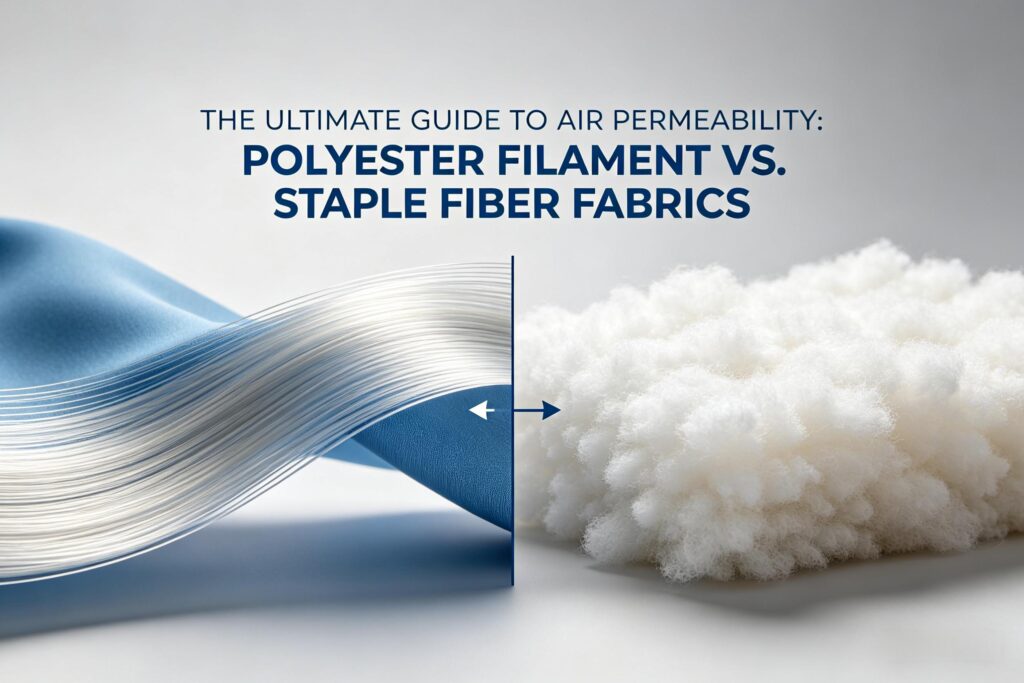
A filament is a single, continuous fiber of theoretically infinite length. In production, molten polyester is extruded through spinnerets to form these long, smooth threads. Multiple filaments are then combined with minimal twist to form a yarn. This results in a yarn structure that is inherently smooth, uniform, and dense. Fabrics woven or knitted from filament yarns, such as those used in linings, lingerie, or technical outer shells, typically have a sleek, sometimes shiny surface and a distinct drape.
2.2. What is Polyester Staple Fiber?
Staple fibers are short, discrete lengths of polyester, typically ranging from 32mm to 150mm. These fibers are created by cutting or breaking continuous filament tows. To create a yarn, these short fibers must be spun—aligned, twisted, and consolidated—much like cotton or wool. This spinning process introduces air pockets and creates a yarn that is inherently fuzzier, bulkier, and more porous than its filament counterpart. The resulting fabric has a more matte, cotton-like hand feel.
3. The Science of Airflow: Key Factors Influencing Breathability
Air permeability is not dictated by the fiber alone but is the result of a complex interplay between fiber properties, yarn construction, and fabric engineering.
3.1. Fiber Morphology: Smoothness vs. Hairiness
This is the most direct point of divergence.
- Filament: The continuous, smooth surface creates yarns with fewer protruding fibers. When woven tightly, this can lead to a denser, less porous fabric structure that may restrict airflow. One study on pure polyester fabrics noted that air permeability is often poor regardless of the fiber’s cross-sectional shape. The smoothness, however, allows for the creation of consistent, open-weave structures where intended.
- Staple: The staple spinning process inherently produces hairier yarns with many fiber ends protruding. These hairs create microscopic spaces and channels within the yarn itself, which can facilitate air movement. The yarn is less dense by volume, promoting inherent loft and porosity.
3.2. Yarn Structure: From Fiber to Thread
The yarn formation process locks in breathability potential.
- Filament Yarns: Composed of a bundle of parallel, smooth filaments, these yarns can be packed tightly together. Their permeability is highly dependent on the weave/knit structure chosen by the fabric engineer.
- Staple Spun Yarns: The twist applied during spinning binds fibers but also traps air. A lower twist generally increases loft and air permeability but may reduce strength. The irregular arrangement of staple fibers creates a naturally more open 3D structure.
3.3. Fabric Architecture: The Final Determinant
Ultimately, the fabric’s construction is the most powerful lever for controlling air permeability.
- Weave/Knit Density: A plain weave with a high thread count will always be less breathable than an open mesh knit, regardless of fiber type. Research consistently identifies fabric compactness as a primary factor influencing air permeability.
- Fabric Weight and Thickness: Generally, lighter and thinner fabrics allow for better airflow.
- Finishing Processes: Chemical coatings or mechanical compactions (calendaring) can dramatically seal fabric surfaces and reduce breathability.
4. Comparative Analysis: Filament vs. Staple in Practice
Given the influence of fabric structure, a direct comparison must consider comparable constructions.
4.1. Inherent Air Permeability
In side-by-side comparisons of fabrics with similar weight and construction, staple fiber fabrics often exhibit an advantage in air permeability tests. This is due to the inherent loft and micro-porosity of the spun yarn. Industrial data supporting this shows that for comparable fabric weights, those made from staple fibers can have different, often more favorable, permeability profiles depending on the specific structure. In contrast, the smooth, dense yarns of filament can lead to tighter packing in the fabric. A study on dry polyester fabrics concluded that in pure polyester fabrics, air permeability is generally poor, underscoring the critical role of structure over raw fiber format.
4.2. Moisture Management and Comfort
Air permeability is one part of the comfort equation; moisture management is another.
- Filament: Standard polyester filament is hydrophobic. However, its smooth surface allows moisture (in vapor or liquid form) to spread quickly across the fabric if a wicking finish is applied, facilitating evaporation. This is why many high-performance “moisture-wicking” athletic shirts use fine, textured filament yarns.
- Staple: The capillary spaces between staple fibers can promote natural wicking through capillary action. Research on specialized fibers has found that staple fiber knit fabrics can have better moisture transport than their filament counterparts due to a greater number of capillary channels. Blending staple polyester with hydrophilic fibers like cotton significantly improves moisture absorption and overall comfort perception.
4.3. Durability and Performance Retention
This is a clear domain where filament excels.
- Filament: Continuous fibers provide superior strength, abrasion resistance, and dimensional stability. Filament fabrics are less prone to pilling because there are no short fiber ends to work loose.
- Staple: Spun yarns are generally weaker and more prone to abrasion. The constant friction during wear can cause fiber ends to pill. Over time, the loft of a staple fabric may compress, potentially reducing its initial breathability advantage.
5. Beyond the Basics: Choosing the Right Material for Your Application
The choice is not about which fiber is universally “better,” but which is optimal for the intended use. The following table provides a clear guide:
| Target Application | Recommended Fiber Type | Key Rationale & Technical Considerations |
|---|---|---|
| High-Performance Sportswear, Base Layers | Fine/Textured Filament | Smooth filaments with functional wicking finishes rapidly move sweat for evaporative cooling. High strength withstands intense activity. Look for micro-denier or specially profiled (e.g., cross-shaped) filaments for enhanced surface area and softness. |
| Everyday Casual Wear (T-shirts, Polos), Bed Linens | Staple Fiber (Often Blended) | The natural loft and cotton-like feel of staple provide superior immediate comfort and breathability for daily use. Blends (e.g., 50% polyester/50% cotton) balance durability, easy care, and comfort. |
| Technical Workwear, Uniforms, Outer Shells | Filament | Superior durability, abrasion resistance, and ability to create tightly woven, wind-resistant or coated fabrics are paramount. Consistency and strength are key. |
| Lightweight Summer Apparel, Linings | Filament | Can be engineered into very fine, lightweight, and smooth fabrics with consistent airflow. Ideal for silky linings and flowing garments. |
5.2. The Strategic Role of Reliable Sourcing
Navigating these technical choices requires more than a product catalog. Partnering with a specialized supplier like Glyarn transforms material selection from a sourcing task into a strategic advantage. Glyarn’s expertise lies in understanding these nuanced performance trade-offs. For a brand developing a premium athletic line, they wouldn’t just offer “polyester yarn”; they would recommend a specific high-tenacity, micro-denier, profiled filament that optimizes moisture transport, skin feel, and durability. They ensure batch-to-batch consistency in yarn properties—a critical factor, as variation in fiber denier or twist can alter the fabric’s breathability profile. For projects targeting eco-conscious markets, Glyarn can provide access to high-quality recycled (rPET) polyester in both filament and staple forms, ensuring sustainability goals don’t compromise performance specifications.
6. Conclusion: There is No “Winner,” Only the Right Choice
The debate over the air permeability of polyester filament versus staple fiber reveals a fundamental truth in textile science: fiber type sets the stage, but fabric construction directs the play.
In controlled, like-for-like fabric constructions, polyester staple fiber often holds an inherent advantage in air permeability due to the porous, lofty structure of spun yarn. This makes it an excellent choice for applications prioritizing immediate comfort, softness, and moisture absorption, especially in blends.
However, polyester filament offers unparalleled control, strength, and consistency. Through advanced yarn texturing and precise fabric engineering, filament fabrics can be designed to achieve targeted and durable breathability, making them indispensable for high-performance and technical applications where durability is as crucial as comfort.
Therefore, the most effective question is not “Which is more breathable?” but “Which fiber, in which construction, best delivers the specific balance of breathability, durability, moisture management, and hand feel required for my product?” By clearly defining your performance priorities and collaborating with a technically proficient partner like Glyarn, you can cut through the complexity. This partnership ensures you select not just a material, but an engineered solution that delivers on the promise of comfort, quality, and value to your end-user.
