
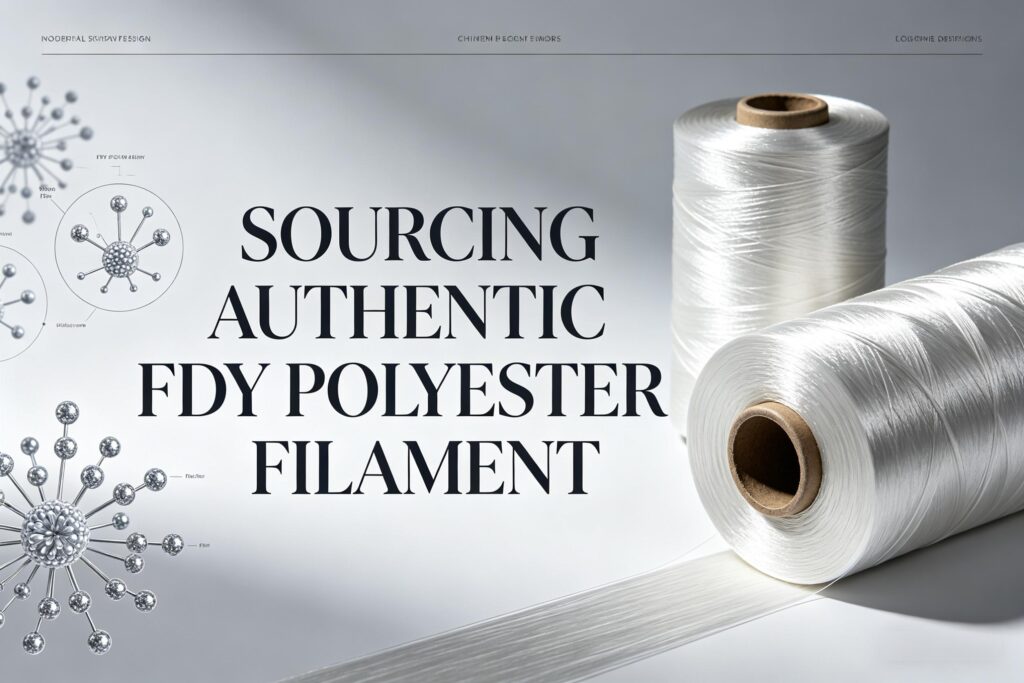
Abstract: In the global textile supply chain, sourcing Fully Drawn Yarn (FDY) polyester filament is a foundational activity. However, distinguishing authentic, high-quality FDY from substandard alternatives can be a significant challenge, with direct implications for production efficiency, product quality, and brand reputation. This definitive guide provides international buyers with a comprehensive framework for identifying and sourcing legitimate FDY. We will decode the essential characteristics of true FDY, outline a step-by-step verification protocol covering certifications, physical audits, and performance testing, and analyze the strategic value of partnering with established, transparent suppliers. This resource is designed to equip you with the knowledge and tools to build a resilient, quality-assured supply chain.
Table of Contents
- Defining Authenticity: What Truly Constitutes “Regular” FDY?
- 1.1. Core Process & Specifications: The Spin-Draw-Winding Continuum
- 1.2. Key Differentiators: FDY vs. POY, UDY, and Mislabeled Products
- 1.3. International Standards and Grade Classifications (e.g., USTER® Statistics)
- The Verification Framework: How to Rigorously Assess a Supplier
- 2.1. Documental Proof: Certifications, Test Reports, and Traceability
- 2.2. Manufacturing Audit: Critical Checkpoints in the Production Process
- 2.3. Laboratory & Performance Testing: Validating Key Physical Properties
- Strategic Sourcing: Building a Partnership with a Reliable Supplier
- 3.1. Beyond Price: Evaluating Technical Support, Consistency, and Innovation
- 3.2. Case in Point: Glyarn’s Integrated Approach to Quality Assurance
- 3.3. Risk Mitigation: Managing Logistics, Contracts, and Supply Chain Transparency
- Conclusion and Actionable Checklist for Buyers
1. Defining Authenticity: What Truly Constitutes “Regular” FDY?
Authentic FDY is defined by its integrated spin-draw process. Unlike partially oriented yarns (POY) that require separate drawing, FDY undergoes spinning, drawing, and heat-setting in one continuous, precisely controlled line. This results in a yarn with complete molecular orientation and crystallization, giving it its final, stable properties directly on the bobbin.
The hallmarks of “regular” or standard FDY are:
- High Tenacity & Low Elongation: It exhibits optimal strength for its denier with minimal stretch.
- Excellent Dimensional Stability: Very low and consistent shrinkage values (e.g., Boiling Water Shrinkage typically between 5-8%).
- Uniform Linear Density: Minimal denier variation along the filament length (< 1.0% CV% is a marker of high-quality production).
- Superior Evenness: Low thickness variation, critical for avoiding fabric defects like barré. This is quantified by instruments like the USTER® TESTER, with results benchmarked against global USTER® Statistics percentiles.
Table 1: Distinguishing Authentic FDY from Common Alternatives/Substitutes
| Parameter | Authentic FDY | Partially Oriented Yarn (POY) | Undrawn Yarn (UDY) | Mislabeled/Substandard “FDY” |
|---|---|---|---|---|
| Production Process | Integrated spin-draw-winding. | High-speed spinning only; drawing is separate. | Low-speed spinning; requires full drawing. | Often an off-spec or poorly controlled FDY process, or mis-sold POY. |
| Molecular State | Fully oriented and crystallized. | Partially oriented, uncrystallized. | Unoriented, amorphous. | Inconsistent orientation, poor crystallization. |
| Key Property: Tenacity | High (e.g., 3.8 – 4.5 cN/dtex). | Low (requires drawing to develop strength). | Very Low. | Lower than standard, often variable. |
| Key Property: Elongation | Low (e.g., 20-30%). | Very High ( > 120%). | Extremely High. | Higher and less predictable than standard. |
| Thermal Shrinkage | Low and uniform. | Very high and unstable. | Extremely high. | Often inconsistent, leading to fabric distortion. |
| Primary Use | Direct weaving/knitting for stable fabrics. | Feedstock for draw-texturing (DTY) or draw-winding. | Must be drawn before use. | Risky for quality-sensitive applications; may cause production issues. |
2. The Verification Framework: How to Rigorously Assess a Supplier
Verifying authenticity requires a multi-layered approach beyond simple supplier claims.
2.1. Documental Proof
- Business & Quality Certifications: Look for ISO 9001 (Quality Management) and increasingly, ISO 14001 (Environmental Management). For specific industries, OEKO-TEX® STANDARD 100 or GRS (Global Recycled Standard) for recycled polyester may be relevant.
- Technical Data Sheets (TDS): A legitimate supplier provides detailed TDS for each product code, listing standard ranges for denier, tenacity, elongation, shrinkage, and evenness (USTER® values).
- Batch Test Reports: Insist on seeing actual test reports from international-standard labs (e.g., using ASTM or ISO methods) for the specific batch you are purchasing.
2.2. Manufacturing Audit
A physical audit of the production facility is invaluable. Key checkpoints include:
- Raw Material Source: Verification of PTA/MEG or chip quality.
- Process Control: Observation of the spin-draw line, especially the temperature control of godet rollers and the winding tension system.
- In-line Quality Monitoring: Presence of automatic denier and broken filament detection systems.
- Laboratory On-site: A well-equipped in-house lab for daily quality checks is a strong positive indicator.
2.3. Laboratory & Performance Testing
Conducting or commissioning independent tests on pre-shipment samples is non-negotiable. Critical tests include:
- Physical Properties: Tenacity, Elongation (ASTM D2256), Linear Density (ASTM D1907).
- Thermal Properties: Boiling Water Shrinkage and Dry Heat Shrinkage (ASTM D4974).
- Quality Evenness: USTER® TESTER for thickness variation (CV%), imperfections, and hairiness.
- Application Test: A small-scale weaving or knitting trial to observe performance, dye uptake uniformity, and final fabric appearance.
3. Strategic Sourcing: Building a Partnership with a Reliable Supplier
The lowest price often carries the highest risk of hidden costs from production stops, fabric defects, and customer returns. Strategic sourcing focuses on total value and risk mitigation.
3.1. Beyond Price: The Value of a Technical Partner
A reliable FDY supplier acts as an extension of your R&D team. They provide:
- Consistency: Batch-to-batch uniformity that ensures predictable manufacturing.
- Technical Co-development: Assistance in selecting the right yarn specifications (denier, luster, cross-section) for new fabric developments.
- Problem-Solving Support: Rapid troubleshooting if fabric issues arise, leveraging their deep process knowledge.
3.2. Case in Point: Glyarn’s Integrated Approach to Quality Assurance
A supplier like Glyarn exemplifies this partnership model. Their approach embeds quality at every stage:
- Upstream Control: They work closely with selected polymer producers, ensuring raw material consistency.
- Smart Manufacturing: Their production lines utilize Industry 4.0 principles with real-time data monitoring of every godet temperature and winding tension, ensuring process parameters are locked within narrow, optimal windows.
- Data-Driven Delivery: Each shipment from Glyarn is accompanied by a comprehensive Quality Passport—not just a standard TDS, but the actual batch test data and USTER® spectrogram, providing full transparency and traceability.
- Application Engineering: For a client developing a new lightweight, waterproof tent fabric, Glyarn’s engineers didn’t just supply a 40D FDY. They recommended a specific triangular cross-section filament for higher strength-to-weight ratio and better coating adhesion, and provided shrinkage data critical for the fabric’s thermal lamination process. This deep collaboration de-risks innovation for the buyer.
3.3. Risk Mitigation
- Contracts: Ensure contracts specify quality standards, test methods, rejection procedures, and liability.
- Supply Chain Transparency: Understand your supplier’s own supply chain resilience. Do they have single or multiple source plants? What is their energy security and logistics plan?
- Ethical Compliance: Verify social responsibility compliance through audits or certifications like BSCI or SMETA.
4. Conclusion and Actionable Checklist for Buyers
Sourcing authentic FDY is a systematic process of verification and relationship building.
Your FDY Supplier Verification Checklist:
- Documents: Received and verified ISO certificates, detailed TDS, and batch-specific test reports.
- [Standards: Specifications are benchmarked against international test methods (ASTM/ISO) and USTER® Statistics.
- [Audit: Conducted or planned an on-site manufacturing audit focusing on process control and lab capabilities.
- Testing: Performed independent lab tests on samples for tenacity, shrinkage, and evenness.
- Trial: Completed a small-scale application test (weaving/knitting/dyeing).
- Partner Evaluation: Assessed the supplier’s technical support capability, innovation record, and transparency.
- Contract: Agreement includes clear quality specifications, acceptance criteria, and compliance terms.
By shifting the focus from a transactional purchase to a verified, technical partnership with suppliers like Glyarn, international buyers can secure not just a material, but a foundation for quality, innovation, and supply chain resilience. In today’s market, where product integrity is paramount, this is the definitive strategy for sourcing authentic FDY polyester filament.
