
Table of Contents
- Executive Summary: Defining the Process and Its Market Significance
- Raw Material Fundamentals: Selecting the Right Polyester Filament
- The Core Process Chain: From Bale to Web Formation
- The Thermal Calendering Unit: Heart of the Bonding Process
- 4.1. Roll Configuration and Temperature Control
- 4.2. Pressure, Nip, and Dwell Time
- 4.3. Embossing Patterns and Their Functional Impact
- Post-Bonding Treatments and Finishing
- Process Parameters and Final Product Property Control
- 6.1. Key Performance Property Matrix
- 6.2. Parameter Adjustment for Different Weight Grades
- Application-Specific Manufacturing Guidelines
- Equipment, Technology, and Cost Considerations
- Conclusion: The Strategic Advantages of Thermal Calendering
- FAQ
1. Executive Summary: Defining the Process and Its Market Significance
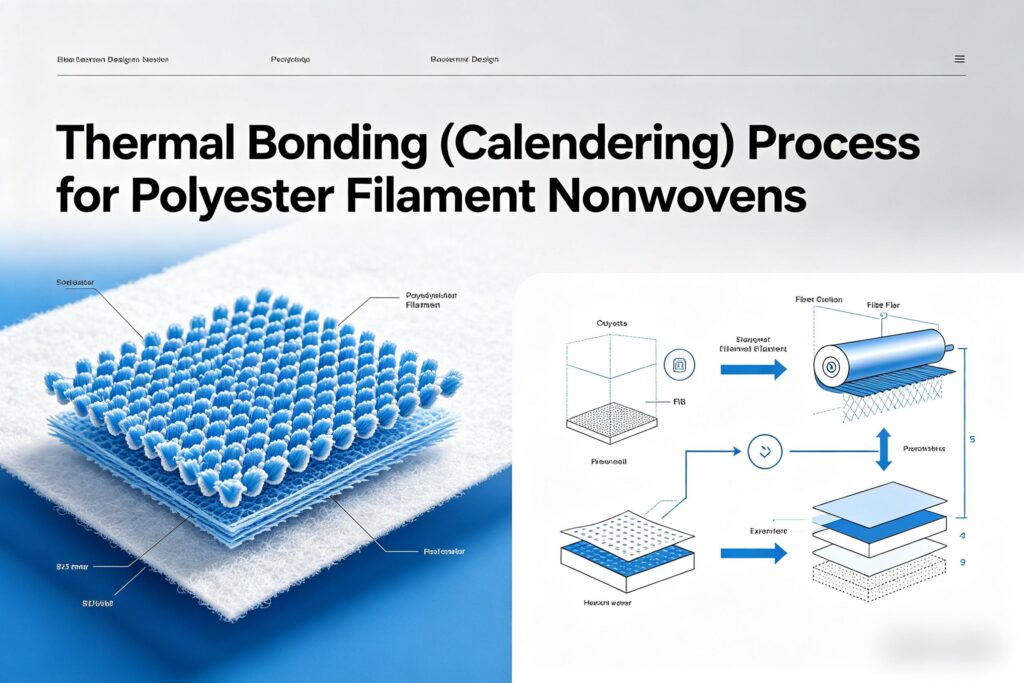
For industrial buyers across textiles, hygiene, filtration, and geotextiles, understanding the thermal bonding (or calendering) process for polyester filament nonwovens is crucial for specifying the correct material for demanding applications. Unlike needling or chemical bonding, thermal calendering is a continuous, dry-laid process where a web of continuous polyester filaments is consolidated through precisely controlled heat and pressure, causing the filaments to fuse at their crosspoints. This method produces nonwovens characterized by exceptional strength-to-weight ratios, high dimensional stability, consistent uniformity, and a clean, additive-free profile. It is the dominant technology for creating lightweight to medium-weight spunbond fabrics used in critical areas like medical drapes, crop covers, furniture linings, and high-performance filtration. This guide will dissect the entire process, empowering buyers to communicate effectively with manufacturers and source materials that meet exact technical specifications.
2. Raw Material Fundamentals: Selecting the Right Polyester Filament
The process begins with the polymer. Polyester (PET) is chosen for its:
- High Melting Point (~260°C): Allows a wide thermal processing window.
- Excellent Tensile Properties: Provides inherent web strength.
- Thermoplastic Nature: Essential for thermal bonding.
Critical Polymer and Filament Specifications:
- Intrinsic Viscosity (IV): Typically 0.60 – 0.65 dl/g for standard spunbond. Higher IV (>0.70) can be used for high-strength applications but is harder to spin.
- Additives: TiO₂ for opacity and UV resistance, optical brighteners, spin finishes (lubricants) that must be volatile or compatible to avoid roll contamination.
- Bicomponent Filaments: A game-changer for low-pressure bonding. The most common is the “sheath-core” configuration (e.g., CoPET/PET), where the CoPET sheath has a lower melting point (~110-160°C) than the PET core. This allows bonding at lower temperatures, preserving filament integrity and creating softer, bulkier fabrics.
3. The Core Process Chain: From Bale to Web Formation
A modern spunbond-calender line is a fully integrated, high-speed operation (>300 m/min).
- Polymer Feeding & Extrusion: PET chips are dried, melted in an extruder (~280-300°C), and precisely metered.
- Spinning: Melt is forced through a spinneret containing thousands of fine holes, forming continuous filaments. High-velocity cool air (quench air) solidifies and attenuates (draws) the filaments.
- Web Formation: The curtain of filaments is deposited randomly onto a moving conveyor (forming belt) via air dispersion or electrostatic charges, creating a uniform, unbonded web (often called a “spunlaid” web). This randomness is key to isotropic properties.
4. The Thermal Calendering Unit: Heart of the Bonding Process
The unbonded web is weak and fibrous. The calender transforms it into a coherent fabric.
4.1. Roll Configuration and Temperature Control:
The standard configuration is a two-roll nip.
- Heated Roll: Typically a steel roll, heated internally by oil or electrically. Surface temperature is precisely controlled, often between 180°C and 230°C for homopolymer PET.
- Resilient Roll: The counter-roll is covered with a resilient material like cotton-phenolic or silicon rubber. It conforms to ensure uniform pressure across the web.
For bicomponent fibers, the heated roll temperature is set just above the sheath polymer’s melting point (e.g., 120-170°C), significantly saving energy and allowing the use of a harder, more durable steel counter-roll (creating a steel-to-steel nip for sharper embossing).
4.2. Pressure, Nip, and Dwell Time:
- Linear Pressure: Applied by the nip, typically 40 – 120 N/mm. Higher pressure increases bond strength but reduces thickness and softness.
- Dwell Time: The time the web is under heat and pressure in the nip, typically 10 – 100 milliseconds. It is a function of machine speed and nip width.
4.3. Embossing Patterns and Their Functional Impact:
The heated roll is almost always engraved with an embossing pattern. This is not merely decorative; it is a critical engineering tool.
Table 1: Common Embossing Patterns and Their Effects
| Pattern Type | Pattern Description | Key Characteristics | Typical Applications |
|---|---|---|---|
| Point/Quilt Pattern | Discrete raised points (e.g., diamonds, dots) covering 8-20% of the roll surface. | Excellent balance of strength, softness, and bulk. Low bonding area preserves loft. | Medical/surgical fabrics, hygiene top sheets, wipes, interlinings. |
| Screen/Mesh Pattern | Continuous network of lines (like a window screen). Bond area can be 15-30%. | Higher strength and integrity, more paper-like feel. Reduced porosity. | Geotextiles, carpet backing, heavy-duty wipes, membrane substrates. |
| Fine-Hole/Honeycomb | Very small, densely packed points. | Creates a smooth, uniform surface. Good for lamination or printing. | Graphic arts substrates, battery separators (with appropriate polymer). |
| Plain/Smooth Roll | No pattern (used with resilient roll only). | Creates a flat, film-like sheet with very high density and opacity. Low air permeability. | Specialized filtration, synthetic paper, high-barrier layers. |
5. Post-Bonding Treatments and Finishing
After calendering, the fabric may undergo:
- Online Slitting & Winding: The fabric is trimmed and wound into jumbo rolls.
- Offline Finishing: This can include hydroentanglement (spunlace) to combine spunbond strength with textile-like softness, laminations, coatings (e.g., acrylic, PU), dyeing, or antistatic/antimicrobial treatments.
6. Process Parameters and Final Product Property Control
The interaction of key parameters determines the final fabric’s “hand” and performance.
Table 2: Key Process Parameters and Their Impact on Fabric Properties
| Process Parameter | Primary Control Knob For | Effect of Increasing the Parameter | Trade-off / Side Effect |
|---|---|---|---|
| Calender Temperature | Bond Strength, Fabric Integrity | Increases bond area/strength, reduces elongation. | Can reduce softness and bulk; risk of thermal degradation or “glazing” (over-bonding). |
| Nip Pressure | Fabric Density, Thickness, Bond Point Definition | Increases density, reduces thickness (caliper), sharpens emboss. | Reduces porosity and air permeability; can crush and stiffen the fabric. |
| Machine Speed (Line Speed) | Production Rate, Dwell Time | Reduces dwell time, potentially lowering bond strength if not compensated. | Must be balanced with temperature/pressure to maintain quality. Key to throughput. |
| Web Weight (GSM) | Base Strength, Opacity | Naturally increases tensile strength, tear resistance, and opacity. | Increases material cost per unit area; affects drape and flexibility. |
6.2. Parameter Adjustment for Different Weight Grades:
- Lightweight (10-25 gsm): Used for disposable medical/hygiene. Requires lower temperature and pressure to prevent web destruction. Fine point patterns are essential.
- Medium Weight (30-80 gsm): The workhorse range for interlinings, covers. Moderate temperature and pressure with a screen or point pattern.
- Heavyweight (100-200 gsm): For geotextiles, filtration. Requires higher temperatures to ensure heat penetrates the full web thickness, often with a screen pattern for maximum integrity.
7. Application-Specific Manufacturing Guidelines
- Medical Drapes & Gowns (SMS fabric): A spunbond-meltblown-spunbond laminate is standard. The outer spunbond layers are typically lightly calendered (point bond, 12-15% area) to remain soft and breathable while providing strength. The critical barrier is the meltblown middle layer.
- Crop Covers & Agrofabrics: Focus is on UV stability (additives in polymer), uniform light diffusion, and controlled porosity. A point-bonded, lightweight (17-30 gsm) fabric is common. Must resist degradation for a full season.
- Furniture & Mattress Liners (Quilt Backing): Requires good tensile strength, puncture resistance, and dimensional stability. A 25-50 gsm fabric with a screen or point bond is used. It must not crack or delaminate during quilting.
- High-Efficiency Filtration: Often uses fine denier filaments (<1 dpf) for high surface area. Calendering parameters are tuned to create a uniform pore structure without excessive compression. May be followed by resin treatment.
8. Equipment, Technology, and Cost Considerations
- Capital Investment: A complete spunbond-calender line is a multi-million-dollar investment, favoring large-scale production for economies of scale.
- Technology Leaders: Key machinery suppliers include Reifenhäuser, ANDRITZ Asselin-Thibeau, and STP Impianti.
- Cost Drivers: The primary cost is raw polymer (PET). The thermal bonding process itself is relatively energy-efficient compared to wet-laid or heavily chemical-bonded processes. High line speeds keep conversion costs low. Bicomponent fibers add a 15-30% material cost premium but can save energy and enable premium properties.
9. Conclusion: The Strategic Advantages of Thermal Calendering
Thermal calendering of polyester filament nonwovens remains a premier technology because it delivers unmatched consistency, high production speeds, and a clean, sustainable profile (no solvents or chemical binders). For buyers, the key to leveraging this process is to understand the language of polymer type, filament denier, bond pattern, and bonding percentage.
Final Procurement Recommendation: When sourcing, provide manufacturers with a complete performance specification, not just a weight. Example: “Point-bonded, 20 gsm polyester spunbond nonwoven. Fabric must exhibit MD tensile strength > 25 N/5cm, CD tensile > 15 N/5cm, and air permeability of 2000 l/m²/s at 100 Pa. Intended for medical cover stock.” This level of detail ensures you receive a fit-for-purpose engineered material.
10. FAQ
Q1: What is the main difference between “thermal bonding” and “calendering” in this context?
A1: They are essentially synonymous in spunbond production. “Thermal bonding” is the general mechanism—using heat to fuse fibers. “Calendering” is the specific, most common equipment used to apply that heat and pressure—via a calender roll nip. Other thermal bonding methods exist (e.g., through-air ovens), but calendering is dominant for continuous filament webs.
Q2: Why is the fabric sometimes stiff after calendering?
A2: Stiffness is usually caused by excessive bonding area, too high pressure, or too high temperature. This over-consolidates the web, reducing the number of free, flexible filament segments between bond points. Switching to a bicomponent fiber or a point bond pattern with lower area coverage can dramatically improve softness.
Q3: Can recycled polyester (rPET) be used in this process?
A3: Yes, but with critical considerations. rPET often has variable IV and higher impurity levels, which can clog spinnerets and cause filament breaks. It requires sophisticated filtration and precise process adjustment. Leading nonwoven producers now offer rPET spunbond fabrics, but they may command a slight premium and have marginally reduced strength consistency.
Q4: How does this compare to needle-punched polyester nonwovens?
A4: Calendered Spunbond: Thin, smooth, high strength-to-weight, low loft. Excellent for barrier and light cover applications. Needle-Punched: Thicker, bulkier, felt-like, higher porosity. Excellent for filtration, insulation, and geotextiles where thickness and void volume are needed. They are complementary technologies for different property sets.
Q5: What does “bond area percentage” mean, and how is it controlled?
A5: It is the percentage of the total fabric area that is physically fused by the calender rolls. It is controlled by the embossing pattern design on the heated roll. A fine dot pattern may cover 10%; a heavy screen pattern may cover 25%. A higher percentage increases strength but reduces softness, bulk, and permeability.
Q6: Is the process suitable for making colored nonwovens?
A6: Yes, through two main methods: 1) Mass Coloration (Dope Dyeing): Adding color pigments or masterbatch to the polymer melt before spinning. This is most colorfast and environmentally friendly (no water waste). 2) Post-Dyeing: Passing the finished fabric through a dye bath. This is more flexible for small lots but uses water and energy.
Q7: What is the typical production capacity of a modern line?
A7: Modern lines are designed for high throughput. A standard line can produce 3,000 to 10,000+ metric tons per year, depending on width (typically 3.2m or 4.2m) and operational hours. This makes the process ideal for large-volume commodity items but less flexible for very small, custom orders.
