
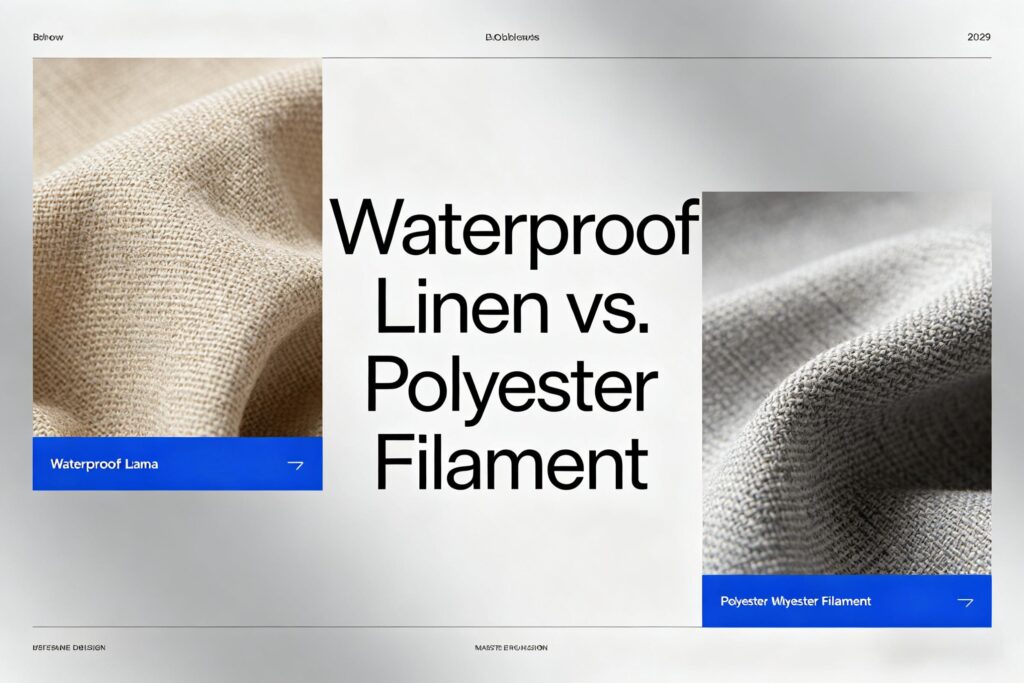
For global textile buyers and product developers, the question “Which is better, waterproof linen or polyester filament?” is not a matter of simple preference. It’s a strategic decision with significant implications for product performance, cost, supply chain, and brand positioning. This definitive guide cuts through marketing claims to deliver a data-driven, application-focused analysis. We will examine the core properties, advantages, and limitations of each material, providing the technical depth needed for informed sourcing decisions across apparel, home textiles, and industrial applications.
Table of Contents
- Introduction: Defining the Contenders
- Part I: The Science of Waterproofing: Two Paths to a Dry Surface
- Part II: Head-to-Head Performance Analysis
- 3.1. Durability and Mechanical Properties
- 3.2. Comfort and Wearability
- 3.3. Aesthetics, Sustainability, and Market Perception
- 3.4. Cost Structure and Supply Chain Considerations
- Part III: Strategic Application Guide & Data-Driven Decision Matrix
- 4.1. Table 1: Performance Comparison Summary
- 4.2. Table 2: Application-Specific Recommendations
- Part IV: The Future of Performance Textiles: Blends and Innovations
- Conclusion & Key Takeaways
1. Introduction: Defining the Contenders
- Waterproof Linen: This is a natural bast fiber that undergoes a post-production chemical finishing process. Its inherent breathability and moderate moisture absorption are overlaid with a durable water-repellent (DWR) coating, creating a unique hybrid of natural comfort and engineered function. Finishes like NR-8700 can achieve high water resistance (up to 90 points on standard tests) while preserving fabric integrity .
- Polyester Filament: This is a synthetic polymer fiber (polyethylene terephthalate). Its waterproof nature is often inherent and structural, achieved through tight weaves, dense fabric constructions, or integrated membrane laminations (e.g., in performance outerwear). As a hydrophobic fiber with only 0.4-0.5% moisture regain , it provides a highly reliable moisture barrier.
2. Part I: The Science of Waterproofing: Two Paths to a Dry Surface
The fundamental difference lies in how each material achieves water resistance.
Waterproof linen relies on surface modification. A chemical finish (historically fluorinated, now increasingly eco-friendly “C0” or “C6” DWR) is applied to the fabric. This finish causes water to bead up and roll off the surface without wetting the linen fibers underneath. The performance can diminish over time with abrasion and washing, requiring re-treatment .
For polyester filament, water resistance is a core property. The non-absorbent polymer itself repels water. In high-performance applications, a microporous membrane (like ePTFE or PU) is laminated to the fabric. This membrane has pores smaller than a water droplet but larger than a water vapor molecule, achieving the coveted “waterproof yet breathable” standard.
3. Part II: Head-to-Head Performance Analysis
3.1. Durability and Mechanical Properties
- Tensile & Abrasion Strength: Polyester filament excels with high tensile strength (4.3-5.5 gf/denier) and exceptional abrasion resistance , making it ideal for gear, upholstery, and high-wear applications. Linen, while strong for a natural fiber, is less abrasion-resistant and more prone to wear at stress points.
- Wrinkle & Shape Recovery: This is a clear win for polyester. It has excellent elasticity recovery, ensuring garments and products maintain their shape. Pure linen is known for wrinkling easily and has poor elastic recovery . Even when blended, studies show it is polyester, not other synthetics like nylon, that most effectively improves linen’s wrinkle resistance .
- Longevity of Waterproofing: Polyester’s waterproofing is more durable as it is integral to the fiber or membrane. Linen’s surface finish will degrade and require maintenance.
3.2. Comfort and Wearability
- Breathability & Moisture Management: Here, waterproof linen has a potential advantage in specific contexts. The natural linen fiber underneath the DWR finish is highly breathable and can absorb significant moisture vapor (helping with sweat management) before feeling damp . However, in a high-humidity or high-activity scenario, where sweat production is high, the DWR coating can trap moisture inside, leading to clamminess. Polyester, while less breathable in basic weaves, excels in active scenarios when paired with advanced moisture-wicking treatments and breathable membranes that actively transport vapor outward.
- Thermal Regulation: Linen’s hollow fiber structure provides excellent thermal conductivity, creating a “cooling” sensation in warm weather—it can make the wearer feel 4–8°C cooler . Polyester tends to retain heat unless specially engineered for cooling.
- Hand Feel & Drape: Finished linen retains a distinct, slightly textured, natural “dry” hand feel associated with quality. Polyester offers a smoother, often silkier hand, and its drape can be engineered from fluid to structured.
3.3. Aesthetics, Sustainability, and Market Perception
- Aesthetic: Linen offers an irreplicable natural, rustic, and high-end aesthetic with subtle slubs and variations. Polyester provides a clean, consistent, and modern look that can be engineered to mimic other materials.
- Sustainability Narrative: Linen is a biodegradable, natural fiber with a lower carbon footprint in production, appealing to eco-conscious brands and consumers. Polyester’s reliance on petrochemicals is a drawback, though the industry is shifting towards recycled polyester (rPET) from post-consumer plastic, which significantly improves its sustainability profile.
- Additional Properties: Linen possesses natural antibacterial and anti-static properties . Polyester is inherently resistant to mildew and chemicals.
3.4. Cost Structure and Supply Chain Considerations
- Fabric Cost: High-quality pure linen is a premium fiber. The complex processing from flax plant to spinnable fiber results in significant loss (up to 25% during degumming) and higher cost, often 30-50% more than blended alternatives . Polyester filament is a commodity chemical product with stable, scalable, and typically lower pricing.
- Minimum Order Quantities (MOQs): Polyester production benefits from massive economies of scale, allowing for lower MOQs and greater flexibility. Premium linen often requires larger commitments.
- Consistency & Lead Time: Polyester offers unmatched batch-to-batch consistency in color, denier, and performance. Linen, as an agricultural product, can have natural variations in color and fiber length, affecting lead times and requiring careful quality control.
4. Part III: Strategic Application Guide & Data-Driven Decision Matrix
The “better” material is entirely defined by the end-use. Use the following tables to guide your selection.
Table 1: Core Performance Comparison Summary
| Performance Characteristic | Waterproof Linen | Polyester Filament | Key Takeaway |
|---|---|---|---|
| Primary Waterproof Mechanism | Surface DWR Finish | Inherent / Membrane Laminate | Polyester offers more durable waterproofing. |
| Durability (Abrasion/Tear) | Moderate | Excellent | Polyester is superior for high-wear applications. |
| Wrinkle Resistance | Poor (improves with blends) | Excellent | Polyester wins for low-maintenance products. |
| Breathability (Static) | Excellent | Moderate to Good | Linen is superior in dry, warm, low-activity use. |
| Moisture-Wicking (Active) | Poor (can trap sweat) | Excellent (when engineered) | Polyester is superior for sportswear. |
| Thermal Feel | Cooling | Can be Warm / Neutral | Linen is ideal for warm-weather comfort. |
| Sustainability (Virgin) | High (Biodegradable) | Lower (Fossil-based) | Linen has a stronger natural narrative. |
| Cost & Supply Stability | Higher, More Variable | Lower, Highly Stable | Polyester offers better cost control. |
| Aesthetic | Natural, Rustic, Luxe | Modern, Consistent, Versatile | A subjective choice driven by brand identity. |
Table 2: Application-Specific Recommendations
| Industry / End-Use | Recommended Primary Material | Rationale & Technical Justification |
|---|---|---|
| High-Fashion Rainwear / Trench Coats | Waterproof Linen | The premium, natural aesthetic and dry hand feel justify the cost and care requirements. Ideal for fashion-over-function designs. |
| Technical Outerwear / Ski Jackets | Polyester Filament (+Membrane) | Unbeatable for durable waterproofing, reliable breathability during high exertion, abrasion resistance, and lightweight packability. |
| Premium Summer Apparel | Waterproof Linen or Linen Blend | The natural cooling effect and breathability are paramount. A DWR finish protects against light showers without sacrificing comfort. |
| Performance & Sportswear | Polyester Filament | Superior moisture management, shape retention, durability, and ease of care are critical. Can be engineered for specific sports. |
| Upholstery / Contract Furniture | Polyester Filament | Exceptional abrasion resistance (Martindale tests), colorfastness, stain resistance, and ease of cleaning are essential for commercial use. |
| Luxury Home Textiles (Drapes, Cushions) | Waterproof Linen | The natural texture and sophisticated look create a high-end ambiance. Waterproofing adds functionality for outdoor cushions. |
| Technical Gear & Bags | Polyester Filament | Demands extreme durability, water resistance, and dimensional stability. High-denier polyester fabrics (e.g., 600D, 1000D) are standard. |
5. Part IV: The Future of Performance Textiles: Blends and Innovations
The “either/or” debate is increasingly being solved by “both.” Engineered blends combine the strengths of both fibers. For instance, a 55% Linen / 45% Polyester blend creates a fabric with the beautiful texture and improved wrinkle resistance (from the polyester) , better durability, and easier care. Such hybrids are central to modern textile development.
Innovation is also key. The focus for linen is on more durable and eco-friendly DWR finishes . For polyester, the frontier is enhanced biodegradability, advanced fiber profiling for better moisture-wicking, and sophisticated membrane technologies that push the limits of breathability.
6. Conclusion & Key Takeaways
The choice between waterproof linen and polyester filament is a strategic balancing act between natural heritage and engineered performance, aesthetic storytelling and functional reliability, and sustainability ideals and commercial pragmatism.
- Choose Waterproof Linen when: Your priority is natural aesthetics, premium hand feel, static cooling comfort, and a strong sustainability story for applications where extreme durability and maintenance are secondary concerns (e.g., fashion outerwear, luxury home goods, summer collections).
- Choose Polyester Filament when: Your priority is uncompromising durability, reliable and long-lasting waterproofing, easy care, cost-effective production, and high-performance functionality (e.g., technical outerwear, sportswear, contract upholstery, industrial applications).
For forward-thinking brands, the most successful strategy often involves leveraging both: using pure polyester filament where performance is non-negotiable and incorporating waterproof linen or sophisticated linen blends where emotion, aesthetics, and natural comfort define the product’s value. In doing so, you meet the diverse demands of the modern global market.
