
Table of Contents
- The Allure and Complexity of Gradient Yarn
- Demystifying Gradient Yarn Production Methods
- 2.1. Space-Dyed Yarn: The Predominant Commercial Technique
- 2.2. Fiber Blending and Carding Techniques
- 2.3. Innovative Methods: Digital Yarn Printing and Core-Wrapping
- Critical Technical Specifications for Industrial Buyers
- 3.1. Gradient Transition Length and Precision Control
- 3.2. Color Fastness and Consistency Across Batches
- 3.3. Fiber Compatibility and Dye Selection
- Table 1: Technical Comparison of Primary Gradient Yarn Production Methods
- Application-Specific Considerations and Challenges
- 4.1. Knitted and Woven Apparel: Managing Pattern Alignment and Fabric Yield
- 4.2. Home Textiles and Carpet Manufacturing: Large-Scale Color Flow Management
- 4.3. Specialized Uses: Toy Making, Art Yarn, and Technical Textiles
- Table 2: Application-Focused Guide to Gradient Yarn Specification
- Sourcing Strategy and Supplier Qualification
- 5.1. Key Questions for Your Yarn Supplier
- 5.2. Evaluating Samples and Pilot Runs
- 5.3. Understanding Cost Drivers: From Dye Chemistry to MOQs
- Design and Production Planning with Gradient Yarn
- 6.1. Calculating Yardage and Managing Inventory for Gradient Projects
- 6.2. Machine Set-Up and Tension Control for Optimal Results
- 6.3. Minimizing Waste in Cutting and Assembly
- Quality Control and Testing Protocols
- Smart Gradients and Sustainable Production
- Mastering Gradient Yarn for Competitive Advantage
- FAQ: Addressing Common Industrial Sourcing and Production Queries
1. The Allure and Complexity of Gradient Yarn
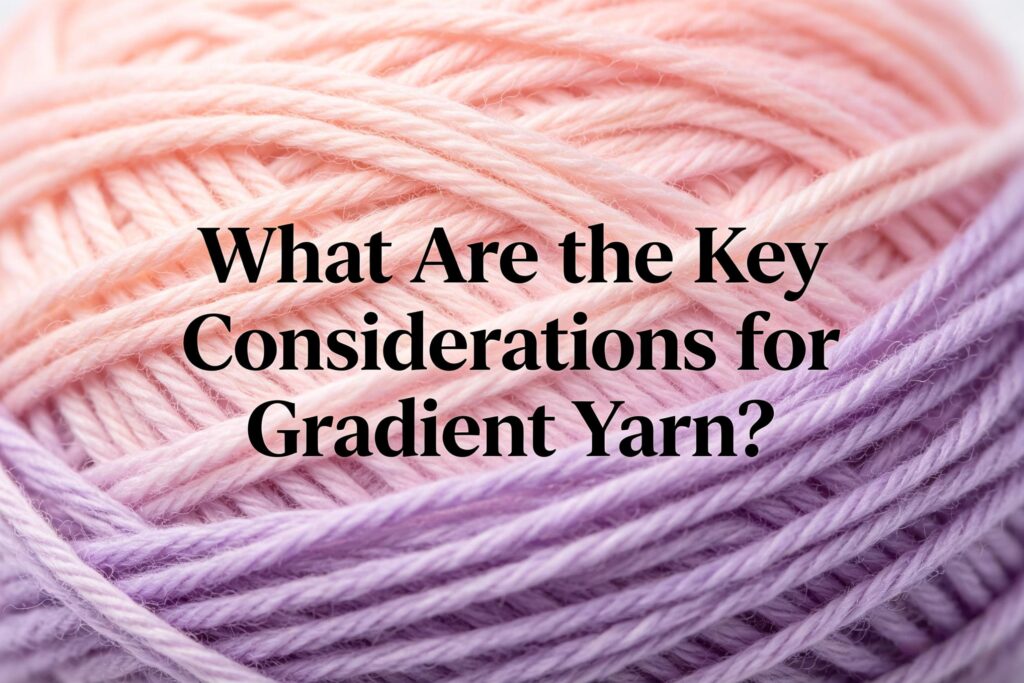
For procurement managers and product developers, gradient yarn (also known as ombré, shaded, or space-dyed yarn) represents a powerful tool for creating visually striking, high-value textiles without the need for complex jacquard weaves or multi-yarn intarsia. This yarn features a deliberate, controlled transition of color along its length, producing fabrics with soft, flowing color shifts. However, its beauty is matched by its technical complexity. Successfully integrating gradient yarn into commercial production requires a deep understanding of its manufacturing constraints, precise specification, and meticulous production planning. This guide moves beyond aesthetic appeal to provide a comprehensive, data-driven framework for sourcing and utilizing gradient yarn effectively across various industrial applications.
2. Demystifying Gradient Yarn Production Methods
The method of creation fundamentally impacts the yarn’s characteristics, cost, and suitability.
2.1. Space-Dyed Yarn: The Predominant Commercial Technique
This is the most common and scalable method for filament and staple yarns (cotton, acrylic, wool). The process involves:
- Precision Dye Application: The yarn, wound on a special conveyor or reel, passes through precisely controlled dye applicators. Each applicator deposits a specific color at predetermined intervals.
- Fixation and Washing: The yarn is then steamed or heated to fix the dyes, followed by washing to remove excess. The sequence and length of each color application define the gradient.
- Key Control Points: Dye viscosity, conveyor speed, and applicator timing must be perfectly synchronized. This method allows for sharp or soft transitions, but the repeat length is fixed by the machine setup.
2.2. Fiber Blending and Carding Techniques
Primarily for woolen-spun yarns and non-wovens. Different colored fiber batts are layered in a calculated ratio on the carding machine. As the fibers are blended during carding and drafting, they create a heathered, melange-style gradient within the yarn strand itself, rather than along its length. The effect is more diffuse and random, excellent for heather effects in knitwear.
2.3. Innovative Methods
- Digital Yarn Printing: An emerging technology where yarn is precisely printed with pigment inks before spinning or plying. It offers unprecedented design freedom, including photorealistic gradients and unlimited color changes, but at a premium cost and with lower production speeds.
- Core-Wrapping: A colored roving or pre-dyed sliver is wrapped around a neutral core yarn during spinning. This creates a subtle, intermittent gradient effect dependent on the thickness of the wrapped layer.
3. Critical Technical Specifications for Industrial Buyers
3.1. Gradient Transition Length and Precision
This is the single most important specification.
- Transition Length: Defined as the linear length (in meters or yards) over which the yarn transitions fully from Color A to Color B. A short transition (e.g., 0.5m) creates a rapid, dramatic shift. A long transition (e.g., 10m) creates a slow, subtle gradient ideal for large garments or blankets.
- Pattern Repeat: The total length of the complete color sequence before it repeats. For planning, you must know if the pattern is symmetric (A>B>A) or progressive (A>B>C>D).
- Tolerance: A specification might read: “Gradient from Navy to White over 5.0m ±0.15m, with a total repeat of 10.0m.”
3.2. Color Fastness and Batch Consistency
- Fastness Testing: Gradient yarn must undergo rigorous testing for colorfastness to washing (AATCC 61), light (AATCC 16), and crocking/rubbing (AATCC 8). Inconsistent dye fixation can lead to bleeding or fading in one color section only.
- Batch-to-Batch Consistency: Reproducing the exact gradient sequence and color hue across multiple dye lots is challenging. Suppliers must use computerized dosing and provide master standard references.
3.3. Fiber and Dye Compatibility
Not all fiber-dye combinations behave equally in space-dyeing.
- Acrylic & Nylon: Excel with cationic/basic dyes, offering brilliant colors and good fastness. Ideal for consistent gradients.
- Polyester: Requires disperse dyes and high-temperature/pressure (HT/HP) dyeing, which can be more complex for precise space-dyeing but is common.
- Wool & Cotton: Use acid and reactive dyes respectively. Care must be taken with wool to avoid felting during processing.
Table 1: Technical Comparison of Primary Gradient Yarn Production Methods
| Method | Best For Fibers | Transition Control | Pattern Repeat Limitation | Relative Cost | Production Speed |
|---|---|---|---|---|---|
| Space-Dyeing | Acrylic, Nylon, Cotton, Polyester, Wool | High (Pre-programmable) | Fixed by machine gear setup | $$ | High |
| Fiber Blending | Wool, Wool Blends, Acrylic | Low (Random, Heathered) | Non-repeating, random | $ | High |
| Digital Printing | Most Filament Yarns | Ultra-High (Pixel-level) | Virtually unlimited | $$$$ | Low |
| Core-Wrapping | Woolen-spun blends | Medium (Subtle, Textural) | Semi-random | $$ | Medium |
4. Application-Specific Considerations and Challenges
4.1. Knitted and Woven Apparel
- Pattern Matching: For knitwear (especially flat-bed), the starting point of the gradient in each hank/skein must be aligned (“put-up”) to ensure sweaters knit from multiple skeins show a continuous, uninterrupted color flow. This often requires hand-winding or special coning with synchronization marks.
- Fabric Yield Calculation: You cannot calculate yardage based on weight alone. You must account for the gradient repeat length to ensure you have enough yarn in each color phase to complete all garment pieces. A 5% overage is a minimum safety margin.
- Weaving Considerations: In weaving, the gradient will appear in the warp or weft direction depending on usage. Warp gradients require exceptional yarn strength and even tension to prevent loom stops.
4.2. Home Textiles and Carpet Manufacturing
- Large-Scale Color Flow: For a large blanket or carpet, the gradient transition length must be scaled appropriately. A 2m transition on a 2m wide blanket will look like a bold stripe; a 20m transition will create a gentle, overall shift.
- Pile Direction and Sheen: In velvet or cut-pile carpets, the direction of the pile can affect the perceived color of the gradient due to light reflection. This must be consistent across the entire production run.
Table 2: Application-Focused Guide to Gradient Yarn Specification
| Application | Recommended Gradient Type | Critical Spec to Lock Down | Primary Challenge | Mitigation Strategy |
|---|---|---|---|---|
| High-Fashion Knitwear | Space-Dyed, Long Transition (8m+) | Put-up/Synchronization | Color banding at seams | Use hand-synchronized skeins; design seams to fall at color transitions. |
| Casual Socks | Space-Dyed, Short Transition (0.3-1m) | Color Fastness to Wash | Bleeding, fading | Specify AATCC 61 2A test, grade 4+. Use nylon for durability. |
| Hand-Tufted Rugs | Space-Dyed or Blended Roving | Total Yardage per Color Phase | Running out of a mid-tone | Order 20% extra; use yarn from same lot per project. |
| Plush Toys | Space-Dyed Acrylic | Batch Color Consistency | Mismatch between toy limbs | Insist on dyed-to-match master lot; batch dye all yarn for one production run. |
| Upholstery Weaves | Space-Dyed Warp Yarn | Tensile Strength & Abrasion | Yarn breakage on loom | Specify high-tenacity fiber (e.g., nylon 6,6); apply protective sizing. |
5. Sourcing Strategy and Supplier Qualification
5.1. Key Questions for Your Supplier:
- “What is the minimum and maximum gradient transition length your equipment can produce?”
- “Can you provide lab dip reports for each color in the gradient and a physical gradient standard for the full sequence?”
- “What is your standard tolerance for transition length and repeat accuracy?”
- “Do you offer skein synchronization or marked cones for knitting applications?”
- “What is your typical batch size and lead time for a custom gradient?”
5.2. Evaluating Samples:
Never proceed without a production-scale sample (min. 1-2 kg). Knit or weave a significant swatch to see the actual fabric effect, check for unintended pooling or blotching, and test wash it.
5.3. Cost Drivers:
Costs are higher than solid-dye yarn due to: setup/cleaning time between colors, lower machine speeds, more complex dye inventory, and potentially higher waste. MOQs for custom gradients are typically 500kg and up.
6. Design and Production Planning with Gradient Yarn
6.1. The “Yarn Management” Imperative:
Treat gradient yarn like a precious resource. Segment inventory by dye lot and by position within the gradient sequence if possible. Use project management software to track yardage consumption per color phase.
6.2. Machine Setup:
For knitting, tension must be flawless to avoid “rowing” (horizontal lines). For weaving, warping must be perfectly even.
7. Quality Control and Testing Protocols
Incoming inspection should include: verification of gradient length against standard, color fastness tests per agreed standards, and strength testing. A spectrophotometer can be used to measure color points along the gradient against the master standard.
8. Smart Gradients and Sustainable Production
Look for advances in sustainable dyeing (low liquor ratio, bio-based dyes) for gradients, and programmable “smart” gradients that can change in response to temperature or light.
9. Mastering Gradient Yarn for Competitive Advantage
Gradient yarn is a potent differentiator, but it demands a technical, detail-oriented approach. Success hinges on precise specification, a collaborative partnership with a capable supplier, and rigorous production planning. By understanding and controlling the variables outlined—from transition length and fastness to put-up and yield calculation—industrial buyers can harness the full creative and commercial potential of gradient yarn, minimizing risk and maximizing the impact of their final products.
10. FAQ
1. Q: Can you achieve a gradient effect with natural, undyed fibers?
A: Yes, through fiber blending. By blending naturally colored fibers (e.g., different shades of brown cotton, gray and white wool, bamboo and merino), you can create a subtle, heathered gradient effect within the yarn. This is eco-friendly but offers less color range and control.
2. Q: What is the biggest mistake when ordering gradient yarn for the first time?
A: Underestimating the yardage required for a specific color phase. Designers often fail to account for the fact that only a portion of the total yarn is in the desired mid-tone color. Always conduct a detailed yardage analysis based on the gradient repeat and garment piece sizes.
3. Q: How do I prevent “pooling” or unintended color clusters in knitted garments?
A: Pooling is caused by the interaction between the gradient repeat length and the stitch count of your garment. To minimize it: 1) Swatch extensively with the exact needle size and stitch count. 2) Choose a gradient with a very long transition (less perceptible pooling). 3) Work with your supplier to slightly randomize the dye intervals to break up patterns.
4. Q: Is gradient yarn suitable for automated, high-speed sock knitting machines?
A: Yes, but with caveats. The yarn must be on cones with perfect tension and the gradient repeat must be short enough to create the desired stripe/banding effect on the small sock circumference. Consistency is key to avoid machine stops.
5. Q: What does “put-up” mean in the context of gradient yarn?
A: “Put-up” refers to how the yarn is wound and presented. For gradient yarn, synchronized put-up means each skein or cone in a batch starts at the exact same point in the color sequence. This is essential for large knitting projects where multiple skeins are used simultaneously to ensure a seamless color flow.
6. Q: Can I get a gradient yarn that transitions between more than two colors?
A: Absolutely. This is called a multi-color or rainbow gradient. The technical specification (e.g., “transition from Red to Blue via Purple over 4m, then Blue to Green over 4m, total repeat 8m”) simply becomes more complex. Production control and color matching are more challenging, affecting cost and MOQ.
7. Q: How does fiber content affect the visual sharpness of the gradient?
A: Filament yarns (silk, polyester, nylon) produce the sharpest, cleanest color transitions due to their smooth, continuous surface. Staple/spun yarns (wool, cotton, acrylic) create a slightly softer, more diffused transition because the color is distributed across many short fibers that may not align perfectly.
8. Q: For a carpet manufacturer, is it better to use gradient yarn in the warp or weft?
A: It depends on the desired visual effect and manufacturing constraints.
- Warp Gradient: Creates vertical lines of color flow. Requires immense consistency in yarn tension and strength across thousands of ends. Higher risk, dramatic effect.
- Weft Gradient: Creates horizontal bands. Easier to manage technically, as weft yarn is inserted sequentially. More common for controlling color zones across a carpet width.
9. Q: What are the lead times typically like for custom gradient yarn development?
A: Significantly longer than for solid colors. Allow 10-16 weeks from initial concept to bulk delivery. This includes lab dip development and approval (2-3 weeks), sample dyeing and shipping (2-3 weeks), production scheduling (variable), and the actual dyeing/production process (3-4 weeks).
10. Q: Are there any special care instructions for garments made with gradient yarn?
A: Always follow the care label for the fiber content. However, extra caution is advised: wash in cold water on a gentle cycle, with similar colors, and lay flat to dry. Aggressive washing or drying can cause migration between adjacent colors, especially in the early washes, blurring the crispness of the gradient.
