
Contents
- Introduction: Defining Polyester Filament Curtains in the Home Textile Market
- Material Fundamentals: The Core Properties of Polyester Filament
- The Advantages of Polyester Filament Curtains: A Performance Breakdown
- The Disadvantages of Polyester Filament Curtains: Recognizing the Trade-offs
- Specifications & Quality Assessment: A Buyer’s Technical Guide
- Market Context and Application-Specific Insights
- Conclusion: Making an Informed Sourcing Decision
1. Introduction: Defining Polyester Filament Curtains in the Home Textile Market
In the global home furnishings industry, “curtains” are not a single product but a diverse category defined by light control, privacy, and aesthetics. Among them, polyester filament curtains—including both semi-sheer “sheers” and more opaque styles—have secured a dominant market position. These curtains are engineered from continuous polyester filaments (long threads) rather than short staple fibers, resulting in a fabric characterized by strength, smoothness, and a consistent appearance.
The demand for these products is significant and growing. The polyester filament market is experiencing steady expansion, with the home textiles segment—encompassing curtains, drapes, and upholstery—driving a substantial portion of this demand. As businesses seek to balance cost, performance, and sustainability, understanding the nuanced profile of polyester filament curtains becomes essential for making strategic purchasing decisions.
2. Material Fundamentals: The Core Properties of Polyester Filament
The inherent characteristics of the raw material dictate the final product’s performance. Polyester, a synthetic polymer, is engineered for durability and functionality.
- High Strength and Dimensional Stability: The polymer chains in polyester filaments provide excellent tensile strength, making them resistant to tearing and stretching. Fabrics retain their shape over time and through washes, contributing to a long lifespan.
- Low Moisture Absorbency: Polyester is naturally hydrophobic, absorbing very little moisture from the air. This is a double-edged sword: it makes the fabric quick-drying and resistant to mildew, but it can also impact comfort and static buildup in certain climates.
- Exceptional Durability and Resilience: Polyester fibers have high elastic recovery, meaning they resist wrinkles and creasing. The material is also highly resistant to damage from chemicals, mold, insects, and general abrasion.
These fundamental properties translate directly into the specific advantages and disadvantages experienced by the end-user.
3. The Advantages of Polyester Filament Curtains: A Performance Breakdown
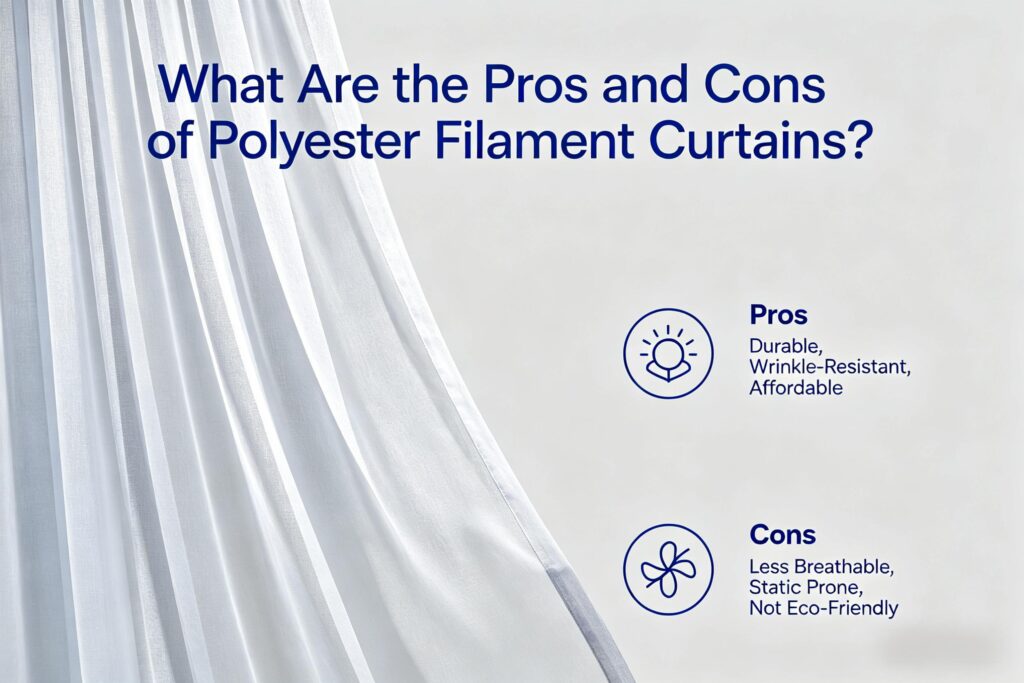
Polyester filament curtains offer a compelling package of benefits for both consumers and procurement professionals.
Unmatched Durability and Ease of Care
This is their most significant selling point. The fabric’s strength ensures it can withstand the wear and tear of daily use, including frequent opening, closing, and sun exposure. They are highly resistant to wrinkling, often requiring no ironing after washing. Maintenance is straightforward, as they are typically machine-washable and dry quickly due to low moisture absorption.
Light Control, Privacy, and Aesthetic Flexibility
Manufacturers skillfully weave and finish polyester filament to achieve a wide range of light transmission and privacy levels. Public procurement tenders, which demand precise performance, specify these clearly: standard curtains aim for a high light-blocking rate (≥95%), while semi-transparent “sheer” curtains allow a specific, soft light penetration (typically 30-70%) for privacy without total darkness. The smooth surface of filament yarns also allows for excellent color fidelity, vibrant prints, and a variety of textures, from crisp sateens to airy voiles.
Cost-Effectiveness and Supply Chain Stability
Polyester filament is a commodity-scale product with a mature and efficient global supply chain. This translates to a significant cost advantage over natural fibers like cotton, linen, or silk. For large-volume buyers such as hotel chains, property developers, or major retailers, this cost predictability and availability are crucial for budgeting and project planning.
Resistance to Environmental Factors
Polyester boasts excellent lightfastness, outperforming most natural fibers and retaining its color strength even after prolonged exposure to sunlight. This makes it ideal for sunlit rooms. Its resistance to mildew, moths, and corrosion further ensures longevity in various climates.
Advantages at a Glance
| Advantage Category | Specific Benefits | Material Basis & Business Impact |
|---|---|---|
| Durability & Care | High strength, wrinkle resistance, easy machine washing, quick drying. | Polyester’s high elastic recovery and low moisture absorption. Reduces customer complaints and returns. |
| Function & Aesthetics | Precise light control (from 30% to 100% blackout), vibrant color/print options, variety of textures. | Engineering of yarn denier, weave density, and finishing. Allows for targeted product lines for different market segments (e.g., bedrooms vs. living rooms). |
| Economic & Supply | Lower cost vs. natural fibers, stable pricing, reliable and scalable supply. | Economies of scale in petrochemical and textile manufacturing. Enables competitive pricing and secure inventory for large orders. |
| Environmental Resistance | Superior colorfastness (resists sun fading), mildew-proof, moth-proof. | Chemical stability of the polyester polymer. Ideal for high-sunlight applications and humid climates, enhancing product lifespan. |
4. The Disadvantages of Polyester Filament Curtains: Recognizing the Trade-offs
Despite their strengths, these curtains have well-documented limitations that can affect consumer perception and suitability for certain applications.
- Comfort and Feel: The most common critique is the “synthetic” hand feel. Polyester filament can feel less soft and breathable compared to natural fibers like cotton or linen. Its low moisture absorption means it doesn’t “breathe” as well, which can make rooms feel less airy in hot, humid conditions.
- Static Electricity and Dust: Due to its low conductivity, polyester is prone to generating static electricity, especially in dry environments. This static attracts and holds dust, lint, and pet hair, potentially increasing the frequency of cleaning required.
- Environmental and Sustainability Considerations: As a petroleum-based product, the environmental footprint of virgin polyester is a growing concern for eco-conscious brands and consumers. The production is energy-intensive, and the material is not biodegradable. However, this is a rapidly evolving area, with the market shifting towards recycled polyester (rPET) and “green fibers” made from post-consumer plastic, which are becoming a significant value-add and selling point.
- Specialized Processing Requirements: Achieving certain high-performance features can add complexity. For instance, while the base fiber is difficult to ignite, achieving certified flame retardancy often requires adding chemical treatments or using inherently flame-retardant yarns. Similarly, the initial dyeing of polyester requires high-temperature processes, though leading suppliers now offer pre-colored “solution-dyed” yarns that are more eco-friendly and colorfast.
5. Specifications & Quality Assessment: A Buyer’s Technical Guide
For professional buyers, moving beyond generic descriptions to concrete specifications is key. Here are critical parameters to evaluate.
Key Performance Indicators (KPIs) for Sourcing:
- Fabric Weight (GSM): Directly relates to density, drape, and light blockage. Sheer curtains may start around 140-156 GSM, while blackout curtains can exceed 400-600 GSM.
- Tensile and Tear Strength: Measured in Newtons (N), this quantifies durability. A tender for student dormitories, for example, might require a minimum tear strength of 80-250N depending on the product.
- Light Fastness & UV Resistance: Crucial for color retention. High-quality curtains should achieve a light fastness rating of 5-6 or higher on standard scales.
- Flame Retardancy (FR): A non-negotiable for contract/commercial projects (hotels, schools, offices). Specifications often mandate compliance with standards like GB 8624 B1 level (China) or similar international codes, sometimes requiring the property to survive over 200 washes.
- Eco-Certifications: For sustainable sourcing, look for Global Recycled Standard (GRS) certification for recycled content or OEKO-TEX Standard 100 for verified safety from harmful substances.
6. Market Context and Application-Specific Insights
The polyester filament curtain market is not monolithic. Needs vary dramatically by segment:
- Hospitality & Contract: This sector prioritizes durability, flame retardancy, and precise light control. Heavy-duty fabrics with high GSM and certified FR performance are standard. Long-term warranties and fade resistance are key purchasing factors.
- Residential/Retail: Here, aesthetics, value, and ease of care dominate. Consumers look for trendy colors, good drape, and machine-washability. The rise of e-commerce has increased demand for products that look and feel premium while remaining affordable.
- The “Green” Trend: Sustainability is no longer niche. Major brands and government tenders increasingly specify recycled content and environmentally friendly production processes. Forward-thinking suppliers are responding. For instance, a specialized yarn producer like Glyarn has built a reputation not just for consistent quality in standard polyester filaments, but for pioneering in eco-friendly and functional yarns. By offering a range of rPET and solution-dyed yarns, they enable curtain manufacturers to meet this growing demand for products that are both high-performing and responsible, adding a compelling layer of value to the finished curtain.
7. Conclusion: Making an Informed Sourcing Decision
Polyester filament curtains present a balanced proposition of significant strengths and manageable weaknesses. Their durability, cost-effectiveness, functional versatility, and ease of maintenance make them a logical and reliable choice for the majority of large-scale and mid-market applications.
The decision to source them should be guided by the specific end-use. For projects where longevity, budget, and precise performance (like light control or FR ratings) are paramount, they are often the optimal solution. Their limitations in feel and environmental perception can be mitigated by selecting higher-quality weaves, blended fabrics, or products made from recycled materials.
Ultimately, success lies in partnering with professional suppliers who can provide detailed technical specifications and who are evolving with market trends—particularly the shift towards circularity and enhanced functionality. By doing so, procurement professionals can ensure they are sourcing a product that delivers not just on immediate practical needs, but also on the evolving values of the global market.
