
Table of Contents
- How I Learned That Not All PET Chips Are the Same
- What Is a PET Chip Anyway? (Quick Refresher for Buyers)
- The Main PET Chip Families You’ll Encounter
- Detailed Comparison Table – Intrinsic Viscosity, Melting Point, Applications
- Semi-Dull vs Bright Chips – The TiO₂ Difference That Changes Everything
- Chip Grade Breakdown – A-Grade, B-Grade, and Recycled
- My Personal Experience – Three Chip Types That Surprised Me
- Best Chip by End Product
- How to Spot a Bad Batch Before You Spin It
- FAQs (From Real Conversations with Factory Owners)
- Your Yarn Quality Starts Under the Chip
1. How I Learned That Not All PET Chips Are the Same
Early in my career, I made an assumption that cost me an entire container of yarn. I thought: “PET chips are PET chips. How different can they be?”
Very different, as it turns out.
I had ordered what I believed was standard semi-dull FDY 150D from a new supplier. The price was good. The sample looked fine. But when the full order arrived, the yarn had a grayish tint that I couldn’t bleach out. My customer rejected the entire batch.
After weeks of arguing, the supplier finally admitted they had used bright chips instead of semi-dull chips. To my untrained eye, the chips themselves looked identical. But the fabric told a different story.
That experience sent me down a rabbit hole of understanding PET chips – what they are, how they vary, and why the choice of chip is actually more important than the spinning process itself.
Eight years later, I’ve handled chips from over thirty producers across China, Taiwan, South Korea, and India. Here’s what I wish someone had told me on day one.
2. What Is a PET Chip Anyway? (Quick Refresher for Buyers)
PET stands for polyethylene terephthalate. A “chip” is simply the solid, pellet-shaped form of PET resin after polymerization. Think of it as the flour before you bake the bread. Your yarn – whether FDY, DTY, or POY – is made by melting these chips and extruding them through spinnerets.
Why you should care: The chip determines roughly 70% of your final yarn’s properties. Viscosity affects strength. TiO₂ content affects luster. Additives affect dye uptake. You cannot spin premium yarn from mediocre chips. I’ve tried. It doesn’t work.
The global PET chip market was roughly 35 million tons in 2024. But hidden inside that number are dozens of distinct types, each suited for different applications.
3. The Main PET Chip Families You’ll Encounter
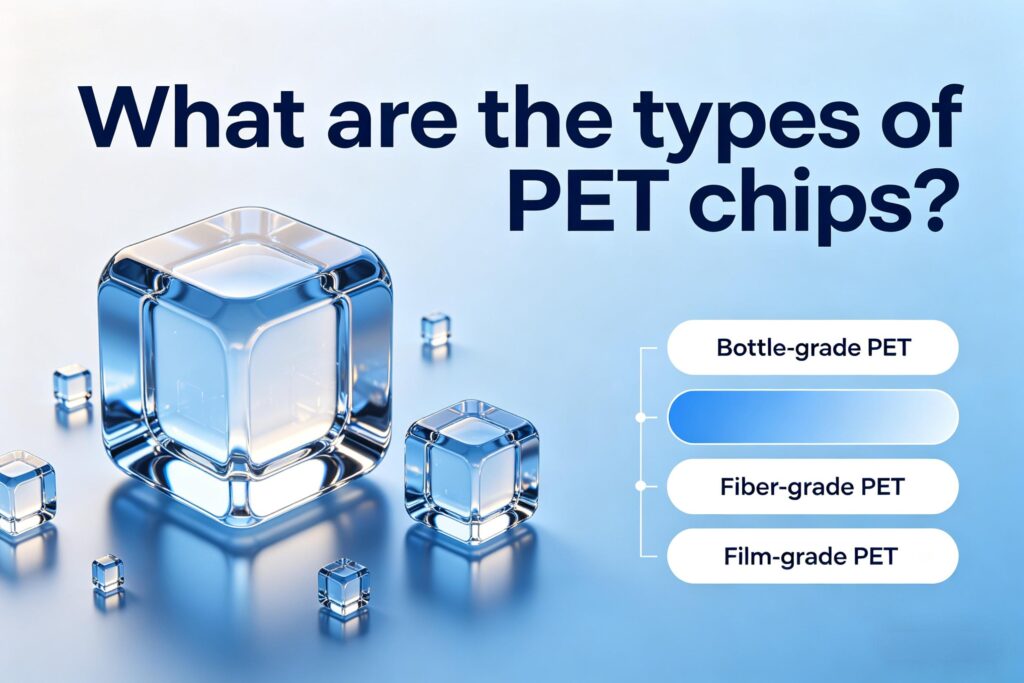
After sorting through countless spec sheets and purchase orders, I’ve grouped PET chips into five main families. These cover about 95% of what you’ll find in the polyester supply chain.
| Chip Family | Typical Intrinsic Viscosity (IV) | Primary Use | Relative Cost |
|---|---|---|---|
| Fiber-grade (textile) | 0.60 – 0.68 | FDY, DTY, POY, staple fiber | Baseline |
| Bottle-grade | 0.72 – 0.84 | Water bottles, food containers | +5–10% |
| Film-grade | 0.60 – 0.65 | Packaging film, photographic film | -5% (sometimes cheaper) |
| High-viscosity (industrial) | 0.85 – 1.00 | Tire cord, conveyor belts, engineering plastics | +15–30% |
| Cationic dyeable (CDP) | 0.62 – 0.68 | Deep-dye yarn, two-tone fabrics | +8–12% |
Within fiber-grade alone, you have semi-dull, full-dull, bright, and ultra-bright variations. And that’s before we talk about recycled chips.
4. Detailed Comparison Table – Intrinsic Viscosity, Melting Point, Applications
Let me give you real numbers from actual production specifications I’ve collected.
| Parameter | Fiber-grade (Standard) | Bottle-grade (Recycled-compatible) | High-Viscosity | CDP Chip |
|---|---|---|---|---|
| Intrinsic Viscosity (IV) | 0.64 – 0.66 | 0.74 – 0.80 | 0.90 – 1.00 | 0.63 – 0.67 |
| Melting Point (°C) | 258 – 262 | 250 – 255 | 260 – 265 | 254 – 258 |
| Carboxyl End Groups (mol/t) | ≤30 | ≤25 | ≤35 | ≤28 |
| Diethylene Glycol (%) | ≤1.2 | ≤1.0 | ≤1.5 | ≤1.3 |
| Acetaldehyde (ppm) | ≤1.0 | ≤1.5 (bottle grade stricter) | ≤1.0 | ≤1.0 |
| Crystallinity (%) | 45 – 55 | 50 – 60 | 40 – 50 | 45 – 55 |
| Typical End Use | Clothing, home textiles | Bottles, then recycled yarn | Tire cord, straps | Deep-dye fabrics |
One thing I learned the hard way: you cannot spin bottle-grade chips directly into fine denier FDY. The IV is too high. The melt pressure will spike, and your spinnerets will clog. I watched a Taiwanese mill try this – they replaced three spinnerets in one shift.
5. Semi-Dull vs Bright Chips – The TiO₂ Difference That Changes Everything
This is where many buyers get tripped up. The difference between semi-dull and bright chips is simply the amount of titanium dioxide (TiO₂) added during polymerization.
| Chip Type | TiO₂ Content | Appearance | Best For |
|---|---|---|---|
| Bright | 0% (none) | Clear, high gloss | Satin ribbons, linings, glossy fabrics |
| Semi-dull | 0.3 – 0.4% | Slightly muted sheen | Most apparel – T-shirts, shirts, dresses |
| Full-dull | 2.0 – 2.5% | Matte, almost white | Activewear, automotive, industrial fabrics |
I once received a shipment of “semi-dull” chips that turned out to have only 0.1% TiO₂. The yarn looked almost bright. My customer thought I had substituted cheaper materials. I hadn’t – but the supplier had.
How to check without a lab: Spin a small sample and hold it next to a known reference. The difference is visible to the naked eye once you’ve seen it a few times. Bright chips make yarn that sparkles under direct light. Semi-dull looks clean but not shiny. Full-dull looks chalky.
6. Chip Grade Breakdown – A-Grade, B-Grade, and Recycled
Grades matter more than many buyers realize. Here’s what each grade actually means based on my inspection records.
A-Grade (Prime)
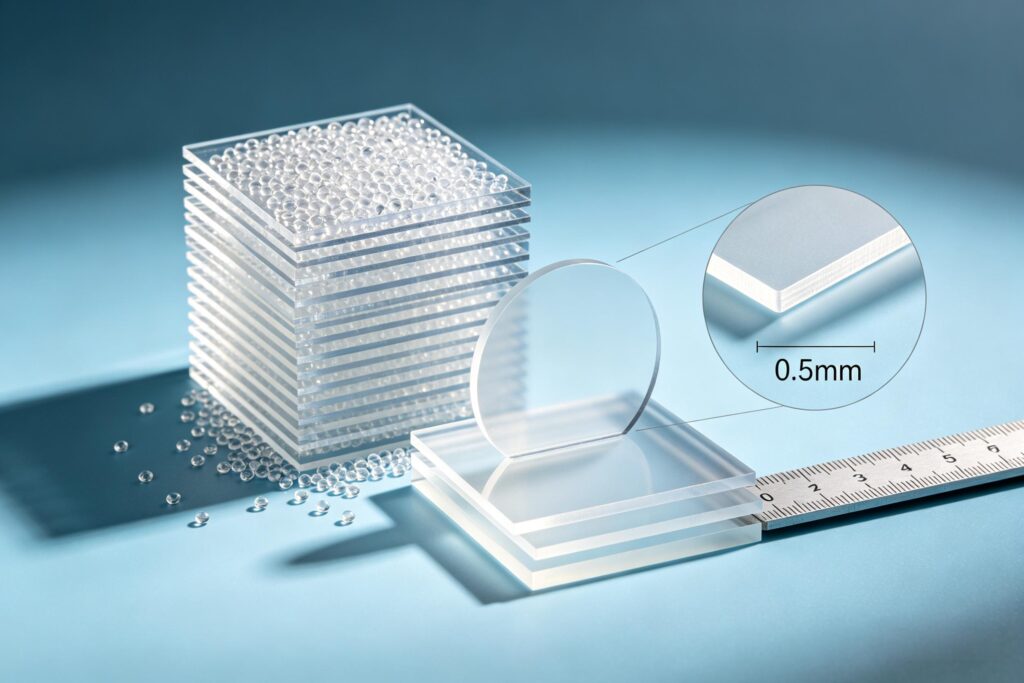
- Uniform size and shape (typical pellet size 3–4mm)
- No color variation between pellets
- IV variation ≤0.02
- Moisture content <0.4% (before drying)
- Price: Baseline
B-Grade (Off-spec)
- Slight size variation or dust content
- May have slight yellowness (b value up to 4.0)
- IV variation up to 0.05
- Often comes from line changeovers or start-up batches
- Price: Typically 10–20% below A-grade
Recycled (Post-consumer or Post-industrial)
- Derived from PET bottles or waste yarn
- IV typically 0.68 – 0.75 (before solid stating)
- Can contain contaminants if poorly sorted
- Price: Often similar to A-grade or slightly higher (green premium)
My personal rule: Never buy B-grade for fine denier yarns (under 150D). The variations will show up as dye spots or weak spots. For heavy denier industrial yarns (600D+), B-grade can be acceptable if you have good process control.
I’ve used B-grade successfully for 1000D FDY used in tarpaulins. The customer never noticed. But for 75D lining fabric? Disaster. Every defect was visible.
7. My Personal Experience – Three Chip Types That Surprised Me
Let me share three real examples from my notebook.
Surprise 1 – The “Cheap” Chinese Bright Chips
Year: 2023. Supplier: Unknown trader via Alibaba. Price: $780/ton for bright fiber-grade chips (market then was $850). I was tempted. A colleague warned me. I bought 50 tons anyway. The chips looked fine. But when spun, the yarn had inconsistent denier – ranging from 145D to 158D on a 150D target. Lab analysis showed the chips had varying IV between pellets. Some were 0.62, some 0.70. The supplier had mixed two different production runs.
Lesson: Cheap chips are cheap for a reason. IV uniformity is not negotiable.
Surprise 2 – Vietnamese Bottle-Grade for Staple Fiber
Year: 2024. A mill in Vietnam showed me they were spinning recycled bottle chips directly into staple fiber at 1.5 denier. I was skeptical. But their solid-stating process was excellent – they had reduced the IV from 0.78 to 0.68 through controlled drying. The fiber had higher strength than virgin at the same denier. I now buy recycled staple from them regularly.
Lesson: Don’t dismiss recycled chips. Some mills have mastered the process.
Surprise 3 – South Korean CDP Chips
Year: 2025. I needed cationic dyeable chips for a two-tone uniform project. South Korean chips cost $1,050/ton. Chinese CDP cost $920. I tried both. The Chinese chips worked fine – until we tried deep black. Then they showed a reddish undertone that the Korean chips didn’t. My customer accepted it after a discount, but I learned that high-end applications demand high-end chips.
Lesson: “Good enough” depends entirely on your target market.
8. Best Chip by End Product
Based on my experience across dozens of products, here’s my scoring system (1–10 scale) for chip types by application.
| End Product | Fiber-grade (Std) | Bright Chip | Full-dull | Recycled | CDP |
|---|---|---|---|---|---|
| T-shirts (white) | 9 | 4 (too shiny) | 7 | 6 | 5 |
| T-shirts (black) | 8 | 3 | 8 | 5 | 9 |
| Sportswear | 7 | 2 | 9 | 6 | 6 |
| Lining fabric | 6 | 9 | 4 | 5 | 3 |
| Industrial webbing | 3 (too weak) | 2 | 5 | 4 | 2 |
| Carpet backing | 8 | 7 | 6 | 9 | 4 |
| Automotive interior | 5 | 3 | 10 | 6 | 5 |
| Eco bags | 4 | 3 | 4 | 10 | 3 |
My personal picks:
- Best all-around: Fiber-grade semi-dull with IV 0.65 and TiO₂ 0.3%. Works for 80% of textile applications.
- Best for uniformity: South Korean or Taiwanese fiber-grade. More expensive but lower CV in spinning.
- Best value: Chinese A-grade from top producers (Sinopec, Hengli, Tongkun). Skip the traders; go direct.
- Best for green marketing: Recycled bottle-grade from mills with GRS certification. Don’t trust uncertified claims.
9. How to Spot a Bad Batch Before You Spin It
After several costly mistakes, I developed a simple pre-spinning checklist. You can do most of these without expensive lab equipment.
Visual inspection
Spread a handful of chips on white paper. Look for:
- Yellowish pellets (indicates thermal degradation)
- Atypical size differences (more than 20% variation)
- Dust or fines (will clog filters)
Simple moisture test (field method)
Take 100g of chips. Heat them in a metal pan on a hot plate at 150°C for 10 minutes. Weigh before and after. If weight loss exceeds 0.8%, stop. The chips need more drying, or they will hydrolyze during spinning.
IV check (basic)
You need a lab for precise IV, but you can get a rough sense by dissolving a few pellets in a 60/40 phenol-tetrachloroethane solution. High IV chips take longer to dissolve. This isn’t scientific, but after doing it 50 times, you’ll recognize outliers.
What I actually do now: I pay for a third-party lab test on every new supplier. One UV-Vis and IV test costs about $180. That $180 has saved me over $50,000 in bad batches.
10. FAQs (From Real Conversations with Factory Owners)
Q1 – Can I mix A-grade and B-grade chips in the same hopper?
Technically yes, but don’t. The uneven IV will cause denier variation. I tried a 90/10 mix once. The yarn had “thick-thin” sections that broke on the loom. Fine for low-stress applications like filter fabrics. Not fine for apparel.
Q2 – Why are bottle-grade chips cheaper than fiber-grade sometimes?
Supply and demand. When PET bottle recycling booms, bottle-grade can drop below fiber-grade. In early 2024, I saw bottle-grade at $760 while fiber-grade was $820. But remember – you can’t spin fine denier from bottle-grade without solid-stating. Factor that cost in.
Q3 – What is “solid stating” and do I need it?
Solid stating is a post-treatment that raises IV and removes acetaldehyde. If you’re using bottle-grade chips for yarn, you absolutely need it. Without solid stating, your yarn will have weak spots and may smell like acetic acid. Some Chinese suppliers skip this step to cut costs. Ask for proof.
Q4 – How much TiO₂ should I specify for semi-dull?
0.32–0.38% is the industry standard. Below 0.30% and the yarn starts looking bright. Above 0.45% and you’re paying for full-dull without the matte performance. I put “TiO₂ 0.35% ±0.03%” in all my semi-dull contracts.
Q5 – Are recycled chips as strong as virgin?
It depends entirely on the recycling process. Good recycled chips (well-sorted, melt-filtered, solid-stated) can match or exceed virgin strength. Bad recycled chips (mixed colors, poorly filtered) will break constantly. I’ve seen both extremes. Pay for certification.
Q6 – What’s the shelf life of PET chips?
If stored properly (dry, away from sunlight), fiber-grade chips last 12–18 months. After that, they absorb moisture and can yellow. I’ve spun 24-month-old chips – the yarn had lower tenacity and more broken filaments. Don’t hoard chips.
Q7 – Why do South Korean chips cost more than Chinese chips?
Consistent IV and fewer contaminants. Korean producers (SK, KPIC) run cleaner processes. For critical applications like fine denier (under 50D) or high-speed spinning (over 4,000 m/min), the premium is worth it. For standard 150D FDY, Chinese top-tier is fine.
Q8 – Can I use high-viscosity chips for regular yarn?
No. High-viscosity chips (IV >0.85) require higher melt temperatures and pressures. They also cool differently, leading to slower spinning speeds. I watched a mill try. They wasted three days and 10 tons of chips.
Q9 – What is a “masterbatch” and why does my chip supplier mention it?
Masterbatch is concentrated additive (color, UV stabilizer, flame retardant) mixed with base chips. You add a small percentage to the hopper to achieve special properties. Standard fiber-grade chips have no masterbatch. If your supplier mentions it, ask exactly what additive they’re selling you.
Q10 – How many tons should I buy for a trial run?
Start with 5–10 tons. That’s enough to run a production batch (approx. 2,000–4,000 kg of yarn) without committing to a full container. If the chips work well, order 50 tons. If they don’t, you’ve lost a minimal amount. I’ve learned this the expensive way.
11. Your Yarn Quality Starts Under the Chip
After eight years of buying, rejecting, testing, and eventually spinning thousands of tons of polyester products, I’ve come to a simple conclusion:
The chip is not the sexy part of the story. No one asks their fabric supplier, “What IV were your chips?” But the chip determines whether your yarn breaks, whether your fabric dyes evenly, and whether your customer comes back.
Before you worry about draw ratios, spin finishes, or loom speeds, make sure you’re starting with the right chip. Test every new supplier. Trust but verify. And never assume that two chips that look the same will spin the same.
Because I made that assumption once. And I still remember the look on my customer’s face when they saw that grayish fabric.
