
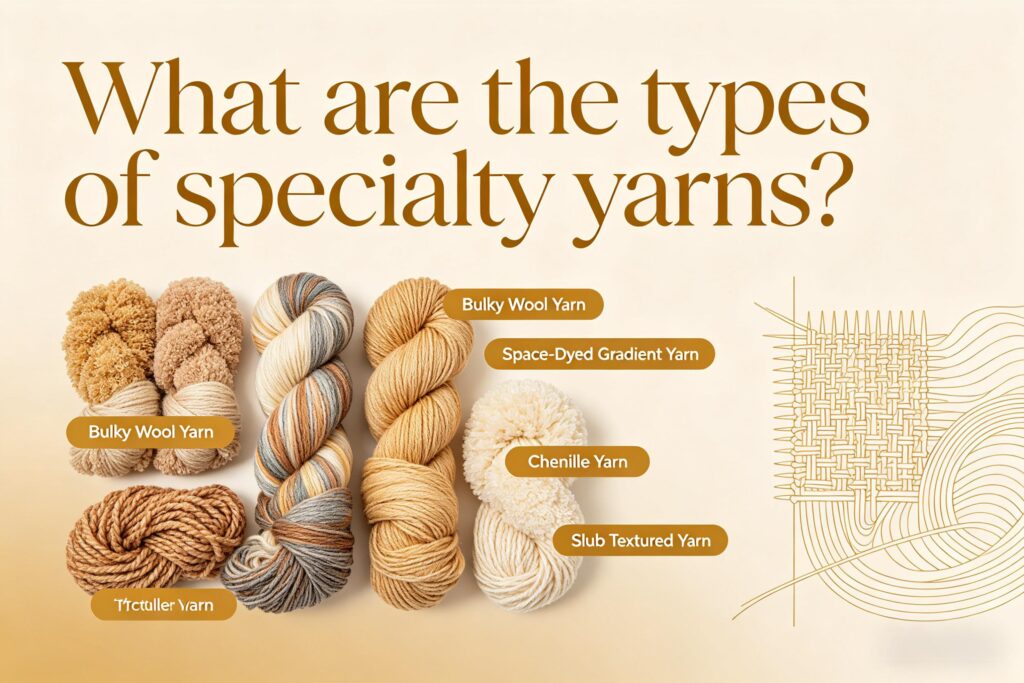
Navigating the World of Specialty Yarns: A Buyer’s Guide for Technical and Aesthetic Innovation
Introduction: Beyond the Ordinary
For sourcing professionals in apparel, textiles, carpet manufacturing, and soft goods, the selection of yarn is a fundamental decision that dictates product performance, cost, and market appeal. While commodity yarns form the backbone of production, specialty yarns—also known as novelty or fancy yarns—are the strategic tools for differentiation and value creation. These are yarns engineered through specialized materials, equipment, or processes to achieve unique structural, aesthetic, or functional properties. This guide provides a comprehensive, technical overview of major specialty yarn types, empowering buyers to make informed decisions that drive innovation and competitive advantage.
Table of Contents
- Understanding the Spectrum: Defining Specialty Yarns
- Structural Innovators: Aesthetic and Textural Yarns
- 2.1 Fancy or Novelty Yarns
- 2.2 Bouclé and Loop Yarns
- 2.3 Chenille Yarns
- Performance Enhancers: Functional and Technical Yarns
- 3.1 Technical and High-Strength Yarns
- 3.2 Elastic and Stretch Yarns
- 3.3 Flame-Retardant (FR) Yarns
- Material Masters: Yarns with Unique Compositions
- 4.1 Blended, Composite, and Hybrid Yarns
- 4.2 Tape, Network, and Metallic Yarns
- The Buyer’s Framework: Selection, Specification, and Sourcing
1. Understanding the Spectrum: Defining Specialty Yarns
Specialty yarns deviate from the uniform structure of standard yarns. They are typically created to fulfill one of three core objectives: to introduce a distinctive visual or tactile effect, to impart a specific functional performance, or to utilize a unique material composition. These yarns find applications far beyond fashion, extending into upholstery, drapes, carpets, plush toys, and high-tech industrial fabrics. For a buyer, understanding this classification is the first step in targeted sourcing.
2. Structural Innovators: Aesthetic and Textural Yarns
This category prioritizes sensory impact, creating fabrics with distinctive looks and feels.
2.1 Fancy or Novelty Yarns
This is a broad sub-category where visual irregularity is the design feature. They are often produced on specialized twisting machines where a core yarn, an effect yarn, and a binder yarn are combined.
- Key Types: Slub/Yarn (Thick & Thin): Features deliberate, irregular thick places. Spiral/ Corkscrew: Two yarns of different thicknesses or twist levels plied together. Nub/Spot/ Knot: Features bunches of fibers wrapped at intervals.
- Buyer’s Note: Consistency lies in the pattern of inconsistency. Specify parameters like slub length, frequency, and size range for quality control.
2.2 Bouclé and Loop Yarns
These yarns create a looped or curled surface, lending a highly textured, three-dimensional effect and a soft hand. They are constructed by feeding the effect yarn faster than the core, causing it to buckle and form loops which are then locked in place by a binder yarn.
- Primary Use: High-fashion knitwear, coats, decorative upholstery, and accent fabrics.
- Technical Point: Loop integrity is critical. Poor binding can lead to snagging during weaving, knitting, or use.
2.3 Chenille Yarns
Chenille is recognizable by its exceptionally soft, velvety pile that protrudes in all directions. It is made by slicing a specially woven “blanket” of warp yarns wefted with short tufting yarns, creating a yarn with a dense, fuzzy surface.
- Primary Use: Luxury throws, upholstery, decorative pillows, and high-end apparel.
- Buyer’s Note: Chenille’s abrasion resistance can be lower than other structures. Its luxurious hand is paramount, so fiber quality (e.g., mercerized cotton, rayon, silk) is a key cost and quality factor.
3. Performance Enhancers: Functional and Technical Yarns
Here, the primary value lies in engineered physical properties that meet specific end-use demands.
3.1 Technical and High-Strength Yarns
These are engineered for extreme durability and protection, often using high-performance fibers.
- Common Fibers: Aramid (e.g., Kevlar®, Nomex®), Ultra-High Molecular Weight Polyethylene (UHMWPE), and composites with glass or stainless steel.
- Key Properties: Exceptional tensile strength, cut/puncture/abrasion resistance, and high-temperature tolerance.
- Applications: Protective gloves and apparel, cut-resistant liners for luggage, safety equipment, high-strength ropes, and industrial composites.
3.2 Elastic and Stretch Yarns
These yarns provide engineered elongation and recovery, crucial for fit, comfort, and shape retention. While spandex (Lycra) cores are well-known, alternative technologies exist.
- Textured Stretch Yarns: Made from thermoplastic filaments (like polyester or nylon) processed with false-twist or air-jet texturing to induce crimp and bulk, providing moderate, non-elastic stretch.
- Bi-component Stretch: Uses fibers with differential shrinkage to create a permanent, spring-like structure after heat setting.
3.3 Flame-Retardant (FR) Yarns
Designed to resist ignition and prevent flame spread. Performance can be inherent to the fiber or applied via treatment.
- Inherent FR Fibers: Aramids (Nomex®, Kevlar®), modacrylic, and FR-treated viscose. These offer durable protection that won’t wash out.
- Applications: Firefighting gear, military uniforms, protective workwear, theater and transportation upholstery, and children’s sleepwear.
4. Material Masters: Yarns with Unique Compositions
Innovation in blending and material form defines this group.
4.1 Blended, Composite, and Hybrid Yarns
These yarns combine different materials to leverage the advantages of each component.
- Core-Spun Yarn: A core filament (e.g., spandex for stretch, aramid for strength) is wrapped with staple fibers (e.g., cotton for comfort). This provides hidden functionality.
- Covered Yarn: Similar to core-spun, but the core is completely covered by a spun or filament yarn, fully concealing it.
- Intimate Blends: Different staple fibers (e.g., polyester/cotton, wool/acrylic) are blended before spinning to create a uniform yarn with averaged properties.
4.2 Tape, Network, and Metallic Yarns
These rely on unconventional material forms.
- Tape/Network Yarns: Made from extruded polymer films slit into ribbons (tape) or fused fiber networks. They are cost-effective and create unique flat, lustrous effects.
- Metallic Yarns: Integrate metal (often aluminum) or metallized polyester film for decorative sparkle. They are often laminated or wrapped around a core for protection and workability.
To aid comparison, the following table summarizes key specialty yarn types.
Table 1: Technical and Application Overview of Major Specialty Yarn Types
| Yarn Type | Primary Characteristic | Typical Fibers Used | Key Applications | Critical Sourcing Parameter |
|---|---|---|---|---|
| Slub / Fancy | Irregular thickness, visual texture | Cotton, Linen, Silk, Synthetics | Shirts, dresses, home decor, denim | Slub dimension tolerance, evenness of effect spacing |
| Bouclé / Loop | 3D looped texture, soft bulk | Wool, Mohair, Acrylic, Cotton | Knitwear, coats, high-end upholstery | Loop consistency & security, resistance to snagging |
| Chenille | Luxurious, velvety pile surface | Cotton, Rayon, Acrylic, Silk | Throws, cushions, robes, decorative fabric | Pile density, fiber quality, abrasion resistance |
| High-Strength | Extreme tenacity & cut resistance | Aramid, UHMWPE, Glass, Steel | Protective gear, cut-resistant fabrics, composites | Tensile strength (cN/tex), cut resistance level |
| Flame-Retardant | Non-flammable, self-extinguishing | FR-treated Cotton/Wool, Modacrylic, Aramid | Workwear, uniforms, contract furnishings | FR standard compliance (e.g., NFPA 701, EN 13501) |
| Core-Spun | Hidden functional core | Core: Spandex, Filament; Sheath: Cotton, Polyester | Activewear, jeans, technical apparel | Core content %, uniformity of covering |
| Metallic | Decorative shine, luster | Metallized polyester, Laminated aluminum | Eveningwear, trims, brocades, decorative fabrics | Tarnish resistance, color consistency, flexibility |
5. The Buyer’s Framework: Selection, Specification, and Sourcing
Selecting the right specialty yarn requires a disciplined approach to ensure project success.
- Define the Need Precisely: Start with the end-product requirement. Is it aesthetic (a rustic look), functional (stretch recovery), or performance-based (cut protection)? This dictates the category.
- Request Detailed Specifications: Move beyond the name. For a fancy yarn, request data on slub size and frequency. For a technical yarn, require certified test reports for strength or FR performance.
- Prioritize Supplier Collaboration: Specialty yarns often require custom development. Partner with spinners who have proven expertise and can provide technical support from sampling to production.
- Evaluate Total Cost: Consider not just price per kg, but also processing efficiency. A difficult-to-handle yarn can increase weaving/knitting downtime, negating any material savings.
In conclusion, the world of specialty yarns offers a powerful toolkit for product innovation. For the strategic buyer, success lies in understanding the technical DNA of each yarn type, specifying requirements with precision, and fostering collaborative partnerships with expert suppliers. By mastering this domain, you can unlock new design possibilities, enhance product performance, and deliver exceptional value to your end customers.
