
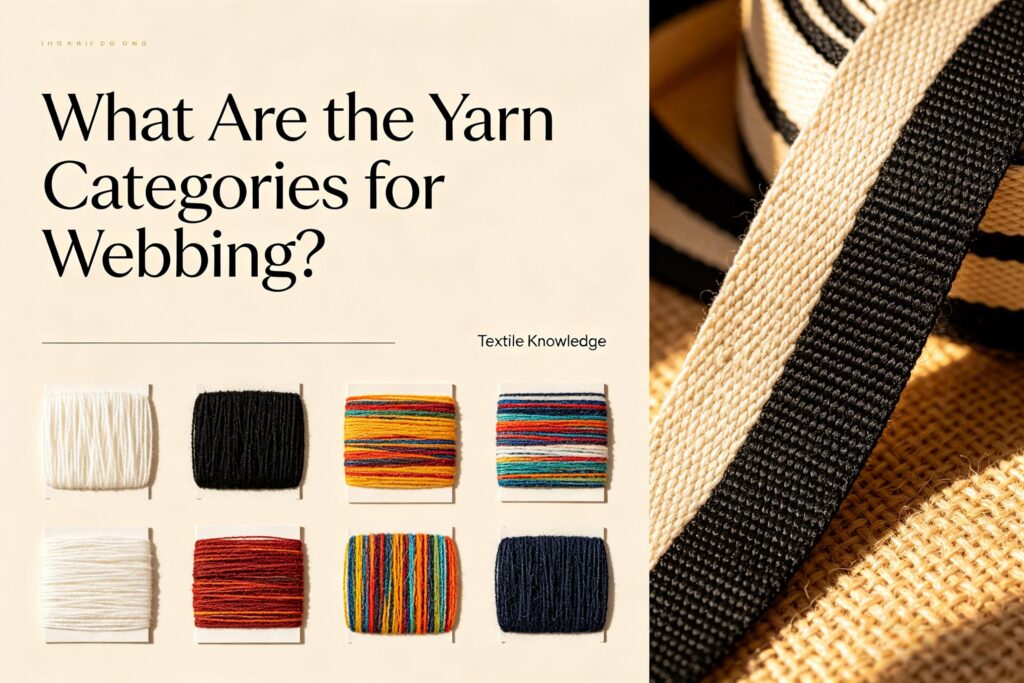
This article provides a comprehensive guide to yarn categories used in the webbing industry. It outlines the various fiber types, yarn constructions, and specialized materials used to produce the narrow fabrics that are essential in countless industrial and commercial applications. From synthetic workhorses like polyester and nylon to high-performance aramid and ultra-strong specialty fibers, this guide will help you understand the building blocks of webbing and make informed sourcing decisions for your projects.
Table of Contents
- Introduction: The Critical Role of Yarn in Webbing Performance
- Chapter 1: Foundational Fiber Types
- Natural Fibers (Cotton, Jute)
- Synthetic Fibers (Polyester, Nylon, Polypropylene)
- High-Performance & Specialty Fibers
- Chapter 2: Yarn Construction and Form
- Staple Spun Yarns vs. Filament Yarns
- Yarn Twist, Count, and Denier
- Special Constructions: Textured, Fancy, and Composite Yarns
- Chapter 3: Application-Specific Yarn Selection
- Heavy-Duty and Industrial Webbing
- Elastic and Stretch Webbing
- Decorative and Lightweight Webbing
- Chapter 4: Performance Characteristics and Data
- Strength, Elongation, and Abrasion Resistance
- Environmental Resistance (UV, Chemical, Moisture)
- Safety and Compliance Standards
- Conclusion: Building the Future of Webbing Through Material Innovation
1. Introduction: The Critical Role of Yarn in Webbing Performance
Webbing, a type of narrow fabric, is a versatile and critical component found in applications ranging from automotive seatbelts and military gear to outdoor equipment and fashion accessories. Its performance, durability, and functionality are fundamentally determined by the yarns from which it is woven or knitted. The question “What are the yarn categories for webbing?” is therefore central to designing a product that meets specific safety, aesthetic, and functional requirements.
Understanding the vast array of available yarns—from classic natural fibers to advanced technical synthetics—enables manufacturers, designers, and buyers to make strategic sourcing decisions. This guide will systematically explore these categories, providing clear data and application-focused insights to add value to your next project.
2. Chapter 1: Foundational Fiber Types
The choice of fiber is the first and most significant decision, as it defines the core properties of the final webbing.
Natural Fibers
Traditional and valued for specific aesthetics and comfort, though generally less dominant in high-strength industrial webbing today.
- Cotton: Known for its comfort, good grip, and excellent dyeability. Historically used in belts and light-duty straps, its use has declined in industrial applications due to susceptibility to moisture, mildew, and lower strength compared to synthetics.
- Jute and Other Plant Fibers: Used primarily for rustic decorative webbing or low-cost, biodegradable packaging applications.
Synthetic Fibers
These form the backbone of the modern webbing industry due to their superior strength, consistency, and engineered properties.
- Polyester (PET): Arguably the most widely used webbing fiber. It offers an outstanding balance of high tensile strength, excellent resistance to UV radiation and chemicals, and minimal elongation under load. This makes it the top choice for automotive seatbelts, cargo tie-downs, outdoor furniture, and long-life safety harnesses.
- Nylon (Polyamide, PA): Prized for its exceptional toughness, high abrasion resistance, and good elasticity (elongation). Nylon webbing is ideal for applications involving shock absorption, such as climbing slings, tow straps, and rescue equipment. A key drawback is its loss of strength when wet.
- Polypropylene (PP): A lightweight and economical fiber that is inherently water-resistant and floats. It is commonly used in inexpensive tie-downs, non-critical bag straps, and marine applications. However, it has lower UV resistance and melting point than polyester or nylon.
High-Performance & Specialty Fibers
Used where extreme conditions or specific functionalities are required.
- Aramid (e.g., Kevlar, Twaron): Offers extraordinary heat resistance and very high strength-to-weight ratios. Used in cut-resistant safety straps, high-temperature industrial applications, and aerospace components.
- High-Strength Polyethylene (HPPE, e.g., Dyneema, Spectra): One of the strongest fibers in the world by weight. Used for ultra-lightweight lifting slings, marine lines, and ballistic applications where minimal weight and bulk are critical.
- Fiberglass and Basalt: Provide excellent thermal insulation and are non-combustible. Used in high-temperature insulation webbing and fire blankets.
- Elastomeric (Spandex/Lycra): Incorporated as a core or blend to provide controlled, recoverable stretch in webbing for sports gear, adaptive clothing, and medical braces.
3. Chapter 2: Yarn Construction and Form
Beyond fiber type, how the yarn is constructed profoundly impacts the hand feel, strength, and weaving performance.
Staple Spun Yarns vs. Filament Yarns
- Filament Yarns: Made from continuous fibers (synthetic or silk). They produce webbing with a smooth surface, higher tenacity, and better resistance to pilling and abrasion. Most high-performance polyester and nylon webbings use filament yarns.
- Staple Spun Yarns: Made from short fibers twisted together. They give webbing a softer, more cotton-like feel, better grip, and a matte appearance. Often used in decorative or comfort-focused applications.
Key Yarn Parameters
- Linear Density (Denier or Tex): Indicates the yarn’s thickness or mass per length. A higher denier (e.g., 1000D) means a thicker, heavier, and generally stronger yarn.
- Twist Level: The number of turns per meter. Higher twist increases yarn cohesion and strength but can reduce its bulk.
Special Constructions
- Textured Yarns: Filament yarns that have been processed to introduce bulk, stretch, or a different texture.
- Fancy/Yarn-Dyed Yarns: Include melanges, space-dyed, or twisted multi-color yarns used to create visual patterns directly in the weave.
- Composite/Coated Yarns: A core of one material (e.g., rubber for elasticity, aramid for strength) sheathed with another fiber (e.g., polyester). This combines properties that are difficult to achieve with a single fiber.
4. Chapter 3: Application-Specific Yarn Selection
Matching the yarn to the end-use is critical. Here is a breakdown for common webbing categories:
Heavy-Duty and Industrial Webbing
This includes safety harnesses, lifting slings, and cargo control products.
- Primary Yarn: High-tenacity polyester filament yarn is the standard for its strength and durability. For even higher strength-to-weight, HPPE yarns are used.
- Key Specs: Extremely high tensile strength (e.g., webbing strength exceeding 11,000 Newtons for safety harnesses), low elongation, and high abrasion resistance.
- Examples: Seatbelt webbing, warehouse tie-downs, marine mooring lines.
Elastic and Stretch Webbing
Used in apparel, athletic gear, and medical supports.
- Primary Yarn: A composite yarn with a spandex (elastane) core, wrapped with polyester or nylon. The sheath protects the elastic core and provides color/dyeability.
- Key Specs: Controlled, recoverable stretch (often 50-100%), durability through stretch cycles.
- Examples: Elastic straps for backpacks, athletic braces, adjustable closures.
Decorative and Lightweight Webbing
Used in fashion, luggage, and craft applications.
- Primary Yarn: Can be cotton, textured polyester, acrylic, or polypropylene. Yarn-dyed or fancy yarns are common for visual appeal.
- Key Specs: Aesthetic qualities (color, sheen, texture), cost-effectiveness, and adequate strength for the application.
- Examples: Bag handles, trim on clothing, pet collars, crafts.
5. Chapter 4: Performance Characteristics and Data
Selecting the right yarn involves understanding quantitative performance metrics.
Mechanical Properties
- Tensile Strength: The force required to break the yarn or webbing. Polyester and nylon filaments offer strengths measured in grams per denier (g/d), with high-tenacity versions at the top end.
- Elongation at Break: Nylon exhibits higher elongation (15-25%) than polyester (10-15%), making it more energy-absorbent.
- Abrasion Resistance: Critical for longevity. Nylon typically outperforms polyester, which in turn far outperforms polypropylene.
Environmental Resistance
- UV Degradation: Polyester has superior UV resistance, making it ideal for outdoor use. Nylon and polypropylene require UV stabilizers.
- Chemical/Moisture Resistance: Polyester resists most acids and is hydrophobic. Nylon is resistant to alkalis but absorbs water, which temporarily reduces its strength.
- Temperature Tolerance: Most synthetics soften at high heat. Aramid and fiberglass are chosen for extreme temperature applications.
Safety and Compliance
Webbing for life-critical applications (automotive, fall protection, aviation) must meet stringent global standards (e.g., FMVSS, EN, UIAA). These regulate factors like minimum breaking strength, width, and durability after environmental exposure. Reputable yarn suppliers provide fibers that are engineered and certified to help webbing manufacturers meet these standards.
6. Conclusion: Building the Future of Webbing Through Material Innovation
The world of webbing yarns is diverse and dynamic, moving far beyond basic cotton or nylon. Today’s selection ranges from cost-effective polypropylene to cutting-edge, ultra-strong polyethylene and heat-resistant aramids.
The key to successful webbing design and sourcing lies in a clear understanding of the end-use requirements and the specific properties each yarn category brings. By starting with the foundational choice of fiber—be it the all-around reliability of polyester, the tough elasticity of nylon, or the extreme performance of specialty fibers—and then specifying the correct yarn construction, manufacturers can engineer webbing products that are precisely fit for purpose.
As technology advances, we can expect further innovation in sustainable fibers (like recycled polyester and bio-based polymers) and smart yarns with integrated sensors or phase-change materials. Staying informed about these yarn categories is the first step in leveraging these innovations to build better, safer, and more intelligent webbing solutions for the future.
