
A Technical Guide to Selection and Application
Table of Contents
1. Introduction: The Strategic Importance of Yarn Specifications in Scarf Manufacturing
1.1 Connecting Yarn Properties to Final Product Success
1.2 Beyond Aesthetics: A Framework for Functional Design
2. Decoding the Language: Key Yarn Parameters Explained
2.1 Fiber Content: The Foundation of Function and Feel
2.2 Yarn Count: The Language of Fineness and Weight
2.3 Yarn Construction: Singles, Plied, and Special Types
3. Yarn Specifications by Scarf Category: A Technical Selection Guide
3.1 Lightweight and Decorative Scarves (Voile, Summer Scarves)
3.2 Classic Winter Scarves (Knit and Woven for Warmth)
3.3 Luxury and High-Fashion Scarves (Premium Market)
4. From Specification to Fabric: Ensuring Quality and Compliance
4.1 Introduction to Performance Standards: ASTM D3785 & D4035
4.2 Practical Selection Checklist for Industrial Buyers
5. Conclusion: Building a Future-Proof Sourcing Strategy
5.1 The Trend Towards Value-Added Yarns
5.2 Final Recommendations
1. Introduction: The Strategic Importance of Yarn Specifications in Scarf Manufacturing
For industrial buyers and procurement managers, selecting yarn for scarf production is a critical decision that goes far beyond choosing a color or texture. The chosen yarn specification is the DNA of the final product, directly dictating not only its appearance and tactile quality but also its performance, durability, production efficiency, and market positioning. A deep understanding of yarn parameters allows professionals to precisely engineer scarves that meet specific functional needs—from the breathable warmth of a winter accessory to the sheer elegance of a fashion piece.
This guide provides a comprehensive, technical, and commercial framework for navigating yarn selection. We will translate complex specifications into actionable intelligence, enabling you to make sourcing decisions that optimize cost, ensure quality, and deliver tangible value to your end customers.
1.1 Connecting Yarn Properties to Final Product Success
The structure and properties of yarn fundamentally influence the characteristics of the final fabric and garment. As outlined by the China Cotton Textile Association, yarns directly affect a fabric’s surface (smoothness, luster, texture), its hand feel (softness, fullness, drape, elasticity), and its performance (wear resistance, pilling tendency). A specification mistake at the yarn stage is often impossible to correct later in production, potentially leading to product failure, returns, and brand damage.
1.2 Beyond Aesthetics: A Framework for Functional Design
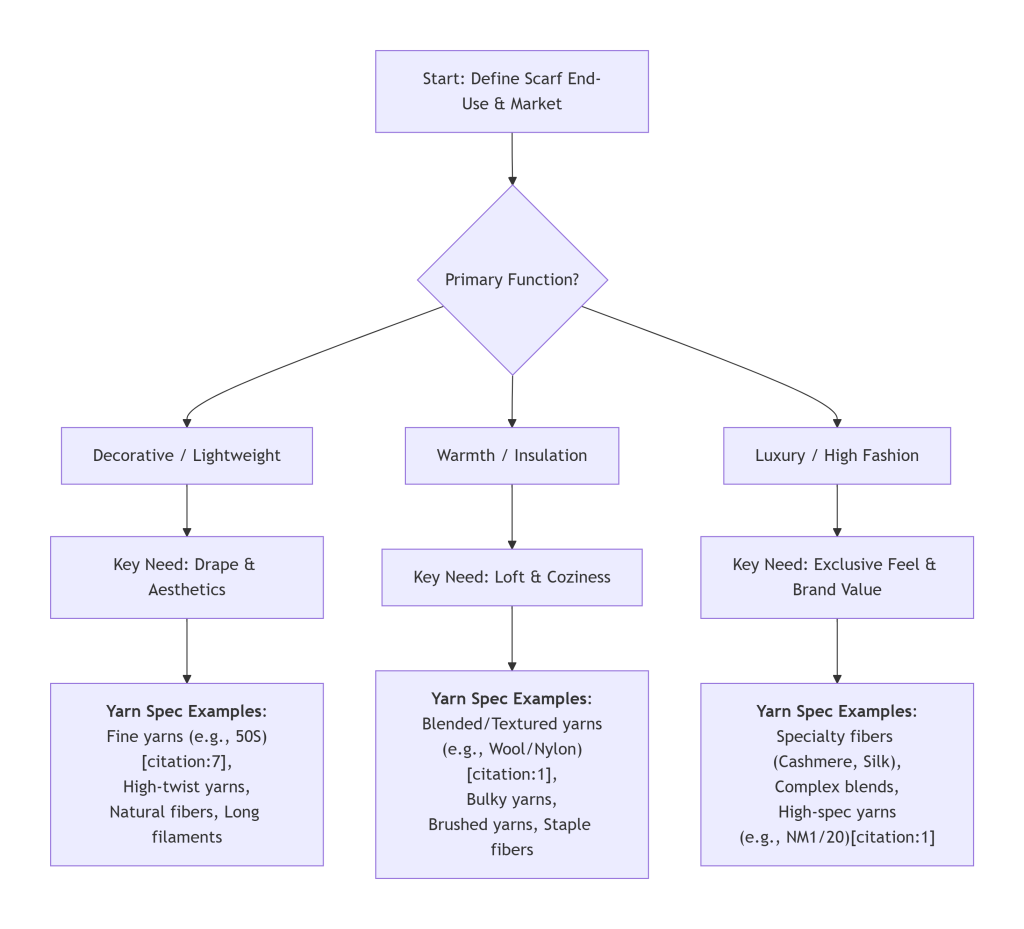
Selecting scarf yarn must begin with the end-use. This decision tree outlines the primary considerations:
2. Decoding the Language: Key Yarn Parameters Explained
To make informed decisions, you must master the language of yarn specifications. The key parameters are defined below.
2.1 Fiber Content: The Foundation of Function and Feel
The raw material is the most significant determinant of a scarf’s properties. Fibers are broadly categorized as natural, synthetic, or regenerated, each with distinct advantages for scarf applications.
Natural Fibers:
- Wool: The quintessential cold-weather fiber. It provides excellent warmth due to its natural crimp, which traps air. Merino wool is prized for its softness and is less likely to itch.
- Cashmere & Alpaca: Luxury fibers offering superior softness and warmth-to-weight ratios. They are premium and command higher prices.
- Cotton: A plant fiber known for its softness, breathability, and good moisture absorption. It is less elastic than wool and ideal for lightweight or transitional scarves.
- Silk: A luxurious filament fiber known for its natural luster, smoothness, strength, and beautiful drape. It can be used for both warm and cool weather accessories.
Synthetic & Regenerated Fibers:
- Acrylic: A cost-effective and versatile synthetic that often mimics wool’s bulk and warmth. It is lightweight, colorfast, and easy to care for, but may have a different hand feel than natural fibers.
- Nylon (Polyamide): Known for its exceptional strength, elasticity, and abrasion resistance. It is rarely used alone for scarves but is frequently blended (e.g., 10-30%) with natural fibers like wool to significantly enhance durability without compromising warmth, as seen in commercial scarf yarn blends.
- Rayon/Viscose: A regenerated cellulose fiber that offers a silky drape and luster at a lower cost than silk. It is often blended with other fibers to improve aesthetics.
- Bamboo (Rayon): A regenerated fiber with good breathability, softness, and slight natural luster, marketed as an eco-friendly alternative.
2.2 Yarn Count: The Language of Fineness and Weight
Yarn count is a numerical expression that indicates the yarn’s fineness or coarseness, directly related to the thickness and weight of the final fabric. Understanding the different counting systems is essential for global sourcing.
- Fixed-Weight Systems (e.g., Metric Count – Nm, English Cotton Count – Ne): The higher the number, the finer the yarn. Example:
NM1/20indicates a yarn where 1 gram is 20 meters long; a50Syarn is finer than a32Syarn. - Fixed-Length Systems (e.g., Denier – D, Tex): The higher the number, the coarser/heavier the yarn. Example: A
120D/2yarn indicates a 2-ply yarn made from 120 denier singles.
For scarves, finer counts (e.g., 50S, NM1/20+) are used for lightweight, draping fabrics, while coarser counts create heavier, warmer, and more textured products.
2.3 Yarn Construction: Singles, Plied, and Special Types
How fibers are assembled into yarn critically impacts its strength, evenness, and character.
- Singles Yarn: A single strand of twisted fibers. It can be used for a rustic feel but may be less strong and more prone to pilling.
- Plied Yarn: Two or more singles yarns twisted together (e.g.,
32S/2,120D/2). Plying increases strength, durability, and yarn evenness, resulting in a more balanced fabric with better stitch definition. It is the standard for quality scarves. - Specialty Yarns:
- Textured/Brushed Yarns: Yarns that have been processed to create loops, crimps, or a brushed surface. This dramatically increases bulk, softness, and insulation properties. A raised/bulked yarn is a prime example, creating a soft, fuzzy surface ideal for cozy winter scarves.
- Elastic/Filament Yarns: Yarns that incorporate spandex or rely on synthetic filament structure for stretch and recovery.
3. Yarn Specifications by Scarf Category: A Technical Selection Guide
The optimal yarn specification is dictated by the scarf’s intended market and function. The following table provides actionable specifications for three primary categories.
| Scarf Category | Primary Consumer Need | Ideal Fiber Types | Recommended Yarn Specification Examples | Resulting Fabric Properties |
|---|---|---|---|---|
| Lightweight / Decorative | Drape, Sheerness, Breathability, Aesthetic Detail | Fine Cotton, Silk, Bamboo Rayon, Fine Wool, Polyester Voile | Yarn Count: Fine (e.g., 40S/2 – 60S/2, 50S singles) Construction: High-twist singles or plied. May use long filaments for smoothness. | Lightweight (low GSM), excellent drape, crisp or fluid hand, often sheer. Suitable for printing and delicate embroidery. |
| Classic Winter | Warmth, Softness, Coziness, Durability | Wool, Acrylic, Wool/Nylon/ Cashmere Blends, Alpaca | Yarn Count: Medium to Coarse (e.g., NM1/7 – NM1/15, ~8S-16S). Construction: Plied yarns, textured/bulked yarns , brushed yarns. | Medium to heavy weight, high loft, fuzzy or brushed surface for warmth, good stitch definition for patterns. |
| Luxury / High-Fashion | Exclusive Hand Feel, Superior Drape, Brand Prestige, Unique Texture | Cashmere, Silk, Fine Merino, Camel Hair, Specialty Blends (e.g., Wool/Cashmere/Nylon) | Yarn Count: Fine to Medium (e.g., NM1/20 – NM1/30, 60S/2+). Construction: High-quality plied yarns, complex blends, may include metallic or fancy yarns for detail. | Luxuriously soft hand, fluid yet substantial drape, subtle luster, impeccable finish. Often uses high-specification yarns like NM1/20 44% wool, 19% cashmere, 34% nylon. |
3.1 Case Study: Deconstructing a Commercial Scarf Yarn
Let’s analyze a real-world example to see how specifications translate: NM1/20 44% wool, 19% cashmere, 34% nylon, raised/bulked yarn.
- Fiber Content (44% wool / 19% cashmere / 34% nylon): This blend marries luxury and performance. The cashmere provides ultimate softness, the wool offers warmth and resilience, and the nylon (at a significant 34%) adds crucial tensile strength and durability, reducing pilling and wear. This creates a scarf that feels luxurious but is built to last.
- Yarn Count (NM1/20): This is a fine yarn, meaning it can be knitted or woven into a fabric that is lightweight yet warm, avoiding a bulky feel.
- Yarn Type (raised/bulked yarn): The brushing process lifts the fiber ends, creating an extremely soft, fuzzy surface that enhances perceived warmth and comfort. This yarn is specifically recommended for “scarves, intimate apparel, and lightweight outerwear”.
4. From Specification to Fabric: Ensuring Quality and Compliance
Selecting the right specification is the first step. Ensuring the yarn and final fabric meet consistent performance standards is what separates professional suppliers from the rest.
4.1 Introduction to Performance Standards: ASTM D3785 & D4035
For industrial buyers, relying on international standards is non-negotiable for quality assurance. The ASTM D3785 standard covers performance requirements for woven necktie and scarf fabrics, while ASTM D4035 covers knitted versions.
While the full tables of requirements are detailed within the standards, they typically mandate testing and set minimum thresholds for:
- Fabric Strength: Resistance to breaking (grab test) and tearing.
- Durability: Colorfastness to washing, crocking (rubbing), and light exposure.
- Dimensional Stability: Resistance to shrinkage after laundering.
- Fabric Appearance: After simulated wear and cleaning cycles.
Insisting that your fabric supplier can provide test reports aligned with these standards, or working with a yarn supplier like Glyarn that understands and builds these performance parameters into their yarn development process, de-risks your procurement and ensures a consistent, reliable end product.
4.2 Practical Selection Checklist for Industrial Buyers
Before finalizing a yarn purchase, use this checklist:
- Define the “Hand Feel”: Is the target soft and fuzzy, crisp and dry, or fluid and silky? Request physical samples.
- Specify the Weight (GSM): Determine the desired grams per square meter for the final scarf fabric.
- Verify Blend Consistency: For blended yarns, demand a Certificate of Analysis (CoA) confirming the percentage of each fiber. Be wary of suppliers who cannot provide this.
- Check Yarn Evenness: Inquire about the yarn’s USTER statistics or other evenness metrics to predict fabric uniformity and knitting/wearing performance.
- Inquire About Minimum Order Quantities (MOQ): MOQs can vary from 1kg for stock colors to 50kg for custom-dyed lots. Plan your sourcing accordingly.
- Request Performance Data: Ask for data on pilling resistance (e.g., ICI Box), shrinkage, and colorfastness relevant to your end-use.
5. Conclusion: Building a Future-Proof Sourcing Strategy
The scarf market is dynamic, with trends shifting towards multi-functional and sustainable products. The future lies in yarns that offer not just warmth, but also moisture management, sustainable credentials (like recycled fibers), and innovative textures.
5.1 Final Recommendations
- Start with the End-User: Never select yarn in a vacuum. Let the scarf’s function, target market, and price point guide your technical specifications.
- Value Engineering through Blends: Pure cashmere is exquisite, but a wool/cashmere/nylon blend can deliver 90% of the luxury feel with 200% of the durability at a controlled cost. Work with suppliers to explore intelligent blends.
- Partner with Technical Experts: The complexity of translating a design concept into a perfect yarn specification is high. Partnering with a technical yarn supplier like Glyarn provides access to specialized expertise. They can guide you through the interplay of fiber, count, and twist, co-develop custom blends to meet specific functional goals (e.g., a machine-washable luxury blend), and ensure the yarn performs seamlessly on your knitting or weaving machines. This transforms your yarn sourcing from a commodity purchase into a strategic value-creation process.
Mastering yarn specifications is the key to unlocking innovation, quality, and profitability in scarf manufacturing. By applying the framework outlined in this guide, you can make confident, data-driven sourcing decisions that result in superior products and a stronger competitive edge.
Note: This article is intended as a professional guide. Yarn specifications and market prices are subject to change. Physical sampling and testing are always recommended before finalizing a bulk order.
