
Table of Contents
- Demystifying Yarn Numbering – The Critical Link Between Denier (D) and Filament Count (F)
- Yarn Fundamentals: Understanding Denier and Filament Count Separately
- The “D” and “F” Relationship: Why It’s the Core of Yarn Specification
- Performance & Application Analysis: How D/F Values Dictate Fabric Characteristics
- Market Standards & Data Tables: Common 70D Configurations and Their Uses
- Sourcing and Quality Control: Key Questions for Your Yarn Supplier
- Future Trends: The Evolution of Multi-Filament Yarns
- Frequently Asked Questions (FAQs)
Article: “70D Yarn is How Many F?” – The Complete Guide for Textile Professionals
1. Demystifying Yarn Numbering – The Critical Link Between Denier (D) and Filament Count (F)
For sourcing managers and product developers in the global textile industry, a yarn specification like “70D” is just the beginning of the story. The critical, often overlooked, question is: “70D yarn is how many F?” Understanding the relationship between Denier (D) and Filament Count (F) is not mere technical trivia—it’s the key to unlocking predictable fabric performance, controlling costs, and ensuring manufacturing success. This guide provides a comprehensive breakdown of this essential specification, equipping you with the knowledge to specify, source, and utilize yarns with precision.
2. Yarn Fundamentals: Understanding Denier and Filament Count Separately
Before exploring their relationship, we must define the terms clearly.
- Denier (D): A Measure of Linear Density
- Definition: The weight in grams of 9,000 meters of yarn. It is a direct numbering system where a higher number indicates a heavier, thicker yarn.
- Formula: Denier (D) = (Weight in grams / Length in meters) × 9,000
- Practical Implication: Denier primarily determines the fabric’s weight, drape, and durability. A 70D yarn is finer than a 150D yarn but heavier than a 40D yarn. It is a standard measure for synthetic continuous filaments (polyester, nylon) and silk.
- Filament Count (F): A Measure of Fiber Fineness Within the Yarn
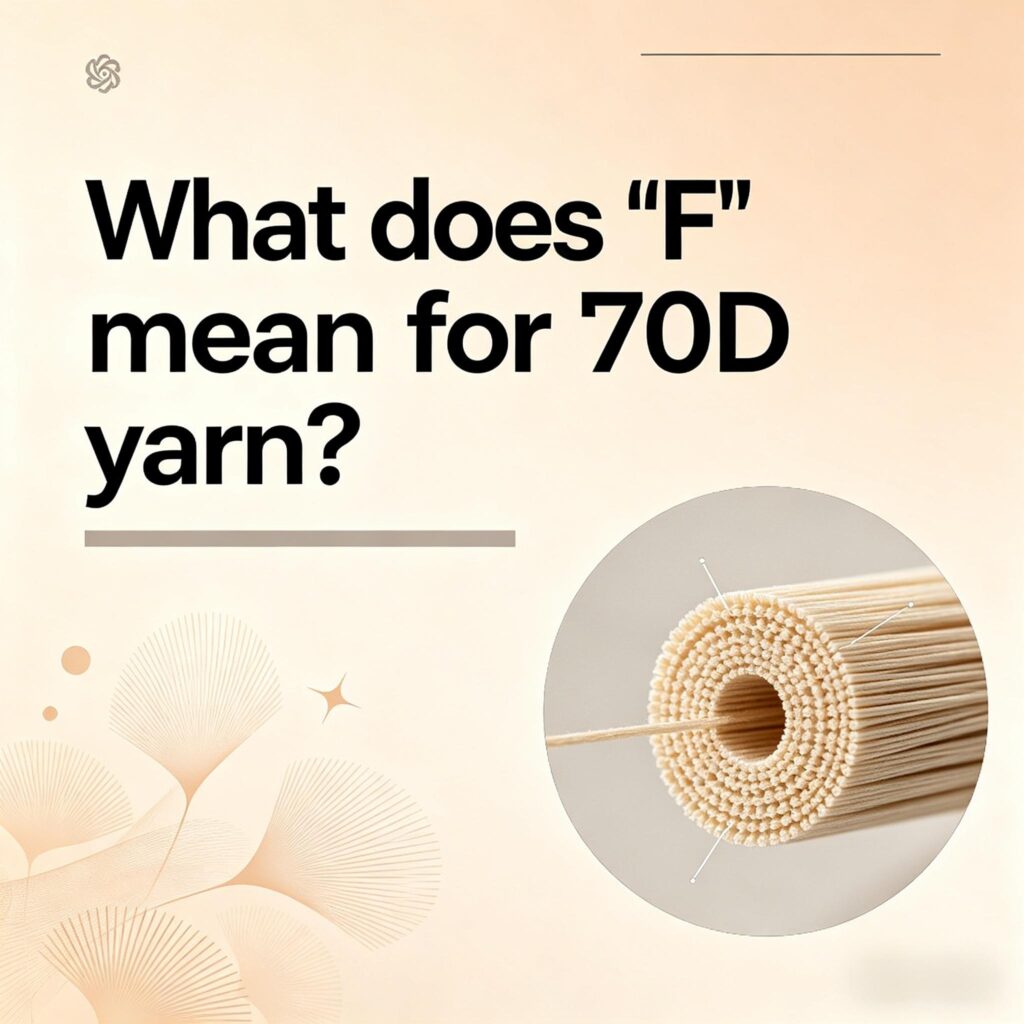
- Definition: The number of individual continuous filaments that are bundled together to form a single strand of yarn.
- Practical Implication: Filament count is the primary driver of the yarn’s hand-feel, texture, and coverage. It defines whether the yarn is a monofilament (1F) or, more commonly, a multi-filament (e.g., 24F, 36F, 72F, 144F).
3. The “D” and “F” Relationship: Why It’s the Core of Yarn Specification
The magic—and the business-critical information—lies in the relationship between these two numbers. They are intrinsically linked by a simple but powerful concept.
- The Core Principle: For a given Denier (D), the Filament Count (F) determines the fineness of each individual filament.
- The Formula:
Individual Filament Fineness (in dtex or denier per filament) = Total Yarn Denier (D) / Number of Filaments (F)- Note: dtex = D / 9. For simplicity, the textile industry often uses “dpf” (denier per filament) directly.
- A Practical Example:
Let’s compare two common 70D yarns:- Yarn A: 70D/24F
- Individual Filament Fineness = 70D / 24F ≈ 2.92 Dpf
- Yarn B: 70D/144F
- Individual Filament Fineness = 70D / 144F ≈ 0.49 Dpf
- Yarn A: 70D/24F
4. Performance & Application Analysis: How D/F Values Dictate Fabric Characteristics
The choice of “F” for a given “D” is a strategic decision that directly impacts the final product.
| Yarn Specification (70D/XF) | Individual Filament Fineness | Key Fabric Characteristics | Ideal Applications |
|---|---|---|---|
| Low-F (e.g., 70D/12F to 70D/36F) | High (e.g., 5.8 dpf to 1.9 dpf) | Stiffer hand-feel, crisp drape, excellent durability, more prone to “scroop” or rustle sound, less covering power. | Technical shells, umbrella fabrics, luggage, backpacks, stiff linings, industrial sewing threads. |
| Mid-F (e.g., 70D/48F to 70D/72F) | Medium (e.g., 1.45 dpf to 0.97 dpf) | Excellent balance of softness and strength, smooth texture, good drape, versatile. | Mainstream apparel (blouses, shirts, dresses), lightweight activewear, mid-range lingerie, linings for suits and dresses. |
| High-F / Microfiber (e.g., 70D/144F to 70D/288F+) | Very Low (e.g., <0.5 dpf) | Extremely soft, silky hand-feel, luxurious drape, high covering power (hides weaving lines), excellent moisture-wicking, prone to pilling. | Premium lingerie, high-end athletic wear, luxury linings, high-quality flags/banners, ultra-soft plush toys. |
| Monofilament (70D/1F) | Equal to yarn denier (70 dpf) | Very stiff, plastic-like feel, transparent/see-through, high resilience. | Mesh fabrics (e.g., for laundry bags), tulle, veils, specific technical fabrics. |
Coverage Power: Higher “F” count means more filaments packed into the same yarn diameter, creating a yarn that can cover a larger surface area more effectively. This is critical for achieving opacity in lightweight fabrics.
5. Market Standards & Data Tables: Common 70D Configurations and Their Uses
Table: Industry-Standard 70D Yarn Configurations & Sourcing Benchmarks
| Specification | Common Industry Name | Price Premium vs. Base 70D/36F | Key Quality Control Check | Primary Geographic Source (for Polyester) |
|---|---|---|---|---|
| 70D/24F | Semi-Dull, Standard Tenacity | -5% to -10% | Even dye uptake, filament breakage | China, India, Southeast Asia |
| 70D/36F | Full-Dull, Standard Workhorse | Baseline | Consistency of dullness, tensile strength | Global (China, Taiwan, Korea, Turkey) |
| 70D/48F | Fine Filament, Soft | +5% to +15% | Filament entanglement, softness test | Taiwan, Korea, China (premium mills) |
| 70D/72F | High-Filament, Premium | +15% to +30% | Evenness, low defect count (neps) | Korea, Taiwan, Japan, specialized EU mills |
| 70D/144F & 288F | Microfiber / Super Microfiber | +40% to +100%+ | Pilling resistance, consistent sub-denier fineness | Specialized mills in Korea, Japan, advanced Chinese mills |
- Price Drivers: Higher “F” counts require more sophisticated spinning technology (precise polymer control, finer spinnerets), lower production speeds, and often premium raw materials, justifying the cost premium.
- The Dull/Bright Factor: Most apparel-grade 70D yarn is semi-dull or full-dull (TiO2 added to polymer) to avoid a shiny, synthetic appearance. Bright (no TiO2) 70D is used for specific effects like tafta or certain technical fabrics.
6. Sourcing and Quality Control: Key Questions for Your Yarn Supplier
To avoid costly mistakes, always ask these questions beyond just “70D”:
- “What is the exact filament count (F) for this 70D yarn?” Never assume. 70D is meaningless without the “F”.
- “What is the luster (bright, semi-dull, full-dull) and cross-section (round, triangular, octalobal)?” This further defines aesthetics and functionality (e.g., triangular for sparkle, octalobal for wicking).
- “Can you provide technical data sheets with tensile strength, elongation, and shrinkage data for this specific D/F combination?”
- “What is the minimum order quantity (MOQ) for this specific grade?” MOQs for specialty high-F yarns can be significantly higher.
- “Do you have existing fabric samples (e.g., plain weave, twill) made with this exact yarn for us to evaluate hand-feel?”
7. Future Trends: The Evolution of Multi-Filament Yarns
The drive is towards ultra-high filament counts and engineered cross-sections to create enhanced functionalities:
- Ultra-Softness & Sustainability: 70D/288F and finer yarns are becoming more accessible, reducing the need for chemical softeners.
- Functional Fibers: Combining 70D with bi-component filaments (e.g., sheath-core for thermal bonding) or adding functionality (antimicrobial, UV protection) at the polymer stage.
- Circular Economy: The development of high-quality recycled polyester (rPET) yarns in precise D/F specifications (e.g., 70D/72F rPET) to meet brand sustainability mandates without sacrificing performance.
8. Frequently Asked Questions (FAQs)
Q1: Is there a standard “F” count for a given “D” like 70D?
A: No. There is no single standard. 70D/36F (Full Dull) is perhaps the most common “workhorse” for apparel linings. 70D/72F is a premium standard for face fabrics. The “F” is a deliberate choice based on the desired end-product performance.
Q2: Does a higher “F” count mean a stronger yarn?
A: Not necessarily. Tensile strength is more closely related to the polymer quality, molecular orientation (drawn ratio), and the total Denier (D). A 70D/24F yarn may have higher tenacity (strength per denier) because of thicker, more robust individual filaments. Higher “F” yarns prioritize softness and coverage over pure tensile strength, though they are still strong enough for their intended applications.
Q3: We are making a lightweight, silky dress. Our supplier offers 50D/72F and 70D/144F. Both feel soft. Which is better?
A: This is an excellent comparison.
- 50D/72F: Lighter fabric weight, slightly less coverage, excellent drape.
- 70D/144F: Slightly heavier but with superior coverage (more filaments per area), an even softer, more luxurious hand-feel due to finer individual filaments (0.49 dpf vs. 0.69 dpf), and potentially better opacity.
- Recommendation: For a silky dress where opacity and a decadent hand-feel are priorities, 70D/144F is likely the superior choice, despite its slightly higher denier.
Q4: Why do high “F” count yarns sometimes pill more?
A: The extremely fine filaments in high-F yarns (e.g., <0.5 dpf) are more susceptible to breaking and tangling from surface abrasion. These broken filaments form the tiny balls known as pills. This can be mitigated by tighter fabric constructions, appropriate fabric finishes, and blending with stronger fibers.
Q5: How does filament count affect dyeing?
A: Higher filament counts provide a larger total surface area for dye molecules to bond to, which can lead to richer, deeper shades and excellent colorfastness. However, it requires precise dyeing control to ensure levelness across the thousands of fine filaments.
