
Table of Contents
- Executive Summary: The Strategic Value of Semi-Dull Yarn
- Demystifying Luster: The Core Principle of Semi-Dull Polyester
- 2.1. The Science of Light Reflection on Filaments
- 2.2. Manufacturing Process: How TiO₂ Creates the Semi-Dull Effect
- Technical Specifications & Comparative Analysis
- 3.1. Key Property Data: Semi-Dull vs. Bright vs. Full-Dull
- 3.2. TiO₂ Content Standards and Their Impact
- Performance Advantages in Key Applications
- 4.1. Apparel: Dyeability, Color Depth, and Aesthetic Superiority
- 4.2. Home Textiles & Upholstery: Achieving Premium Visual and Tactile Qualities
- 4.3. Technical & Industrial Uses: Beyond Aesthetics
- Sourcing and Specification Guidelines for Buyers
- 5.1. Critical Questions for Your Supplier
- 5.2. Interpreting Technical Data Sheets
- 5.3. Cost-Benefit Analysis: When to Choose Semi-Dull
- Future Trends and Innovations
- Conclusion: Making an Informed Choice
- Frequently Asked Questions (FAQ)
1. Executive Summary: The Strategic Value of Semi-Dull Yarn
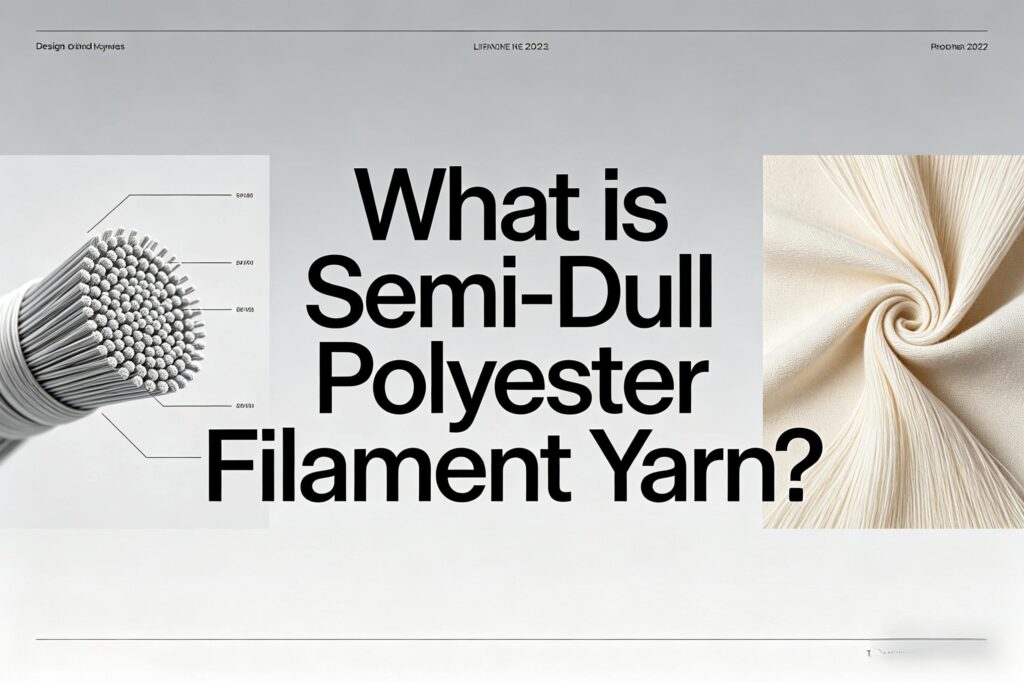
For procurement managers and product developers across the textile supply chain, selecting the right type of polyester filament is a fundamental decision impacting aesthetics, performance, and cost. Semi-dull polyester filament yarn has emerged as the industry’s versatile workhorse, strategically positioned between high-gloss bright yarn and matte full-dull yarn. It offers a subtle, low-to-mid luster that delivers superior, consistent dyeing results, a softer hand feel, and a more natural, premium appearance compared to standard bright yarn. Understanding its properties is not merely a technicality—it’s a critical step in developing fabrics that meet evolving market demands for quality, durability, and sophisticated aesthetics in apparel, home furnishings, and industrial products.
2. Demystifying Luster: The Core Principle of Semi-Dull Polyester
Luster in synthetic fibers is fundamentally about light management. A perfectly smooth, transparent filament (bright yarn) acts like a optical fiber, allowing light to pass through with minimal scattering, resulting in a sharp, sometimes “plastic-like” shine.
- 2.1. The Science of Light Reflection: Semi-dull yarn is engineered to disrupt this smooth light transmission. By introducing microscopic, light-scattering particles within the polymer, light rays are diffused in multiple directions. This diffusion reduces the intensity of direct specular reflection (the sharp glare) and increases diffuse reflection, creating a softer, more subdued sheen.
- 2.2. Manufacturing Process: The Role of TiO₂: The primary agent for this effect is Titanium Dioxide (TiO₂), a white pigment. During the polymer chip melting stage (polycondensation), a precise percentage of TiO₂ (typically 0.3% to 0.5% by weight) is uniformly added. As the polymer is extruded through the spinneret to form filaments, these embedded TiO₂ particles create controlled imperfections within the fiber. These particles are the key to scattering light and giving the yarn its characteristic semi-dull appearance.
3. Technical Specifications & Comparative Analysis
Choosing between luster levels requires a clear comparison of their inherent properties.
Table 1: Comparative Analysis of Polyester Filament Luster Types
| Property | Bright (BR) | Semi-Dull (SD) / Semi-Matte | Full-Dull (FD) / Matte |
|---|---|---|---|
| TiO₂ Content | 0% (None) | 0.3% – 0.5% | 2.0% – 2.5% (or higher) |
| Visual Luster | High, shiny, transparent | Medium, subdued, soft sheen | Very low, matte, chalky appearance |
| Light Reflection | Direct, specular | Mixed specular & diffuse | Primarily diffuse |
| Dyeing Result | Can appear “brassy” or less even; colors may look synthetic. | Excellent color yield and evenness; deeper, richer shades. | Excellent evenness; yields flat, non-reflective colors. |
| Fiber Transparency | High | Low to Moderate | Very Low (Opaque) |
| Typical Hand Feel | Crisp, sometimes slick | Softer, more pleasant drape | Dry, cotton-like, soft |
| Primary Applications | Taffeta, linings, sparkly fabrics, packaging. | Broad: Knits, woven apparel, upholstery, bedding, automotive. | High-end sportswear, suede-like fabrics, black-out curtains. |
Source: Industry-standard polymer and technical fiber data.
Table 2: Impact of TiO₂ on Key Physical Properties (Semi-Dull vs. Bright)
| Property | Effect of TiO₂ Addition (Semi-Dull) | Implication for Buyers |
|---|---|---|
| Tenacity | Slight decrease (typically <5%) | Generally insignificant for most applications; still meets high-performance specs. |
| Elongation | May slightly increase | Can contribute to better elasticity and fatigue resistance in fabrics. |
| Abrasion Resistance | Comparable or slightly improved | The particles can alter surface friction, often benefiting fabric durability. |
| Spinning Process Stability | Improved | TiO₂ can act as a nucleating agent, enhancing polymer crystallization for more stable production. |
4. Performance Advantages in Key Applications
- 4.1. Apparel: The Benchmark for Quality
- Dyeability: Semi-dull yarn is the preferred choice for vibrant, deep colors. The TiO₂ particles provide innumerable sites for dye molecules to bond, leading to higher color absorption (K/S values) and superior color fastness compared to bright yarn. This means richer blacks, more intense reds, and consistent shades across large fabric rolls.
- Aesthetics: It avoids the cheap, synthetic look associated with bright yarn, offering a luxurious, natural-fiber-like appearance similar to high-quality cotton or silk. This is crucial for brands targeting the mid-to-high market segment in sportswear, lingerie, shirts, and dresses.
- 4.2. Home Textiles & Upholstery:
- Semi-dull fabrics exhibit a warm, inviting glow rather than a cold, plastic shine. In bedding, this creates a premium look. In upholstery and curtains, it reduces harsh light reflection, enhancing visual comfort.
- Its superior dye evenness is critical for large, uniform pieces like sofa covers or drapery, where visible shading variations are unacceptable.
- 4.3. Technical & Industrial Uses:
- Beyond aesthetics, the light-scattering property of TiO₂ contributes to enhanced UV resistance. The particles help block and scatter harmful UV rays, slowing down the photodegradation of the polymer—a valuable trait for automotive interiors, outdoor fabrics, and tarpaulins.
- Its opacity is beneficial for applications where show-through is undesirable.
5. Sourcing and Specification Guidelines for Buyers
- Critical Supplier Questions:
- “What is the exact TiO₂ percentage in your semi-dull yarn?”
- “Can you provide a Color Yield comparison report (K/S values) for key shades vs. your bright yarn?”
- “Is the TiO₂ added during polymerization (chip) or in a masterbatch? (In-polymer is superior for consistency).”
- Interpreting Data Sheets: Look for “Luster Type: SD” or “Semi-Dull.” Verify denier, filament count (e.g., 75D/72F SD), and tenacity. The presence of TiO₂ is often assumed in SD specifications.
- Cost-Benefit Analysis: Semi-dull yarn carries a small premium over bright yarn (typically 3-8%) due to the added raw material (TiO₂) and process refinement. This premium is almost always justified by the significant uplift in fabric quality, dyeing efficiency (less dye required for deep shades), and marketability. For standard applications, it often provides the optimal balance of cost and performance, outperforming full-dull yarn where extreme matteness is not required.
6. Future Trends and Innovations
The market is seeing a rise in differentiated semi-dull products. These include:
- Controlled Luster Yarns: Engineered with specific TiO₂ particle sizes and distributions to achieve targeted luster levels between semi-dull and full-dull.
- Functional Semi-Dull Yarns: Combining TiO₂ with other additives (e.g., anti-bacterial agents, moisture-wicking enhancers) for multi-functional fabrics.
- Sustainability-Driven Demand: As brands seek natural aesthetics without the environmental footprint of cotton, semi-dull polyester offers a durable, recyclable alternative with a pleasing, non-synthetic look.
7. Conclusion: Making an Informed Choice
Semi-dull polyester filament yarn is not just an option; for countless applications, it is the technical and aesthetic standard. Its ability to bridge the gap between the performance of synthetics and the desirable appearance of natural fibers makes it an indispensable tool for modern textile manufacturing. By specifying semi-dull yarn, you invest in predictable dyeing behavior, enhanced fabric quality, and ultimately, products that resonate with discerning consumers.
8. Frequently Asked Questions (FAQ)
Q1: Is semi-dull polyester the same as “semi-matte”?
A1: Yes, these terms are interchangeable in the industry. Both refer to the standard mid-luster yarn containing approximately 0.3-0.5% TiO₂.
Q2: Can you dye semi-dull polyester to a very bright, neon color?
A2: Yes, absolutely. Semi-dull yarn excels at holding vibrant colors. The perceived “brightness” of a neon color comes from the dye’s spectral reflectance, not the fiber’s luster. A neon pink on semi-dull will appear intense and uniform, without a metallic shine.
Q3: Does semi-dull yarn have any disadvantages compared to bright yarn?
A3: The primary trade-off is the minimal cost premium. Some ultra-sheer, deliberately glittery fabrics specifically require the high transparency and sparkle of bright yarn, making semi-dull unsuitable for that niche. There is also a negligible difference in absolute tenacity.
Q4: How can I visually distinguish semi-dull from bright yarn in a fabric sample?
A4: Hold the fabric under a direct light source (like a desk lamp). Bright yarn will show a sharp, concentrated line of reflection. Semi-dull yarn will show a broader, softer, and more “bloomed” reflection that seems to come from within the fabric structure.
Q5: Is the TiO₂ in the yarn safe for skin contact and the environment?
A5: Yes. Titanium Dioxide (in this rutile form) is a globally approved, inert, and non-toxic pigment used extensively in cosmetics (sunscreen), paints, and food coloring. It is fully encapsulated within the polyester polymer and does not leach out.
Q6: For black fabrics, is full-dull always better than semi-dull?
A6: Not necessarily. While full-dull gives the flattest, most non-reflective black, semi-dull produces a deep, rich black with a subtle depth and luxe appearance (like a black piano finish). Full-dull black can appear slightly flat or grayish. The choice depends on the desired aesthetic.
Q7: Does using semi-dull yarn affect the spinning or weaving process?
A7: It generally improves process stability. The TiO₂ aids in crystallization, leading to less friction and more consistent filament properties. Mills typically find it runs with equal or better efficiency than bright yarn.
Q8: Can I mix semi-dull and bright yarns in one fabric?
A8: Yes, this is a common technique to create visual effects. For example, using bright yarn in the warp and semi-dull in the weft can produce a subtle cross-hatch luster or “shot” effect, adding complexity to the fabric’s visual texture.
