
A Complete Guide for Sourcing and Manufacturing Professionals
Table of Contents
- Introduction: The Spinneret – The Heart of Filament Creation
- Defining the Term: What Do We Mean by “Spinneret Diameter”?
- The Science of the Hole: Key Parameters Beyond Simple Diameter
- Spinneret Specifications for Major Polyester Filament Types
- Strategic Selection and Sourcing for End-Use Applications
- Conclusion: Making an Informed Decision on Spinneret Specifications
1. Introduction: The Spinneret – The Heart of Filament Creation
For procurement managers and production executives across the global textile and industrial sectors, understanding the core components of the manufacturing supply chain is key to optimizing quality, cost, and performance. In the production of polyester filament, a single, precision-engineered component stands as the gatekeeper between raw polymer and finished yarn: the spinneret.
This guide is designed not for the spinneret manufacturer, but for the downstream professional—the apparel factory manager sourcing high-quality yarns, the carpet producer seeking consistent bulk continuous filament (BCF), the textile engineer developing new fabric lines, or the plush toy manufacturer requiring specific fiber characteristics. By demystifying the technical specifications of spinnerets, particularly the often-misunderstood concept of “diameter,” this article will empower you to communicate more effectively with yarn suppliers, understand the implications of yarn specifications on your final product, and make more informed sourcing decisions that align with your business goals.
2. Defining the Term: What Do We Mean by “Spinneret Diameter”?
The question “What is the diameter of a spinneret for polyester filament?” can be interpreted in two distinct ways, and confusing them leads to miscommunication. It is crucial to distinguish between:
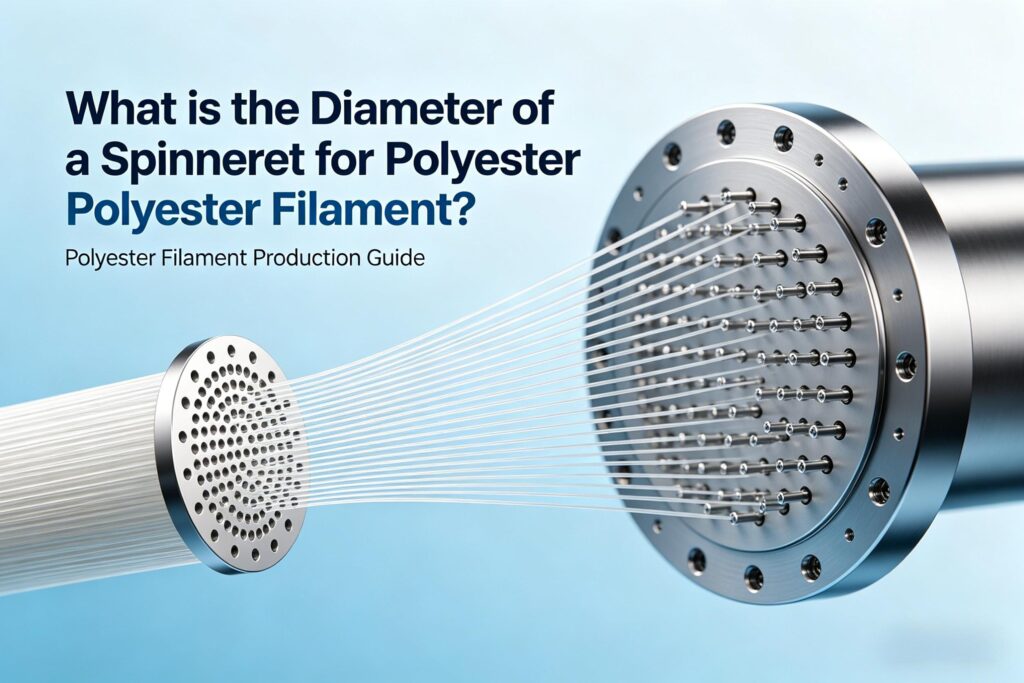
- Spinneret Plate Diameter: This refers to the overall physical size of the metal disc or plate that contains the spinning holes. This is a macroscopic dimension, typically measured in millimeters (mm), and relates to the size and capacity of the spinning machine position. Common industrial spinneret plate diameters include 75mm, 85mm, 88mm, 90mm, 100mm, and up to 160mm. For instance, research on producing fine-denier yarn specified an optimal spinneret plate diameter of 88 mm.
- Spinneret Micro-Hole Diameter: This is the diameter of each individual, microscopic hole through which the molten polyester is extruded to form a single filament. This is a critical process parameter measured in tenths of a millimeter (e.g., 0.10 mm) or microns. The Chinese industry standard FZ/T 92038-2023, which governs round-hole spinnerets for melt spinning (including polyester), specifies an applicable micro-hole diameter range of 0.1mm to 1.0mm.
The micro-hole diameter has a direct and profound impact on the resulting filament’s properties, while the plate diameter is more related to production engineering. The rest of this article will focus primarily on the micro-hole diameter and its related parameters.
3. The Science of the Hole: Key Parameters Beyond Simple Diameter
Selecting a micro-hole diameter is not arbitrary. It is determined by complex polymer rheology and the desired final yarn specifications. Key interrelated factors include:
- Final Filament Denier (dtex): There is a direct relationship. A larger hole allows more polymer flow, generally producing a thicker filament. For example, to produce a very fine 83 dtex/144f yarn, a micro-hole diameter of 0.17 mm was used. For heavier industrial yarns or BCF for carpets, holes can be much larger (e.g., 0.4-0.6mm).
- Shear Rate: As molten polymer is forced through a small hole, it experiences shear. Too high a shear rate (from too small a hole for a given flow) can cause polymer degradation. The diameter must be chosen to keep shear within an optimal window.
- Draw-Down Ratio (DDR): This is the ratio of the final, solidified filament speed to the speed of the polymer as it exits the hole. A specific hole diameter, combined with a designed DDR, determines the final filament thickness. Industry studies suggest optimal draw ratios for quality spinning.
- Longitudinal Ratio (L/D Ratio): This is the ratio of the length of the micro-hole to its diameter. It is as important as the diameter itself. An appropriate L/D ratio (commonly between 2:1 to 3.33:1 for polyester) ensures proper polymer flow alignment and pressure build-up, which affects yarn strength and uniformity.
- Number of Holes (Filament Count): The total number of micro-holes in the plate determines the total number of filaments in the yarn (e.g., 144f). The plate diameter must be sufficient to accommodate the required number of holes in a stable arrangement.
Table 1: Impact of Spinneret Micro-Hole Parameters on Filament Properties
| Parameter | Typical Range for Polyester | Effect if Increased | Primary Consideration |
|---|---|---|---|
| Micro-Hole Diameter | 0.10 mm – 1.0 mm | Produces thicker single filaments; lowers shear rate. | Target yarn denier per filament (dpf). |
| Longitudinal Ratio (L/D) | 1.5:1 – 3.5:1 | Increases spin pressure and polymer orientation; can improve tensile strength. | Polymer viscosity and desired yarn tenacity. |
| Number of Holes (Filament Count) | 24f – 384f+ | Creates yarns with more filaments; improves yarn softness and coverage. | Final yarn denier and intended fabric hand-feel. |
4. Spinneret Specifications for Major Polyester Filament Types
Polyester filament is not a monolith. The spinneret specifications are meticulously tailored for each yarn category.
Table 2: Spinneret Specifications by Polyester Filament Type
| Filament Type | Typical End-Use | Example Yarn Spec | Typical Micro-Hole Diameter | Key Spinneret Considerations |
|---|---|---|---|---|
| Fine-Denier / Microfilament POY/FDY | High-end apparel, lightweight functional wear, lining. | 83 dtex/144f, 133 dtex/144f | 0.15 mm – 0.20 mm | High hole count precision; small L/D ratio to manage pressure. Critical for uniform dyeing in fabrics. |
| Standard Textile POY/FDY | Common apparel, home textiles. | 167 dtex/48f | 0.20 mm – 0.30 mm | Balanced design for stability and production efficiency. Most common workhorse configuration. |
| Industrial & Tire Cord Yarn | Tires, conveyor belts, ropes, geotextiles. | 1111 dtex/192f | 0.30 mm – 0.50 mm+ | Larger, robust holes for high-viscosity polymer; designed for maximum tenacity, not fineness. |
| BCF (Bulk Continuous Filament) | Carpet pile, upholstery, automotive textiles. | 1100-2000 dtex/ ~350f | 0.40 mm – 0.60 mm | Often uses special hole shapes (e.g., trilobal) to increase bulk and soil-hiding ability. Larger diameter handles higher throughput. |
| Monofilament | Screen mesh, fishing line, sewing thread, industrial fabrics. | 87 Denier (≈97 dtex) | 0.10 mm – 5.00 mm | A single, large hole. Diameter directly equals final monofilament diameter after drawing. Precision is paramount for consistency. |
5. Strategic Selection and Sourcing for End-Use Applications
As a downstream buyer, you are not selecting a spinneret directly, but you are selecting a yarn whose properties were dictated by one. Here’s how to apply this knowledge strategically:
- For Apparel Manufacturers:
- Seek Consistency: For premium, lightweight fabrics, inquire about yarns made from fine-denier, multi-filament sources (e.g., 0.15-0.18mm holes). This ensures softness and uniform dye uptake.
- Ask About Origin: Yarns produced from spinnerets with poor hole machining (rough surfaces, inconsistent L/D) lead to barre (streaky) fabric defects. Partner with spinners known for high-quality polymer filtration and spinneret maintenance.
- For Carpet & Upholstery Producers:
- Understand Bulk: Specify BCF yarns known for good bulk and cover. This property is engineered at the spinneret through special hole geometries (like trilobal) in the 0.4-0.6mm range.
- Durability Link: For high-traffic contract carpets, the tenacity built into the filament via proper spinneret L/D ratio and drawing process is critical for long-term performance.
- For Plush Toy & Specialty Textile Makers:
- Define Hand-Feel: The softness of a plush toy is directly related to filament fineness (dpf). Communicate your desired softness level to your yarn supplier, who will, in turn, select the appropriate micro-hole diameter and filament count.
- Consider Monofilaments: For brushes, doll hair, or rigid structures, monofilament yarns are used. Their precise diameter (from 0.05mm to over 5.00mm) is a key ordering specification.
6. Conclusion: Making an Informed Decision on Spinneret Specifications
While you may never purchase a spinneret, its “diameter”—specifically the micro-hole diameter—is a fundamental variable encoded into every meter of polyester filament you source. It is a primary determinant of yarn fineness, strength, uniformity, and ultimately, the suitability of that yarn for your final product.
Moving forward, empower your sourcing dialogue. Instead of just asking for “150 Denier polyester,” drill deeper. Ask: “What is the filament count (f) and the approximate denier per filament (dpf)?” This information provides immediate insight into the spinneret technology used and the yarn’s inherent characteristics. By understanding the principles outlined in this guide, you transition from a passive buyer to a knowledgeable partner, capable of specifying materials that deliver targeted performance, quality, and value for your specific applications.
