
The Inside Story of a Thread: Unraveling the Key Differences Between DTY and FDY Polyester
In the intricate world of synthetic textiles, not all polyester yarns are created equal. While both originate from the same petrochemical base, the manufacturing processes for Draw Textured Yarn (DTY) and Fully Drawn Yarn (FDY) impart fundamentally different characteristics, making each suitable for distinct applications. Understanding the difference between them is crucial for anyone involved in textile manufacturing, product design, or sourcing, as the choice between DTY and FDY directly impacts the hand feel, performance, and ultimate end-use of a fabric.
The divergence between these two yarns begins on the production line, right after the initial spinning of Partially Oriented Yarn (POY), which serves as the common precursor for both. The journey of FDY is a continuous and linear one. The POY is subjected to a high-speed drawing process where it is stretched, fully orienting its polymer molecules and crystallizing its structure. This process is done in a single, integrated step, resulting in a smooth, straight, and fully stabilized filament yarn. FDY is, in essence, a “finished” product straight off the production line, ready to be woven or knitted. Its molecular alignment gives it high tensile strength and excellent dimensional stability.
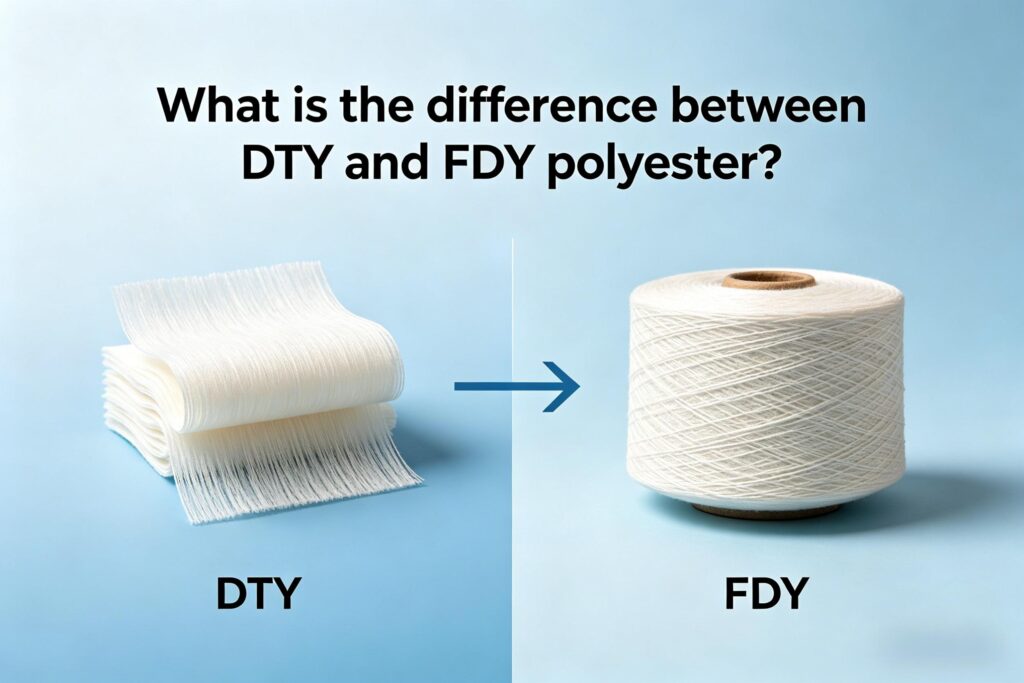
In contrast, the production of DTY involves a critical additional step known as texturizing. After the POY is drawn, it is fed through a texturizing machine, most commonly using a false-twist method. In this chamber, the filaments are heated, twisted, and then untwisted, which permanently imparts a three-dimensional crimp, loops, and coils into the individual filaments. This process transforms the once-smooth yarn into a voluminous, stretchy, and thread. The core structural difference is this: FDY consists of straight, parallel filaments, while DTY is composed of crimped and interlooped filaments that create air pockets within the yarn structure.
This fundamental structural difference dictates their respective properties and, consequently, their ideal applications. FDY Polyester is known for:
- Smoothness and Lustre: Its straight filaments create a sleek, shiny surface.
- High Strength: Excellent tensile strength makes it resistant to pulling forces.
- Dimensional Stability: It has minimal stretch and excellent shape retention.
- Applications: These properties make FDY the go-to choice for linings, umbrella fabrics, sheer curtains, high-thread-count bed sheets, and sewing thread where smoothness, strength, and a silky appearance are desired.
On the other hand, DTY Polyester is characterized by:
- Softness and Bulk: The crimped structure gives it a soft, cotton-like or wool-like hand feel.
- Stretch and Elasticity: It exhibits significant elongation and recovery, providing comfort and freedom of movement.
- Opacity and Warmth: The air pockets trapped within the yarn enhance its covering power and provide better insulation.
- Improved Absorbency: The textured surface can wick moisture more effectively than the smooth surface of FDY.
- Applications: These qualities make DTY ideal for apparel such as sportswear, fleece jackets, dresses, trousers, and hosiery, as well as for home textiles like velour upholstery and blankets.
In summary, the choice between DTY and FDY is not about quality but about functionality. FDY offers a sleek, strong, and stable foundation for fabrics requiring a smooth drape and high strength. DTY provides comfort, warmth, and softness for applications where stretch and a natural fiber feel are paramount. Recognizing this distinction empowers designers and manufacturers to select the perfect yarn, ensuring the final fabric performs exactly as intended for its specific end-use.
