
From Polymer to Fabric: The Manufacturing Process of Polyester Yarn
Polyester yarn, a ubiquitous material in the modern textile industry, begins its life not in a field, but in a petrochemical plant. Its creation is a marvel of industrial engineering, transforming simple molecular components into the strong, durable, and versatile fibers that constitute everything from clothing to home furnishings. The manufacturing process can be broadly divided into two key stages: creating the polymer and then spinning it into yarn, with variations leading to different yarn types.
Stage 1: Polymerization – Creating the Base Chip
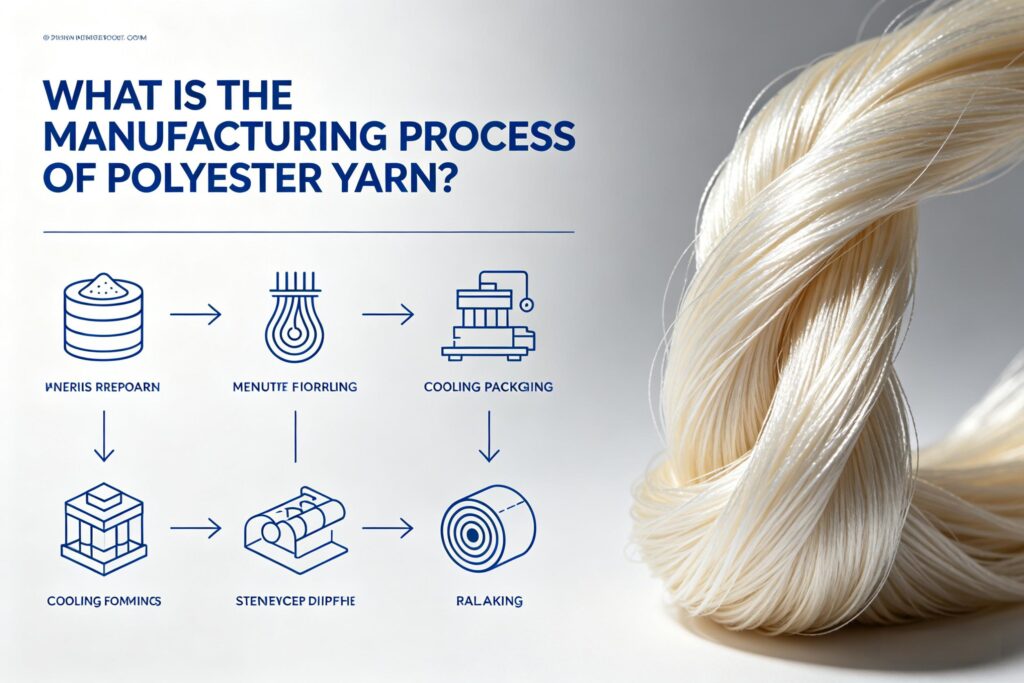
The journey of polyester yarn starts with raw materials derived from petroleum: primarily purified terephthalic acid (PTA) and monoethylene glycol (MEG). These two components are mixed and subjected to a chemical reaction known as polymerization. In a high-temperature, vacuum-controlled environment, the PTA and MEG molecules link together to form long, chain-like molecules called polyethylene terephthalate (PET). This molten PET is then extruded through a slot, cooled, and cut into tiny chips. These PET chips, resembling small plastic pellets, are the fundamental building blocks of all polyester yarn. They can be stored, transported, and later melted again for the spinning process. At this stage, additives such as delusterants (like titanium dioxide to make the yarn less shiny) or colorants can be introduced to create specific visual effects in the final product.
Stage 2: Spinning – Transforming Chips into Filaments
The second stage is where the solid chips are transformed into continuous filaments. The PET chips are first thoroughly dried to remove any moisture, as water can cause degradation during melting. The dried chips are then fed into a massive, multi-story machine called a spinneret, where they are melted at temperatures exceeding 280°C (536°F). This molten polymer is forced through the tiny holes of a spinneret, which functions like a sophisticated showerhead. As the thin streams of molten polymer exit the spinneret, they are cooled and solidified by a flow of conditioned air, forming continuous individual filaments.
The critical step that follows is drawing, which orients the polymer molecules and gives the yarn its strength and elasticity. The newly formed filaments, which are relatively weak, are stretched between sets of rollers rotating at different speeds. This drawing process aligns the long-chain polymer molecules along the axis of the filament, significantly increasing its tensile strength. For textured yarns, which mimic the bulk and softness of natural fibers like cotton, an additional step called texturizing (often using air-jet or false-twist methods) is introduced to introduce permanent crimps, loops, and coils into the filaments.
Finally, the continuous filaments are wound onto bobbins or cones as a multifilament yarn. If the yarn is intended as staple fiber (short lengths like cotton or wool), numerous filament tows are combined, drawn further, and then cut or broken into predetermined lengths before being baled for spinning on traditional ring or open-end spinning systems.
In essence, the manufacturing of polyester yarn is a seamless fusion of chemistry and mechanical engineering. It is a highly controlled, continuous process that efficiently converts petrochemicals into a consistent and customizable textile fiber, underscoring its dominance in the global fabric market.
