
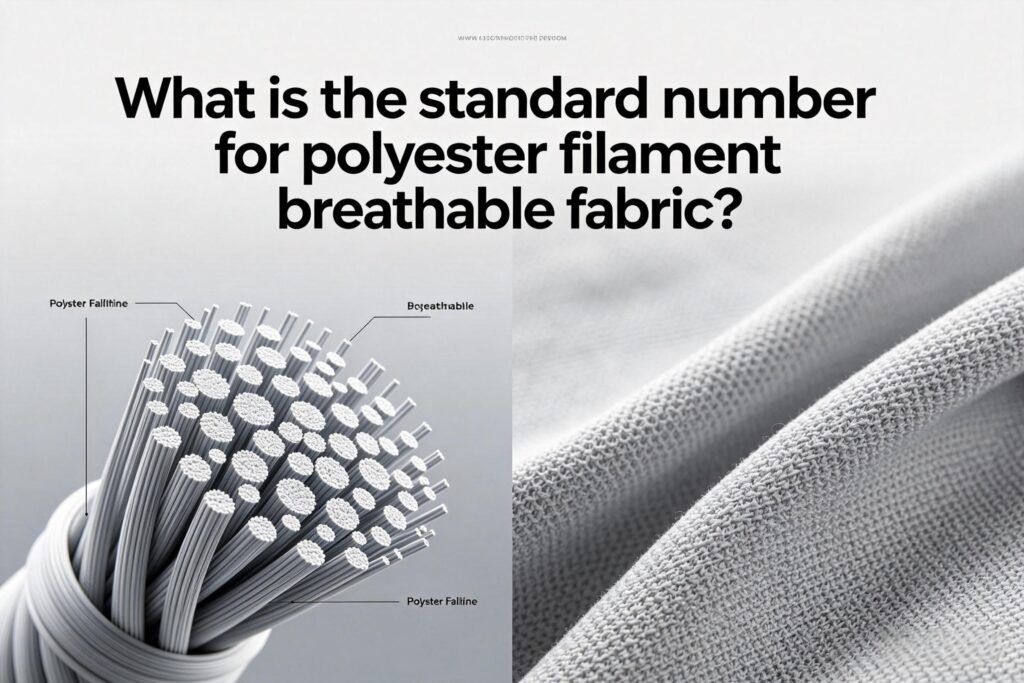
There is no single, universal “standard number” exclusively for polyester filament breathable fabrics. Instead, their performance is evaluated under a series of international and regional standards that measure specific properties. The most crucial standard for breathability (moisture vapor transmission) is ISO 15496:2018 (Textiles — Measurement of water vapour permeability of textiles for the purpose of quality control). For related properties like air permeability, ISO 9237 is key. Other critical standards include ASTM E96 (Water Vapor Transmission) and AATCC 195 (Liquid Moisture Management) in North America, and JIS L 1099 in Japan. Understanding this ecosystem of standards, not just one code, is essential for specifying, sourcing, and quality control.
The Definitive Guide to Standards for Polyester Filament Breathable Fabrics
Table of Contents
- Executive Summary: Beyond a Single Code – A Framework for Mastery
- Part 1: Deconstructing “Breathability” in Polyester Fabrics
- 1.1. The Science of Comfort: Moisture Vapor Transmission (Breathability) vs. Air Permeability
- 1.2. Engineering Breathability in Filament Fabrics: Woven Structures, Finishes, and Membranes
- Part 2: The Global Standards Matrix – A Buyer’s Reference Library
- 2.1. Moisture Vapor Transmission (Breathability) Standards
- ISO 15496:2018: The Global Benchmark for QC
- ASTM E96: The American Standard (Desiccant & Water Methods)
- JIS L 1099: The Japanese Gold Standard (A1, B1, B2 Methods)
- 2.2. Air Permeability & Ventilation Standards
- ISO 9237: The International Textile Air Permeability Test
- ASTM D737: Standard Test Method for Air Permeability of Textile Fabrics
- 2.3. Liquid Moisture Management Standards
- AATCC 195: A Holistic View of Liquid Transport
- 2.4. Related Performance & Safety Standards
- ISO 811 & AATCC 35: Water Resistance
- ISO 11611/11612: Flame Resistance for Protective Wear
- Table 1: The Buyer’s Quick-Reference Guide to Key Standards
- 2.1. Moisture Vapor Transmission (Breathability) Standards
- Part 3: Translating Data into Product Specifications
- 3.1. Decoding the Units: From g/m²/24h and RET to mm/s and %
- 3.2. Setting Your Specification: Application-Driven Performance Tiers
- 3.3. The Certification Landscape: From Supplier Claims to Third-Party Verification
- Table 2: Application-Specification Matrix: Matching Standards to End-Use
- Part 4: Industrial Applications & Their Unique Demands
- 4.1. Performance & Outdoor Apparel: High MVTR, Durability, and Brand-Specific Protocols (e.g., Gore-Tex®)
- 4.2. Workwear & Protective Clothing: Balancing Breathability with EN/ISO Safety Standards
- 4.3. Medical & Hygiene Textiles: Barrier Properties, MVTR, and Sterility (e.g., ASTM F2407)
- 4.4. Home Textiles & Upholstery: Comfort Breathability and Durability (e.g., for Mattress Covers)
- 4.5. Technical & Industrial Uses: Filtration, Geotextiles, and Specialized Air Flow Requirements
- Part 5: The Strategic Sourcing Workflow
- 5.1. Step 1: Define Functional Needs (Beyond “Breathable”)
- 5.2. Step 2: Draft the Technical Data Sheet (TDS) with Explicit Standard References
- 5.3. Step 3: Supplier Qualification & Capability Auditing
- 5.4. Step 4: Incoming QC: Validating Compliance with Your Own Testing
- Part 6: Future Trends & Evolving Standards
- 6.1. Sustainability-Driven Standards: rPET and Bio-Based Polymers
- 6.2. Smart Textiles & Dynamic Breathability
- 6.3. The Push for Harmonization and Digital Passports
- Frequently Asked Questions (FAQ)
- Conclusion: Building Confidence Through Standardization
1. Executive Summary: Beyond a Single Code
For industrial buyers, the question of a “standard number” for polyester breathable fabrics is the starting point, not the answer. True mastery lies in understanding the suite of international standards that define performance. This knowledge transforms you from a passive recipient of supplier claims into an active specifier who can demand proof, compare offerings globally, and mitigate the risk of product failure. Breathability is not a monolith; it is a combination of moisture vapor transfer, air flow, and liquid management, each measured differently. This guide provides the framework to navigate this complexity, enabling you to source fabrics with confidence for any application, from high-performance apparel to specialized industrial uses.
2. Part 1: Deconstructing “Breathability“
1.1. The Science of Comfort
- Moisture Vapor Transmission Rate (MVTR): The true measure of “breathability.” It quantifies how much water vapor (sweat) can pass through a fabric in 24 hours (g/m²/24h). High MVTR is critical for activity.
- Air Permeability: Measures the volume of air passing through a fabric under pressure (mm/s or cfm). Related to wind resistance and ventilation feel.
- Liquid Moisture Management: How a fabric transports liquid sweat away from the skin (AATCC 195). A fabric can have high MVTR but poor liquid spreading.
1.2. Engineering Breathability
Polyester filament fabrics achieve breathability through:
- Construction: Tightly woven filaments create a barrier; loose weaves, meshes, or micro-porous constructions enhance air and vapor flow.
- Finishes: Durable water repellent (DWR) treatments keep liquid out but allow vapor through.
- Membranes & Laminates: A micro-porous (e.g., ePTFE) or hydrophilic membrane is laminated to the fabric, creating a high-performance barrier that is waterproof yet breathable.
3. Part 2: The Global Standards Matrix
Table 1: The Buyer’s Quick-Reference Guide to Key Standards
| Property | Key International Standard (ISO) | Key North American Standard | Key Japanese Standard | Typical Units | What it Tells You |
|---|---|---|---|---|---|
| Moisture Vapor Transmission | ISO 15496 (QC focus) | ASTM E96 (Procedures A & B) | JIS L 1099 (Methods B1, B2) | g/m²/24h | How much sweat vapor escapes. Higher is better for activity. |
| Air Permeability | ISO 9237 | ASTM D737 | JIS L 1096 (8.26.1) | mm/s, cm³/cm²/s | How much air flows through. Affects wind chill and ventilation. |
| Liquid Moisture Management | – | AATCC 195 | – | Moisture Management Index (0-1) | How effectively liquid sweat is wicked and spread. |
| Water Resistance | ISO 811 (Hydrostatic Head) | AATCC 35 (Spray Test) | JIS L 1092 | mm H₂O, Rating | Pressure (in mm) before water penetrates. |
| Thermal & Evaporative Resistance | ISO 11092 (Sweating Guarded Hotplate) | ASTM F1868 | – | RET (m²·Pa/W) | A lower RET value means better breathability. |
Critical Note: JIS L 1099 B1 (40°C, 90%→50% RH gradient) is considered one of the most rigorous and realistic tests for high-performance apparel, often yielding lower but more reliable numbers than some ASTM E96 conditions.
4. Part 3: Translating Data into Product Specifications
3.2. Setting Your Specification
Don’t just ask for “high breathability.” Specify:
- “Minimum MVTR of 10,000 g/m²/24h as per ISO 15496.”
- “Maximum RET value of 6 m²·Pa/W as per ISO 11092.”
- “Air permeability between 50-100 cm³/cm²/s per ISO 9237 at 100 Pa.”
Table 2: Application-Specification Matrix
| End-Use Application | Recommended MVTR (ISO 15496) | Key Standards to Reference | Additional Critical Specs |
|---|---|---|---|
| Everyday Casual Wear | 3,000 – 6,000 g/m²/24h | ISO 15496, ASTM D737 | Pilling resistance, colorfastness. |
| High-Intensity Sportswear | 15,000 – 30,000+ g/m²/24h | JIS L 1099 B1, ISO 11092 (RET <6) | Durable water resistance (ISO 811 >10,000mm), wicking (AATCC 195). |
| Waterproof Breathable Rainwear | 10,000 – 25,000 g/m²/24h | ISO 15496, ISO 811 (>15,000 mm) | Seam taping, DWR durability (AATCC 22). |
| Workwear / Uniforms | 5,000 – 10,000 g/m²/24h | ISO 15496, relevant EN/ISO safety standards | Tear strength, abrasion resistance, flame resistance if required. |
| Medical Gowns (Surgical) | ASTM F2407 (specifies MVTR min.) | ASTM F2407, EN 13795 | Liquid barrier performance (ASTM F1670/F1671). |
| Mattress & Pillow Ticking | 2,000 – 5,000 g/m²/24h | ISO 15496, ISO 9237 | Barrier to allergens/dust mites, durability to repeated washing. |
5. Part 4: Industrial Applications & Their Unique Demands
- Performance Apparel: The pinnacle of breathability engineering. Buyers must understand brand-specific certifications (e.g., Gore-Tex®) which have their own, often more stringent, test protocols layered on top of ISO/ASTM standards.
- Protective Workwear: Here, breathability must be balanced against primary hazards (flame, chemicals, particulates). A standard like ISO 11612 (heat and flame) will dictate fabric construction, which in turn limits maximum achievable MVTR. The specification becomes a careful optimization.
- Medical Textiles: Breathability (MVTR) is crucial for surgeon comfort, but it is secondary to the liquid barrier standards (ASTM F1671) that prevent pathogen transmission. The fabric is a compromise, and standards define the minimum acceptable window.
- Home Textiles: For bedding, breathability prevents clamminess and improves sleep comfort. Standards like OEKO-TEX® Standard 100 (for chemical safety) become as important as physical performance specs.
6. Part 5: The Strategic Sourcing Workflow
- Define Needs: Is it vapor breathability (sweating) or air flow (ventilation) that matters most? What are the waterproof, durability, and safety needs?
- Draft the TDS: Create a Technical Data Sheet that lists every performance property, its target value, the exact test standard, and the acceptable tolerance. E.g., “MVTR: 20,000 g/m²/24h ± 15% (ISO 15496).”
- Audit Suppliers: Ask for test reports from accredited third-party labs (SGS, Bureau Veritas, etc.). Scrutinize the date, standard, and conditions. Visit to audit their QC processes.
- Incoming QC: Do not rely solely on supplier reports. Perform random batch testing on key metrics like MVTR and water resistance. This protects your production and brand.
7. Part 6: Future Trends
- Circular Economy: Standards are emerging for Recycled Content Verification (e.g., SCS Recycled Content) and Lifecycle Assessment, which will become part of the fabric specification.
- Smart Fabrics: Phase-change materials and responsive membranes that alter breathability with temperature or humidity. New standards will be needed to quantify this dynamic performance.
- Digital Product Passports (DPP): EU legislation will require a digital record of a product’s composition, durability, and environmental impact. The data generated by the standards discussed here will feed directly into DPPs.
8. Frequently Asked Questions (FAQ)
Q1: We received two MVTR values from a supplier: one from ASTM E96 and one from JIS L 1099 B1. They are very different. Which one is correct?
A1: Both are “correct,” but they are not directly comparable. ASTM E96 (especially Procedure B) often gives higher numbers than the more stringent JIS L 1099 B1 test. Always compare data tested to the same standard under the same conditions. For high-performance claims, the JIS B1 result is generally considered more reliable and conservative.
Q2: Is a higher MVTR number always better?
A2: Not necessarily. An extremely high MVTR often comes at the cost of reduced wind resistance, water resistance, or fabric durability. The goal is to match the MVTR to the activity level. A 30,000 MVTR fabric is over-engineered (and more expensive) for a casual jacket but essential for a mountaineering shell.
Q3: What is the difference between a “water-resistant” and a “waterproof breathable” fabric?
A3: This is defined by a combination of standards.
- Water-Resistant: Typically refers to a DWR-treated fabric that sheds light rain (good spray test rating – AATCC 35) but has a low hydrostatic head (ISO 811 < 1,500mm). Breathability can vary.
- Waterproof Breathable: Must have a high hydrostatic head (ISO 811 > 10,000mm is a common benchmark for “waterproof”) AND a substantiated high MVTR (e.g., >10,000 g/m²/24h). Sealed seams are also required.
Q4: Can a 100% polyester woven fabric be truly “breathable” without a membrane?
A4: Yes, but within limits. A very loosely woven or mesh polyester fabric can have excellent air permeability and decent moisture vapor transmission through the pores. However, it will have little to no water resistance. True “weather protection” breathability (blocking liquid water while passing vapor) almost always requires a membrane or a very dense, tightly woven construction with a DWR.
Q5: How important is third-party lab certification versus a supplier’s in-house test report?
A5: For critical applications and new supplier qualification, third-party reports are vital. They provide unbiased verification. In-house reports are useful for routine batch-to-batch consistency checks. Your contract should specify the right for you to audit their lab or require periodic third-party validation.
Q6: We make children’s stuffed toys. Do breathability standards apply to us?
A6: Indirectly, but importantly. While MVTR may not be a key spec, air permeability (ISO 9237) is crucial for safety to prevent suffocation hazards if a child covers their face with the toy fabric. Additionally, flammability standards (like US 16 CFR Part 1630 or EU EN 71-2) are non-negotiable and will influence fabric construction.
Q7: What is the first standard I should ask for when sourcing a new breathable fabric?
A7: Start with the most relevant performance standard for your end-use. For a rain jacket, ask for ISO 811 (Hydrostatic Head) and ISO 15496 (MVTR) data. For a sportswear jersey, ask for AATCC 195 (Moisture Management) and ASTM D737 (Air Permeability). Always request the full test report, not just a summary number.
9. Building Confidence Through Standardization
In the global market for technical textiles, standards are the common language that ensures quality, safety, and performance. For the professional buyer, moving beyond the search for a single “standard code” to command a comprehensive understanding of the standards matrix is a powerful competitive advantage. It enables precise specification, eliminates supplier ambiguity, reduces product failure risk, and ultimately builds trust with your end customer. By applying the framework in this guide, you transform breathability from a marketing buzzword into a precisely engineered, verified, and deliverable feature of your product.
