
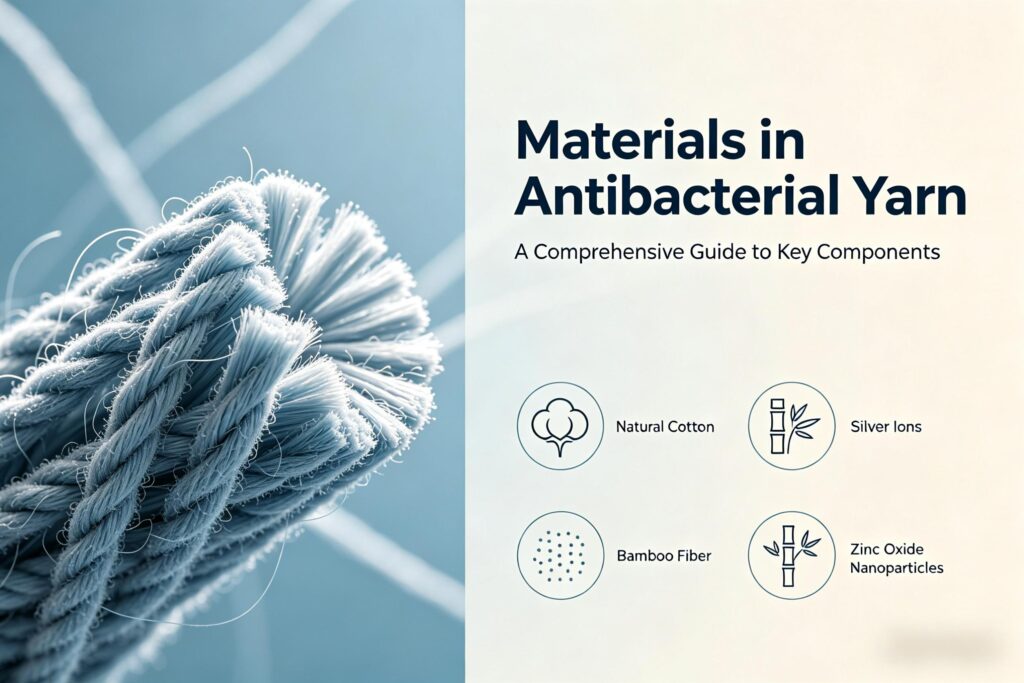
A Comprehensive Guide to Antibacterial Yarn: Materials, Mechanisms, and Market Applications
Table of Contents
- Introduction: The Rising Demand for Hygiene and Functional Textiles
- Core Mechanisms: How Antibacterial Agents Work
- Material Spectrum: In-Depth Analysis of Active Agents
3.1. Inorganic / Metallic Agents
3.2. Organic Compounds
3.3. Natural and Biopolymer Agents
3.4. Emerging and Advanced Materials - Fiber Substrate and Integration Technologies
- Performance Validation and Industry Standards
- Market Applications and Value Proposition Analysis
- Future Trends and Strategic Considerations for Buyers
1. Introduction: The Rising Demand for Hygiene and Functional Textiles
In today’s global market, textiles are increasingly expected to be more than just aesthetic coverings; they are evolving into active interfaces that enhance well-being and safety. The demand for hygiene-functional textiles has surged, driven initially by heightened health awareness and now sustained by their integration into everyday life. The global market for antimicrobial textiles, a key segment, is a testament to this shift. Valued at approximately USD 11.5 billion in 2022, it is projected to grow robustly, with a Compound Annual Growth Rate (CAGR) of 6.8% to 7.5%, reaching an estimated USD 20.5 billion by 2032. This growth is underpinned by demand from medical textiles, activewear, home furnishings, and protective apparel.
For international buyers and product developers, navigating this specialized sector requires a clear understanding of its foundation: the antibacterial yarn. This yarn is engineered not just from fibers, but from a sophisticated combination of a textile substrate and integrated active agents. This article provides a detailed, technical, and commercially relevant guide to the materials that constitute antibacterial yarns, their mechanisms, performance validation, and strategic application across industries.
2. Core Mechanisms: How Antibacterial Agents Work
Antibacterial functionality is not a single action but is achieved through specific biochemical mechanisms that disrupt microbial life cycles. Understanding these is key to selecting the right material for an application.
- Contact Killing (Oligodynamic Action): Primarily associated with metallic ions like silver (Ag⁺) and copper (Cu²⁺). These ions are released in minute quantities, bind to the bacterial cell wall and membrane, causing structural damage. They then penetrate the cell, disrupt enzyme functions and DNA replication, leading to cell death. This mechanism is broad-spectrum and effective for long durations.
- Membrane Disruption: Used by agents like quaternary ammonium compounds (QACs) and certain chitosan derivatives. These cationic (positively charged) compounds are attracted to the negatively charged bacterial cell membrane. They integrate into and disrupt the membrane’s lipid bilayer, causing leakage of cellular contents and eventual cell lysis (bursting).
- Interference with Metabolism / Protein Synthesis: Agents like triclosan (now heavily regulated) and some metal ions inhibit key enzymes (e.g., those in the fatty acid synthesis pathway), preventing bacteria from producing essential components for growth and reproduction.
- Oxidative Stress Induction: Materials like zinc oxide (ZnO), especially in nanoparticle form, can generate reactive oxygen species (ROS) such as hydrogen peroxide upon exposure to light (UV or visible) or moisture. These ROS molecules cause severe oxidative damage to cellular components, including proteins, lipids, and DNA.
3. Material Spectrum: In-Depth Analysis of Active Agents
Antibacterial yarns are classified by the active agent embedded within or on the fiber. The choice dictates performance, safety, durability, and cost.
3.1. Inorganic / Metallic Agents (The Dominant Segment)
These are prized for their durability, broad-spectrum efficacy, and heat stability.
- Silver-Based Agents: The gold standard and most prevalent. Used as silver nanoparticles (AgNPs), silver zeolites, or silver salts.
- Mechanism: Primarily contact killing/oligodynamic action.
- Advantages: Exceptionally broad-spectrum (bacteria, fungi, some viruses), high efficacy at low concentrations, and relatively durable wash resistance when properly incorporated (e.g., masterbatch).
- Considerations: Higher cost; potential for graying or color changes in fibers if not stabilized.
- Copper and Its Compounds: An ancient biocidal material experiencing a renaissance.
- Forms: Copper oxide (CuO) nanoparticles, copper-infused zeolites.
- Advantages: Excellent antibacterial and antifungal properties; often more cost-effective than silver; inherent color (can be aesthetic or limiting).
- Applications: Growing in medical textiles, socks, and home textiles.
- Zinc Oxide (ZnO): A versatile, white compound.
- Mechanism: Oxidative stress (ROS generation) and some membrane interaction.
- Advantages: Good antibacterial (especially against S. aureus), UV-blocking properties, safe, and low cost. Effective against odor-causing bacteria.
- Applications: Dominant in sportswear, casual wear, and innerwear for odor control.
3.2. Organic Compounds
These are often more specific in their action and can be engineered for high initial kill rates.
- Quaternary Ammonium Compounds (QACs):
- Mechanism: Membrane disruption.
- Advantages: Fast-acting, effective at low concentrations, colorless.
- Disadvantages: Leaching concerns; wash durability can be lower than inorganic agents; some bacterial resistance reported.
- Use: Often applied as a topical finish rather than integrated into the polymer.
- Triclosan and Similar Phenolics:
- Status: Once common, now highly restricted or banned in many regions (EU, US) for consumer textiles due to concerns over hormonal disruption, environmental persistence, and bacterial resistance.
- Buyer Advisory: Avoid specifying yarns containing these agents for markets with stringent regulations (e.g., EU REACH).
3.3. Natural and Biopolymer Agents
Aligning with the “clean label” and sustainable product trends.
- Chitosan: Derived from chitin in crustacean shells.
- Mechanism: Membrane disruption (cationic) and film-forming barrier.
- Advantages: Biodegradable, non-toxic, biocompatible, inherently antimicrobial.
- Disadvantages: Wash durability can be a challenge; sourcing and consistency vary; color may be off-white.
- Applications: Medical wound dressings, advanced natural textiles.
- Plant-Based Extracts: (e.g., neem, aloe vera, tea tree oil).
- Status: Highly niche and experimental for durable yarns. Volatility, low wash fastness, and standardization are major hurdles.
- Current Use: Primarily in non-woven disposables or topical finishes with limited lifespan.
3.4. Emerging and Advanced Materials
- Graphene and its derivatives (e.g., GO – Graphene Oxide): Offer a unique combination of antibacterial action (via membrane stress and ROS), conductivity, and strength. Cost and scalable fiber integration remain R&D challenges.
- Engineered Peptides: Synthetic chains of amino acids designed to mimic natural antimicrobial peptides. High specificity and potency but currently prohibitively expensive for mass-market textiles.
Table 1: Comparative Overview of Key Antibacterial Agent Materials
| Agent Type | Primary Materials | Key Mechanism | Durability | Relative Cost | Best For Applications |
|---|---|---|---|---|---|
| Inorganic | Silver NPs, Copper Oxide, Zinc Oxide | Contact Killing, Oxidative Stress | High (Masterbatch) | Medium-High | Medical textiles, performance wear, premium home textiles |
| Organic | QACs | Membrane Disruption | Low-Medium (Finish) | Low | Disposable medical/textiles, short-life products |
| Natural | Chitosan | Membrane Disruption | Low-Medium | Medium | Sustainable/natural brands, medical (dressings) |
| Emerging | Graphene Oxide | Physical Damage, ROS | Potentially High | Very High | Next-gen smart & performance textiles |
4. Fiber Substrate and Integration Technologies
The carrier fiber and how the agent is added are as crucial as the agent itself.
- Fiber Substrates:
- Synthetics (Polyester, Nylon, Polypropylene): Ideal for masterbatch integration. The agent is compounded into the polymer chips before extrusion, creating a permanent, durable distribution of the agent within the fiber core. This offers excellent wash resistance (often 50+ industrial washes).
- Natural & Cellulosic (Cotton, Viscose, Lyocell): More challenging. Agents are typically added via grafting (chemical bonding to fiber surface) or encapsulation during spinning (e.g., in viscose dope). Durability is improving but generally lower than masterbatch synthetics.
- Integration Methods:
- Masterbatch / Melt Spinning: The premium method for synthetics. Ensures even distribution and longevity.
- Surface Finishing / Coating: Applying agents post-yarn or post-fabric production. Lower cost but results in a coating that can wear, leach, and affect hand feel.
- Grafting: Chemically bonding agents to fiber surfaces. Good durability on cellulosics but can be complex.
5. Performance Validation and Industry Standards
Claims must be backed by standardized, third-party testing. Key international standards include:
- ISO 20743 / AATCC 100: Quantitative assessment. Measures the log reduction (e.g., 99.9% kill = 3-log reduction) of specific bacteria (S. aureus, E. coli, K. pneumoniae) after a controlled contact time (usually 24h).
- JIS L 1902 / AATCC 30: Assesses antifungal activity against mold and mildew.
- Wash Durability Tests (e.g., AATCC 61, ISO 105-C06): Performance is tested after a specified number of home or industrial wash cycles to validate longevity claims.
- Safety & Biocompatibility: For medical or skin-contact uses, agents and finished yarns may need testing per ISO 10993 series.
Buyer Insight: Demand test reports from accredited labs. A reputable supplier should provide data showing, for example, “>99.9% (3-log) reduction against S. aureus and E. coli per ISO 20743, maintained after 50 industrial washes (AATCC 61).”
6. Market Applications and Value Proposition Analysis
The value of antibacterial yarn is application-specific.
- Medical & Healthcare Textiles: (Surgical gowns, drapes, bedding) Value: Infection Control. Premium silver or copper-based yarns are justified to reduce Hospital-Acquired Infections (HAIs). Durability to industrial laundering is non-negotiable.
- Sportswear & Activewear: Value: Odor Management & Hygiene. Zinc oxide or silver-based polyester/nylon is dominant. The proposition is extended garment wearability, freshness, and brand premium.
- Socks & Innerwear: Value: Comfort and Basic Hygiene. Zinc oxide or lower-load silver agents in cotton blends are common. Manages microbial growth that causes odor and skin irritation.
- Home Textiles (Towels, Bedding, Upholstery): Value: Freshness, Allergen Reduction. Prevents microbial buildup that causes odors, mildew, and can exacerbate allergies. Silver or chitosan are used.
7. Future Trends and Strategic Considerations for Buyers
- Sustainability Driving Innovation: Demand is rising for agents with favorable environmental profiles—non-leaching, non-bioaccumulative, and derived from renewable sources. The focus on circular economy will pressure the use of agents that don’t hinder textile recyclability.
- Multifunctionality: Yarns combining antibacterial properties with moisture-wicking, temperature regulation, or UV protection are becoming standard in performance segments.
- Regulatory Scrutiny: Regulations (EU REACH, US EPA) are tightening on biocidal products. Buyers must ensure agents and finished yarns are compliant for their target markets.
- Strategic Sourcing Advice:
- Define the “Why”: Is the need for true medical-grade protection, odor control, or a marketing feature? This dictates agent type and investment.
- Audit for Integration Method: For durable performance, prefer masterbatch-integrated synthetics over topical finishes. Ask the supplier for technical details on the integration process.
- Insist on Compliance and Data: Require full disclosure of active agents, Material Safety Data Sheets (MSDS), and valid, standardized test reports for efficacy and wash durability.
- Consider Total Cost of Ownership (TCO): A higher upfront cost for a durable, effective yarn may yield lower long-term cost through performance consistency and brand protection, compared to a cheaper, leaching finish that fails quickly and risks reputational damage.
In conclusion, antibacterial yarn is a sophisticated product category where material science meets market need. Success lies in moving beyond generic claims to a precise understanding of the active materials, their integration, and their validation. By doing so, buyers can specify yarns that deliver genuine, durable value, ensuring product integrity and meeting the evolving expectations of the global market.
