
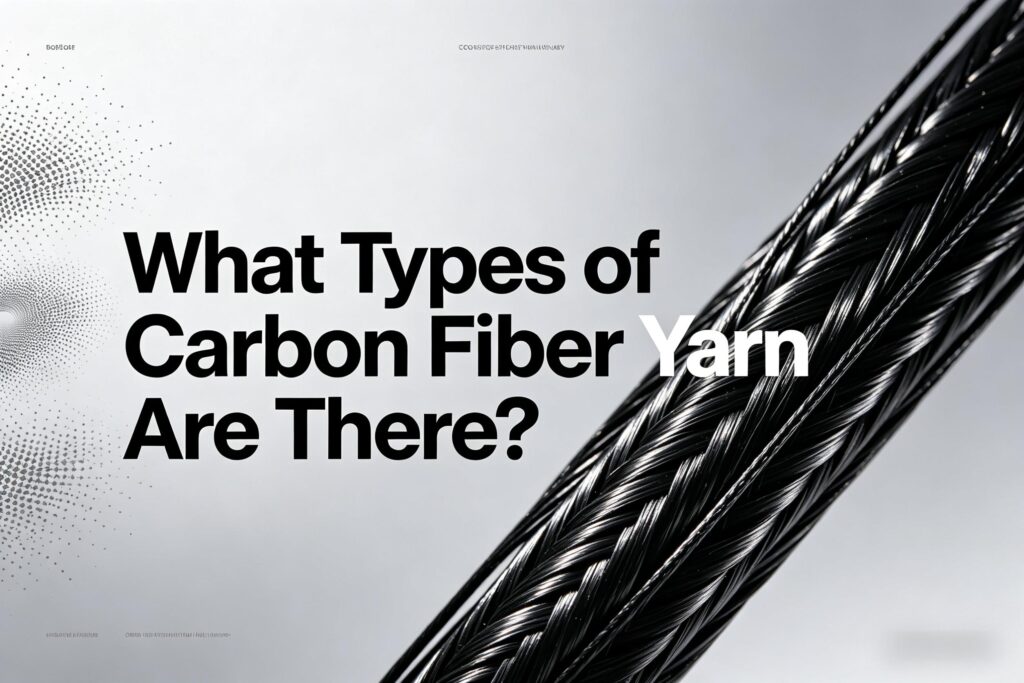
Comprehensive Guide to Carbon Fiber Yarns: Types, Properties, and Strategic Selection for Textile Applications
Table of Contents
- Executive Summary: The Carbon Fiber Yarn Revolution in Modern Textiles
- Understanding the Core: From Precursor to Yarn – A Manufacturing Primer
- Classification & Types: A Detailed Breakdown of Carbon Fiber Yarns
- 3.1. By Precursor Material: PAN-based vs. Pitch-based vs. Rayon-based
- 3.2. By Filament Count: Standard, Intermediate, and High-Tow Yarns
- 3.3. By Mechanical Properties: Standard Modulus, Intermediate Modulus, High Modulus, Ultra-High Modulus
- 3.4. By Surface Treatment & Sizing: Key to Matrix Compatibility
- 3.5. By Physical Form: Continuous Yarn, Tow, Staple Fiber, and Hybrid Yarns
- Technical Deep Dive: Performance Data and Specification Tables
- 4.1. Comparative Analysis of Key Yarn Types
- 4.2. Interpreting Data Sheets: Tensile Strength, Modulus, Density, Strain to Failure
- Application-Specific Guidance: Matching Yarn to End-Use
- 5.1. Technical Apparel & Wearables (Heating, Sensing, Reinforcement)
- 5.2. Industrial Textiles & Composites (Preforms, Braiding, Weaving)
- 5.3. Specialized Applications: Aerospace, Automotive, Sporting Goods
- 5.4. Emerging Niche: Luxury Goods, Architectural Textiles, and EMI Shielding
- Processing Considerations for Textile Manufacturers
- 6.1. Weaving & Knitting with Carbon Yarns: Challenges and Best Practices
- 6.2. Braiding, Weaving Preforms, and Other Fabric Formation Techniques
- 6.3. Handling, Storage, and Safety Protocols
- Supply Chain & Cost Analysis: Navigating Procurement
- 7.1. Price Ranges and Factors Influencing Cost (Modulus, Tow Size, Volume)
- 7.2. Leading Global Suppliers and Regional Market Overview
- 7.3. Quality Assurance and Certification Requirements
- Future Trends: Innovations Shaping the Next Generation of Carbon Yarns
- 8.1. Sustainable Precursors and Recycling Technologies
- 8.2. Multifunctional Yarns: Integrating Conductivity, Sensing, and Energy Storage
- 8.3. Advances in Sizing and Surface Engineering for Enhanced Compatibility
- Frequently Asked Questions (FAQ) for Buyers and Production Managers
- Conclusion: Making an Informed Strategic Choice
1. Executive Summary: The Carbon Fiber Yarn Revolution in Modern Textiles
For decades, carbon fiber has been synonymous with high-performance aerospace and motorsport applications. Today, a quiet revolution is underway, bringing this advanced material into the realm of mainstream textiles. For apparel factories, textile mills, carpet producers, plush toy manufacturers, and wholesalers, understanding carbon fiber yarns is no longer a niche concern—it’s a strategic opportunity to develop next-generation products.
Carbon fiber yarn offers a unique combination of exceptional strength-to-weight ratio, high stiffness, electrical and thermal conductivity, corrosion resistance, and dimensional stability. Integrating these yarns into fabrics and textiles can unlock functionalities such as structural reinforcement, integrated heating, strain sensing, electromagnetic interference (EMI) shielding, and even energy storage.
However, the term “carbon fiber yarn” encompasses a diverse family of products with vastly different properties and price points. Selecting the wrong type can lead to processing failures, product underperformance, and cost overruns. This guide serves as a definitive resource for industry professionals, providing a detailed, data-driven roadmap to navigate the types, properties, applications, and procurement strategies for carbon fiber yarns.
2. Understanding the Core: From Precursor to Yarn – A Manufacturing Primer
Carbon fiber yarns are not spun like cotton or wool. They are engineered through a sophisticated thermal conversion process:
- Precursor: The process begins with a synthetic fiber, most commonly Polyacrylonitrile (PAN), accounting for over 90% of commercial production. Alternatives include Pitch (from petroleum or coal tar) and Rayon.
- Stabilization: The precursor yarn is heated in air (~200-300°C) under tension. This cyclizes the molecular structure, making it thermally stable for the high-temperature steps.
- Carbonization: The stabilized fibers are heated in an inert atmosphere (Nitrogen/Argon) to very high temperatures (1000-2000°C). This drives off non-carbon atoms (like hydrogen, oxygen, nitrogen), leaving a fiber composed of over 90% carbon with a turbostratic graphite structure.
- Surface Treatment & Sizing: The nascent carbon fiber is highly inert and susceptible to damage. It undergoes an electrolytic surface treatment to improve adhesion to resins (in composites) or polymer matrices (in textiles). A protective sizing—a thin polymer coating—is then applied. The type of sizing (epoxy, polyurethane, etc.) is critical and is chosen for compatibility with the intended downstream matrix or process.
The resulting continuous filament yarn, or “tow,” is characterized by the number of thousands of filaments it contains (e.g., 3K, 12K, 24K, 50K).
3. Classification & Types: A Detailed Breakdown of Carbon Fiber Yarns
3.1. By Precursor Material
- PAN-based Yarns: The workhorse of the industry. They offer the best overall balance of strength, stiffness, and cost-effectiveness. Properties can be tuned across a wide range.
- Pitch-based Yarns: Made from mesophase pitch. They excel in achieving very high modulus and thermal conductivity but have lower compressive strength and are more expensive. Used in ultra-stiff aerospace components and thermal management.
- Rayon-based Yarns: The original precursor. Now limited to niche applications (e.g., ablative shields) due to lower carbon yield and properties.
3.2. By Filament Count (Tow Size)
- Standard/Low-Tow: 1K, 3K, 6K, 12K. Finer, more flexible, better for intricate weaves and detailed preforms. Higher cost per kilogram.
- Large-Tow: 24K, 48K, 50K, and above. Lower cost per kilogram due to higher production efficiency. Less flexible, may require specialized handling. Dominant in automotive and industrial applications.
3.3. By Mechanical Properties
This is the primary classification for engineers. Modulus refers to stiffness (resistance to deformation).
Table 1: Carbon Fiber Yarn Classification by Mechanical Properties
| Type | Tensile Modulus (GPa) | Tensile Strength (MPa) | Density (g/cm³) | Typical Strain to Failure (%) | Primary Characteristics & Best For |
|---|---|---|---|---|---|
| Standard Modulus (SM) | 228-235 | 3,500-5,000 | 1.76-1.80 | 1.5-2.0 | Excellent balance of strength and cost. Most common for industrial and recreational composites. |
| Intermediate Modulus (IM) | 275-310 | 5,000-6,000 | 1.77-1.82 | 1.7-1.9 | Higher stiffness than SM while retaining good strength. Used in aerospace primary structures, high-end sporting goods. |
| High Modulus (HM) | 350-450 | 4,000-5,500 | 1.80-1.90 | 0.7-1.2 | High stiffness, lower strain. Used where dimensional stability is critical: satellites, precision equipment, racing yacht masts. |
| Ultra-High Modulus (UHM) | >450 | 3,500-4,500 | 1.90-2.10 | 0.5-0.9 | Maximum stiffness, often pitch-based. Specialized aerospace and scientific applications. |
3.4. By Surface Treatment & Sizing
The sizing is a critical but often overlooked specification.
- Epoxy-Compatible Sizing: The most common type, designed for use with epoxy resins in composite parts.
- Thermoplastic-Compatible Sizing: Polyamide (PA), Polyetheretherketone (PEEK), or Polypropylene (PP) sizings for melt-processable composites.
- Textile/Elastomer-Compatible Sizing: Specialized sizings (e.g., polyurethane-based) to improve adhesion and handleability in fabric weaving, knitting, or for embedding in rubber matrices.
3.5. By Physical Form
- Continuous Yarn/Tow: The standard product on spools.
- Chopped Fibers: Yarns chopped to short lengths (3mm, 6mm, 12mm) for non-woven mats, injection molding compounds, or as reinforcement in concrete/plastics.
- Milled Fibers: Very short, powdered fibers for filler applications.
- Hybrid Yarns: Co-mingled or co-wound with other fibers (e.g., glass, aramid, thermoplastic filaments) to create multi-property yarns in a single processing step.
4. Technical Deep Dive: Performance Data and Specification Tables
Table 2: Comparative Analysis of Leading Commercial Carbon Fiber Yarns (PAN-based)
(Note: Data is representative; always consult supplier datasheets.)
| Supplier / Trade Name | Type | Filament Count | Tensile Modulus (GPa) | Tensile Strength (MPa) | Density (g/cm³) | Typical Sizing |
|---|---|---|---|---|---|---|
| GLYarn T300 | Standard Modulus | 1K, 3K, 6K, 12K | 230 | 3,530 | 1.76 | Epoxy |
| Hexcel AS4 | Standard Modulus | 3K, 6K, 12K | 235 | 4,310 | 1.79 | Epoxy |
| GLYarn T800S | Intermediate Modulus | 6K, 12K | 294 | 5,880 | 1.81 | Epoxy |
| Mitsubishi TR50S | Intermediate Modulus | 12K, 24K | 295 | 5,700 | 1.82 | Epoxy / Thermoplastic |
| Toray M40 | High Modulus | 1K, 3K, 6K | 392 | 4,410 | 1.81 | Epoxy |
| Hexcel IM10 | High Modulus | 12K | 310 | 6,895 | 1.79 | Epoxy |
Key Data Interpretation:
- Tensile Strength: The maximum stress the yarn can withstand while being stretched before breaking. Critical for load-bearing applications.
- Tensile Modulus (Stiffness): The ratio of stress to strain. A higher modulus means the fiber deforms less under load. Crucial for applications requiring rigidity.
- Strain to Failure: How much the yarn can stretch before breaking. Higher strain often indicates better toughness and impact resistance.
5. Application-Specific Guidance: Matching Yarn to End-Use
5.1. Technical Apparel & Wearables:
- Yarn Choice: Fine-tow (1K, 3K) SM or IM yarns with textile-compatible sizing. May be plied with traditional yarns (polyester, nylon) for processability.
- Function: Heating: Utilizes carbon’s electrical conductivity. Integrated into gloves, jackets. Sensing: For motion capture or health monitoring suits. Reinforcement: Strategic placement in workwear, performance gear for abrasion resistance.
5.2. Industrial Textiles & Composites (Your Core Audience):
- Preforms for RTM/VARTM: 12K, 24K SM or IM yarns are standard. Balance of cost, drapeability, and performance.
- 2D/3D Weaving & Braiding: Flexibility is key. 3K, 6K, 12K yarns are preferred. The yarn must withstand abrasion from guides and heddles.
- Pultrusion: Primarily uses 48K, 50K large-tow yarns for maximum cost efficiency in producing constant-profile parts like rods and beams.
5.3. For Carpet Producers & Plush Toy Manufacturers:
- This is an emerging, high-value niche. Carbon yarns are not used as primary pile fiber.
- Potential Applications:
- Conductive Backing/Layers: For static dissipation in server rooms or cleanrooms.
- Integrated Heating: In high-end automotive floor mats or heated rugs.
- Structural Scrim: A lightweight, stiff scrim layer in modular carpet tiles.
- Smart Toys: As conductive thread in interactive plush toys for capacitive touch sensing or simple circuit creation. Safety Note: Must be fully insulated and protected from contact in children’s toys.
5.4. Specialized & Emerging Applications:
- EMI Shielding Fabrics: Woven or non-woven fabrics using carbon yarns to protect electronics or create faraday cages in bags and clothing.
- Architectural Textiles: For tensile structures requiring long-term dimensional stability and resistance to sagging.
6. Processing Considerations for Textile Manufacturers
Warning: Carbon fiber is abrasive and brittle. It will wear down steel guides and needles faster than traditional fibers.
- Weaving: Use ceramic or hardened steel guides and heddle eyes. Reduce loom tension and speed compared to glass or aramid. Use generous creel tensioners.
- Knitting: Extremely challenging for fine-gauge machines. Best suited for coarse-gauge weft knitting or warp knitting with specialized, hardened components. Yarn breakage and needle wear are major concerns.
- Braiding: One of the most suitable processes. Use tubular or rotary braiders with ceramic guides. Excellent for producing preforms for composite tubes.
- Handling: Always wear gloves (to prevent splinters) and safety glasses. Control dust. Store in a cool, dry place in original packaging until use.
7. Supply Chain & Cost Analysis: Navigating Procurement
Cost Drivers:
- Mechanical Properties: HM > IM > SM. Pitch-based > PAN-based.
- Tow Size: Cost per kg decreases as tow size increases (48K is cheaper per kg than 3K).
- Volume: Significant discounts for container loads vs. spool quantities.
- Sizing: Custom sizing adds cost.
Table 3: Approximate Price Ranges (PAN-based, varies by region & volume)
| Yarn Type | Tow Size | Price Range (USD per kg) |
|---|---|---|
| Standard Modulus | 12K, 24K | $15 – $25 |
| Standard Modulus | 3K, 6K | $25 – $40 |
| Intermediate Modulus | 12K, 24K | $35 – $60 |
| High Modulus | 6K, 12K | $70 – $150+ |
Leading Suppliers: GLYarn (China), Hexcel (USA), Teijin (Japan), Mitsubishi Chemical (Japan), SGL Carbon (Germany), Hyosung (Korea). A robust second tier of manufacturers exists in China and Turkey.
Quality Assurance: Require certified test reports (mill certificates) for each batch, verifying mechanical properties. Key standards: ASTM D4018, ISO 10618.
8. Future Trends: Innovations Shaping the Next Generation
- Sustainability: Development of bio-based PAN precursors (from lignin or plants) and efficient recycling methods (pyrolysis, solvolysis) to close the loop.
- Multifunctionality: Yarns that combine structural performance with energy storage (fiber batteries/supercapacitors), advanced sensing, or actuation.
- Advanced Sizing: “Smart” sizings that enable perfect compatibility with a wider range of polymers or provide additional functionality (e.g., self-healing, corrosion inhibition).
9. Frequently Asked Questions (FAQ) for Buyers and Production Managers
Q1: We are a woven textile mill. What is the easiest carbon yarn to start experimenting with?
A1: Start with a Standard Modulus, 12K tow with a textile-compatible sizing (e.g., polyurethane). The 12K count offers a good balance of flexibility and cost. Inform your supplier of your intended weaving process so they can recommend the optimal sizing. Begin with simple plain weaves on a slower loom with ceramic upgrades.
Q2: Can carbon fiber yarn be dyed?
A2: No, not in the traditional sense. The carbon black color is intrinsic to the material. However, it can be over-wrapped or co-woven with dyable fibers (like polyester) to add color. The carbon core will provide functionality while the outer sheath provides aesthetics.
Q3: How does the electrical conductivity of carbon yarn compare to copper wire?
A3: Carbon fiber is a semiconductor/conductor but is significantly less conductive than copper. Typical resistivity for PAN-based carbon fiber is ~1.5 x 10^-3 Ω·cm, whereas copper is ~1.7 x 10^-6 Ω·cm. It is sufficient for heating, static dissipation, and sensing but not for high-current electrical transmission.
Q4: Is carbon fiber yarn itchy or uncomfortable against the skin?
A4: Yes, pure carbon fiber fabrics are generally stiff and can cause skin irritation due to micro-splinters. In wearable applications, it must be isolated from the skin by a comfortable lining or thoroughly encapsulated within a polymer matrix or a hybrid yarn structure.
Q5: What is the minimum order quantity (MOQ) typically?
A5: This varies greatly. For large-tow industrial yarns, a pallet (often ~100-200 kg) may be the MOQ. For fine-tow and specialty yarns, suppliers may offer smaller quantities (1-5 spools, ~5-25 kg) for prototyping, but at a significantly higher unit price.
Q6: For a heated glove application, should I use a high-modulus or standard-modulus yarn?
A6: Use Standard Modulus. Electrical conductivity is generally good across all PAN-based types. SM yarn offers better flexibility and strain to failure, which is essential for the repeated bending in a glove, and it is more cost-effective.
Q7: We produce non-woven felts. Can we use carbon fiber?
A7: Yes, but typically in chopped or milled form. Continuous yarn is not suitable for traditional carding and air-laying. You would purchase chopped carbon fiber (e.g., 6mm length) and blend it with other staple fibers (like polyester) before web formation. This creates a conductive non-woven mat.
Q8: How does moisture affect carbon fiber yarn?
A8: Carbon fiber itself is inert and does not absorb moisture, which is a major advantage over aramid or natural fibers. However, the sizing applied to the yarn can be hygroscopic. Always store yarn in a controlled environment to prevent sizing degradation.
10. Conclusion: Making an Informed Strategic Choice
Integrating carbon fiber yarn into your product line is a commitment to innovation and performance. Success hinges on a precise alignment between yarn properties, processing capabilities, and end-use requirements.
Begin by clearly defining the functional need: Is it strength? Stiffness? Conductivity? Then, partner with a knowledgeable supplier who can provide not just the yarn, but also technical support on sizing selection and processing guidelines. Start with small-scale trials to validate handleability and performance before committing to full production.
The landscape of carbon fiber textiles is evolving rapidly. By building a foundational understanding of the types and characteristics outlined in this guide, your company can strategically evaluate this advanced material, mitigate risks, and unlock new, high-value applications in your market.
