
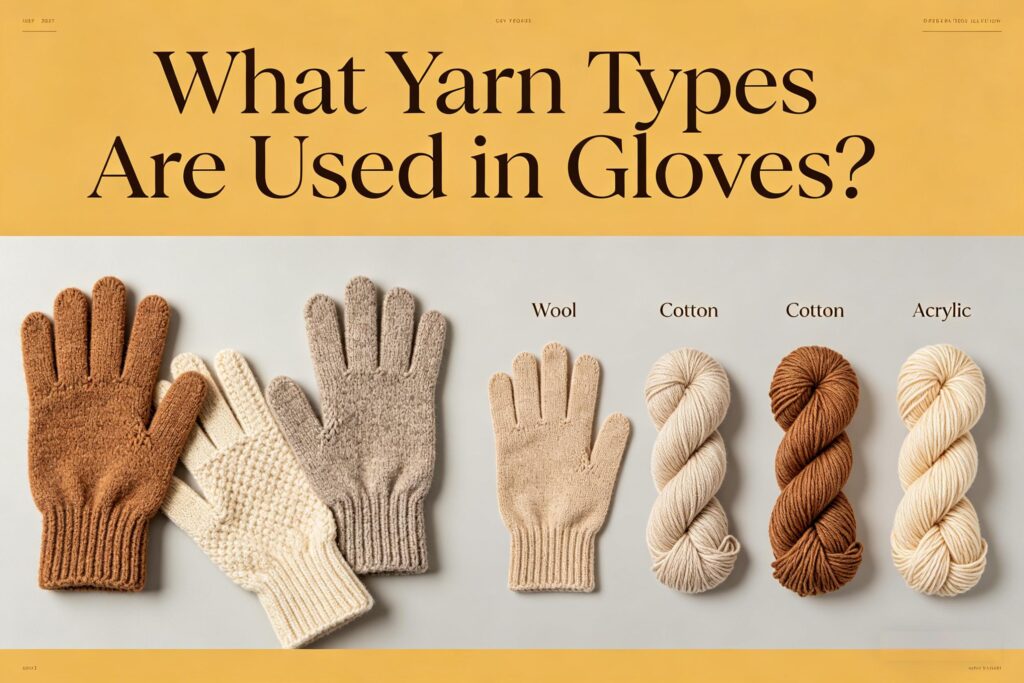
For procurement managers across the apparel, home textile, and manufacturing sectors, selecting the right yarn is the fundamental decision that dictates a glove’s destiny. The difference between a premium cashmere dress glove, an abrasion-resistant industrial work glove, and a soft plush toy paw is rooted in yarn selection. This guide demystifies the extensive array of yarns used in glove manufacturing, providing the technical knowledge and data-driven insights needed to source effectively, innovate confidently, and ensure your final products meet precise market demands.
Table of Contents
- Introduction: The Yarn as the Blueprint of Glove Performance
- Chapter 1: The Core Fiber Portfolio
- Natural Fibers
- Synthetic & Chemically-Derived Fibers
- High-Performance & Technical Fibers
- Chapter 2: Yarn Construction: Twists, Plys, and Advanced Structures
- Chapter 3: Application-Driven Selection for Key Industries
- Fashion & Apparel Gloves
- Industrial & Protective Gloves
- Home Textiles, Toys, and Specialized Uses
- Chapter 4: Specifications, Testing, and Sourcing Strategy
- Conclusion: Building a Future-Proof Glove Supply Chain
1. Introduction: The Yarn as the Blueprint of Glove Performance
A glove is a highly engineered textile product where functionality and aesthetics are inseparably woven into its very fibers. The choice of yarn directly controls a core set of properties that define a glove’s suitability for its end use:
- Tactile and Comfort Properties: Warmth, softness, breathability, moisture management, and hand feel.
- Mechanical Performance: Tensile strength, abrasion resistance, cut resistance, elasticity, and durability.
- Aesthetic and Sensory Appeal: Luster, drape, texture, color vibrancy, and overall luxury perception.
- Functional Capabilities: Thermal insulation, water repellency, chemical resistance, antimicrobial properties, and flame retardancy.
For buyers, a deep understanding of yarn types is not merely academic—it is a critical tool for risk management, cost control, and product differentiation. Choosing the wrong yarn can lead to product failure, returns, and brand damage, while the right choice can open new markets and build lasting customer loyalty.
2. Chapter 1: The Core Fiber Portfolio
Glove yarns are built from three primary categories of fibers, each offering a distinct set of inherent properties.
2.1 Natural Fibers
Prized for their comfort, breathability, and classic aesthetics, natural fibers form the backbone of non-technical glove applications.
- Cotton: The ubiquitous workhorse. It is highly absorbent, soft against the skin, breathable, and offers good tensile strength. As shown in technical studies, a 100% cotton yarn can achieve a tenacity of around 13.90 cN/tex. It is ideal for everyday fashion gloves, liners, and lightweight work gloves but lacks elasticity and dries slowly.
- Wool (Including Merino, Lambswool): The gold standard for warmth. Its natural crimp creates air pockets that provide excellent insulation even when damp. Wool yarns are inherently more elastic and resilient than cotton but can be itchy for some and require careful maintenance.
- Silk: The luxury fiber. Silk filaments are remarkably strong for their fineness, imparting a unique, luminous sheen and an exceptionally smooth, lightweight hand feel. It is used in high-end dress gloves, thermal liners for its warmth without bulk, and beauty gloves for its skin-friendly properties.
- Specialty Natural Fibers: This includes cashmere and alpaca for ultra-soft, luxury thermal gloves, and hemp for its durability and natural antimicrobial characteristics.
2.2 Synthetic & Chemically-Derived Fibers
These fibers provide consistency, durability, and specific performance attributes unattainable by natural fibers alone.
- Acrylic (PAN): The primary wool substitute. Acrylic yarns, including textured variants like bouclé, are lightweight, warm, colorfast, and highly resistant to moths and mildew. They are cost-effective but can have a less “natural” hand feel and lower breathability.
- Polyester (PES): The champion of durability and shape retention. It is strong, quick-drying, resistant to wrinkles and abrasion, and often used in blends to improve durability. Polyester filament yarn is noted for its extremely high tenacity and elongation, making it very tough.
- Nylon (Polyamide/PA): Known for its exceptional abrasion resistance, strength, and elasticity. Nylon filament yarn, as data indicates, possesses extreme toughness with very high elongation at break (over 300%), making it ideal for reinforcing high-wear areas on gloves.
- Elastane (Spandex/Lycra): Rarely used alone but critical as a minor blend component (typically 2-10%). It provides essential stretch and recovery, ensuring a snug, comfortable fit in both fashion and performance gloves.
2.3 High-Performance & Technical Fibers
This category is engineered for extreme conditions and protective applications.
- Aramid Fibers (Para- and Meta-): Includes brands like Kevlar® and Nomex®. Para-aramid is renowned for its exceptional cut, heat, and flame resistance and is a core component in industrial safety gloves.
- Ultra-High-Molecular-Weight Polyethylene (UHMWPE): Fibers like Dyneema® and Spectra® offer an outstanding strength-to-weight ratio and superior cut resistance, often used in lightweight protective gloves.
- Fiberglass: Used as a core component in composite yarns for cut-resistant gloves. Its hard, inorganic filaments provide the primary defense against sharp edges but are always sheathed in other fibers for wearer comfort and yarn integrity.
- Modacrylic & Other FR Fibers: Flame-retardant synthetics designed to self-extinguish, used in gloves for welding, firefighting, and electrical work.
- Coated Yarn Substrates (for Dipped Gloves): While not a textile yarn in the traditional sense, the base knit for latex, nitrile, or PVC dipped gloves is crucial. It is typically a lightweight, stretchy yarn (often cotton, nylon, or polyester) that provides the form and comfort for the polymer coating that delivers chemical or liquid barrier protection.
3. Chapter 2: Yarn Construction: Twists, Plys, and Advanced Structures
The raw fiber is only the beginning. How it is spun and constructed into a yarn defines its final character and performance.
- Yarn Count/Linear Density: Measured in Denier (D) or Tex, it indicates the yarn’s thickness. Heavier yarns (e.g., 600D for protective gloves) are stronger and more durable, while finer yarns (e.g., 50D for dress gloves) are more delicate and flexible.
- Twist Level: The number of twists per meter (tpm) impacts strength and hand feel. Higher twist increases strength and creates a harder yarn, while low twist yields a softer, loftier yarn. Bouclé yarns have a very low twist to create their characteristic loops.
- Ply: Multiple single strands (singles) are twisted together to form a plied yarn (e.g., 2-ply). Plying improves strength, evenness, and durability. Many glove yarns are 2-ply constructions.
- Advanced Composite Structures: For protective gloves, sophisticated engineered yarns are the norm.
- Core-Spun Yarns: A central core (e.g., fiberglass or steel filament for cut resistance) is wrapped with a staple fiber sheath (e.g., cotton or polyester) for comfort.
- Covered or Wrapped Yarns: A high-performance filament (e.g., UHMWPE or aramid) is helically wrapped with a softer yarn to protect the core and improve wearability. This structure is detailed in patents for cut-resistant gloves, which describe a glass fiber core with a para-aramid wrap.
- Blended Yarns: Fibers are mixed at the spinning stage to combine properties. For instance, a 50% Wool / 50% Acrylic blend balances the warmth and feel of wool with the durability and cost-effectiveness of acrylic, showing a favorable combination of tenacity and elongation.
4. Chapter 3: Application-Driven Selection for Key Industries
Selecting the optimal yarn requires a clear understanding of the glove’s end-use. The following table provides a strategic sourcing guide.
| Target Industry & Glove Type | Primary Function & Challenges | Recommended Yarn Types & Constructions | Key Performance Metrics to Specify |
|---|---|---|---|
| Fashion & Apparel | Aesthetics, drape, softness, seasonal comfort. | Fine wool, cashmere, silk, cotton, fine acrylic. Lightweight, high-twist yarns for dress gloves; bulkier yarns for winter knits. | Yarn evenness, pilling resistance, colorfastness to light and perspiration, softness (hand feel). |
| Industrial & Safety | Cut, abrasion, puncture, and heat resistance; durability. | Engineered composites: Core yarns of fiberglass/steel wrapped with aramid (e.g., Kevlar®) or UHMWPE (e.g., Dyneema®). Heavy-duty nylon, polyester. | Cut resistance level (e.g., ANSI/EN 388 rating), abrasion cycles, tensile strength, Dexterity Rating. |
| General Purpose / Work | General durability, grip, cost-effectiveness, light-duty protection. | Cotton, polyester/cotton blends, acrylic, nylon. Medium-weight, plied yarns. | Abrasion resistance, seam strength, dimensional stability after washing. |
| Dipped / Liquid Protection | Chemical, viral, or liquid barrier; dexterity. | Knitted substrates: Stretch nylon, polyester, or cotton. The yarn forms the supportive liner for polymer coatings (nitrile, latex, PVC). | Chemical permeation data (ASTM F739), liner seam integrity, ergonomic fit. |
| Home Textiles & Toys | Softness, safety, washability, aesthetic texture. | Acrylic, polyester, cotton. Chenille, bouclé, and other fancy yarns for plush toys. Yarns must meet strict safety standards (no loose fibers, non-toxic). | Safety compliance (e.g., ASTM F963, EN71), colorfastness, pilling resistance, softness. |
5. Chapter 4: Specifications, Testing, and Sourcing Strategy
Navigating from concept to a reliable supply of finished gloves requires a disciplined approach.
- Develop a Comprehensive Technical Specification: Go beyond fiber content. Your Tech Pack should include: Fiber blend percentages, Yarn count/Denier, Ply and twist, Target fabric weight (GSM), Color standards, and Required physical performance tests.
- Leverage Industry Standards: Reference established standards to define quality expectations. For example, ASTM D4115 provides a performance specification for women’s and girls’ dress glove fabrics, covering parameters like seam strength and durability, which can serve as a useful benchmark even beyond its direct scope.
- Prioritize Pre-Production Sampling and Testing: Never skip the prototyping stage. Test glove samples for:
- Physical Performance: Abrasion (Martindale), tensile/tear strength, cut resistance (ISO 13997/TDM-1000), colorfastness to washing and light.
- Comfort & Fit: Consistent sizing, hand fatigue during extended use, breathability.
- Strategic Sourcing Partnerships: Engage with suppliers who offer technical expertise, not just transactional sales. A reliable partner should help translate your performance needs into the correct yarn specifications, provide access to innovative materials (like graphene-enhanced fibers for cut resistance), and ensure consistent quality through certified manufacturing processes.
6. Conclusion: Building a Future-Proof Glove Supply Chain
The landscape of glove yarns is dynamic, driven by advancements in material science and evolving end-user demands. The future points towards multifunctional yarns (e.g., cut-resistant fibers with inherent antimicrobial properties), sustainable innovations (recycled and bio-based synthetics), and smart textiles (yarns integrated with sensing capabilities for monitoring in industrial settings).
For the strategic buyer, mastery of yarn types is a powerful lever for value creation. By methodically applying the principles outlined in this guide—starting with a precise definition of end-use requirements, understanding the fiber and construction toolkit, and validating choices through rigorous testing—you can systematically reduce sourcing risk, drive product innovation, and build a glove supply chain that is not only robust for today’s needs but also adaptable for tomorrow’s challenges.
I hope this guide provides a solid foundation for your sourcing decisions. If you have a specific glove application in mind, please feel free to ask for more detailed information on material selection for that particular use case.
