
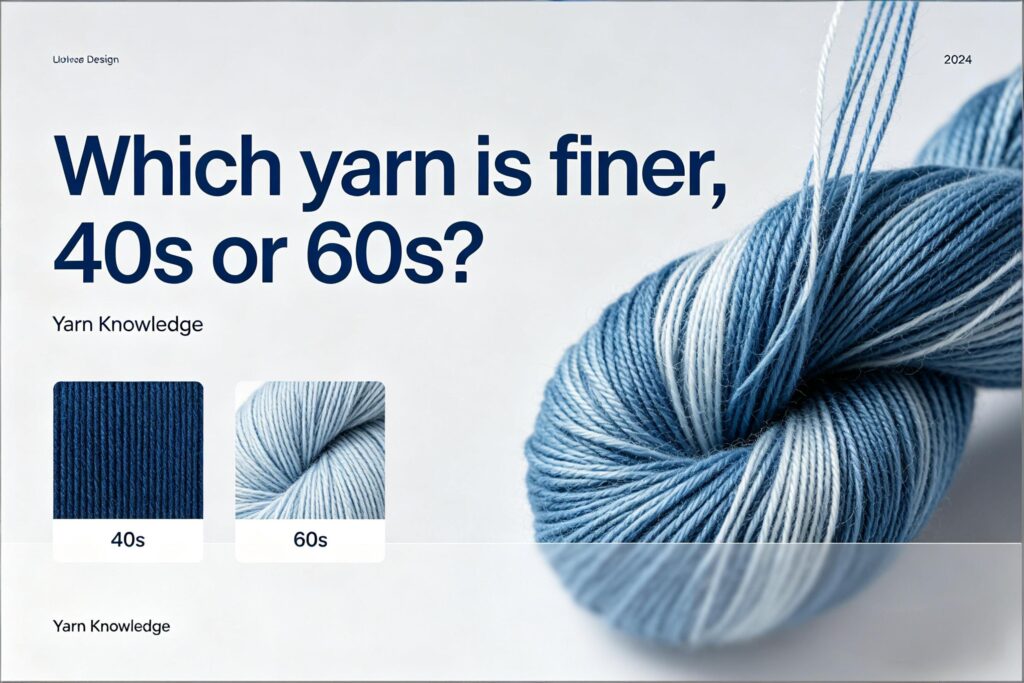
Article Outline
- My First Yarn Confusion – A $3,000 Mistake
Personal story of ordering the wrong count and ruining a production run. - The Short Answer – No Math, Just Logic
Clear, direct answer to the title question before we dive deep. - Yarn Count Systems Explained (Without the Headache)
English cotton count (Ne), metric count (Nm), denier, tex – when to use each. - The Number Rule: Higher Count = Finer Yarn
Why a 60s yarn is thinner than 40s, with a real-world analogy. - 40s vs 60s
Diameter, weight, twist, strength, cost – full data table. - What “Finer” Actually Means for Your End Product
Hand feel, drape, breathability, durability – and trade-offs. - Typical Applications for 40s and 60s
T-shirts, shirting, bedding, suits, high-end knits – which count for which. - Spinning Technology Limits – Can Any Mill Spin 60s?
Cotton quality, ring vs rotor spinning, and why 60s is harder to make. - Cost Difference – Is Finer Always More Expensive?
Price per kg vs price per meter – the counterintuitive math. - 40s vs 60s Across 8 Factors
A decision matrix for buyers, product managers, and designers. - Which One Should You Choose? (Decision Flow)
A simple yes/no guide based on product type, budget, and machinery. - Common Misconceptions – What Beginners Get Wrong
“Higher count means stronger” and other myths debunked. - My Personal Rule of Thumb After 8 Years in Sourcing
Practical heuristics I use before placing any yarn order. - So Which Is Finer?
Recap with confidence score and one-sentence takeaway. - FAQ
1. My First Yarn Confusion – A $3,000 Mistake
Six years ago, I was sourcing yarn for a small run of luxury T-shirts. The mill asked: “What count do you need – 40s or 60s?”
I had no idea. So I guessed. “40s,” I said, because 40 sounded smaller and I assumed that meant thinner.
Wrong. Completely wrong.
The fabric arrived. It was heavy, thick, and had zero drape. My customer rejected the whole batch. $3,000 down the drain, plus two weeks of lost time.
That night, I finally sat down and learned yarn counts properly. And I realized: most people in fashion – even experienced ones – get this backwards.
So let me save you the same expensive lesson.
2. The Short Answer – No Math, Just Logic
Here’s the direct answer to the question “Which yarn is finer, 40s or 60s?”:
60s is finer than 40s.
In the English cotton count system (the most common one for cotton yarns), the higher the number, the finer the yarn.
Think of it like this:
- 10s is a thick, chunky yarn (like a rug or a heavy sweater).
- 40s is a medium-fine yarn (standard T-shirt).
- 60s is a fine, almost silky yarn (luxury shirting or high-end knits).
- 100s is extremely fine (premium dress shirts).
So 60s is thinner, lighter, and softer than 40s.
But that’s just the headline. The real story is much more interesting – and way more useful for anyone who actually buys or specifies yarn.
3. Yarn Count Systems Explained (Without the Headache)
Before we compare, let’s quickly clarify the different systems. Because “60s” means different things in different parts of the world.
| System | Abbreviation | What It Measures | Common For | Higher Number Means |
|---|---|---|---|---|
| English cotton count | Ne | Number of 840-yard hanks per pound | Cotton, spun polyester | Finer yarn |
| Metric count | Nm | Number of 1000-meter hanks per kg | Linen, wool, blends | Finer yarn |
| Denier | D | Weight in grams per 9000 meters | Silk, filament yarns | Thicker yarn |
| Tex | tex | Weight in grams per 1000 meters | Universal, industrial | Thicker yarn |
Important: In Ne (English cotton count), higher number = finer. In denier and tex, higher number = thicker. This is where people get tripped up.
When someone says “40s” or “60s” in a cotton or blended yarn context, they almost always mean Ne (English cotton count). So from here on, that’s our system.
4. The Number Rule: Higher Count = Finer Yarn
Let’s make this intuitive.
Imagine you have one pound of cotton. You spin it into yarn.
- If you make 40 “hanks” (each hank is 840 yards), you get 40s yarn. Each strand is relatively thick.
- If you make 60 hanks from the same one pound, you get 60s yarn. Each strand is thinner because the same amount of fiber is stretched over more length.
Real-world analogy:
Think of playdough. If you roll one ball of playdough into a snake that’s 40 inches long, it’s fairly thick. If you roll the same ball into a 60-inch snake, it’s thinner. Same dough, more length = finer diameter.
That’s exactly how yarn count works.
So yes: 60s is finer than 40s. No debate.
5. 40s vs 60s
Now let’s put actual numbers on it. These are typical values for 100% combed cotton ring-spun yarn.
| Property | 40s Ne | 60s Ne | Difference / Insight |
|---|---|---|---|
| Approximate diameter (mm) | 0.18 – 0.20 | 0.14 – 0.16 | 60s is ~25% thinner |
| Yards per pound | ~33,600 | ~50,400 | 60s gives 50% more length per lb |
| Typical twist level (TPI) | 22 – 26 | 28 – 34 | 60s needs more twist for strength |
| Breaking strength (cN/tex) | 22 – 26 | 18 – 22 | 40s is slightly stronger |
| Typical price (USD/kg) | $3.20 – $4.00 | $4.50 – $6.50 | 60s is 30–60% more expensive |
| Fabric weight (gsm, single jersey) | 140 – 160 | 110 – 130 | 60s produces lighter fabric |
| Abrasion resistance | Good | Moderate | 40s wears longer |
Finer yarn is not “better” in every way. It’s lighter, softer, and more expensive. But it’s also weaker and less durable. You choose based on the end use, not the number.
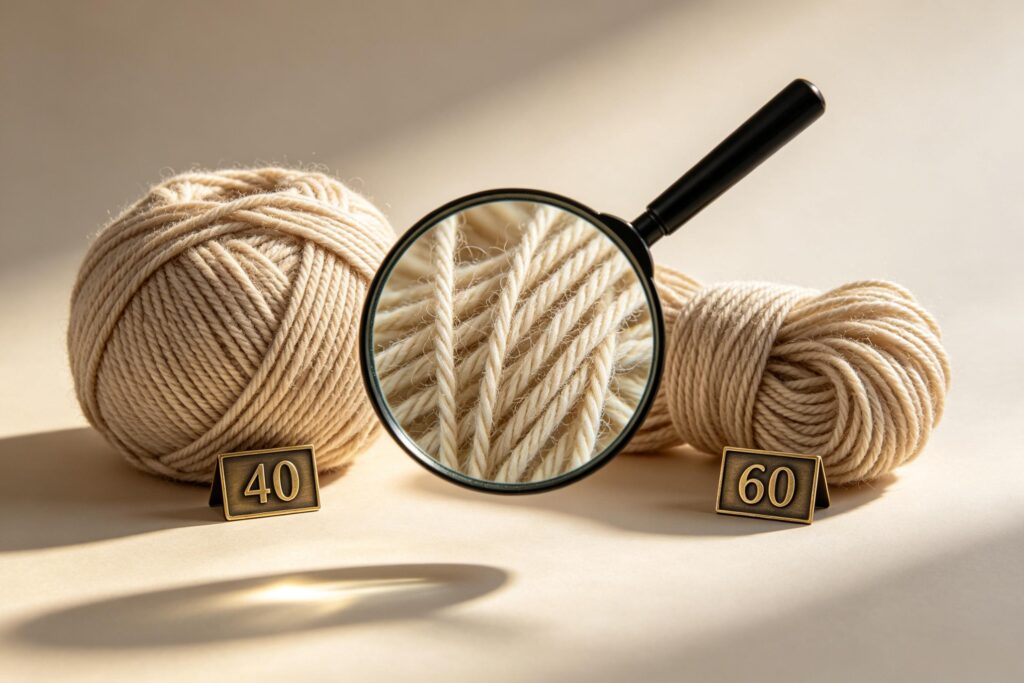
6. What “Finer” Actually Means for Your End Product
When you switch from 40s to 60s, here’s what changes in the final fabric:
| Attribute | 40s feels like… | 60s feels like… | Best for… |
|---|---|---|---|
| Hand feel (touch) | Smooth but substantial | Silky, almost slippery | 60s for luxury; 40s for everyday |
| Drape | Moderate, holds shape | Fluid, falls softly | 60s for blouses, dresses |
| Breathability | Good | Excellent | 60s for summer; 40s for spring/fall |
| Opacity / Sheerness | Opaque | Slightly sheer if knit loosely | 40s for single-layer garments |
| Pilling tendency | Low | Medium (finer fibers can pill) | 40s for high-friction areas |
| Wrinkle resistance | Moderate | Lower (finer = more wrinkles) | 40s for travel wear |
I once made a batch of men’s polo shirts in both 40s and 60s from the same cotton. The 40s felt like a solid, reliable shirt. The 60s felt like something you’d wear to a rooftop dinner. Both good. Just different.
7. Typical Applications for 40s and 60s
Not every product needs 60s. In fact, most don’t.
Common uses for 40s:
- Basic T-shirts (mass market)
- Bed sheets (standard hotel quality)
- Denim weft yarns
- Workwear knits
- Towels (if plied)
- Affordable jersey dresses
Common uses for 60s:
- Luxury T-shirts ($50+ retail)
- High-end men’s dress shirting (with 80s or 100s)
- Fine-knit sweaters (with mercerization)
- Premium bed linens (Egyptian cotton)
- Lightweight summer blouses
- Inner linings for suits
The sweet spot for most “better” products is 50s or 60s. 40s is everyday quality. 60s is “premium.” Once you go above 80s, prices skyrocket and durability drops fast.
8. Spinning Technology Limits – Can Any Mill Spin 60s?
Here’s something many buyers don’t realize: not every mill can spin 60s yarn.
Spinning finer yarns requires:
- Longer, cleaner cotton fibers (e.g., Giza 86, Supima, or long-staple Chinese cotton).
- Tighter ring-spinning frames (rotor spinning typically maxes out around 40s).
- Better humidity and temperature control.
- More frequent traveler and ring changes.
In practice:
- Rotor (open-end) spinning: usually 6s – 40s. 60s is nearly impossible.
- Ring spinning: 10s – 120s. 60s is doable but requires good fiber.
- Compact ring spinning: best for 60s+ because it reduces hairiness.
I’ve visited mills in Bangladesh that run 40s beautifully but can’t hold tolerance at 60s. They get uneven yarn – thick and thin spots – that ruins fabric appearance.
Always ask for a sample of the exact count before placing bulk orders. A certificate means nothing if the mill hasn’t actually run that count recently.
9. Cost Difference – Is Finer Always More Expensive?
Yes – but not in the way you might think.
On a per-kilogram basis: 60s costs 30–60% more than 40s.
On a per-meter-of-fabric basis: the difference is smaller, because finer yarn produces lighter fabric.
Let me show you with real numbers.
| 40s (single jersey) | 60s (single jersey) | Calculation | |
|---|---|---|---|
| Yarn price (USD/kg) | $3.50 | $5.20 | Market average (2025) |
| Fabric weight (gsm) | 150 | 120 | 20% lighter for 60s |
| Fabric yield (kg per 100m, 150cm width) | 2.25 kg | 1.80 kg | 60s uses less weight |
| Yarn cost per 100m fabric | $7.88 | $9.36 | 60s is ~19% more expensive per meter |
So yes, 60s still costs more per meter – but only about 19% more, not 50% more. The lighter weight partially offsets the higher per-kg price.
If you’re selling by the garment, the extra $0.02 per T-shirt for 60s might be worth the premium positioning.
10. 40s vs 60s Across 8 Factors
Here’s a decision matrix I actually use when advising clients.
| Factor | Winner | Why |
|---|---|---|
| Fineness (thickness) | 60s | 0.15mm vs 0.19mm diameter – noticeably thinner |
| Softness against skin | 60s | Lower fiber surface area contact per square cm |
| Durability / strength | 40s | Thicker fibers resist breaking and abrasion better |
| Cost per kg | 40s | 30–60% cheaper than 60s |
| Cost per garment (lightweight) | 40s | Even after weight adjustment, 40s is still cheaper |
| Fabric drape | 60s | More fluid, less structure |
| Ease of knitting/weaving | 40s | Fewer ends-down, fewer defects |
| Availability (mill options) | 40s | Most mills can spin 40s; fewer can do 60s consistently |
Verdict: Choose 40s for durability, cost, and ease of production. Choose 60s for softness, drape, and a premium hand feel.
11. Which One Should You Choose? (Decision Flow)
Not sure? Answer these three questions.
Question 1: What’s your target retail price?
- Under $20 per garment → 40s
- $20–$50 per garment → consider 50s or 60s
- Over $50 per garment → 60s or higher
Question 2: How important is durability?
- Very important (workwear, kids’ clothes, socks) → 40s
- Moderate (T-shirts, casual shirts) → either, but 40s safer
- Low (lingerie, blouses, evening wear) → 60s
Question 3: What’s your mill’s capability?
- Only rotor spinning → 40s max
- Ring spinning with good cotton → 60s possible
- Compact spinning with long-staple cotton → 60s ideal
If you answer “not sure” to any of these, order a sample of both counts from your mill and make a small trial fabric. It’s cheaper than a full batch mistake.
12. Common Misconceptions – What Beginners Get Wrong
I’ve heard these myths repeatedly. Let me bust them.
Myth 1: “Higher count means stronger yarn.”
False. Thicker yarn (lower count) is almost always stronger because there are more fibers in the cross-section.
Myth 2: “60s feels better than 40s for everyone.”
Not true. Some people prefer the “body” of a 40s T-shirt. 60s can feel too flimsy for some applications.
Myth 3: “If 60s is finer, it must be higher quality.”
Not automatically. Quality depends on fiber grade, spinning consistency, and finishing – not just count. A poorly spun 60s is worse than a well-spun 40s.
Myth 4: “You can substitute 40s with 60s in the same knitting pattern.”
Absolutely not. You’ll need to adjust stitch length, machine gauge, and sometimes even needle size.
I learned myth #4 the hard way when I tried to run 60s on a machine set up for 40s. The fabric came off looking like lace – huge holes between stitches. Embarrassing.
13. My Personal Rule of Thumb After 8 Years in Sourcing
After hundreds of yarn orders, here’s the mental shortcut I use:
- Use 40s when: you care about cost, durability, or thick fabric.
- Use 60s when: you care about softness, drape, or lightweight.
- Use 50s when: you’re torn – it’s the perfect middle ground.
One more rule: never switch counts without knitting a sample first. Even a 10s difference changes fabric weight by 15–25%.
And if a supplier tells you “60s feels exactly like 80s but cheaper,” walk away. They’re guessing.
14. So Which Is Finer?
60s is finer than 40s. No question.
- Thinner diameter
- Lighter weight per meter
- Softer hand feel
- More expensive
- Less durable
But “finer” doesn’t always mean “better for your product.”
If you’re making durable everyday T-shirts, 40s is the smarter choice. If you’re making a luxury blouse that needs to feel like silk, 60s is worth the premium.
Know your product. Know your customer. Then pick the count – don’t let the number pick for you.
15. FAQ – 8 Quick Answers for Designers & Sourcing Pros
Q1: Is 60s always finer than 40s in every yarn system?
No. In English cotton count (Ne), yes. In denier or tex, higher number means thicker. Always check the system.
Q2: Can I knit 60s on the same machine as 40s?
Not without adjustments. You’ll need to increase stitch length and sometimes change to a finer gauge needle.
Q3: Does 60s pill more than 40s?
Often yes. Finer fibers can entangle more easily, especially with shorter-staple cotton. Mercerization helps reduce pilling.
Q4: Which count is better for printing (screen or digital)?
40s. The thicker, more uniform surface holds print better. 60s can let ink bleed through because the fabric is thinner.
Q5: Why is 60s so much more expensive than 40s?
Because it requires better cotton, slower spinning speeds, more twist, and tighter quality control. All add cost.
Q6: Is there a 50s? And where does it fit?
Yes. 50s is the middle ground – finer than 40s but more durable than 60s. It’s great for premium basic T-shirts.
Q7: Can I get 60s in recycled cotton?
Rarely. Most recycled cotton has shorter fibers after shredding, which makes spinning above 40s very difficult.
Q8: Which count do luxury brands use for T-shirts?
It varies. 50s for mid-tier luxury, 60s for higher-end, and 80s or 100s for ultra-premium (though those are very fragile).
Heat-Resistant Fiber Yarns: Which Ones Actually Work for Clothing, Carpets & Toys?
