
Table of Contents
- Introduction: The Shocking Reality of Static in Your Production Line
- The Science of Static Electricity: A Primer on Triboelectric Charging
- Intrinsic Culprit #1: The Hydrophobic Nature of Polyester
- Intrinsic Culprit #2: The Chemical Structure and High Electrical Resistance
- The Processing Paradox: How Manufacturing Amplifies Static
- Environmental Triggers: The Role of Low Humidity
- Quantifying the Problem: Data on Static’s Impact
- Industry-Specific Solutions and Best Practices
- Future Trends: Innovations in Anti-Static Polyester
- Conclusion: Building a Static-Managed Supply Chain
1. Introduction: The Shocking Reality of Static in Your Production Line
For any professional involved in the manufacturing of textiles, carpets, or plush goods, the word “static” is more than a minor nuisance—it’s a persistent operational headache. Picture this: polyester fibers defiantly clinging to machine parts, creating neps and breaks; yarns repelling each other, leading to uneven fabric formation; finished carpets attracting dust the moment they’re installed; or a plush toy giving a small shock. These are not isolated incidents but direct consequences of polyester filament’s notorious propensity for static accumulation.
Understanding why polyester generates such significant static electricity is the first critical step toward effective control. This knowledge is power—the power to reduce downtime, improve product quality, enhance worker safety, and ultimately protect your bottom line. This article delves beyond surface-level explanations, providing a technical yet accessible deep dive into the root causes, supported by data and actionable solutions tailored for global manufacturers, procurement managers, and brand owners.
2. The Science of Static Electricity: A Primer on Triboelectric Charging
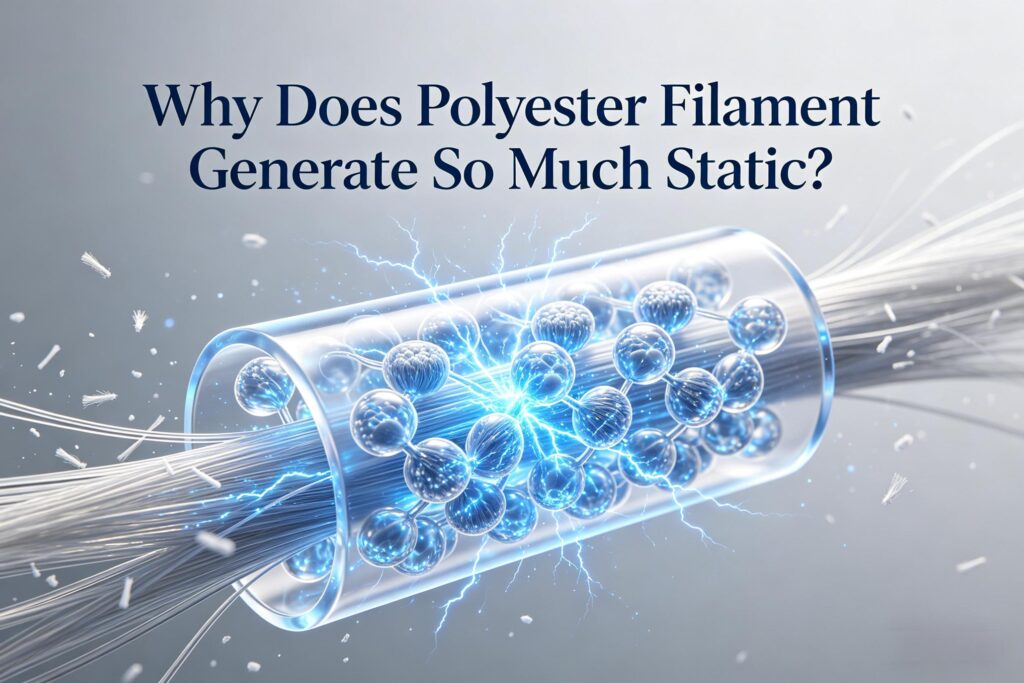
At its core, static electricity on polyester is a manifestation of the triboelectric effect. This is the process by which electrical charges are generated when two different materials come into contact and are then separated.
- Contact: When polyester filaments rub against metal guides, ceramic eyes, or even other fibers (like cotton in a blend), their surfaces make intimate contact.
- Charge Transfer: Due to differences in their innate ability to hold or donate electrons (their position on the Triboelectric Series), electrons are transferred from one material to the other.
- Separation: When the materials separate, one is left with a net positive charge (loss of electrons) and the other with a net negative charge (gain of electrons).
- Charge Accumulation: Polyester, being an excellent insulator, traps these charges on its surface. They cannot flow away, leading to a build-up of static electricity.
Key Fact: Polyester consistently ranks high on the triboelectric series as a material that readily becomes negatively charged when rubbed against common materials like metals or cotton.
3. Intrinsic Culprit #1: The Hydrophobic Nature of Polyester
The primary inherent reason for polyester’s static problem is its hydrophobicity. Polyester is a synthetic polymer (polyethylene terephthalate) with a molecular backbone that has no affinity for water.
- The Moisture Bridge: In natural fibers like cotton or wool, absorbed moisture from the atmosphere forms a thin, conductive layer on the fiber surface. This layer allows static charges to dissipate (leak away) harmlessly.
- The Polyester Reality: Polyester typically has a very low moisture regain (about 0.4% at 65% RH, compared to cotton’s 8-10%). This means its surface remains dry. Without this conductive pathway, any triboelectric charge generated is trapped, leading to a rapid and high-voltage static build-up.
4. Intrinsic Culprit #2: The Chemical Structure and High Electrical Resistance
The molecular design of polyester is a double-edged sword. The same aromatic ring structure that gives it strength, durability, and wrinkle resistance also makes it an exceptional electrical insulator.
- Volume Resistivity: This is a key metric for a material’s ability to impede electrical flow. Polyester filament can have a volume resistivity in the range of 10^14 – 10^16 ohm·cm. For context, a good conductor like copper is around 10^-6 ohm·cm. This astronomically high resistance is why charges remain localized on the fiber.
- Surface Resistivity: Similarly, the resistance to current flow along the material’s surface is extremely high, preventing charge dissipation across the fabric or yarn bundle.
5. The Processing Paradox: How Manufacturing Amplifies Static
The very processes that transform polyester chips into your final product are stages of intense static generation.
Table 1: Static Generation Points in Polyester Filament Processing
| Processing Stage | Action Causing Friction | Common Resulting Issue |
|---|---|---|
| High-Speed Spinning | Filament passing through guides and over rollers at 3,000-6,000 m/min. | Filament breakage, winding instability, “dancing” filaments. |
| Drawing & Texturizing | Severe mechanical deformation, fiber-to-fiber and fiber-to-heater contact. | Yarn entanglement, broken filaments, poor bulk development. |
| Weaving/Knitting | Yarn sliding through heddles, reeds, and needles at high speed. | Loom stoppages, needle line defects, flawed fabric structure. |
| Tufting (Carpets) | Yarn being pulled through creels and tufting needles. | Yarn tension variation, poor pile definition, stopped tufting machine. |
| Cutting & Sewing | High-speed blade contact and synthetic fabric passing over surfaces. | Fabric clinging to blades or tables, misalignment, operator discomfort. |
6. Environmental Triggers: The Role of Low Humidity
The ambient environment acts as a powerful amplifier or suppressor of static.
- The Inverse Relationship: Static propensity has an inverse relationship with Relative Humidity (RH). As RH drops, the air’s ability to hold moisture decreases, further depriving hydrophobic polyester of any chance for surface conductivity.
- Critical Threshold: Problems become severe and often unmanageable when RH falls below 40%. In air-conditioned factories or during winter months in temperate climates, RH can easily drop to 20-30%, creating a perfect storm for static disasters.
- Data Point: Studies show that the surface resistivity of polyester can increase by an order of magnitude (10x) when RH drops from 60% to 30%.
7. Quantifying the Problem: Data on Static’s Impact
Ignoring static has measurable costs that affect efficiency, quality, and safety.
Table 2: The Tangible Costs of Uncontrolled Static Electricity
| Impact Area | Specific Consequences | Estimated Operational Cost Impact |
|---|---|---|
| Production Efficiency | Machine stoppages, increased downtime for cleaning, slower line speeds. | Can reduce overall equipment effectiveness (OEE) by 5-15%. |
| Product Quality | Yarn/fabric defects (neps, bars, streaks), dust attraction, poor coating/adhesion. | Increases first-pass reject rates; requires additional inspection and rework. |
| Worker Safety & Comfort | Minor shocks leading to distraction; in extreme cases, risk of ignition in flammable atmospheres. | Potential for increased injury rates and lower worker morale/productivity. |
| End-User Experience | Garments clinging to the body, unpleasant shocks, rapid soiling of carpets/furnishings. | Leads to customer complaints, product returns, and brand reputation damage. |
8. Industry-Specific Solutions and Best Practices
A multi-pronged strategy is required to combat static effectively. The goal is to either prevent charge generation or facilitate its safe dissipation.
A. Chemical Solutions (The Most Common Approach):
- Spin Finishes & Topical Anti-Stats: Applied during fiber production or later finishing, these are surfactant-based chemicals that migrate to the fiber surface. They work primarily by absorbing atmospheric moisture, creating a conductive layer. Their effectiveness is highly humidity-dependent.
- Internal/Permanent Anti-Stats: These are compounds (e.g., polyethylene glycol-based polymers, ionic monomers) incorporated into the polymer melt before spinning. They provide a more durable, humidity-independent anti-static effect by creating a conductive network within the fiber itself.
B. Physical & Environmental Solutions:
- Humidity Control: Maintaining factory RH between 50-60% is the single most effective environmental control. This requires investment in proper humidification systems.
- Static Eliminators (Bars & Nozzles): These devices, placed at critical points on machinery, emit a stream of ionized air (positive and negative ions) that neutralizes the static charge on the passing material. They are highly effective and humidity-independent.
- Conductive Materials: Using grounded, conductive or antistatic materials for guides, rollers, and flooring can help drain charges away.
Solution Selection Guide:
| Solution Type | Mechanism | Pros | Cons | Best For |
|---|---|---|---|---|
| Topical Anti-Stats | Moisture absorption for surface conduction. | Low cost, easy application. | Temporary, washes out, humidity-dependent. | Short-term processing aid. |
| Internal Anti-Stats | Conductive pathways within the fiber. | Durable, wash-resistant, consistent. | Higher raw material cost, can affect other properties. | Premium carpets, technical textiles, medical fabrics. |
| Humidification | Increases air conductivity and fiber moisture layer. | Treats the root cause for the entire area. | High energy cost, maintenance, not localized. | Weaving, spinning halls. |
| Ionizing Bars | Emits ions to neutralize surface charge. | Immediate, precise, humidity-independent. | Requires power, periodic cleaning. | Critical points: slitting, winding, tufting. |
9. Future Trends: Innovations in Anti-Static Polyester
The industry is moving toward more sustainable and integrated solutions:
- Bio-based and Sustainable Anti-Stats: Development of anti-static agents derived from renewable resources to meet eco-certifications.
- Nanotechnology: Incorporation of conductive nanomaterials (e.g., carbon nanotubes, graphene oxide) at very low percentages to create fibers with inherent, permanent conductivity without affecting other properties.
- Smart Fibers: Research into fibers that can actively manage their surface energy or conductivity in response to environmental triggers.
10. Conclusion: Building a Static-Managed Supply Chain
For procurement managers and production heads, the question is no longer if static will be a problem, but how well it is managed. When evaluating polyester filament suppliers, move beyond basic price and denier specs. Inquire about their anti-static strategy:
- Do they offer filaments with internal anti-static properties for challenging applications?
- What is the humidity level in their winding and packing areas?
- Can they provide data on the surface resistivity of their yarns?
Proactively addressing static electricity is a strategic investment. It ensures smoother production flows, higher quality outputs, and superior end-products that meet the expectations of today’s discerning markets. By understanding the deep-seated reasons behind polyester’s static nature and implementing a tailored blend of solutions, you can transform this shocking challenge into a controlled, competitive advantage.
