
Table of Contents
1. Introduction: The Unseen Engineering in a Single Yarn
2. Decoding “300D”: The Language of Yarn Specification
3. The Chemical Genesis: From Petrochemicals to Polymer Chips
4. The Core Production Process: Melt Spinning of Filament Yarn
5. Post-Spinning Processes: Drawing, Texturing, and Finishing
6. Quality Assurance: The Metrics that Define Performance
7. Beyond Commodity: Specialty and High-Performance 300D Yarns
8. Partnering for Success: The Role of Specialized Suppliers like Glyarn
9. Conclusion: The Confluence of Chemistry, Engineering, and Partnership
1. Introduction: The Unseen Engineering in a Single Yarn
To the untrained eye, a spool of 300D polyester filament yarn appears as a simple, continuous thread. Yet, this unassuming material is the product of one of modern chemistry’s and precision engineering’s most sophisticated triumphs. It forms the hidden backbone of countless applications: from the durable fabric of your backpack and the resilient upholstery in your car to the safety components in parachutes and geotextiles. Understanding its production is not merely a technical exercise; it is essential knowledge for brands, product developers, and sourcing professionals who seek to innovate, ensure quality, and manage their supply chains intelligently. This article delves deep into the intricate journey of creating 300D polyester filament, demystifying the science and highlighting the critical control points that separate a generic yarn from a high-performance one.
2. Decoding “300D”: The Language of Yarn Specification
The term “300D” is a precise descriptor in the lexicon of textiles. “D” stands for Denier, a unit of linear mass density. Specifically, it indicates that 9,000 meters of this yarn weigh 300 grams. Therefore, a higher denier number (e.g., 600D, 1000D) signifies a thicker, heavier, and generally stronger yarn. However, denier alone does not tell the full story. It is often coupled with filament count—such as 300D/96F or 300D/192F—where “F” denotes the number of individual, ultra-fine filaments bundled together to form the single yarn. A higher filament count (e.g., 192F) yields a yarn that is softer, more pliable, and with a richer luster, ideal for premium apparel or fine upholstery. A lower filament count results in a stiffer, more robust yarn suited for technical applications. Grasping this nomenclature is the first step in specifying the exact material required for an end product.
3. The Chemical Genesis: From Petrochemicals to Polymer Chips
The story of 300D yarn begins not in a spinning mill, but in a petrochemical complex. The primary raw materials are Purified Terephthalic Acid (PTA) and Monoethylene Glycol (MEG). Through a controlled chemical reaction called polycondensation, these substances are linked together to form long-chain molecules of Polyethylene Terephthalate (PET). In this molten state, the polymer can be directly routed to spinning (a fully integrated process), or, more commonly, it is extruded, cooled, and cut into small, amorphous chips. These chips are the uniform feedstock for the spinning process. Their quality is paramount; the Intrinsic Viscosity (IV) of the polymer must be tightly controlled, as it directly influences the final yarn’s strength and processability. For specialized yarns, additives like TiO2 (delustrant) for a matte finish, optical brighteners, or spin finishes are introduced at this stage.
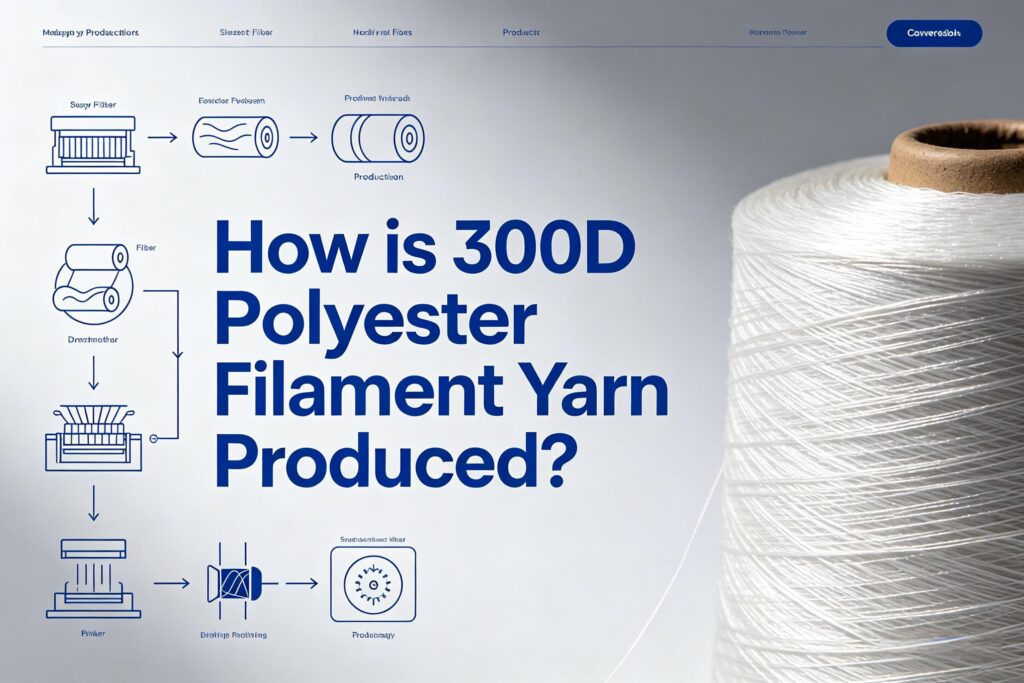
4. The Core Production Process: Melt Spinning of Filament Yarn
This is where engineering precision takes center stage. The polymer chips are fed into a series of specialized vessels:
- Drying: Chips are dried in a vacuum or dehumidified oven to remove all traces of moisture. Even minute amounts of water can cause hydrolytic degradation during melting, severely weakening the final yarn.
- Melting & Filtration: The dried chips are fed into an extruder, where they are heated to a precise temperature (typically 280-300°C) to become a viscous fluid. This melt is then forced through a series of fine metal filters to remove any gel particles or impurities that could cause filament breaks.
- Metering & Spinning: The purified melt is pumped under high pressure to the spinneret—a metal plate riddled with microscopic holes (e.g., 96 or 192 holes for our 300D example). As the melt extrudes through these holes, it forms a nascent thread of liquid polymer.
- Quenching & Solidification: The hot filaments immediately enter a cooling chamber, where a crossflow of conditioned air solidifies them into solid, continuous filaments. The speed and temperature profile of this quenching zone are critical for establishing the initial yarn structure.
5. Post-Spinning Processes: Drawing, Texturing, and Finishing
The yarn exiting the spinneret (known as Undrawn Yarn or UDY) is weak and highly extensible. It must be oriented to develop its strength.
- Drawing (Orientation): The yarn is drawn between sets of rollers running at progressively higher speeds. This mechanical stretching aligns the formerly chaotic polymer chains along the filament’s axis, dramatically increasing tenacity (strength) and reducing elongation. This process crystallizes the polymer, locking in its new, robust structure. The precise draw ratio determines the final yarn’s denier and mechanical properties.
- Texturing (for DTY): To create bulk, stretch, and a cottony feel, the drawn yarn (now called POY – Partially Oriented Yarn) undergoes texturing, often via false-twist texturing. This process heats, twists, and cools the yarn to set a crimped structure, resulting in Draw Textured Yarn (DTY).
- Heat Setting & Lubrication: The yarn is finally heat-set to stabilize its dimensions and eliminate internal stresses. A spin finish or coning oil is applied to provide lubrication, reduce static, and ensure smooth processing in subsequent weaving or knitting operations.
6. Quality Assurance: The Metrics that Define Performance
Throughout production, the yarn is subjected to relentless scrutiny. Key quality parameters include:
- Denier Consistency: Measured via online or laboratory denier scales to ensure it meets the exact 300D specification.
- Tenacity & Elongation: The yarn’s breaking strength and stretch are tested to meet application-specific standards (e.g., higher tenacity for luggage, controlled elongation for seat belts).
- Inter-filament Uniformity: Even dye uptake in fabrics depends on the consistent diameter of every single filament.
- Color & Luster: For undyed yarn, consistent whiteness and dullness (from TiO2) are checked.
- Oil Content & Moisture Regain: Precise levels are maintained for optimal downstream processing.
7. Beyond Commodity: Specialty and High-Performance 300D Yarns
The standard process can be engineered to create advanced materials:
- High-Tenacity (HT) Yarn: Produced with higher IV polymer and optimized drawing, used in technical applications.
- Microfilament Yarn: 300D yarn composed of an exceptionally high number of filaments (e.g., 300D/288F) for ultra-soft, silky fabrics.
- Solution-Dyed (Dope-Dyed) Yarn: Pigment is added to the polymer melt before spinning, creating yarns with superior color fastness to light and washing.
- Recycled (rPET) Yarn: Produced from recycled PET flakes, requiring advanced filtration and process adjustments to ensure consistent quality.
8. Partnering for Success: The Role of Specialized Suppliers like Glyarn
Navigating this complex technical landscape to source the right 300D yarn for a specific project is a significant challenge. This is where the expertise of a specialized supplier becomes invaluable. A supplier like Glyarn operates not merely as a broker but as a technical partner. They bridge the gap between end-users and the often-opaque manufacturing sector by:
- Technical Translation & Specification Matching: They help clients translate functional requirements (e.g., “a fabric that is abrasion-resistant, dyeable, and has a soft hand-feel”) into precise technical yarn specifications (e.g., “300D/144F, semi-dull, medium-tenacity DTY with a specific IV range”).
- Supply Chain Auditing & Quality Stewardship: They vet factories not just on price, but on their process control capabilities, quality management systems, and consistency. They can conduct pre-shipment inspections aligned with the critical parameters discussed in Section 6.
- Access to Specialized Production: For needs like dope-dyed colors, recycled content, or specific performance finishes, Glyarn can identify and engage mills with the appropriate technical niche, saving clients immense research time and risk.
- Managing Complexity & Volume: Whether a client needs a small-batch, custom yarn for product development or a large, consistent supply for full-scale production, a partner like Glyarn can structure the supply chain efficiently, handling logistics, documentation, and ensuring traceability.
9. Conclusion: The Confluence of Chemistry, Engineering, and Partnership
The production of 300D polyester filament yarn is a remarkable synthesis of polymer science, mechanical engineering, and meticulous process control. From the catalytic creation of PET to the high-speed precision of drawing and texturing, each step is calibrated to imbue the final thread with specific, predictable properties. For businesses, mastering this knowledge is power—it enables informed decision-making, fosters innovation in product design, and mitigates supply chain risk. Ultimately, succeeding in today’s market is not just about finding a supplier of yarn; it’s about forging a partnership with experts like Glyarn who possess both deep technical understanding of how yarn is made and the commercial acumen to deliver the right solution reliably. In the intricate world of synthetic fibers, such a partnership is not just an advantage; it is a strategic necessity.
