
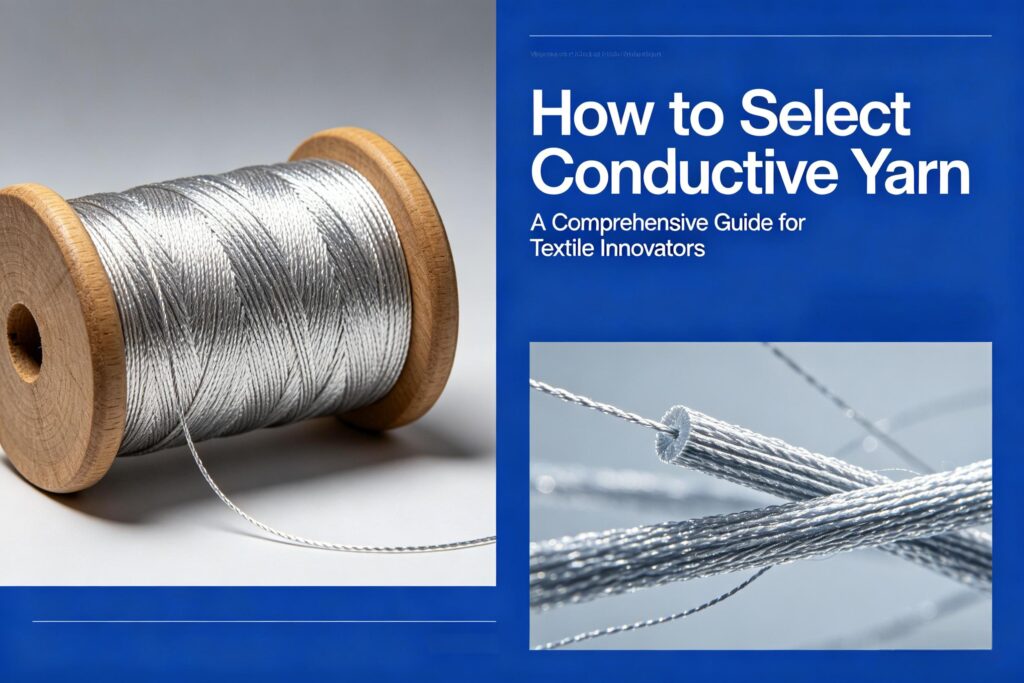
A Comprehensive Guide to Conductive Yarn Selection: Matching Technology to Application for Optimal Performance
Table of Contents
- Introduction: The Rise of Smart Textiles and the Core Role of Conductive Yarns
- Understanding the Core Technologies: A Breakdown of Conductive Yarn Types
- Navigating Key Performance Parameters: The Language of Specifications
- Strategic Selection Matrix: Matching Yarn to Application
- Ensuring Quality and Reliability: Standards, Testing, and Supplier Evaluation
- Industry Trends and Future Outlook
- Conclusion: A Framework for Confident Selection and Innovation
1. Introduction: The Rise of Smart Textiles and the Core Role of Conductive Yarns
The global textile industry is undergoing a profound transformation, moving beyond aesthetics and basic functionality to become an interactive, intelligent interface. Smart textiles—fabrics capable of sensing, responding to, and interacting with their environment or the user—are at the forefront of this revolution. This burgeoning market, driven by wearable electronics, healthcare monitoring, military applications, and the Internet of Things (IoT), is creating unprecedented demand for advanced materials, the most critical of which is conductive yarn.
Far from being a single, uniform product, conductive yarn encompasses a diverse family of technologies, each with distinct performance characteristics, costs, and ideal applications. Selecting the wrong type can lead to product failure, compromised functionality, or unsustainable costs. This guide provides international buyers, designers, and engineers with a clear, actionable framework for selecting conductive yarns. We will demystify the technical landscape, translate key specifications into business value, and provide a data-driven selection matrix to ensure your smart textile project is built on a foundation of optimal material choice. The global conductive fiber market, valued at approximately $3.17 billion in 2022, is projected to surge to $12.5 billion by 2032, reflecting a robust compound annual growth rate (CAGR) of 14.3%.
2. Understanding the Core Technologies: A Breakdown of Conductive Yarn Types
The first and most crucial step in selection is understanding the four primary technological pathways for creating conductive yarn. Each offers a different balance of conductivity, durability, hand feel, and cost.
2.1. Pure Metal Yarns (e.g., Silver, Copper, Stainless Steel)
These yarns are composed entirely of metallic fibers, often fine filaments bundled together.
- How They Work: They offer the highest intrinsic conductivity by providing a direct, low-resistance metallic pathway for electrons. For instance, a stainless steel conductive thread can have a resistance as low as 16 ohms per foot.
- Key Characteristics:
- Advantages: Excellent and stable conductivity (resistance can be ≤1Ω/m), high durability, and good electromagnetic shielding (EMI) performance.
- Challenges: Can be heavy, relatively inflexible, prone to corrosion (depending on metal), often have a metallic hand feel, and are typically the most expensive option. They may also present challenges in textile processing machinery.
2.2. Coated or Plated Yarns
These start with a conventional textile fiber core (e.g., polyester, nylon) which is then coated, plated, or laminated with a conductive layer, most commonly silver, copper, or nickel.
- How They Work: The conductive surface layer carries the electrical current, while the core provides the yarn’s mechanical strength and textile-like properties.
- Key Characteristics:
- Advantages: Better flexibility and hand feel than pure metal yarns, good conductivity (surface resistance can be very low), and often more cost-effective than solid metal. Performance hinges on coating uniformity and adhesion strength.
- Challenges: Conductivity can degrade if the coating wears, cracks, or corrodes over time, especially with washing or abrasion. Long-term durability can be a concern.
2.3. Intrinsically Conductive Polymer (ICP) Based Yarns
These fibers are created by blending or polymerizing conductive materials (like polypyrrole, PEDOT:PSS, or carbon-based substances) directly into the fiber matrix during the spinning process.
- How They Work: Conductivity is an inherent property of the fiber material itself, rather than a surface application. An example is the innovative FLEX™ Yarn, which uses carbonization or metallization fusion technology to embed conductive materials into polyester or nylon, achieving a wide resistivity range from 10⁻² to 10⁷ Ω/cm.
- Key Characteristics:
- Advantages: Excellent uniformity of conductivity, good integration with textile processes, durable conductivity that is less prone to washing off, and the ability to be dyed or treated like conventional yarns.
- Challenges: Conductivity is generally lower than pure metal or thick coatings. It can be sensitive to environmental factors like humidity and may have higher material costs for premium blends.
2.4. Composite or Blended Yarns
These yarns are created by physically blending or plying conductive filaments (e.g., stainless steel, carbon) with non-conductive natural or synthetic staple fibers (e.g., cotton, polyester).
- How They Work: The conductive filaments woven throughout the yarn structure create a network of conductive pathways. An interesting property of some knitted conductive yarns is that their resistance decreases when stretched, as the conductive fibers are pulled into closer contact, making them excellent for strain sensing.
- Key Characteristics:
- Advantages: The best hand feel and wearability, closely mimicking traditional textiles. They offer a good balance between conductivity and comfort.
- Challenges: Conductivity is variable and depends on the blend ratio and distribution of conductive elements. It is generally lower and less predictable than other types, making it less suitable for high-current or precise signal transmission applications.
3. Navigating Key Performance Parameters: The Language of Specifications
To make an informed choice, you must move beyond generic labels and understand the measurable parameters that define performance. Here are the most critical ones:
| Performance Parameter | What It Measures & Why It Matters | Typical Range & Considerations |
|---|---|---|
| Electrical Resistance (Ω/m or Ω/cm) | The opposition to current flow. Lower resistance = better conductivity. This is the single most important specification. | Low (<10 Ω/m):** Signal/power transmission (e.g., heating elements). Medium (10-10⁴ Ω/m):** Sensing, electrodes, static control. High (>10⁵ Ω/m): Limited to basic electrostatic dissipation. |
| Resistance Stability | How resistance changes under environmental stress (washing, bending, humidity, temperature). Critical for product longevity. | Standards like ISO 6330 define wash tests. Look for data on resistance change after 50 washes (target ≥95%) and bending fatigue tests. |
| Durability & Mechanical Properties | Tensile strength, abrasion resistance, and flexibility. Determines if the yarn can survive the textile manufacturing process and end-use. | Check elongation at break and abrasion resistance data. Composite yarns often score highest for traditional textile handling. |
| Environmental Compliance | Adherence to regulations on substances (e.g., REACH, RoHS) and sustainability (e.g., ESG goals). | Some advanced production methods, like the fusion technologies used for FLEX™ Yarn, are noted for being non-toxic and solvent-free, aligning with ESG principles. |
4. Strategic Selection Matrix: Matching Yarn to Application
The optimal yarn is defined by its end use. The following matrix provides a guideline for aligning yarn technology with application priorities.
| Primary Application | Key Requirements | Recommended Yarn Type(s) | Technical & Business Rationale |
|---|---|---|---|
| Signal & Power Transmission (e.g., connecting LEDs, sensors, heating circuits) | Very low and stable resistance, reliable connections. | Pure Metal Yarns (e.g., silver-plated copper), High-Performance Coated Yarns. | Provides the necessary current-carrying capacity with minimal voltage drop and power loss over distance. Pure metal offers the best performance for critical connections. |
| EMI Shielding (e.g., in military tents, data centers, 5G equipment) | High shielding effectiveness (measured in dB) across a frequency range. | Pure Metal Yarns, Densely Coated Yarns, Specialized ICPs. | Requires a continuous conductive surface to reflect/absorb electromagnetic waves. Fabrics woven from high-performance yarns like FLEX™ Fabric can achieve average shielding effectiveness of -70dB. |
| Static Control (e.g., cleanroom garments, electronics manufacturing) | Moderate, consistent conductivity to safely dissipate charge without being fully conductive. | Composite/Blended Yarns, Medium-Resistance ICPs. | Offers a safe level of conductivity to prevent electrostatic discharge (ESD) damage while maintaining comfort and wearability of workwear. |
| Sensing (e.g., pressure, stretch, biometric electrodes) | Controlled & variable resistance that changes predictably with strain, pressure, or moisture. | Composite Yarns, Stretchable Conductive Elastomers, Specialized ICPs. | The intrinsic property of these yarns to change resistance with physical deformation (e.g., resistance drops when a knitted conductive yarn is stretched) makes them ideal sensors. |
| Wearable Comfort & Aesthetics (e.g., smart apparel, everyday wearables) | Excellent hand feel, drape, washability, and breathability comparable to normal fabric. | Composite/Blended Yarns, Fine ICPs. | Prioritizes user comfort and seamless integration into fashion. The conductive elements are discreetly integrated, preserving the textile’s natural properties. |
5. Ensuring Quality and Reliability: Standards, Testing, and Supplier Evaluation
Prototyping with a sample spool is one thing; ensuring consistent, reliable performance in mass production is another. A rigorous approach to quality is non-negotiable.
- Leverage International Standards: Reference established testing protocols to specify and verify performance. Key standards include ISO 3915 for resistivity of conductive fabrics, ASTM D257 for DC resistance, and the newly implemented Chinese national standard GB/T 45370-2025 specifically for determining yarn electrical conductivity. For comprehensive quality control, standards like ASTM D6197 provide methods for classifying and counting faults in spun yarns during electronic testing.
- Demand Comprehensive Test Data: Reputable suppliers should provide detailed test reports from accredited laboratories (with CMA/CNAS, for example). These reports should cover not just initial resistance, but also performance under thermal aging, humidity cycling, and mechanical fatigue.
- Evaluate the Supplier as a Partner: Look beyond the product datasheet. Assess the supplier’s R&D capability (e.g., do they have proprietary technologies like CFT/MFT?), production consistency, and willingness to collaborate on custom solutions. A supplier that understands both textile engineering and electrical requirements is invaluable.
- Conduct Your Own Validation: Before finalizing a selection, subject yarn samples to your own application-specific tests, such as a washability trial or a flex life test that mimics the product’s use.
6. Industry Trends and Future Outlook
The conductive yarn market is dynamic, with several key trends shaping its future:
- Driving Demand: Growth is fueled by wearable health monitors, AI/device shielding needs, and military applications.
- Performance Frontiers: The race is on to develop yarns with higher conductivity, superior durability against washing and abrasion, and enhanced integration flexibility.
- Sustainability Focus: There is increasing pressure and desire for eco-friendly production processes and the use of recycled materials in conductive yarns, aligning with global ESG goals.
- Supply Chain Evolution: The industry is moving towards more integrated, efficient supply chains. Innovative models, such as industrial parks where upstream fiber production and downstream application manufacturing are co-located , are emerging to reduce costs and accelerate innovation.
7. Conclusion: A Framework for Confident Selection and Innovation
Selecting the right conductive yarn is a strategic decision that sits at the intersection of material science, electrical engineering, and textile design. There is no universal “best” yarn—only the best yarn for your specific application.
By systematically working through this framework—1) defining your primary functional need, 2) understanding the trade-offs between different core technologies, 3) specifying and validating key performance parameters, and 4) partnering with a capable, quality-focused supplier—you can de-risk the development process and build smart textile products that are both innovative and reliable.
The future of textiles is intelligent, and conductive yarns are the enabling threads of that future. Making informed, data-driven selections today is the key to weaving success tomorrow.
