
Introduction: The Foundational Choice in Polyester Sourcing
For textile industry professionals worldwide, the choice between polyester filament yarn (PFY) and polyester staple fiber (PSF) is one of the most consequential decisions in the product development and manufacturing process. This choice is not merely technical; it is a strategic business decision that determines cost structure, production efficiency, fabric aesthetics, performance, and market positioning.
From apparel factories seeking the perfect drape for a luxury blouse, to carpet manufacturers requiring durable bulk for high-traffic areas, to toy makers prioritizing a soft, plush hand feel, the fundamental properties of the chosen polyester form dictate success. Misidentifying or mis-specifying these materials can lead to costly production errors, substandard products, and failed market launches.
This comprehensive guide provides textile buyers, product developers, and quality control managers with a clear, actionable framework to distinguish between polyester filament and staple fiber. We will explore not only the “how” but also the critical “why,” linking physical characteristics to commercial outcomes.
Table of Contents
- Fundamental Definitions: Understanding the Core Difference
- Macroscopic & Physical Distinction Methods
- Performance-Based & End-Use Distinction
- Market Data, Cost Analysis, and Strategic Sourcing
- Advanced Quality Control and Verification Techniques
- Conclusion: Making the Right Choice for Your Product
1. Fundamental Definitions: Understanding the Core Difference
The distinction begins at the molecular and production level. Both originate from the same polymer—polyethylene terephthalate (PET)—but their manufacturing journeys diverge, creating two distinct material forms.
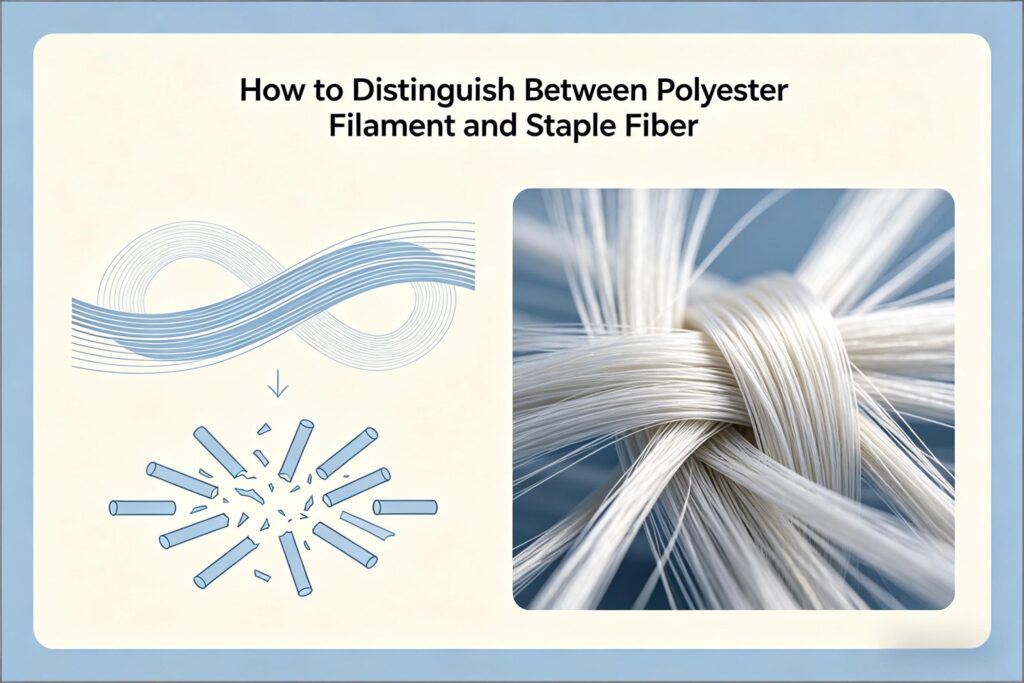
- Polyester Filament Yarn (PFY): Produced through a continuous process where molten polymer is extruded through a spinneret to form endless, parallel filaments. These filaments are collected as a bundle (multi-filament) or kept as a single strand (monofilament) on a bobbin. The result is a continuous, smooth, and coherent yarn with high inherent strength and uniformity. Types include POY (Partially Oriented Yarn), FDY (Fully Drawn Yarn), and DTY (Draw Textured Yarn).
- Polyester Staple Fiber (PSF): Also begins as continuous filament, but this filament tow is deliberately cut or broken into short, discrete lengths—typically ranging from 24mm to 150mm. These short fibers must then be spun, using processes similar to cotton or wool spinning (ring spinning, open-end spinning), to twist them together into a yarn. This process introduces air pockets and creates a discontinuous, fibrous yarn with a completely different surface texture.
The Core Takeaway: Filament is continuous and engineered; staple is discontinuous and processed. This single fact creates a cascade of differentiating properties.
2. Macroscopic & Physical Distinction Methods
The most immediate and accessible methods for differentiation involve simple visual and tactile inspection. These are crucial first-line checks for incoming goods or fabric analysis.
Table 1: Physical and Visual Comparison at the Yarn & Fiber Level
| Characteristic | Polyester Filament Yarn (PFY) | Polyester Staple Fiber (PSF) |
|---|---|---|
| Visual Appearance (Yarn) | Smooth, shiny, lustrous surface. Filaments lie parallel; the yarn looks like a single, coherent, and sleek thread. | Dull, fuzzy, or matte appearance. Fibers protrude from the core (hairiness). Resembles traditional spun yarns like cotton. |
| Tactile Hand Feel | Smooth, cool, and sometimes slippery. Can feel synthetic or silky. | Softer, warmer, drier, and more wool- or cotton-like. Has more grip and texture. |
| Yarn Structure (Under Magnification) | Long, uninterrupted filaments running the yarn’s entire length. No visible fiber ends within the yarn bundle. | Multiple short fibers twisted together. Many loose fiber ends are visible protruding from the yarn core. |
| Tensile Test (Simple Pull) | High tenacity, less elongation. When it breaks, it tends to snap cleanly. | Lower tenacity, higher elongation. The break is less abrupt as fibers slip and pull apart. |
| Burn Test (CAUTION: Controlled Lab Setting) | Melts and shrinks from flame, forms a hard, round, black or brown bead. Smell of sweet chemical or vinegar. | Melts and shrinks, may curl away from flame, forms a hard, irregular bead. Same chemical smell, but the fuzzy ends may burn slightly more readily. |
Key Practical Test: The “Pull a Fiber” Test. Gently pluck a single fiber from the yarn.
- Filament: You will pull out a very long, if not entire, continuous strand. It seems endless.
- Staple: You will extract a short, discrete fiber, typically between 32mm and 150mm in length. Trying to pull further just yields another short fiber.
3. Performance-Based & End-Use Distinction
The physical differences manifest directly in fabric performance, dictating which material is suited for a given application. This is where the strategic sourcing decision is made.
Table 2: Performance Profile & Primary Application Matrix
| Performance Attribute | Polyester Filament Yarn (PFY) | Polyester Staple Fiber (PSF) | Impact on End-Use |
|---|---|---|---|
| Strength & Durability | Exceptionally High. Continuous filaments share load efficiently. Abrasion resistant. | Good, but lower. Strength depends on spin twist; fibers can pull apart. More prone to pilling. | PFY: Seatbelts, conveyor belts, high-tenacity fabrics. PSF: General apparel where extreme strength is not critical. |
| Moisture Wicking | Poor (Hydrophobic). Smooth surface offers little capillary action for liquid. | Moderate to Good. Fiber ends and gaps between spun fibers create capillary channels. | PFY: Often used in “wicking” fabrics only when modified with micro-channels or special cross-sections. PSF: More naturally effective in blends for sportswear. |
| Cover & Opacity | Poor. Smooth, parallel filaments pack tightly, creating a sheer fabric unless very high denier or textured. | Excellent. Fibers are randomly arranged, trapping air and light, yielding a fuller, more opaque fabric. | PFY: Sheer curtains, linings, lightweight garments. PSF: Blankets, fleece, upholstery, carpets, where bulk and coverage are key. |
| Pilling Tendency | Very Low. No loose fiber ends to entangle and form pills. | Moderate to High. Loose fiber ends work free and ball up, especially in abrasion zones. | A critical factor for casual knitwear and furnishings. Filament-based knits (microfleece) pill less than staple-based ones. |
| Dyeability & Luster | Can achieve very bright, deep shades and a high, sometimes metallic, luster. | Produces softer, more muted shades with a matte, natural luster. | PFY: High-fashion, athletic wear with vibrant colors. PSF: Apparel mimicking natural fibers (cotton, wool). |
| Compressional Resilience (Bulk) | Low, unless specially textured (like DTY). Compresses flat. | Very High. Loftier, springier, better insulation due to air pockets. | PSF is dominant in: Carpets (for bulk and recovery), Fiberfill for pillows/jackets, Plush Toys (for soft, squeezable volume). |
Industry-Specific Guidance:
- Apparel (Shirting, Blouses): Filament (FDY) gives a smooth, luxurious drape. Staple (or blends) gives a softer, breathable, cotton-like hand.
- Carpets: Staple fiber is almost universal for cut-pile carpets due to its superior bulk, opacity, and resilience. Filament BCF (Bulk Continuous Filament) is used for loop-pile and some commercial carpets for high durability.
- Plush Toys & Home Textiles: Staple fiber is essential for the soft, fuzzy, cuddly texture. Filament would produce a flat, smooth, and often scratchy fabric unsuitable for this application.
4. Market Data, Cost Analysis, and Strategic Sourcing
The choice has direct financial implications beyond the simple cost-per-kilogram.
Cost Structure:
- PFY Production: A capital-intensive, continuous, high-speed process. Economies of scale are massive. The cost is in the polymer and the sophisticated extrusion/drawing technology.
- PSF Production: Involves the additional steps of cutting/breaking and then re-spinning. This adds labor, energy, and time. While the initial fiber may be cheaper, the conversion to yarn adds cost.
Market Data Insight: While commodity pricing fluctuates, PSF yarn typically carries a 10-25% premium over an equivalent denier PFY due to the added processing. However, this is not an apples-to-apples comparison, as they are used for different purposes.
Strategic Sourcing Questions:
- What is the primary function of my end product? (e.g., Durability vs. Softness, Drape vs. Bulk)
- What is the target aesthetic and hand feel? (e.g., Sleek & modern vs. Natural & cozy)
- What are the key performance requirements? (e.g., Pilling resistance, moisture management, insulation)
- What is my total cost framework? Consider not just yarn cost, but also processing efficiency (e.g., filament weaves faster with fewer breaks) and final product value.
5. Advanced Quality Control and Verification Techniques
For contractual validation and resolving disputes, laboratories use definitive methods.
- Microscopy: The most conclusive method. A standard optical microscope will clearly show continuous filaments versus short, spun fibers with twisted structure.
- Fiber Length Analysis: Using a comb sorter or automated system (e.g., HVI). This will quantitatively measure the distribution of fiber lengths, confirming the presence of staple fiber.
- Documentary Verification: Always demand the Mill Test Certificate (MTC). It must state the product as either “Polyester Filament Yarn” with details on denier, filament count, and type (FDY/DTY), or “Polyester Staple Fiber” with details on cut length, denier per filament, and spin finish.
6. Conclusion: Making the Right Choice for Your Product
Distinguishing between polyester filament and staple fiber is a blend of simple observation and deep understanding of end-use requirements. The “how” is accessible to any professional: inspect, feel, and test. The “why” is what separates competent buying from strategic sourcing.
Remember this rule of thumb:
- Choose Polyester Filament (PFY) when you need strength, smoothness, durability, sleek aesthetics, or specific technical performance (like in uniforms, activewear, linings, or high-performance gear).
- Choose Polyester Staple Fiber (PSF) when you need softness, bulk, warmth, opacity, a natural fiber aesthetic, or compressional resilience (like in knitwear, carpets, blankets, plush toys, and fiberfill).
By systematically applying the framework outlined in this guide—from initial physical checks to performance analysis and cost evaluation—you can ensure that the polyester you source is perfectly engineered for your product’s success, providing maximum value to your supply chain and your end customer.
