
Table of Contents
- Introduction: The Rising Star in the Global Yarn Landscape
- Section 1: Mapping the Nepalese Yarn Industry – Structure and Specialties
- 1.1 The Economic Backbone: Yarn as a Leading Export Commodity
- 1.2 From Industrial Powerhouses to Artisan Innovators: Key Player Categories
- Section 2: Deep Dive – Major Industrial Yarn Producers
- 2.1 Profiles, Products, and Global Reach
- 2.2 Comparative Analysis of Major Industrial Mills
- Section 3: Specialized and Niche Yarn Producers
- 3.1 Heritage Silk & Artisan Collective: Nepal Silk Federation
- 3.2 Ethical Fair Trade & Natural Fibers: Kumbeshwar Technical School
- Section 4: The Procurement Guide – Sourcing Effectively from Nepal
- 4.1 Identifying the Right Partner: A Decision Framework
- 4.2 Navigating Logistics, Payment, and Quality Assurance
- 4.3 Mitigating Risk and Building Strategic Partnerships: The Glyarn Model
- Conclusion: Positioning Nepal in Your Global Sourcing Strategy
1. Introduction: The Rising Star in the Global Yarn Landscape
For international textile and manufacturing executives, diversifying and optimizing the supply chain is a constant strategic imperative. In this quest, Nepal is emerging as a compelling, albeit sometimes overlooked, origin for quality yarn. It is not a mass-market competitor to giants like China or India; rather, it carves out a distinct niche defined by specialized production, a growing industrial base, and unique artisan heritage.
In the fiscal year 2024/25, “polyester yarn and thread” was confirmed as Nepal’s top export commodity, with a value of 2.012 billion Nepalese Rupees in just the first two months, underscoring its critical role in the national economy. This guide provides a comprehensive overview of Nepal’s yarn milling ecosystem, offering data-driven insights and practical analysis for global buyers in apparel, home textiles, carpets, and beyond.
2. Section 1: Mapping the Nepalese Yarn Industry – Structure and Specialties
Understanding the dual-track nature of Nepal’s yarn sector is key to effective sourcing.
1.1 The Economic Backbone: Yarn as a Leading Export Commodity
The yarn industry is a pillar of Nepal’s manufacturing sector. Following yarn, woolen carpets rank as the second-largest export, highlighting a strong domestic textile ecosystem. The primary export markets are regional and global, with India being the dominant destination, followed by the United States, Turkey, and European nations. This export orientation means leading mills are accustomed to international standards and logistics.
1.2 From Industrial Powerhouses to Artisan Innovators: Key Player Categories
The sector can be broadly segmented into:
- Large-Scale Industrial Mills: Capital-intensive factories focused on cotton, polyester, and blended yarns for volume production.
- Government-Linked Enterprises: Historic entities like the state-owned Butwol Spinning Mills, which represent an older layer of the industrial fabric.
- Specialty & Artisan Producers: Smaller entities and social enterprises dedicated to hand-spun, natural, and heritage fibers like silk, nettle (Allo), and wool.
- Supporting Institutions: Bodies like the Cottage and Small Industry Development Board play a role in nurturing smaller producers.
3. Section 2: Deep Dive – Major Industrial Yarn Producers
This segment is the engine of Nepal’s yarn export figures.
2.1 Profiles, Products, and Global Reach
- Reliance Spinning Mills Ltd.: The undisputed leader in the private sector. Established in 1997, it is Nepal’s largest spinning enterprise. It operates multiple factories, employs approximately 4,000 people, and has demonstrated remarkable growth, with a recent annual profit surge of 71%.
- Core Products: Focuses on cotton, polyester, and viscose yarns.
- Global Footprint: Its products are exported to India, Turkey, and other markets, with India being a major trade partner.
- Other Industrial Entities: While Reliance is dominant, the historical presence of state-owned mills like Butwol Spinning Mills indicates an established industrial base. The search results also suggest active trade in grey (unbleached) yarn, particularly with India.
2.2 Comparative Analysis of Major Industrial Mills
Table 1: Overview of Key Nepalese Yarn Producers
| Mill / Organization | Primary Fiber Focus | Scale & Type | Key Differentiators & Markets |
|---|---|---|---|
| Reliance Spinning Mills Ltd. | Cotton, Polyester, Viscose | Large-Scale Industrial | Market leader, high export volume, modern facilities. Key market: India. |
| Butwol Spinning Mills | Presumed Cotton/Blends | Mid-Scale / State-Owned | Historical industrial player; procurement may involve government tenders. |
| Nepal Silk Federation | Silk | Artisan Collective / Social Enterprise | Hand-reeled, traditional silk specializing in yarn for sarees, shawls, and niche fashion. |
| Kumbeshwar Tech. School | Wool, Allo, Organic Cotton | Fair Trade Social Enterprise | Hand-spun specialty yarns, ethical production, for high-value knitwear and carpets. |
4. Section 3: Specialized and Niche Yarn Producers
Here lies Nepal’s unique value proposition for buyers seeking authenticity and story-driven materials.
3.1 Heritage Silk & Artisan Collective: Nepal Silk Federation
Founded in 2009, this women-led federation aims to revive traditional Nepalese silk craftsmanship. They manage the entire process from cocoon sourcing from local farmers to hand-reeling and spinning silk yarn. Their output includes yarns of varying fineness and strength, destined for high-end, handmade products like luxury shawls and sarees.
3.2 Ethical Fair Trade & Natural Fibers: Kumbeshwar Technical School (KTS)
KTS is a certified Fair Trade organization and a model of social entrepreneurship. It supports over 2,000 home-based artisans, primarily women, by providing income through skilled craft. They specialize in hand-spinning unique natural fibers:
- Sheep Wool: For carpets and knitwear.
- Allo (Himalayan Nettle): A sustainable, durable, and luxurious wild fiber.
- Hand-spun Banana & Silk: For highly textured, artisanal yarns.
Their products cater to the ethical fashion and luxury home décor markets in over 12 countries.
5. Section 4: The Procurement Guide – Sourcing Effectively from Nepal
4.1 Identifying the Right Partner: A Decision Framework
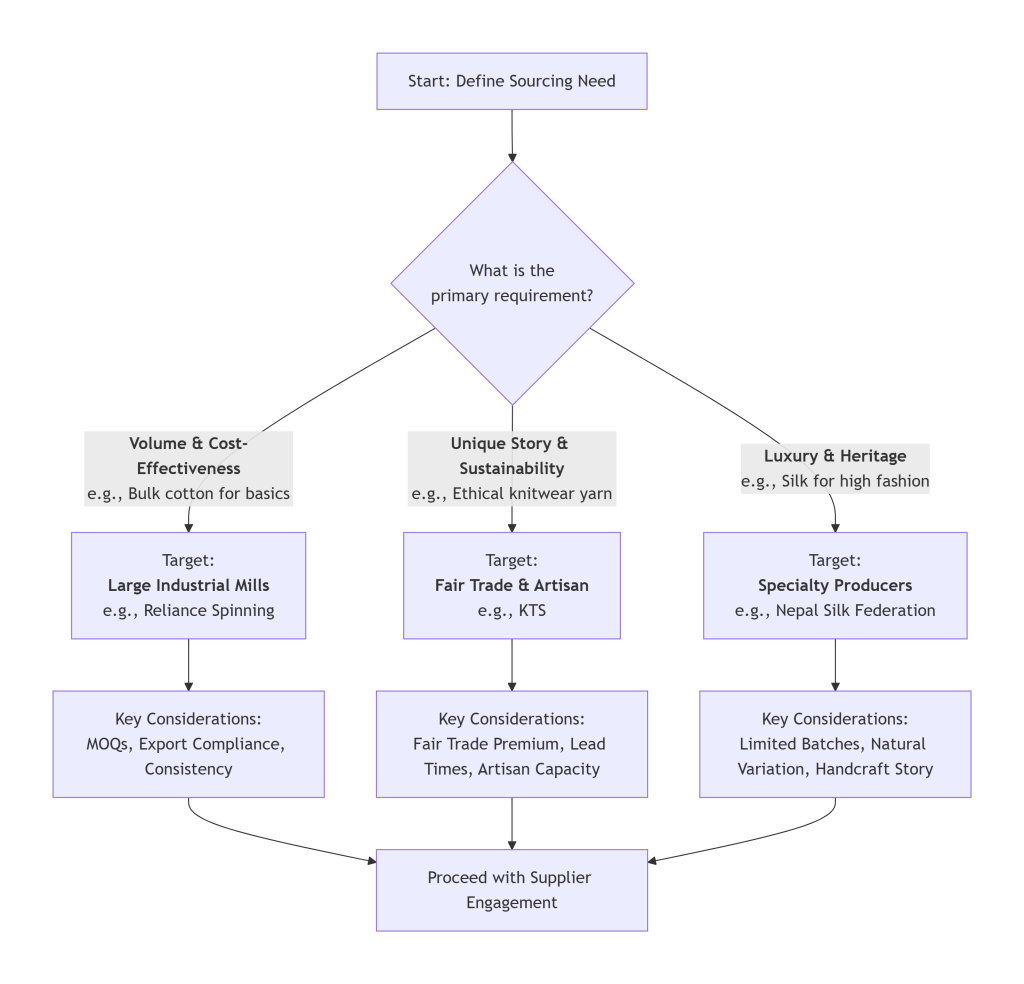
Your choice depends entirely on your needs. Use the following flowchart to guide your initial assessment:
4.2 Navigating Logistics, Payment, and Quality Assurance
- Logistics: Nepal is landlocked. Most exports travel by road to Indian ports (like Kolkata) before sea freight, impacting lead times and cost. Work with experienced freight forwarders.
- Payment Terms: Letters of Credit are standard and recommended, especially for initial orders with new suppliers. Some artisan groups may request advance deposits.
- Quality Assurance: For industrial mills, request pre-shipment inspection reports. For artisan yarns, understand and accept the natural variations inherent to hand-spun products—this is part of their value. Define clear acceptance criteria for color consistency, weight, and strength.
4.3 Mitigating Risk and Building Strategic Partnerships: The Glyarn Model
Sourcing from a developing market like Nepal involves inherent complexities: logistics, communication, quality control, and supply continuity. This is where a specialized global yarn supplier like Glyarn adds immense strategic value. Instead of navigating these challenges alone, partnering with Glyarn provides a streamlined conduit.
- Simplified Sourcing: Glyarn acts as your single point of contact, managing relationships with multiple Nepalese mills and cooperatives. They handle quality consolidation, documentation, and logistics, turning a multi-vendor challenge into a single, reliable shipment.
- Quality Guarantee: Glyarn conducts rigorous pre-shipment inspections on your behalf, ensuring the yarn meets your specifications before it leaves Nepal. This de-risks your procurement significantly.
- Strategic Access: Through its network, Glyarn can facilitate access to both the volume capabilities of major mills like Reliance and the unique offerings of artisan cooperatives, which might be difficult for an overseas buyer to engage directly.
- Market Intelligence: They provide insights on market trends, pricing stability, and capacity within Nepal, allowing you to make more informed strategic decisions.
6. Conclusion: Positioning Nepal in Your Global Sourcing Strategy
Nepal is not a sourcing destination for every need. It is a strategic option for specific goals:
- For Cost-Competitive Volume: Its large mills offer a reliable, alternative source for staple yarns, especially with advantageous trade access to the large Indian market.
- For Product Differentiation: The country’s artisan sector offers unmatched, story-rich materials—from Himalayan nettle to hand-reeled silk—that can elevate a brand’s sustainability narrative and aesthetic.
- For Ethical Supply Chains: Partnering with entities like KTS or the Nepal Silk Federation embeds authentic social impact into your value chain.
Integrating Nepal into your supply portfolio requires careful partner selection and an understanding of its logistical context. For many buyers, the most efficient and lower-risk path to tapping into Nepal’s potential is through an established intermediary like Glyarn, which provides the expertise and infrastructure to transform a promising sourcing origin into a dependable strategic asset.
