
Table of Contents
- Introduction: A Tale of Two Textile Philosophies
- 1.1 Defining the Paradigms: Synthetic Precision vs. Natural Evolution
- 1.2 Thesis: An Informed Choice, Not a Default
- Fiber Genesis: From Polymer Pellets to Cotton Bolls
- 2.1 Polyester Filament: Engineered Consistency
- 2.2 Washed Cotton: Enhanced Natural Fiber
- Structural Analysis: The Blueprint of Fabric Performance
- 3.1 Molecular Architecture and Its Impact
- 3.2 Yarn Structure and Fabric Construction
- Performance Benchmarking: Data-Driven Comparison
- 4.1 Physical and Mechanical Properties
- 4.2 Aesthetic and Sensory Qualities
- 4.3 Care, Durability, and Environmental Interaction
- 4.4 Comparative Analysis Table: Polyester Filament vs. Washed Cotton
- Cost and Value Analysis: From Mill to Market
- 5.1 Raw Material and Manufacturing Economics
- 5.2 Total Cost of Ownership (TCO) and Application-Specific Value
- Strategic Application Guide: Matching Fiber to Function
- 6.1 When to Specify Polyester Filament: Performance-Driven Scenarios
- 6.2 When to Specify Washed Cotton: Experience-Driven Scenarios
- 6.3 Hybrid Strategies: Blending for Optimal Outcomes
- Conclusion: Building a Rational Fabric Sourcing Strategy
1. Introduction: A Tale of Two Textile Philosophies
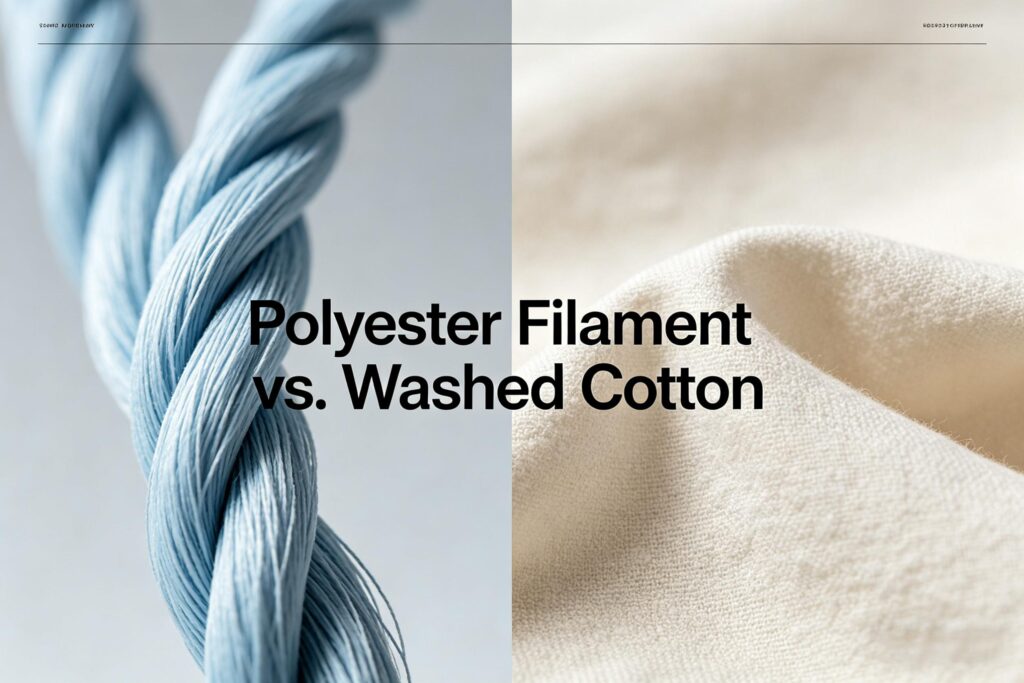
For textile procurement managers and product developers, the choice between Polyester Filament and Washed Cotton is more than a simple material selection; it is a strategic decision between two fundamentally different textile philosophies. One represents the pinnacle of synthetic engineering—predictable, high-performance, and efficient. The other embodies the enhanced natural aesthetic—valued for its comfort, breathability, and evolved, lived-in character. This guide will dissect these materials not as competitors, but as specialized tools, providing a clear, data-driven framework to select the right fiber for the right application, maximizing value for your end product.
2. Fiber Genesis: From Polymer Pellets to Cotton Bolls
- 2.1 Polyester Filament: Engineered Consistency
Polyester filament begins as purified terephthalic acid (PTA) and monoethylene glycol (MEG), derived from petroleum. Through polymerization, these are transformed into polyethylene terephthalate (PET) chips. These chips are melted and extruded through a spinneret to form continuous, indefinite-length filaments. This process allows for precise control over every parameter: denier (fineness), cross-section (round, trilobal), luster (bright to full-dull), and tenacity. The result is a fiber of flawless consistency, batch after batch. - 2.2 Washed Cotton: Enhanced Natural Fiber
Washed cotton starts as a natural staple fiber—the seed hair of the Gossypium plant. Its length, fineness, and strength vary by species (e.g., Supima, Egyptian, Upland). “Washed” is not a fiber type but a finishing process applied to cotton yarn or fabric. It involves controlled washing, enzyme treatments, and sometimes light brushing or tumbling to pre-shrink the material and impart a soft, slightly wrinkled, relaxed hand-feel and appearance. The goal is to give new fabric the comfortable, broken-in character of a well-loved garment from day one.
3. Structural Analysis: The Blueprint of Fabric Performance
- 3.1 Molecular Architecture and Its Impact
- Polyester: Its polymer chains are highly symmetrical and crystalline, creating strong molecular bonds. This gives polyester its exceptional strength, resilience, and hydrophobic (water-repelling) nature. Moisture sits on the fiber’s surface, leading to quick drying.
- Cotton: Composed of cellulose, a natural polymer. Its structure is more amorphous and hydrophilic, with abundant -OH groups that readily form hydrogen bonds with water molecules. This makes cotton highly absorbent (moisture regain ~8.5%) but also prone to swelling, shrinking, and slower drying.
- 3.2 Yarn Structure and Fabric Construction
- Polyester Filament Yarn: Comprised of continuous filaments, resulting in a smooth, dense, and strong yarn. Fabrics have a sleek surface, inherent wrinkle resistance, and can be woven into very tight, lightweight constructions (e.g., microfiber taffeta).
- Cotton Yarn (used for washed cotton): A spun yarn made by twisting together short staple fibers (typically 25-45mm). This creates a yarn with inherent hairiness and porosity, translating to a softer, more textured, breathable, but less lustrous fabric. The washing process further enhances this softness and adds dimensional stability.
4. Performance Benchmarking: Data-Driven Comparison
Table 1: Comparative Analysis: Polyester Filament vs. Washed Cotton
| Performance Attribute | Polyester Filament | Washed Cotton | Key Implication for Selection |
|---|---|---|---|
| Tensile Strength | Very High (4.5-7.0 g/den) | Moderate (2.5-4.5 g/den) | Polyester is superior for durable, high-stress applications (bags, activewear, uniforms). |
| Moisture Management | Hydrophobic / Quick-Drying (Regain: <0.4%) | Hydrophilic / Absorbent (Regain: ~8.5%) | Cotton for sweat absorption (towels, base layers); Polyester for moisture-wicking and fast dry (rainwear, sportswear). |
| Wrinkle Recovery | Excellent | Poor to Fair (improved slightly by washing) | Polyester maintains a crisp look with minimal care; Washed cotton embraces a casual, wrinkled aesthetic. |
| Abrasion Resistance | Excellent | Good | Polyester lasts longer in high-friction applications (upholstery, backpack straps). |
| Dimensional Stability | Excellent (Low Shrinkage) | Good (after pre-washing) | Washed cotton is pre-shrunk, but polyester is inherently stable, crucial for precise garment sizing. |
| Hand Feel & Aesthetics | Smooth, sleek, can feel “cool” or “synthetic.” | Soft, dry, textured, breathable, “natural.” | A primary sensory differentiator. Washed cotton wins for casual comfort; polyester for technical or sleek looks. |
| Color Fastness | Excellent (Disperse dyes bond well) | Very Good (Reactive dyes, but can fade) | Polyester holds vibrant colors longer, especially to washing and UV light. |
| Care & Maintenance | Easy. Machine wash/dry, low iron. | Requires more care. Can shrink, wrinkle, may need ironing. | Polyester reduces care costs for end-user (e.g., hotel linens, uniforms). |
5. Cost and Value Analysis: From Mill to Market
- Raw Material Volatility: Cotton prices are subject to agricultural volatility (weather, pests, harvest yields, trade policies). Polyester feedstock (PTA/MEG) is tied to petrochemical markets, offering different risk profiles.
- Manufacturing Efficiency: The continuous filament spinning process for polyester is extremely efficient and high-speed. Cotton requires multiple steps: ginning, carding, drawing, spinning (ring or open-end) to turn staple into yarn, which is generally more resource-intensive.
- Total Cost of Ownership (TCO): For commercial buyers, TCO extends beyond fabric cost-per-meter.
- Polyester: Lower care costs, higher durability, and color retention can lead to longer product lifespan in applications like hospitality or workwear.
- Washed Cotton: The washing/tumbling finish adds a process cost. While the fabric may have a higher initial cost and lower durability, its premium natural feel commands higher prices in casual apparel and home textiles.
6. Strategic Application Guide: Matching Fiber to Function
- 6.1 Specify Polyester Filament When:
- Performance is Critical: Outerwear shells, sportswear, swimwear, luggage, high-performance uniforms.
- Durability & Longevity are Paramount: Upholstery for high-traffic areas, contract textiles, flags, banners.
- Low Maintenance & Consistent Appearance are Required: Hotel bedding, healthcare curtains, corporate uniforms.
- Complex, Lightweight Constructions are Needed: Ultra-fine linings, microfiber suede, technical membranes.
- 6.2 Specify Washed Cotton When:
- Natural Comfort & Breathability are the Primary Sell: Premium t-shirts, loungewear, casual shirts, bed linens, baby clothing.
- A Casual, Lived-In Aesthetic is Desired: The entire “soft wash” and “vintage” apparel categories.
- Skin Sensitivity or Natural Fiber Preference is a Market Demand: Organic and sustainable fashion lines.
- High Moisture Absorption is Needed: Towels, bathrobes, certain types of activewear like yoga wear.
- 6.3 Hybrid Strategies:
The Polyester-Cotton Blend (e.g., 65/35, 50/50) is a classic compromise, aiming to marry polyester’s strength and wrinkle resistance with cotton’s softness and absorbency. A washed poly-cotton blend fabric is extremely common, offering the easy-care and durability of polyester with the enhanced soft hand of the washed finish.
7. Conclusion: Building a Rational Fabric Sourcing Strategy
The choice between polyester filament and washed cotton is not about which is universally “better,” but which is optimally suited to deliver on the specific promises of your product.
- Polyester Filament is the engineered solution. Choose it when you need to guarantee performance, consistency, durability, and color fidelity. It is the workhorse for technical applications and cost-sensitive, high-volume contracts where lifecycle value is calculated.
- Washed Cotton is the experiential solution. Choose it when the primary value proposition is sensory comfort, natural breathability, and a specific, relaxed aesthetic. It caters to markets where tactile quality and natural origin justify a premium.
Informed sourcing requires moving beyond fiber stereotypes. By understanding the genesis, structure, and quantifiable performance data outlined here, procurement professionals can make strategic, defensible decisions. This knowledge enables you to precisely match material to application, optimize supply chain costs, and ultimately deliver superior value to your customers, whether they are seeking the reliable performance of high-tech polyester or the authentic comfort of softened, natural cotton.
