
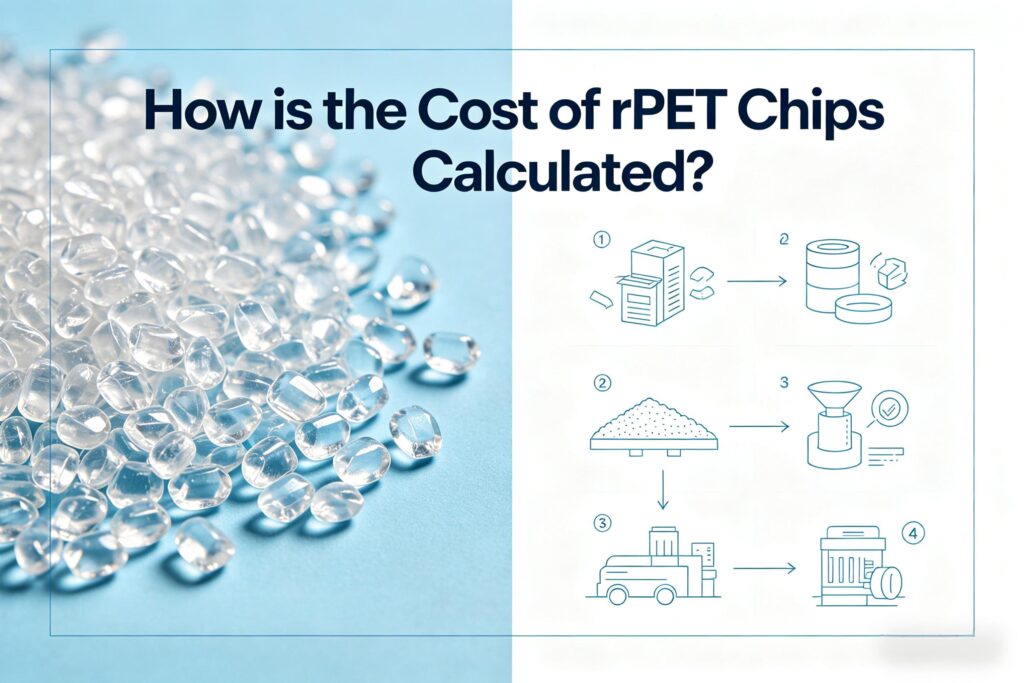
The global shift towards a circular economy has positioned recycled polyethylene terephthalate (rPET) as a critical raw material in the fight against plastic pollution. As demand from brands and regulators surges, understanding the cost structure of rPET chips—the foundational form of this recycled polymer—becomes paramount. Unlike commodities with straightforward pricing, the cost of rPET chips is a complex amalgamation of feedstock dynamics, energy-intensive processing, technological sophistication, and market-driven premiums. This article delves into the multifaceted components that constitute the final price of rPET chips, providing a detailed breakdown of its cost calculation.
I. Foundational Cost Drivers: The Raw Material Pipeline
The journey of an rPET chip begins long before it reaches the pelletizer. The cost of its feedstock, primarily post-consumer PET bottles, forms the volatile and often most significant portion of the total expense.
- Post-Consumer Bale Pricing: The primary raw material is sorted and baled PET bottles, known as “PET bales.” Their price is highly elastic and influenced by:
- Collection & Sorting Infrastructure: Regions with efficient deposit return schemes (DRS) or advanced municipal collection yield higher volumes of clean, sorted material, potentially lowering collection costs per ton. Regions relying on informal collection networks face different cost and supply dynamics.
- Supply and Demand Imbalance: Local and global demand for rPET directly pressures bale prices. Legislative mandates (e.g., recycled content targets) can create bidding wars, driving costs up.
- Bale Quality and Composition: A bale consisting of 99% clear, single-layer PET bottles commands a premium over a mixed-color bale contaminated with caps, labels, and other plastics. The yield—the percentage of usable PET flake from the bale—is a critical factor.
- Geopolitical and Logistical Factors: Export restrictions, shipping costs, and tariffs can create regional price disparities. For instance, Southeast Asian import policies have historically influenced global bale markets.
- Yield Losses and Yield-Adjusted Cost: A critical calculation in cost analysis is the yield-adjusted feedstock cost. Not all purchased bale weight becomes rPET flake. Losses occur from:
- Non-PET Materials: Caps (polypropylene), labels (PP, paper), glue, residues, and other plastics are removed and sold as lower-value stream or incur disposal fees.
- Moisture: Bales can contain significant moisture, which is weight paid for but not converted to product.
- Processing Losses: Inefficiencies in washing, sorting, and extrusion lead to further PET material loss.
- Calculation: If a ton of PET bales costs $500 and the processing yield is 70%, the effective cost of usable PET flake is approximately $500 / 0.70 = $714 per ton. This adjusted figure is the true starting material cost.
II. Processing Costs: The Energy-Intensive Transformation
Converting dirty, sorted bales into clean rPET chips requires significant capital investment and operational expenditure (OpEx).
- Pre-processing and Washing: This stage involves grinding bottles into flakes and a multi-stage hot wash to remove contaminants, adhesives, and food residues. Costs include:
- Energy: Thermal energy for hot water and drying is substantial.
- Water & Effluent Treatment: Large water volumes are used, requiring extensive (and costly) filtration and wastewater treatment systems to meet environmental standards.
- Chemicals: Specialty detergents and washing aids add to costs.
- Deep Cleaning and Decontamination (For Food-Grade): To produce chips suitable for direct food contact, “super-clean” processes are essential. These are major cost drivers:
- Solid-State Polycondensation (SSP): This energy-intensive reactor process increases the intrinsic viscosity (IV) and removes volatile contaminants. It requires high temperatures, vacuum/inert gas, and long residence times, contributing heavily to energy and capital costs.
- Advanced Filtration: Melt filtration systems with fine screens (e.g., 75-150 microns) and polymer filters remove microscopic impurities but require maintenance and screen changes.
- Vacuum Extrusion: Specialized extruders operating under vacuum strip off volatiles and odors.
- Pelletizing and Finishing: The final steps of extruding the melt, underwater or strand cutting, drying, and packaging.
- Labor, Maintenance, and Overhead: Skilled technicians, quality control labs, plant maintenance, and general administrative costs are distributed across production volume.
III. Quality and Specification Premiums
Not all rPET chips are equal. Their price is stratified based on technical specifications:
- Food-Grade vs. Non-Food Grade: Food-grade rPET, certified to meet FDA or EFSA standards, carries a significant premium (often 20-40% or more) over non-food grade chips intended for fibers or strapping.
- Color: Clear/transparent chips are the most valuable, followed by light blue, green, and finally mixed-color/off-white chips.
- Intrinsic Viscosity (IV): High-IV chips (e.g., ≥0.80 dl/g) from SSP processes are priced higher than standard or low-IV chips.
- Consistency and Certification: Suppliers with consistent quality, reliable supply, and third-party certifications (e.g., UL, SCS) can command higher prices.
IV. Market Dynamics and Macroeconomic Factors
The final price is ultimately set by the market, influenced by:
- Virgin PET Resin Price: rPET price is intrinsically linked to virgin PET. It typically trades at a discount, but during supply crunches or high oil prices, the discount can narrow significantly or even invert for premium food-grade rPET.
- Legislation and Policy: Mandatory recycled content laws create guaranteed demand, supporting prices. Tax incentives or extended producer responsibility (EPR) fees can indirectly subsidize or affect costs.
- Corporate Sustainability Commitments: Brand pledges (e.g., 100% recycled packaging) create long-term demand contracts, offering price stability but also competing for limited supply.
- Energy Costs: As an energy-intensive industry, fluctuations in natural gas and electricity prices directly impact processing costs.
V. A Simplified Cost Calculation Model
A hypothetical cost build-up for 1 metric ton of food-grade clear rPET chips might look like this:
- Feedstock Cost: Purchase of PET bales: $600/ton
- Yield Adjustment (70% yield): $600 / 0.70 = $857/ton
- Processing Costs:
- Pre-washing & Flaking: $80
- Super-Clean Processing (SSP, Filtration): $250
- Pelletizing, Energy, Labor: $150
- Total Processing: $480/ton
- Fixed Costs & Overhead (Capital depreciation, admin): $120/ton
- Total Production Cost (2+3+4): $1,457/ton
- Margin: A target margin of, for example, 15%: $219/ton
- Target Selling Price: ~$1,676/ton
This price would then be adjusted based on current virgin PET price (e.g., $1,200/ton), market demand for food-grade rPET, and contractual agreements.
Conclusion
Calculating the cost of rPET chips is not a simple arithmetic exercise. It is a dynamic analysis that intertwines the volatile commodities market for waste bales, the technical and energy costs of sophisticated purification, and the premiums commanded by quality and regulatory compliance. As the industry evolves with chemical recycling and improved collection, the cost structure may shift. However, the fundamental equation will remain: the price of rPET is the price of building a circular system—a reflection of the costs to collect, clean, and restore value to what was once considered waste. For brands and investors, understanding this calculus is essential for making sustainable and economically viable decisions in the plastic value chain of the future.
