
Introduction
In the global pursuit of sustainability and a circular economy, recycled polyethylene terephthalate (rPET) has emerged as a cornerstone material. rPET chips are the foundational, granular form of this recycled polymer, produced by processing post-consumer or post-industrial PET waste—primarily bottles and containers—through collection, sorting, cleaning, and reprocessing. These chips are the vital raw material for manufacturing new products, reducing reliance on virgin plastic, lowering carbon emissions, and tackling plastic pollution. However, not all rPET chips are the same. Their properties, value, and applications are determined by source material, processing technology, and purification levels. This article provides a comprehensive classification of rPET chips, exploring their types based on color, intrinsic viscosity, purification level, and end-use applications.
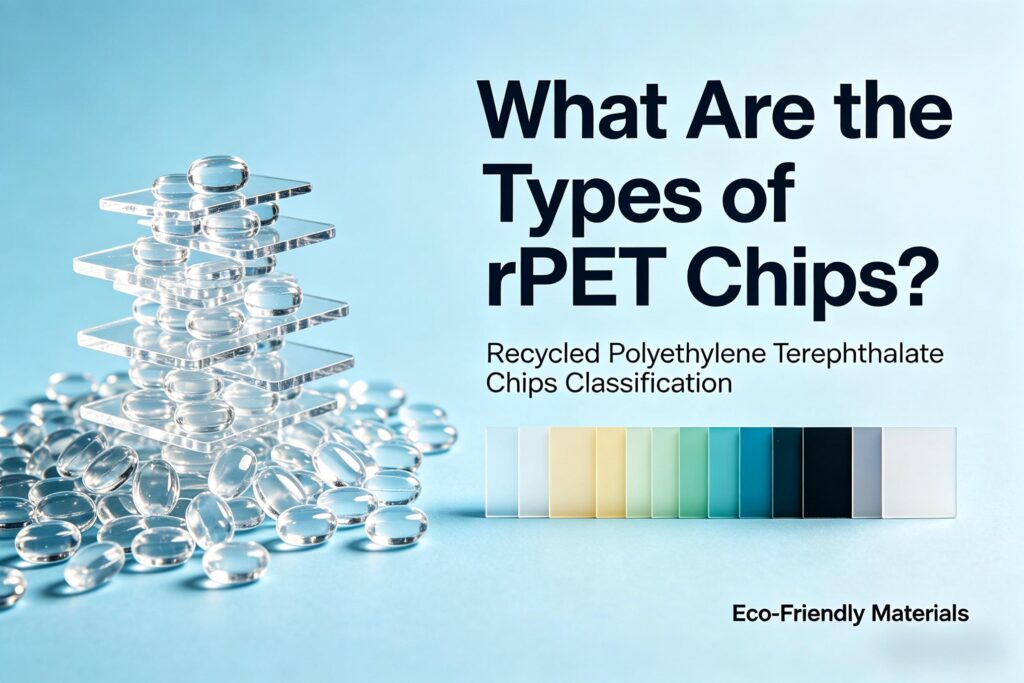
1. Classification by Color and Appearance
Color is a primary and commercially critical differentiator, directly affecting the chip’s market value and suitable applications.
- Clear/Transparent rPET Chips: The most premium grade. Produced from colorless post-consumer PET bottles (e.g., water, clear soda bottles) through stringent cleaning and advanced decontamination processes to remove impurities and minimize yellowing. Their clarity rivals that of virgin PET.
- Primary Applications: Food-contact packaging (especially new beverage bottles), high-quality transparent sheets, and clear blisters.
- Light Blue rPET Chips: Sourced predominantly from blue-tinted PET bottles, commonly used for bottled water. The chips retain a characteristic light blue hue. They may be processed separately or blended.
- Primary Applications: Bottles for non-food items (detergents, cosmetics), fibers for textiles, and engineering applications where color is not a constraint.
- Green rPET Chips: Derived from green PET bottles. Similar to blue chips, they are often kept in a separate stream to maintain color consistency.
- Primary Applications: Non-food packaging, strapping, and fibers. Sometimes used in a mix to create specific colored end-products.
- Mixed Color (Off-White/Brown) rPET Chips: Result from recycling a mix of colored PET bottles (green, blue, amber, etc.). The blending creates a muted, often off-white, light brown, or greyish pellet.
- Primary Applications: Non-food applications where color is unimportant, such as polyester staple fiber (for carpets, filling, geotextiles), strapping, and sheet for non-visual parts.
- Opaque/White rPET Chips: These can be achieved through two methods: 1) Using a high percentage of naturally opaque white PET (e.g., from milk bottles) or 2) Adding titanium dioxide (TiO2) or other whitening agents during the extrusion process.
- Primary Applications: Food containers that require opacity, cosmetic packaging, and technical parts where a bright white appearance is needed.
2. Classification by Intrinsic Viscosity (IV)
Intrinsic Viscosity measures the molecular chain length and, therefore, the material’s strength and suitability for different processing methods. During recycling, PET’s IV drops due to thermal and mechanical degradation.
- High IV rPET Chips (≥ 0.80 dl/g): Undergo a process called Solid-State Polycondensation (SSP) after standard melting and extrusion. SSP increases the molecular weight and IV, restoring the material’s mechanical properties.
- Primary Applications: High-performance applications like new bottle preforms (especially for carbonated drinks), engineering plastics, and high-strength films.
- Medium IV rPET Chips (0.65 – 0.80 dl/g): Represent the standard grade from most mechanical recycling processes without SSP. They possess good mechanical properties for many applications.
- Primary Applications: Fibers for textiles and carpets, non-food containers, thermoformed sheets for clamshells, and strapping.
- Low IV rPET Chips (< 0.65 dl/g): Result from multiple recycling loops or harsh processing conditions. Shorter polymer chains limit strength.
- Primary Applications: Lower-value applications such as fiberfill for insulation, padding (e.g., in jackets, furniture), and non-woven fabrics.
3. Classification by Purification and Decontamination Level
This is the most crucial classification for food-contact safety and high-value applications.
- Super-Clean or Food-Grade rPET Chips: Produced using state-of-the-art “super-clean” recycling technologies. These processes (e.g., enhanced washing, vacuum extrusion, filtration, polymer melt filtration) rigorously remove organic contaminants, volatiles, and non-PET materials. The final chips meet stringent international food safety standards (FDA, EFSA).
- Primary Applications: Direct food-contact packaging, including bottles for beverages, water, and food trays. Can often be used in direct contact with food without a functional barrier.
- Non-Food Grade rPET Chips: Have undergone standard washing and extrusion but do not meet the purity benchmarks for direct food contact. They may contain higher levels of non-PET materials or contaminants.
- Primary Applications: The vast majority of applications listed earlier: fibers, strapping, sheets for non-food items, technical parts, and construction materials.
4. Classification by Physical Form and Processing
- Amorphous rPET Chips: Cooled rapidly after extrusion, resulting in a clear, low-crystallinity chip. They have a lower melting point and are easier to dry and process in subsequent molding.
- Primary Applications: Often the intermediate form before SSP or used directly for sheet extrusion.
- Crystalline rPET Chips: Treated with a crystallizing process, giving them a opaque, white appearance and higher heat resistance. They are less prone to clumping during drying.
- Primary Applications: Commonly fed into SSP reactors or used in processes requiring higher thermal stability.
5. Classification by Source Material
- Post-Consumer rPET (PCR): Derived from used products collected through municipal or deposit systems (bottles, containers). This is the most common and environmentally beneficial type, diverting waste from landfills.
- Post-Industrial rPET (PIR): Derived from manufacturing waste (e.g., trim, off-spec preforms, rejected bottles) generated during the production of virgin PET products. It is typically very clean and homogeneous but contributes less to solving post-consumer waste.
Conclusion
The world of rPET chips is diverse and specialized. From the premium clear food-grade pellets to the versatile mixed-color chips for fibers, each type serves a specific purpose in the value chain. Understanding the classifications—by color (clear, blue, green, mixed), intrinsic viscosity (high, medium, low), purification level (food-grade vs. non-food grade), and form—is essential for manufacturers, brand owners, and policymakers. This knowledge enables the optimal matching of recycled material to application, ensuring technical performance, regulatory compliance, and maximized environmental benefit. As recycling technologies like chemical recycling advance, the spectrum of rPET chips will further broaden, enhancing quality and closing the loop more effectively for a truly circular plastic economy.
