
Article Directory
- Introduction: The Critical Role of Industrial Gloves in Manufacturing
- Beyond Hand Protection: Gloves as a Critical Production Tool
- Polyester Filament Gloves: The Versatile Workhorse
- The High Cost of Poor Quality: Downtime, Injury, and Product Damage
- Chapter 1: Decoding the Material – The Foundation of Quality
- 1.1 Polyester Filament 101: Denier, Filament Count, and Tenacity
- 1.2 Source Material Quality: Virgin vs. Recycled PET and Its Impact
- 1.3 Key Material Property Tests: Breaking Strength, Elongation, Abrasion Resistance
- 1.4 Data Table: Material Specifications vs. Performance Outcomes
- Chapter 2: Construction & Craftsmanship – Where Durability is Built
- 2.1 Knitting Technology: Seamless vs. Linked Seam, Gauge (Needle Count)
- 2.2 Critical Examination Points: Cuff Finish, Stitching Integrity, Finger Construction
- 2.3 The Importance of Consistent Tension and Uniform Stitch Density
- 2.4 Comparison Table: Construction Methods and Their Failure Points
- Chapter 3: Fit, Comfort & Dexterity – The Ergonomics of Performance
- 3.1 Sizing Accuracy and Consistency Across a Batch
- 3.2 Surface Texture: Smooth vs. Grippy Finishes
- 3.3 Breathability and Moisture Management
- 3.4 Dexterity Rating Systems and Practical Tests
- Chapter 4: Performance for Specific Applications
- 4.1 For Assembly & Electronics: Anti-Snag, Linting, and ESD Considerations
- 4.2 For Textile & Apparel Handling: Protection from Oils, Dyes, and Snags
- 4.3 For Light Material Handling & Packaging: Abrasion and Tear Resistance
- 4.4 Application-Specific Selection Matrix
- Chapter 5: The Procurement Audit – A Step-by-Step Quality Checklist
- 5.1 Visual Inspection Protocol
- 5.2 Tactile and Physical Stress Tests (The “Pull and Stretch” Test)
- 5.3 In-Use Trial Design for Batch Evaluation
- 5.4 Supplier Qualification: What to Ask and Verify
- Chapter 6: Beyond the Glove – Total Cost of Ownership (TCO)
- 6.1 Calculating Cost-Per-Use: The Real Metric
- 6.2 Impact on Production Line Efficiency and Error Rates
- 6.3 Data Table: Good vs. Poor Quality Glove TCO Analysis
- Conclusion: Investing in Quality is Investing in Your Process
- Building a Partnership with Your Glove Supplier
- Key Takeaways for Procurement Professionals
- Frequently Asked Questions (FAQs)
The Definitive Guide to Specifying and Sourcing High-Quality Polyester Filament Gloves
1. Introduction: The Unseen Engine of the Production Line
In the intricate ecosystems of modern manufacturing—from delicate textile looms to bustling assembly lines—the humble work glove is more than mere personal protective equipment (PPE). It is a critical interface between human skill and material, a tool that directly influences productivity, product quality, and operator safety. Polyester filament gloves have emerged as a dominant category due to their excellent balance of durability, dexterity, and cost-effectiveness. However, a vast quality chasm separates premium gloves from substandard imitations. For procurement managers, the ability to distinguish between them is not a minor detail; it is a core competency that protects your bottom line. This guide provides the technical framework and practical toolkit to make informed, value-driven sourcing decisions.
2. Chapter 1: Decoding the Material – The Foundation of Quality
The journey to quality begins at the molecular level. Not all polyester is equal.
2.1 Polyester Filament Fundamentals:
- Denier: The linear mass density of the yarn. Common ranges for gloves are 100D to 300D. Lower denier (finer yarn) offers better dexterity; higher denier provides greater durability.
- Filament Count: The number of continuous fine fibers twisted into a single yarn. A higher filament count (e.g., 144-filament vs. 72-filament) typically results in a softer hand feel, better flexibility, and reduced linting.
- Tenacity: The strength of the yarn per unit denier, measured in grams-force per denier (gf/D). High-tenacity filament is essential for durability.
2.2 Source Material: Gloves made from virgin PET offer superior and consistent strength, elasticity, and cleanliness. Gloves incorporating recycled PET (rPET) can be eco-friendly but may exhibit lower tenacity, higher variation in dye affinity, and potential for inconsistent polymer viscosity leading to weak spots.
2.3 Key Material Tests:
- Breaking Strength: Measured in Newtons (N) for the finished glove or yarn. A quality glove should have a consistent, high breaking strength.
- Elongation at Break: Indicates stretch before failure. A moderate, controlled elongation (e.g., 15-30%) is desirable for fit and tear resistance.
- Abrasion Resistance (Martindale or Taber Tests): Measures how many cycles the material can withstand before a hole forms.
2.4 Data Table: Material Specifications & Performance Linkage
| Material Specification | Typical Range for Quality Gloves | Impact on Glove Performance |
|---|---|---|
| Yarn Tenacity (gf/D) | 6.5 – 8.5+ | High tenacity = Superior cut/abrasion resistance, longer lifespan. |
| Filament Count | 96 – 144 filaments | Higher count = Softer feel, better drape, less lint, improved dexterity. |
| Denier (Single Yarn) | 150D – 250D | Lower denier = Finer, more dexterous. Higher denier = Heavier duty. |
| Use of Virgin Polymer | >95% for critical apps | Virgin PET = Consistent strength, reliable performance, low contamination risk. |
3. Chapter 2: Construction & Craftsmanship
A perfect yarn can be ruined by poor manufacturing.
3.1 Knitting Technology:
- Seamless (Circular Knit): The highest standard for general-purpose gloves. Eliminates seams that can chafe, snag, or fail. Provides uniform comfort and strength.
- Linked Seam (Flat Knit & Sewn): A cheaper method where the glove is knit flat and a seam is sewn around it. This seam is a primary failure point, prone to unraveling and causing discomfort.
3.2 Critical Examination Points:
- Cuff: Should be smoothly finished, with a comfortable rolled or elasticated edge that stays put without binding.
- Stitching (on seamed gloves): Look for small, tight, and consistent stitches. Loose or looping threads indicate poor quality control.
- Fingertips: The area of highest wear. Inspect for reinforced knitting or double-layering in premium gloves. Fingertips should be smoothly shaped without holes or loosely knit areas.
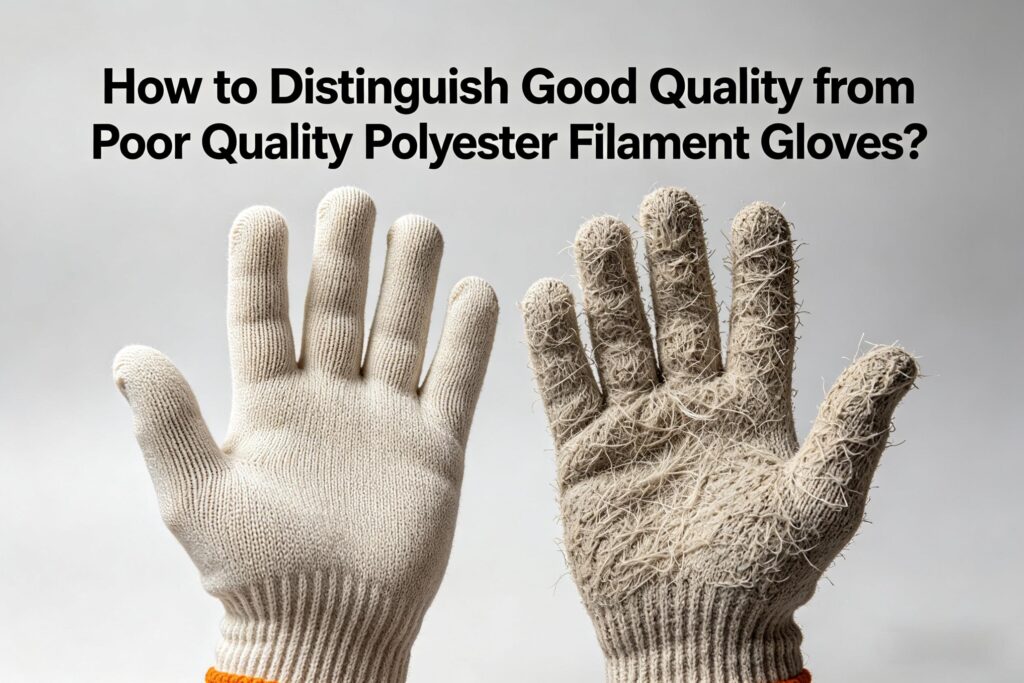
3.3 Tension and Density: The knit should be even and consistent throughout. Hold the glove up to the light. You should not see large, inconsistent gaps (“drop stitches”). Consistent stitch density ensures uniform protection and durability.
4. Chapter 3: Fit, Comfort & Dexterity
A glove that isn’t worn is 100% ineffective.
4.1 Sizing: Quality manufacturers adhere to standardized sizing charts (e.g., ANSI/ISEA). Gloves within a batch should be identical in size. Poor quality shows high size variance, leading to ill-fitting gloves that hamper work.
4.2 Surface Texture: Options range from smooth finishes for handling polished metals or electronics to polyurethane (PU) coated dots/palms for enhanced grip in packaging or material handling.
4.3 Breathability: A tight, non-porous knit traps sweat, causing discomfort and reducing wear time. A quality knit balances density with breathability.
5. Chapter 4: Application-Specific Performance
5.1 Electronics & Precision Assembly: Require low-linting (to avoid contaminating circuits), anti-snag smooth finishes, and sometimes ESD (Electrostatic Discharge) properties. High-filament count, seamless construction is key.
5.2 Textile & Apparel Handling: Must protect fabrics from oils on hands and prevent snags on delicate materials. A clean, smooth, lint-free finish is critical.
5.3 Light Industrial/Packaging: Focus shifts to abrasion resistance for handling cartons and enhanced grip for secure handling. PU dots or palm coatings are common.
6. Chapter 5: The Procurement Audit – Your Hands-On Checklist
Before placing a bulk order, conduct this audit:
- Visual: Check for consistency in color, finish, and size. Inspect seams, cuffs, and fingertips under good light.
- Tactile: Feel for uniformity. Stretch the glove gently in all directions. It should recover its shape without distortion. Feel for rough spots or loose threads inside.
- Destructive Test (Sample): Take a sample glove and try to deliberately tear it at the cuff or finger. A quality glove will resist significantly. Pull on individual fingers with steady force.
- In-Use Trial: Provide a sample batch to a representative production team. Gather feedback on comfort, durability over a shift, and any issues with grip or snagging.
7. Chapter 6: Total Cost of Ownership – The True Measure of Value
Never judge a glove by its unit price alone.
6.1 Cost-Per-Use: This is the ultimate metric.
* Low-Quality Glove: $0.50 per pair, lasts 1 shift. CPU = $0.50.
* High-Quality Glove: $1.20 per pair, lasts 5 shifts. CPU = $0.24.
The “cheaper” glove costs more than twice as much to use.
6.2 Impact on Efficiency: Poor-fitting, uncomfortable, or poorly gripping gloves slow down workers, increase error rates (e.g., dropping parts), and lead to more frequent changes, stealing valuable production time.
8. Conclusion: An Investment, Not an Expense
Specifying high-quality polyester filament gloves is a strategic procurement decision. It directly reduces your total operating costs, minimizes production disruptions, and safeguards your most valuable asset: your workforce. Move beyond price-based sourcing and build a partnership with a supplier who understands your application and can provide consistent, certified quality.
9. Frequently Asked Questions (FAQs)
Q1: What is the single most telling visual check for glove quality?
A: Hold it up to the light and examine the knit consistency. A uniform, dense stitch structure without glaring holes or “runs” indicates good manufacturing control. Also, inspect the inside for loose threads or knots.
Q2: Are thicker polyester gloves always better?
A: Not necessarily. Thickness (often related to denier) increases durability but sacrifices dexterity and tactile sensitivity. The key is matching the thickness to the application. For precision work, a finer, high-filament count glove is superior.
Q3: How important is the country of origin on the label?
A: It is less about the country and more about the specific factory’s quality management systems. A reputable supplier, regardless of location, will have transparent processes and certifications (like ISO 9001). Always qualify the supplier, not just the country.
Q4: Can we get by with recycled PET gloves for all applications?
A: For non-critical, general material handling, rPET gloves can be a good sustainable choice. For applications requiring high strength, low linting, or consistent chemical resistance (e.g., handling certain oils), virgin PET gloves are recommended for performance reliability.
Q5: What does “gauge” mean in glove specifications?
A: Gauge indicates the number of knitting needles per inch in the machine. A higher gauge (e.g., 10-gauge, 13-gauge) means finer needles and a tighter, smoother, more dexterous knit. A lower gauge (e.g., 7-gauge) is coarser and heavier duty.
Q6: How should we test for linting?
A: Rub the glove vigorously against a dark, smooth fabric (like black velvet or a suit sleeve). A high-quality, low-lint glove will deposit very few visible fibers. A poor-quality glove will shed significantly.
Q7: What’s the difference between seamless and “seamfree” gloves?
A: “Seamless” is the correct technical term for circular knit gloves with no seam. “Seamfree” is often a marketing term used for flat-knit gloves where the seam is designed to be less obtrusive, but it is still present and remains a potential weakness.
Q8: Do polyester filament gloves offer any cut resistance?
A: Very minimal. Standard polyester filament gloves are designed for abrasion resistance, dirt/debris protection, and grip. They are not rated for cut protection. For applications with sharp edges, you must specify gloves engineered with cut-resistant fibers (e.g., HPPE, aramid).
Q9: How can we ensure grip quality?
A: For coated gloves, the PU or rubber dots/palm should be firmly bonded and not peel off easily. Test the grip on a dry and lightly oiled surface relevant to your workplace. The coating should enhance friction without being overly tacky.
Q10: Our workers complain of sweaty hands. What should we look for?
A: Prioritize gloves made from high-filament count yarn, which creates a more breathable fabric structure. Also, ensure the knit is not overly tight. Some manufacturers offer styles with micro-ventilation or cotton-blended liners for improved moisture management.
