
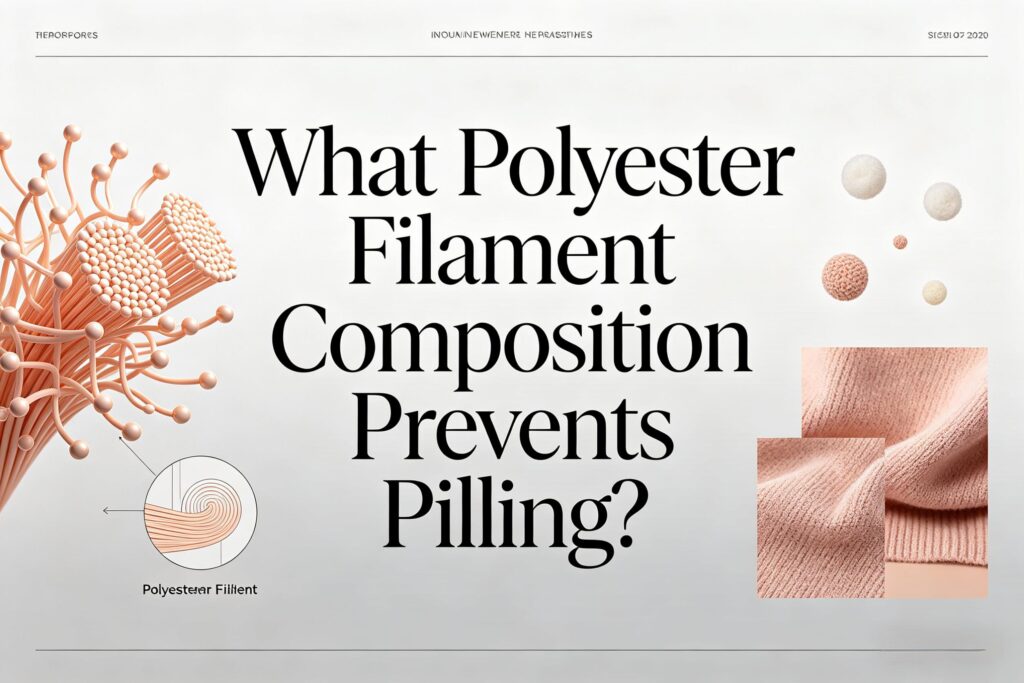
Article Outline: The Ultimate Guide to Pilling Resistance in Polyester Filament Fabrics
- Introduction: The Pilling Problem – Cost, Quality, and Customer Satisfaction
- Understanding the true impact of pilling on brands and manufacturers.
- From single-fiber engineering to fabric construction: A systems approach to pilling.
- Debunking the myth: Is there a single “magic” percentage?
- The Science of Pilling: How and Why Polyester Fabrics Pill
- The Three-Stage Process: Fuzz Formation, Entanglement, Pill Maturation & Wear-Off.
- Key Culprits: Fiber Properties vs. Fabric Construction vs. End-Use Stress.
- Why Polyester is Particularly Prone: Strength and Flexibility as a Double-Edged Sword.
- Fiber-Level Engineering: The First Line of Defense
- Intrinsic Viscosity (IV) and Molecular Weight: The Foundation of Strength.
- Cross-Sectional Geometry: How Trilobal, Octalobal, and Hollow Fibers Reduce Migration.
- Table 1: Impact of Fiber Properties on Pilling Potential.
- Filament vs. Staple: The Inherent Advantage of Continuous Filament.
- The Role of Finishes: Spin Finishes and Lubricants for Reduced Friction.
- Yarn and Fabric Construction: Building Pill-Resistant Structures
- Yarn Twist: Finding the Sweet Spot (TPI – Turns Per Inch).
- Filament Count: The Relationship Between Fineness, Density, and Pilling.
- Fabric Weave and Knit Density: Why Tighter is Generally Better.
- Table 2: Fabric Construction Guidelines for Minimal Pilling.
- Blending Strategies: Can Adding Other Fibers (Nylon, Cotton) Help or Hurt?
- The Role of Chemical and Mechanical Finishing
- Anti-Pilling Chemical Treatments: Resins and Polymer Coatings.
- Mechanical Finishing Processes: Singeing, Shearing, and Bio-Polishing.
- Pros and Cons of Finishing: Durability vs. Environmental Impact.
- Testing and Standards: Quantifying Pilling Resistance
- Industry Standard Methods: Martindale (ISO 12945-2), Random Tumble (ASTM D3512).
- Interpreting Test Results: Understanding the 1-5 Pilling Grade Scale.
- Setting Your Specification: What Grade is “Good Enough” for Your Product?
- A Practical Guide for Procurement: Specifying Anti-Pill Polyester
- Table 3: Spec-by-Application Guide: Optimal Parameters for Common End Uses.
- Apparel (Activewear, Fleece, Suiting): Balancing Performance, Handfeel, and Durability.
- Home Textiles (Upholstery, Bedding): Demanding Requirements for High-Abrasion Use.
- Technical Textiles and Other Applications.
- Cost Considerations and Total Value of Ownership
- The Price of Performance: How Anti-Pill Features Affect Cost.
- Analyzing Failure: The True Cost of Customer Returns and Brand Damage.
- Future Trends and Innovations in Pilling Resistance
- Advanced Polymer Modifications and Nanotechnology.
- Sustainable Anti-Pilling Solutions.
- Conclusion and Key Takeaways: A Holistic Strategy for Pilling Prevention
- FAQ: Frequently Asked Questions
What Polyester Filament Composition Prevents Pilling? A Strategic Guide for Textile Professionals
1. Introduction: The Pilling Problem – Cost, Quality, and Customer Satisfaction
For sourcing managers and product developers, fabric pilling is not a minor aesthetic issue; it is a direct threat to product credibility, brand reputation, and profitability. Returns attributed to poor quality, of which pilling is a leading cause, can erode 3-8% of annual revenue for apparel brands. The question of “what composition prevents pilling” is therefore critical, but the answer is more complex than a simple percentage.
Pilling is a multi-factorial phenomenon. While fiber composition is fundamental, it is only one variable in an equation that includes yarn structure, fabric construction, finishing, and intended use. A 100% polyester fabric can be engineered to be highly pill-resistant, while a poorly constructed 50/50 blend can pill excessively. This guide moves beyond simplistic formulas to provide a technical, actionable framework for specifying truly durable polyester filament textiles.
2. The Science of Pilling: How and Why Polyester Fabrics Pill
Pilling is a wear process with three distinct stages:
- Fuzz Formation: Mechanical abrasion during wear and washing breaks fibers and forces loose ends to the surface.
- Entanglement: These loose fiber ends (fuzz) intertwine with each other due to continued friction.
- Pill Maturation & Wear-Off: The entangled ball becomes anchored by still-attached fibers, forming a visible pill. Depending on fiber strength, the pill may eventually break off.
Why Polyester is Problematic: Polyester’s great strength and flexibility work against it here. Unlike weaker fibers like cotton, where fuzz breaks away easily, polyester’s robust fibers hold onto pills tenaciously. The pills do not easily wear off, making them highly visible and persistent.
3. Fiber-Level Engineering: The First Line of Defense
The battle against pilling starts at the polymer and extrusion level.
- Intrinsic Viscosity (IV): This measures polymer chain length. Higher IV (e.g., >0.72 dl/g) indicates longer, stronger molecular chains. Stronger fibers resist breaking in the first stage (fuzz formation), drastically reducing pilling potential. Textile-grade filament typically ranges from 0.60-0.68 dl/g, while high-tenacity industrial yarns (>0.85 dl/g) show superior pill resistance.
- Cross-Sectional Geometry: The shape of the filament is crucial. Round fibers easily migrate from the yarn bundle. Modified cross-sections (trilobal, octalobal) create more friction and mechanical interlocking within the yarn, holding fibers in place.
- Filament vs. Staple: Continuous filament yarns are inherently more pill-resistant than spun staple yarns. Staple yarns, made from short fibers, have countless loose ends ready to become fuzz. Filament yarns have no ends except at the fabric’s edge.
Table 1: Impact of Fiber Properties on Pilling Potential
| Fiber Property | Favorable for Low Pilling | Unfavorable for Low Pilling | Mechanism |
|---|---|---|---|
| Strength / IV | High Tenacity, High IV | Low Tenacity, Low IV | Strong fibers resist breakage and fuzz formation. |
| Cross-Section | Trilobal, Octalobal, Hollow | Round | Increased inter-fiber friction reduces migration. |
| Fiber Type | Continuous Filament | Staple (Short Fibers) | No free ends to form fuzz. |
| Fineness (Denier per Filament – DPF) | Higher DPF (>3) | Lower DPF (<1 – microfilament) | Coarser, stiffer fibers are less prone to migration. |
4. Yarn and Fabric Construction: Building Pill-Resistant Structures
How fibers are assembled is equally important.
- Yarn Twist: Twist binds fibers together. Higher twist (e.g., 25-35 TPI for weaving yarns) significantly improves pill resistance by locking filaments in place. However, excessive twist can create a harsh handfeel and increase cost.
- Fabric Density: Whether woven or knitted, tighter constructions pill less. A higher thread count (e.g., 120×80 vs. 78×54) or a higher knit gauge reduces the space for fibers to migrate to the surface.
- Blending: Blending polyester with a fiber that breaks cleanly and sheds can help. For example, adding a small percentage of low-strength viscose can create pills that break off quickly. However, blending with another strong fiber like nylon often makes the problem worse, as both fibers hold the pill tightly.
Table 2: Fabric Construction Guidelines for Minimal Pilling
| Construction Parameter | Low-Pill Recommendation | Rationale |
|---|---|---|
| Yarn Twist (TPI) | Medium to High (Application Specific) | Secures fibers within the yarn structure. |
| Weave Density | High Ends & Picks per Inch (EPI/PPI) | Reduces inter-yarn movement and fiber escape. |
| Knit Gauge | Fine Gauge (e.g., 28 gg vs. 18 gg) | Creates a denser, more compact fabric. |
| Fabric Weight | Heavier (e.g., >180 gsm for knits) | More material to resist abrasion. |
| Primary Weave/Knit | Plain Weave, Single Jersey (over loose, floaty weaves) | Shorter yarn floats are less exposed to abrasion. |
5. The Role of Chemical and Mechanical Finishing
When fiber and construction have their limits, finishing provides the final solution.
- Chemical Anti-Pilling Finishes: These are typically thermosetting resin polymers (e.g., polyurethane-based) applied via padding. They coat the fibers and yarn intersections, effectively “gluing” them together to prevent migration. They are highly effective but can stiffen the fabric hand and may wash out over 10-20 cycles.
- Mechanical Finishing: Singeing passes fabric over a flame to burn off surface fuzz. Shearing uses blades to cut off pills after they form. These are effective corrections but do not prevent the root cause.
6. Testing and Standards: Quantifying Pilling Resistance
Never rely on supplier claims alone. Mandate standardized testing.
- Martindale Test (ISO 12945-2): The global benchmark. Fabric samples are rubbed against a standard abrasive in a figure-eight motion. Results are graded visually from 1 (severe pilling) to 5 (no pilling) after a set number of cycles (e.g., 5,000, 10,000, 20,000).
- Specification: For durable apparel like workwear or trousers, a rating of 3.5-4.0 after 10,000 cycles is a good minimum. For high-performance activewear, aim for >4.0 after 20,000 cycles.
7. A Practical Guide for Procurement: Specifying Anti-Pill Polyester
Your specification sheet must be detailed. Here is a guide for common applications.
Table 3: Spec-by-Application Guide for Pilling Resistance
| Application | Recommended Fiber/Yarn Focus | Key Construction & Finish | Target Martindale Grade |
|---|---|---|---|
| Premium Activewear / Performance Fleece | High-IV (>0.70) PET, Trilobal X-section, Filament or micro-staple. | High knit density (e.g., 24-28gg), Bio-polishing, Light anti-pill resin. | ≥ 4.0 @ 20,000 cycles |
| Daily Wear T-Shirts & Knits | Medium-IV PET, Round or Trilobal Filament. | Optimized twist, Medium gauge (20-22gg), Enzyme wash for softness. | ≥ 3.5 @ 10,000 cycles |
| Suiting & Formal Trousers | Filament yarns, potentially with wool/nylon blend. | Tight plain or twill weave, Singeing, Resin finish. | ≥ 4.0 @ 18,000 cycles |
| Upholstery / Contract Fabrics | High-tenacity, High-IV PET. | Very high-density weave, Heavy anti-pill resin finish is critical. | ≥ 4.0 @ 40,000+ cycles |
| Plush Toys (Fleece) | Coarse DPF, Low-IV staple for softness. | Napped finish. Pilling less critical but specify fuzz shedding limits. | ≥ 3.0 @ 5,000 cycles |
8. Cost Considerations and Total Value of Ownership
Specifying anti-pill features increases cost: high-IV polymer, modified cross-sections, higher twist, and resin finishes all add 8-25% to base fabric cost. However, this must be weighed against the Total Cost of Ownership (TCO). A garment returned for pilling costs not just the refund, but also logistics, inspection, potential discounting, and the irreversible cost of lost customer lifetime value. Investing in pill-resistant fabric is a direct investment in brand equity and reduced operational waste.
9. Future Trends and Innovations
The future lies in inherently pill-resistant polymers and nanoscale surface treatments that reduce friction without stiffening the fabric. Sustainable bio-based or recyclable anti-pill resins are also a major development focus, aligning durability with circularity.
10. Conclusion and Key Takeaways
Preventing pilling requires a holistic, engineered approach:
- Start with Strong, High-IV Polymer and consider modified filament cross-sections.
- Construct Densely using sufficient yarn twist and high fabric density.
- Mandate Independent Certification via Martindale testing to a grade and cycle count relevant to your product’s life.
- Use Finishes Judiciously as a final safeguard, understanding their trade-offs.
- Think in Terms of TCO, not just FOB fabric cost.
There is no single magic “percentage” of polyester that prevents pilling. It is the intelligent combination of these factors that creates a truly durable, high-quality fabric that satisfies customers and protects your brand.
11. FAQ: Frequently Asked Questions
Q1: Is a 100% polyester fabric less likely to pill than a blend?
A: Not necessarily. A 100% polyester fabric made from low-IV, round staple fibers in a loose knit will pill badly. A well-constructed 65% polyester / 35% cotton blend, with the polyester being high-IV filament and the cotton providing a break-off point for pills, can perform better. Fiber percentage is less important than fiber quality and construction.
Q2: What’s the difference between pilling and fuzzing?
A: Fuzzing is the first stage (loose fiber ends on the surface). Pilling is the result of those fuzzed fibers tangling into a ball. A fabric that fuzzes may not necessarily pill severely if the fibers break off cleanly.
Q3: Do anti-pill finishes wash out?
A: Most conventional resin-based finishes will diminish over 10-25 home laundering cycles, depending on detergent and wash aggression. Higher-quality, cross-linked finishes last longer. This is why combining finish with good inherent fiber and fabric construction is key for long-term performance.
Q4: We use recycled polyester (rPET). Is it more prone to pilling?
A: It can be, depending on the source. rPET from post-consumer bottles often has a lower and less consistent IV than virgin PET, which can increase pilling potential. It is critical to work with an rPET supplier who can guarantee a minimum IV specification (e.g., ≥ 0.64 dl/g) and to compensate with construction and finish.
Q5: Can pilling be repaired or removed from a finished garment?
A: Surface fuzz and minor pills can be removed with a fabric shaver or lint roller. However, this is a temporary fix and removes material, potentially thinning the fabric. Severe pilling indicates a fundamental fabric issue and cannot be “repaired.”
Q6: What’s a quick check I can do on a fabric sample before ordering?
A: Perform a “rub test.” Take a sample and vigorously rub it against itself for 60 seconds in a circular motion under moderate pressure. Examine for immediate fuzz formation. While not a substitute for Martindale testing, rapid fuzzing is a clear red flag.
Q7: Does fabric color affect pilling visibility?
A: Absolutely. Pilling is far more noticeable on dark, solid colors (navy, black, charcoal) than on heather greys, patterns, or light colors. Specifications for dark-colored garments should be especially stringent.
