
Table of Contents
- Executive Summary: The Fundamental Choice in Textile Sourcing
- From Origin to Fabric: Understanding Fiber Fundamentals
- Head-to-Head: Performance and Property Benchmarking
- The Sourcing Equation: Cost, Sustainability, and Supply Chain Dynamics
- Application-Specific Analysis: Matching Fiber to End-Use
- Strategic Sourcing & Product Development Guidelines
- Conclusion: Building an Informed, Agile Fiber Strategy
1. Executive Summary: The Fundamental Choice in Textile Sourcing
For textile industry professionals—from apparel manufacturers to product developers—the selection between cotton and polyester filament is not merely a choice between a natural and a synthetic fiber; it is a foundational decision impacting cost structure, product performance, supply chain risk, and market positioning. These two fibers represent contrasting philosophies in modern textile production.
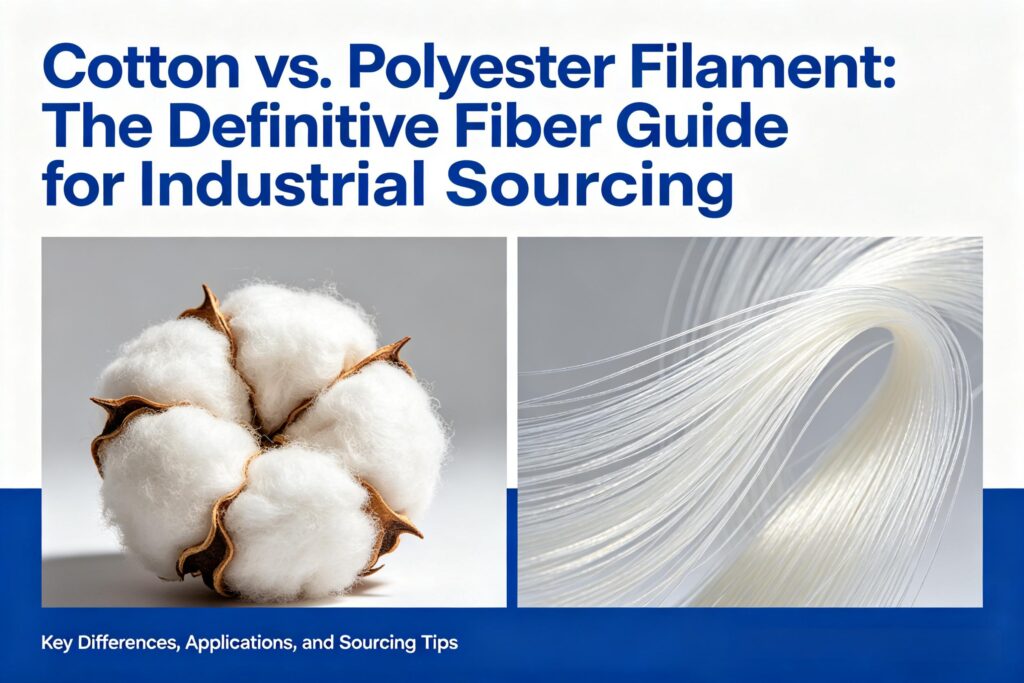
Cotton, the quintessential natural staple fiber, is valued for its breathability, moisture absorbency, natural hand feel, and biodegradability. Polyester filament, a petroleum-based synthetic, excels in durability, dimensional stability, quick-drying properties, and cost-efficiency at scale. In today’s market, the decision is rarely binary. The rise of sophisticated blends and engineered performance variants (e.g., moisture-wicking, recycled) has created a spectrum of possibilities. This guide provides a data-driven, application-focused analysis to empower your sourcing strategy, moving beyond generic attributes to actionable insights for product development and procurement.
2. From Origin to Fabric: Understanding Fiber Fundamentals
The inherent differences begin at the molecular and structural level.
- Cotton (Gossypium):
- Origin: A natural cellulosic fiber harvested from the boll of the cotton plant.
- Structure: A short staple fiber (typically 25-45 mm in length) with a twisted, ribbon-like shape. Its hollow core (lumen) and natural convolutions contribute to its softness and absorbency.
- Processing: After ginning, staple fibers are spun into yarn through processes like carding and combing. The natural fiber length variation creates a yarn with a characteristic fuzzy surface and lower inherent strength than filament synthetics.
- Polyester Filament (Polyethylene Terephthalate – PET):
- Origin: A synthetic polymer derived from petrochemicals (purified terephthalic acid – PTA and monoethylene glycol – MEG).
- Structure: Produced as a continuous filament of theoretically infinite length through melt spinning. The filaments can be used singly (monofilament) or grouped (multifilament). The process creates a smooth, uniform fiber with high strength.
- Processing: Filaments are bundled into yarn without traditional spinning. They can be texturized (DTY) for bulk and stretch or kept smooth (FDY) for strength and luster. This controlled manufacturing yields exceptional consistency in denier and performance.
3. Head-to-Head: Performance and Property Benchmarking
This side-by-side analysis translates chemical structure into tangible, measurable properties crucial for product specification.
Table 1: Core Property Comparison: Cotton vs. Polyester Filament
| Property | Cotton | Polyester Filament | Technical & Commercial Implication |
|---|---|---|---|
| Tensile Strength | Moderate (2.5-5.0 g/d). Weakens when wet (~20% loss). | High (3.5-7.0+ g/d). Strength unaffected or slightly increases when wet. | Polyester garments are more durable, abrasion-resistant, and maintain integrity in wet conditions (sportswear, workwear). |
| Moisture Management | High Absorbency. Can absorb ~24-27% of its weight in moisture. Dries slowly. | Hydrophobic. Absorbs <0.4% moisture. Wicks moisture away via capillary action, dries rapidly. | Cotton feels comfortable in dry heat but can become clammy and heavy with sweat. Polyester is preferred for high-intensity activity and quick-dry applications. |
| Elasticity & Recovery | Low. ~3-7% elongation at break. Poor wrinkle recovery. | Moderate to High. ~15-30% elongation. Excellent recovery from deformation. | Polyester resists creasing and maintains shape better, reducing ironing needs. Blends improve cotton’s durability and wrinkle resistance. |
| Thermal Properties | Good conductor of heat; feels cool to the touch. Provides insulation when dry. | Poor conductor; can feel clammy if non-wicking. Often used in thermal insulation (hollow fibers). | Cotton is preferred for hot-weather casualwear. Polyester is engineered for thermal regulation in performance wear. |
| Dyeability | Excellent for reactive and direct dyes. Yields rich, deep colors but may fade over time. | Requires disperse dyes at high temperatures. Colorfastness to washing and light is generally superior. | Polyester offers long-lasting color vibrancy, critical for uniforms and outdoor textiles. Dyeing process is more energy-intensive. |
| Environmental Impact | Renewable resource, biodegradable. High water & pesticide use (unless organic). Land-intensive. | Derived from non-renewable petrochemicals. Not biodegradable. Lower water use in processing. rPET offers recycled option. | A complex trade-off. Cotton’s impact is agricultural; polyester’s is industrial. GOTS organic cotton and GRS-certified rPET are key sustainable sourcing options. |
Additional Key Metrics for Industrial Buyers:
- Shrinkage: Cotton can shrink 5-10% without pre-shrinking finishes. Polyester exhibits minimal shrinkage (<3%) when properly heat-set.
- Pilling: Cotton pills less than synthetic staples but can form pills. Smooth polyester filament pills minimally; textured polyester (DTY) is more prone.
- UV Resistance: Polyester has excellent inherent UV resistance (loses ~10-20% strength after 500+ hrs). Cotton degrades significantly faster under UV exposure.
4. The Sourcing Equation: Cost, Sustainability, and Supply Chain Dynamics
The procurement decision extends far beyond the price per pound of fiber.
- Cost Volatility & Structure:
- Cotton: Price is subject to extreme volatility driven by weather, harvest yields, global stock levels, and speculative trading. The Cotton A Index is a key benchmark. Long-term contracts are essential for price stability.
- Polyester: Price is tied to crude oil and PTA/MEG feedstock costs. While volatile, its synthetic nature allows for more predictable, large-scale production, leading to generally lower and more stable prices than cotton. As of mid-2025, polyester filament can be 20-40% cheaper than equivalent cotton yarn.
- Supply Chain & Lead Times: Polyester’s integrated, chemical-plant-based production enables faster, more consistent output. Cotton’s annual agricultural cycle and susceptibility to crop failure introduce greater supply chain risk and longer planning horizons.
- The Sustainability Imperative: Both fibers face scrutiny, driving innovation.
- Better Cotton Initiative (BCI), Organic Cotton (GOTS): Address water, pesticide, and social issues in cotton farming.
- Recycled Polyester (rPET): Made from post-consumer plastic bottles, offering a circular solution with a ~30-50% lower carbon footprint than virgin PET. Certified by GRS (Global Recycled Standard).
- Bio-based Polymers: Emerging alternatives like PLA (from corn) or PEF aim to replace fossil-fuel-based synthetics.
5. Application-Specific Analysis: Matching Fiber to End-Use
- Apparel Manufacturing (T-Shirts, Knitwear):
- 100% Cotton: The classic choice for softness, breathability, and premium natural feel in everyday casualwear, basics, and underwear. Ideal for screen printing. Requires anti-shrink finishing.
- 100% Polyester Filament: Used for performance sportswear, sublimation printing (vibrant graphics), uniforms, and quick-dry base layers. Often in microfilament constructions for a silk-like hand.
- Blends (e.g., 65% Polyester / 35% Cotton): The industry workhorse. Combines polyester’s strength, wrinkle resistance, and shrink stability with cotton’s comfort and absorbency. Dominates the polo shirt, casual workwear, and budget-friendly apparel markets.
- Home Textiles (Bedding, Upholstery):
- Cotton: Preferred for bed sheets, towels, and bathrobes where high absorbency and a soft, natural touch are paramount (e.g., Egyptian or Pima cotton).
- Polyester: Dominates in durable upholstery fabrics, blackout curtains, and filling materials (hollow fiber) due to its strength, UV resistance, and resilience. Polyester blends are common in easy-care, wrinkle-resistant bedding.
- Technical & Industrial Textiles:
- Polyester Filament is Dominant. Its strength, mildew resistance, and environmental stability make it irreplaceable for conveyor belts, geotextiles, industrial hoses, and tire cord. Cotton is rarely used except in some specialized wipes or filters.
- Plush Toys & Carpet Manufacturing:
- Polyester is the Standard. Especially DTY (textured) polyester provides the required bulk, durability, colorfastness, and cost-effectiveness for plush pile and carpet face fiber. Cotton is too weak, prone to matting, and not stain-resistant enough for these high-wear applications.
6. Strategic Sourcing & Product Development Guidelines
For Cost-Driven, High-Volume Programs:
- Prioritize polyester-rich blends (80/20 or 65/35 P/C) for optimal durability and cost control.
- Source virgin or rPET filament from large, integrated Asian producers for scale and price stability.
- Utilize dope-dyed (solution-dyed) polyester for supreme colorfastness and reduced water/energy use in processing.
For Premium, Value-Added Products:
- Specify long-staple or organic cotton (GOTS-certified) for superior softness and a marketable sustainability story.
- Explore engineered polyester microfibers or specialty cross-sections (e.g., hexagonal, trilobal) for enhanced moisture-wicking, silk-like luster, or soil-release properties.
- Consider Tencel™ (lyocell) blends with cotton or polyester for next-level drape, moisture management, and sustainability.
Risk Mitigation & Supplier Evaluation:
- Diversify: Do not rely on a single fiber source or geography. Have approved suppliers for both cotton (multiple origins) and polyester.
- Certify: Demand certifications (GRS for recycled, OEKO-TEX for safety, GOTS for organic) and traceable transaction certificates.
- Test Rigorously: Conduct in-house or third-party testing on every lot for key performance indicators (pilling, shrinkage, colorfastness, tensile strength).
7. Conclusion: Building an Informed, Agile Fiber Strategy
The cotton versus polyester debate is no longer about choosing a winner. The modern textile industry thrives on strategic hybridization and precision engineering. The most successful procurement managers and product developers will be those who:
- Match the molecule to the mission: Use data-driven property analysis to select the primary fiber or blend for the exact functional requirements of the end product.
- Master the blend calculus: Understand how even a 10-15% addition of a secondary fiber can dramatically improve performance (e.g., adding polyester to cotton for strength, adding cotton to polyester for comfort).
- Embed sustainability in the specification: View certified recycled polyester (rPET) and organic cotton not as premium options, but as baseline materials for future-proofing your supply chain and brand.
- Source with agility: Build relationships with suppliers who offer technical expertise, consistent quality, and transparency, enabling you to pivot quickly in response to raw material price shocks or new performance demands.
By elevating fiber selection from a commodity purchase to a core component of product design and brand strategy, you unlock opportunities for innovation, cost optimization, and meaningful market differentiation.
