
Executive Summary
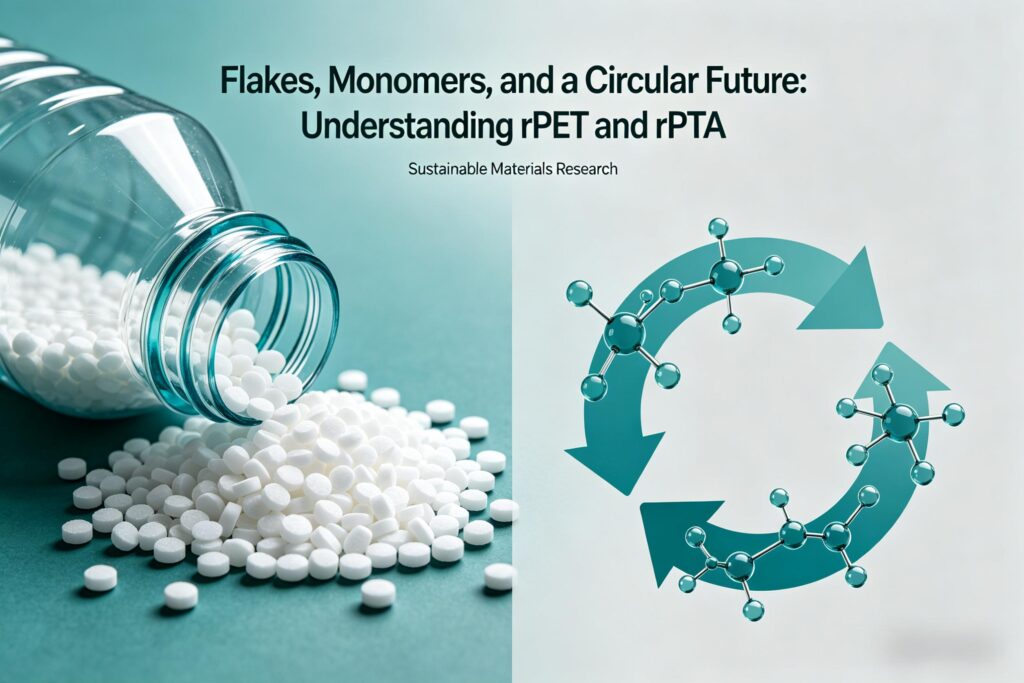
In the global push towards a sustainable circular economy, two materials have emerged as critical players: Recycled Polyethylene Terephthalate (rPET) flakes and Recycled Purified Terephthalic Acid (rPTA). While both originate from post-consumer PET waste, their paths diverge dramatically. rPET flakes are the product of mechanical recycling—a physical process of cleaning, sorting, and shredding used bottles and textiles. In contrast, rPTA is the result of advanced chemical or biological recycling, which breaks waste PET down to its molecular building blocks for repolymerization. The choice between them is not merely technical; it’s a strategic decision impacting product quality, application scope, environmental footprint, and compliance with tightening global regulations. This guide provides a clear, data-driven comparison to inform your sustainable material sourcing strategy.
Table of Contents
- Defining the Materials: From Waste to Resource
- 1.1. What are rPET Flakes?
- 1.2. What is rPTA?
- 1.3. The Core Distinction: Mechanical vs. Chemical/Biological Recycling
- A Comparative Analysis: Performance, Applications, and Data
- 2.1. Production Process and Quality Variance
- 2.2. Material Performance and Properties
- 2.3. Application Scope: From Fibers to Food Contact
- The Business and Sustainability Case
- 3.1. Cost, Availability, and Market Dynamics
- 3.2. Environmental Impact and Carbon Footprint
- 3.3. Regulatory Drivers and Certifications
- Strategic Sourcing for a Circular Future
- 4.1. How to Choose: rPET Flakes or rPTA?
- 4.2. Partnering with Innovative Suppliers: The Case of Glyarn
- 4.3. Future Outlook and Industry Trends
1. Defining the Materials: From Waste to Resource
1.1. What are rPET Flakes?
rPET flakes are the most common form of recycled polyester. They are produced through a mechanical recycling process where post-consumer PET items like bottles, containers, or selected textiles are collected, sorted by color and polymer type, cleaned, and ground into small flakes. These flakes can be directly melted and spun into fibers for textiles—commonly used in fleece, sportswear, and upholstery—or reformed into new containers. The mechanical process is well-established and cost-effective but is sensitive to contamination, which can affect the consistency and quality of the final product. A key scientific study analyzing 20 commercial rPET samples confirmed that while properties can vary, high-quality rPET can perform within the broad range of virgin PET (vPET).
1.2. What is rPTA?
rPTA represents a more advanced approach. It stands for recycled Purified Terephthalic Acid, one of the two primary monomers (along with Mono-Ethylene Glycol, MEG) used to synthesize virgin PET. rPTA is produced through chemical recycling processes like glycolysis or methanolysis, or via cutting-edge biological recycling using specially engineered enzymes. These technologies depolymerize waste PET all the way back to its core molecular components. The resulting rPTA is then repolymerized with glycol to create recycled PET (often called rPET resin or pellet) that is chemically identical to virgin polymer. This “molecular renewal” allows the recycled material to be used in high-value applications, including clear food-grade packaging and high-performance fibers, effectively closing the loop.
1.3. The Core Distinction: Mechanical vs. Chemical/Biological Recycling
The fundamental difference lies in the recycling pathway:
- rPET Flakes (Mechanical): Physical process (sorting, washing, shredding). Maintains the polymer chain but may shorten it. Quality can degrade over cycles (“downcycling”).
- rPTA (Chemical/Biological): Chemical process (depolymerization to monomers). “Resets” the material to its virgin state, enabling infinite recycling without quality loss (“upcycling”).
2. A Comparative Analysis: Performance, Applications, and Data
2.1. Production Process and Quality Variance
The production journey dictates quality consistency. Mechanical recycling of rPET flakes involves multiple steps where contamination from other plastics, dyes, or additives can introduce variance. A study noted that the presence of contaminants like PVC or polypropylene during processing can significantly disturb the process and reduce final material quality.
In contrast, the chemical purification steps in producing rPTA are designed to remove impurities at a molecular level, resulting in a more uniform and predictable feedstock. Innovative biological methods, such as those using AI-designed enzymes, can achieve this purification efficiently under milder conditions.
2.2. Material Performance and Properties
While high-quality rPET flakes are suitable for many applications, studies have identified performance nuances compared to virgin-based materials. For instance, fibers spun from recycled bottle flakes (a form of rPET) have been shown to have a lower crystallinity and melting point, and a higher boiling water shrinkage rate compared to fibers from virgin PET, indicating differences in thermal stability.
Material regenerated from rPTA, however, achieves performance parity with virgin PET. The following table synthesizes key comparative data:
| Property | rPET Flakes (Mechanically Recycled) | rPTA-based Polymer (Chemically/Biologically Recycled) | Implication for Manufacturers |
|---|---|---|---|
| Intrinsic Viscosity (IV) | May be lower; requires adjustment via Solid State Polycondensation (SSP). | Can be precisely controlled during repolymerization to meet stringent specs. | Impacts spinability for fine denier fibers and melt strength for containers. |
| Color & Clarity | Often has a yellowish hue; challenging to achieve crystal-clear output. | Can achieve water-clear transparency, identical to virgin. | Critical for clear bottles and packaging, and for dyeing light/shade textiles. |
| Thermal Stability | Glass transition (Tg) and melting temps may be slightly lower. | Thermal properties match virgin PET benchmarks. | Important for high-temperature filling processes and fabric heat-setting. |
| Contaminant Risk | Higher risk of microscopic contaminants affecting consistency. | Virtually eliminated through chemical purification. | Reduces production line faults and ensures compliance with food-contact standards. |
| Application Benchmark | Excellent for non-food contact textiles, strapping, and non-critical packaging. | Suitable for food-grade packaging, medical textiles, and high-performance apparel. | Defines the market segment and product value. |
2.3. Application Scope: From Fibers to Food Contact
- rPET Flakes: Dominant in fiber and textile applications. Commonly found in carpets, upholstery, fleece (like polar fleece fabrics), industrial yarns, and non-food containers. The range of certified fabrics is expanding, with materials like RPET suede leather being used in automotive interiors, bags, and apparel.
- rPTA-based Polymer: Its food-grade potential is the key differentiator. It is the solution for producing recycled PET bottles for beverages, clear food trays, and high-hygiene packaging. In textiles, it enables the production of recycled fibers with no compromise on quality, suitable for athletic wear, intimate apparel, and even medical fabrics where purity is paramount.
3. The Business and Sustainability Case
3.1. Cost, Availability, and Market Dynamics
Currently, rPET flakes benefit from wider availability and a more mature collection infrastructure, often making them the more cost-effective option. However, prices are volatile and subject to supply chain constraints.
rPTA is a premium product. The advanced recycling technology and purer output command a higher price. Its availability is growing rapidly as major chemical companies and innovators scale up production. For example, companies are moving from 300-ton/year demonstration plants to planning 5,000-ton/year facilities for bio-based rPTA.
3.2. Environmental Impact and Carbon Footprint
Both materials offer significant environmental benefits over virgin PET, which is derived from petroleum.
- rPET Flakes: Saves energy and reduces landfill waste. Using recycled PET can reduce energy consumption by up to 80% compared to virgin PET.
- rPTA-based Polymer: Offers a potentially lower carbon footprint, especially biological processes that operate at lower temperatures. Some life-cycle assessments suggest emission reductions of up to 60% can be achieved through these advanced recycling routes. It also provides a true “cradle-to-cradle” solution, preventing downcycling.
3.3. Regulatory Drivers and Certifications
Global regulations are a powerful market driver. The European Union’s Single-Use Plastics Directive mandates that PET beverage bottles contain at least 25% recycled content by 2025 and 30% by 2030. Similar laws are emerging worldwide.
- rPET Flakes are well-supported by mass balance certification standards (e.g., DIN SPEC 91446) for tracking recycled content in textiles and non-food packaging.
- rPTA-based Polymer is essential for complying with strict food-contact regulations like those from the U.S. FDA and the European Food Safety Authority (EFSA), which require a high degree of purity that mechanical recycling often cannot guarantee.
4. Strategic Sourcing for a Circular Future
4.1. How to Choose: rPET Flakes or rPTA?
Your choice should be guided by your end product and strategic goals:
- Choose rPET Flakes if: Your priority is cost-effective sustainability for non-food contact applications like apparel, home textiles, or general packaging. You have robust supply chain oversight to manage quality variance.
- Choose rPTA-based Polymer if: You are manufacturing food-grade packaging or require virgin-quality performance in textiles. You aim for product transparency, have ambitious recycled content goals, and are building a brand around cutting-edge circularity.
4.2. Partnering with Innovative Suppliers: The Case of Glyarn
Navigating this evolving landscape requires a reliable partner. Forward-thinking suppliers like Glyarn are crucial in bridging the gap between recycled material innovation and practical application. Glyarn doesn’t just supply yarn; it provides material solutions backed by technical expertise. They can guide brands in selecting the right recycled feedstock—whether it’s premium rPET flakes for durable outdoor fabrics or yarns sourced from rPTA-based polymers for high-fashion collections requiring brilliant dyeability and a soft hand-feel.
By partnering with a supplier deeply embedded in the recycling value chain, brands gain access to certified materials, traceability data, and insights into future material innovations, ensuring their products are both sustainable and commercially viable.
4.3. Future Outlook and Industry Trends
The trajectory is clear: the market is moving beyond simple mechanical recycling toward advanced closed-loop systems. Chemical and biological recycling technologies for producing rPTA are scaling rapidly. Furthermore, the emergence of bio-based rPTA—where the monomer is derived from renewable biomass like agricultural waste—points to a future where materials are not only circular but also progressively decoupled from fossil fuels.
For global brands, understanding the rPET vs. rPTA distinction is no longer optional. It is a fundamental aspect of sustainable product design, regulatory compliance, and meeting the sophisticated demands of the conscious consumer. The future belongs to those who can skillfully utilize both pathways to build a truly circular economy.
