
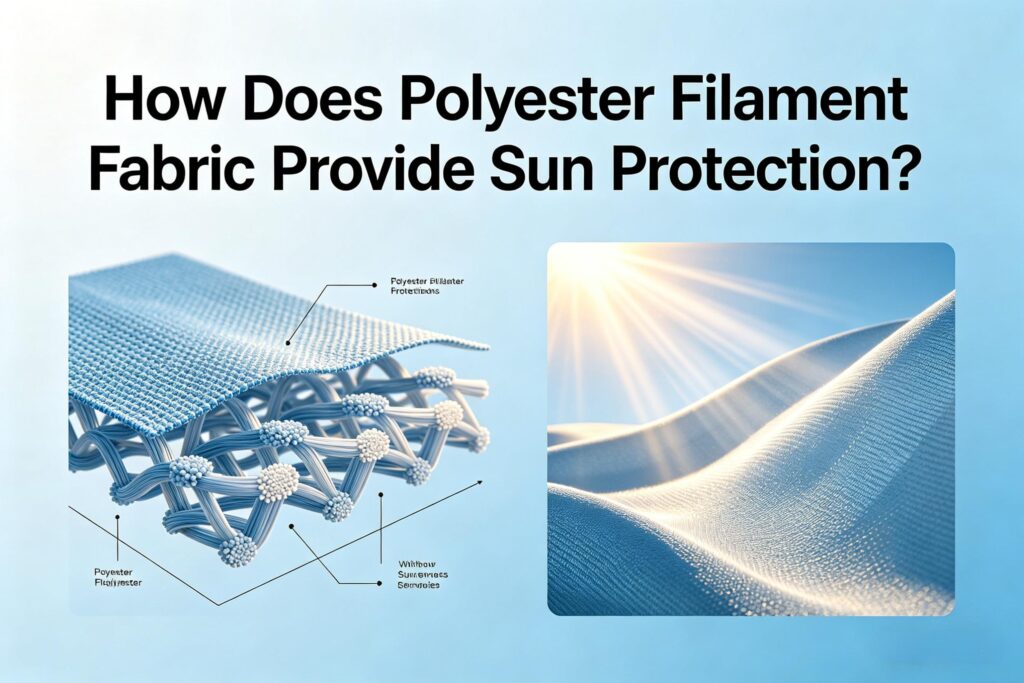
The sun protection mechanism of polyester filament fabric is a sophisticated interplay between its inherent molecular structure and advanced textile engineering. Unlike some natural fibers, polyester offers a robust foundation for blocking ultraviolet (UV) radiation. This capability is quantified by the Ultraviolet Protection Factor (UPF), a critical metric for technical buyers. Protection is achieved through a multi-layered strategy: the intrinsic UV absorption of its polymer chains, a dense physical barrier created by filament weaving, and enhanced performance through strategic dyes and UV-inhibiting additives. For industrial procurement, understanding these principles is key to sourcing functional fabrics that meet specific performance and durability demands in apparel, outdoor gear, home textiles, and beyond.
The Comprehensive Guide to UV Protection in Polyester Filament Fabrics
Table of Contents
- Executive Summary: Why Technical Mastery of UV Protection Matters for Buyers
- Part 1: The Science of UV Radiation and Textile Defense Metrics
- 1.1. UVA, UVB, and UVC: Understanding the Threat Spectrum
- 1.2. The UPF Standard: Decoding the 50+ Rating
- 1.3. Core Defense Mechanisms: Absorption, Reflection, and Blocking
- Part 2: Polyester’s Intrinsic Sun Protective Properties
- 2.1. Molecular Advantage: The Aromatic Benzene Ring Structure
- 2.2. Fiber Morphology: How Filament Density and Surface Create a Barrier
- 2.3. Comparative Analysis: Polyester vs. Cotton, Nylon, and Wool Baseline UPF
- Part 3: Engineering Enhanced Protection: The Manufacturer’s Toolkit
- 3.1. Fabric Construction: The Impact of Weave Density, Weight, and Porosity
- 3.2. Color as a Technology: The Profound Influence of Dyes and Pigments
- 3.3. Chemical Finishes and Additives: UV-absorbers, Ceramics, and Nano-Treatments
- Table 1: Engineering Levers for UPF Enhancement in Polyester Fabrics
- Part 4: Performance Durability and Real-World Degradation Factors
- 4.1. Washes and Wear: How Laundering and Abrasion Affect Long-Term UPF
- 4.2. Environmental Stress: Impact of Chlorine, Saltwater, and Sun Exposure
- 4.3. Specification for Durability: Requesting Test Data (AATCC 183, AS/NZS 4399)
- Part 5: Application-Specific Analysis for Industrial Sourcing
- 5.1. Performance & Outdoor Apparel: Balancing UPF with Breathability and Weight
- 5.2. Workwear & Uniforms: Integrating Sun Protection with Safety Standards
- 5.3. Home & Commercial Textiles: Awnings, Umbrellas, and Indoor Fade Resistance
- 5.4. Specialty Uses: Automotive Interiors, Protective Covers, and Geo-textiles
- Table 2: UPF Specification Guidelines by Market Application
- Part 6: Strategic Sourcing, Verification, and Supply Chain Management
- 6.1. Audit Your Supply Chain: Key Questions for Fiber and Fabric Suppliers
- 6.2. Interpreting Lab Reports and Certifications
- 6.3. Total Cost Analysis: Weighing Upfront Cost Against Longevity and Performance
- Part 7: The Innovation Frontier and Market Trends
- 7.1. Smart & Adaptive Sun Protection
- 7.2. The rPET (Recycled Polyester) Dimension in Sustainable Sun Protection
- 7.3. Market Drivers: Health Awareness and Regulatory Landscapes
- Frequently Asked Questions (FAQ)
- Conclusion: Building Value Through Informed Material Specification
1. Executive Summary: Why Technical Mastery Matters
For procurement professionals, sun protection is transitioning from a niche feature to a core performance criterion across multiple textile segments. The global market for UV-protective textiles is propelled by rising health consciousness and stringent occupational safety regulations. Polyester filament stands out not merely as a passive material but as a highly engineerable platform for achieving and sustaining high UPF ratings. Success in sourcing hinges on moving beyond basic UPF numbers to understand the underlying technologies and their durability. This guide provides the technical framework to differentiate marketing claims from verifiable performance, enabling you to source superior, cost-effective fabrics that deliver lasting value and reduce product failure risk.
2. Part 1: The Science of UV Radiation
- UVA (315-400 nm): Penetrates deeply, causing premature skin aging and contributing to long-term damage.
- UVB (280-315 nm): Primarily responsible for sunburn and direct DNA damage; strongly implicated in skin cancer.
- The UPF Standard: A fabric rated UPF 50 allows only 1/50th (2%) of UV radiation to pass through, blocking 98%. Ratings are categorized: UPF 15-24 (Good), 25-39 (Very Good), 40-50+ (Excellent).
3. Part 2: Polyester’s Intrinsic Advantages
Polyester’s polymer chain contains aromatic benzene rings, which naturally absorb UV radiation in the critical UVB and part of the UVA spectrum. Furthermore, continuous filament yarns enable the production of fabrics with very low porosity and high cover factor, creating an excellent initial physical barrier. A standard, un-dyed polyester fabric often starts with a higher inherent UPF (around 15-20) than a comparable plain cotton fabric (UPF ~5), providing a superior baseline for enhancement.
4. Part 3: Engineering Enhanced Protection
Table 1: Engineering Levers for UPF Enhancement in Polyester Fabrics
| Engineering Lever | Mechanism of Action | Typical UPF Impact | Key Considerations for Buyers |
|---|---|---|---|
| Construction & Weave | Increases the physical “cover factor,” reducing open spaces for UV transmission. | Moderate to High. Tight weaves/knits can achieve UPF 30+ alone. | Affects breathability, weight, and drape. Must be balanced with end-use. |
| Color & Dye Chemistry | Darker/deeper colors (navy, black) and certain dye classes absorb more UV energy. | Very High. A black dye can increase UPF by a factor of 10x vs. white. | The type of dye (disperse) and depth of shade are critical. Pastels offer minimal boost. |
| UV-Inhibiting Additives | Organic compounds (benzotriazoles) or inorganic particles (TiO2, ZnO) are embedded to absorb/scatter UV. | High. Can push fabrics from UPF 30 to 50+. | Durability is key. “Dope-dyed” or “mass-pigmented” fibers (additive in polymer) offer lifelong protection vs. topical finishes that may wash out. |
| Fabric Weight (GSM) | Greater mass provides more material for UV to penetrate. | Moderate. | Correlates with warmth and may limit use in hot-weather apparel. |
5. Part 4: Performance Durability
The initial UPF rating is less important than its retention over the product’s lifespan. Topical coatings can degrade with abrasion and washing. The gold standard for durable protection is solution-dyed or mass-pigmented polyester, where UV-inhibiting pigments or additives are incorporated into the polymer melt before extrusion. This makes the protection intrinsic to every filament, guaranteeing performance regardless of washes or wear.
6. Part 5: Application-Specific Analysis
Table 2: UPF Specification Guidelines by Market Application
| Market Application | Recommended Minimum UPF | Critical Performance Pairings | Sourcing Focus & Durability Need |
|---|---|---|---|
| High-Performance Sportswear | 40+ | Moisture-wicking, breathability, lightweight. | Prioritize solution-dyed fabrics for wash-fastness. Verify breathability data. |
| Outdoor Workwear (Construction) | 50+ | Abrasion resistance, tear strength, colorfastness. | Demand inherently protective fabrics (dark colors + dense weave + additives). Test for abrasion impact on UPF. |
| Fashion Apparel & Beachwear | 30-50+ | Aesthetics, drape, hand feel, color variety. | Ensure dyes are UV-stable to prevent garment fading while protecting the wearer. |
| Shade Fabrics (Awnings, Umbrellas) | 50+ | Water resistance, mildew resistance, dimensional stability. | Focus on high-tenacity filament and coatings for outdoor weathering. UPF must last for years. |
| Automotive & Marine Interiors | 40+ | Fade resistance, thermal stability, cleanability. | Colorfastness to light is paramount. Solution-dyed polyester is industry standard to prevent dashboard/seat fading. |
7. Part 6: Strategic Sourcing
- Audit Questions: “Is the UV protection from a topical finish or is it solution-dyed?” “Can you provide test reports for UPF after 5, 10, and 50 washes (AATCC 183)?” “What is the specific UV-inhibiting agent used?”
- Lab Reports: Look for tests performed by accredited labs (e.g., using AS/NZS 4399 or AATCC 183). Reports should state the tested UPF and the UV transmission percentages.
8. Part 7: The Innovation Frontier
- Smart Protection: Research into photochromic dyes that adjust absorption based on UV intensity.
- Sustainable rPET: High-quality recycled polyester can perform identically to virgin polyester in UV protection if proper additives are used, offering a compelling eco-story.
- Market Drivers: Beyond apparel, growth is driven by automotive (interior fade prevention) and occupational health mandates in agriculture and construction.
9. Frequently Asked Questions (FAQ)
Q1: Is all polyester fabric naturally sun-protective?
A1: It has a better starting point than many fibers, but “protective” is a relative term. A thin, white polyester shirt may have a UPF below 15, offering inadequate protection. Its inherent chemistry allows it to be easily engineered to high UPF levels through the methods described.
Q2: Does washing a polyester garment reduce its UPF rating?
A2: It depends entirely on the source of the protection. If it comes from a topical coating, yes, washing will degrade it over time. If the protection comes from the fiber’s intrinsic color (solution-dyed) or embedded additives, the UPF will remain effectively unchanged for the life of the garment.
Q3: For maximum durability, what should I look for on a spec sheet?
A3: The single most important term is “solution-dyed,” “mass-pigmented,” or “dope-dyed.” This indicates UV protection (via color and/or additives) is locked into the fiber. Next, look for a high fabric density (high thread count) and a stated compliance with a durability test standard (e.g., “UPF 50+ after 50 home washes”).
Q4: How does color affect the UPF of polyester compared to cotton?
A4: Color dramatically affects both, but polyester benefits more efficiently. A jet-black polyester can achieve UPF 50+ easily due to the synergy of dye and fiber chemistry. A black cotton, while better than white, may struggle to reach the same level without chemical finishes because the fiber itself is more transparent to UV.
Q5: We manufacture outdoor furniture. Is UPF 50 enough for a sun umbrella?
A5: For commercial or residential shade applications, UPF 50+ is the expected benchmark. However, the fabric’s degradation from weather is your primary concern. Specify high-tenacity polyester with UV-inhibiting stabilizers in the yarn and solution-dyed color to ensure the UPF and color integrity last for multiple seasons.
Q6: Can a fabric be both high UPF and highly breathable?
A6: Yes, but it requires careful engineering. A very tight weave boosts UPF but kills breathability. The solution is to use a moderately open construction but achieve high UPF through deep solution-dyed colors and embedded UV absorbers. This allows air flow while maintaining protection. Always request breathability (ASTM D737) data alongside UPF claims.
Q7: How does recycled polyester (rPET) compare for sun protection applications?
A7: Properly sourced rPET can be functionally identical. The key is the quality of the recycle stream and the manufacturing process. High-grade rPET filament can be solution-dyed and embedded with additives just like virgin polyester. Always request the same test data and verify the supplier’s expertise in producing performance-grade rPET.
10. Building Value Through Specification
In the competitive textile landscape, performance features like proven, durable sun protection are powerful differentiators. For the industrial buyer, expertise in the principles and technologies behind polyester’s UV defense is a strategic asset. It transforms the specification process from a cost-centric negotiation to a value-engineering dialogue. By demanding verifiable data on durability, understanding the source of protection, and aligning fabric technology with end-use demands, you secure materials that enhance product quality, ensure customer safety and satisfaction, and build a stronger, more resilient brand.
