
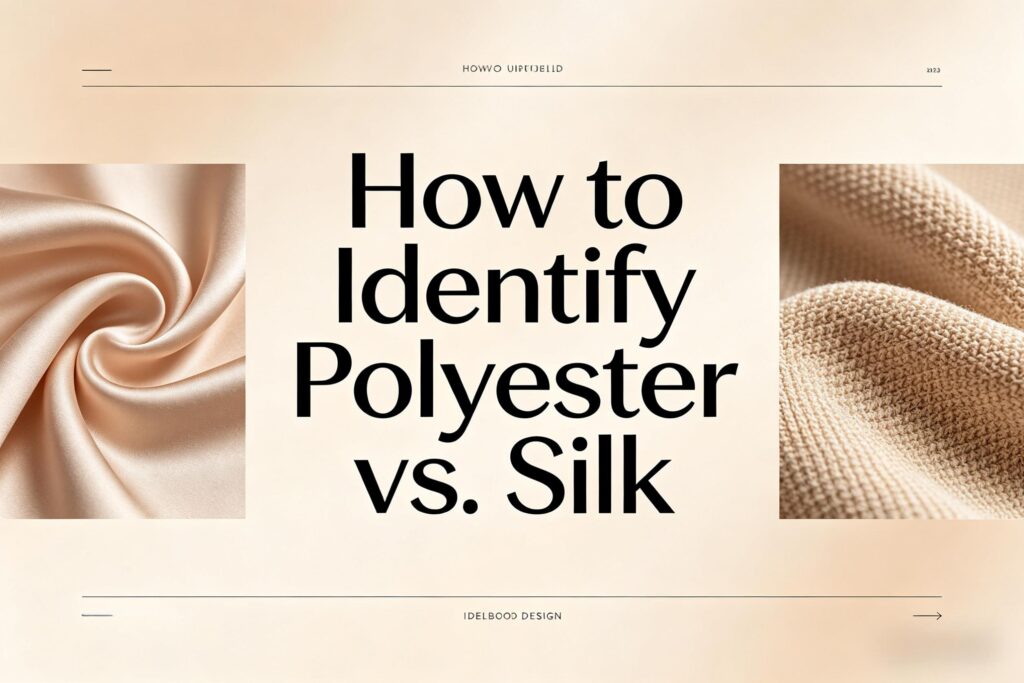
Accurately distinguishing between polyester (a synthetic fiber) and silk (a natural protein fiber) is a critical skill for textile professionals, affecting sourcing decisions, quality control, cost negotiation, and brand integrity. While modern “silk-like” polyester can be highly deceptive visually, a systematic approach using burn tests, microscopic analysis, chemical solubility tests, and physical property assessments can provide definitive identification. Mastering these techniques protects your business from costly mislabeling, adulteration, and ensures you get the fiber—and value—you pay for.
The Definitive Guide to Identifying Polyester vs. Silk: Techniques, Tools, and Tactics for Industry Buyers
Table of Contents
- Executive Summary: Beyond the Naked Eye – Why Accurate Fiber ID is Non-Negotiable
- Part 1: Fundamental Differences: The Science Behind the Fibers
- 1.1. Origin & Chemistry: Petrochemical Polymer vs. Natural Protein
- 1.2. Economic & Sourcing Implications: The Massive Cost Differential
- Part 2: Rapid Field & Office Identification Methods (Destructive & Non-Destructive)
- 2.1. The Burn Test: The Most Telling Quick Check
- 2.2. Hand Feel & Visual Inspection: Developing a Trained Sensory Palate
- 2.3. The “Crunch” Test and Drape Observation
- Table 1: Side-by-Side Comparison of Key Identification Markers
- Part 3: Laboratory & Analytical Techniques for Definitive Proof
- 3.1. Microscopic Analysis: Longitudinal and Cross-Sectional Views
- 3.2. Chemical Solubility Tests: Using Specific Agents for Confirmation
- 3.3. Density Gradient & Staining Methods
- Part 4: The Modern Challenge: Identifying High-Quality “Silk-Imitating” Polyester
- 4.1. How Polyester Mimics Silk: Microfilaments, Profiled Cross-Sections, and Finishes
- 4.2. Advanced Testing Required When Visual and Tactile Clues Fail
- Part 5: Application-Specific Identification Protocols
- 5.1. Yarn & Fabric Procurement: Testing Incoming Bulk Shipments
- 5.2. Garment & Product Inspection: Spot-Checking Finished Goods and Blends
- 5.3. For Rug & Carpet Buyers: Identifying Fiber Content in Pile Yarns
- 5.4. For Toy Manufacturers: Ensuring Safety and Labeling Compliance
- Part 6: Building a Supplier Verification & Quality Assurance Program
- 6.1. Contractual Clauses for Fiber Specification and Penalties for Adulteration
- 6.2. Creating an In-House Fiber ID Kit and Lab Corner
- 6.3. When to Use Third-Party Testing Labs (e.g., SGS, Bureau Veritas)
- Frequently Asked Questions (FAQ)
- Conclusion: Empowering Your Procurement with Knowledge and Verification
1. Executive Summary: Beyond the Naked Eye
For a procurement manager, the difference between polyester and silk is not merely aesthetic; it is a financial, ethical, and legal frontier. Silk commands a premium often 10 to 20 times that of high-quality polyester. The incentive for adulteration—whether outright substitution or undisclosed blending—is immense. Relying on supplier documentation or a visual inspection alone is a high-risk strategy. This guide provides a layered, actionable framework for identification, from simple tests that can be performed at a desk to laboratory methods that provide irrefutable evidence. Implementing these practices is your primary defense against fraud, ensuring product quality, safeguarding your brand’s reputation, and ultimately protecting your bottom line.
2. Part 1: Fundamental Differences
- Origin & Chemistry:
- Polyester (PET): A synthetic polymer derived from petroleum. Its chain is composed of repeating units of ethylene terephthalate. It is hydrophobic and has high chemical resistance.
- Silk: A natural protein fiber produced by the silkworm (Bombyx mori). Its primary components are fibroin (the fibrous core) and sericin (the gum-like coating). It is a continuous filament.
- Economic Reality: Raw Mulberry silk yarn can cost $50-$150 per kilogram, while filament polyester yarn costs $3-$8 per kilogram. This stark difference is the root cause of the need for vigilance.
3. Part 2: Rapid Field & Office Identification Methods
Table 1: Side-by-Side Comparison of Key Identification Markers
| Test Method | Polyester (PET) | Silk (Bombyx mori) | Procedure & Key Observations |
|---|---|---|---|
| Burn Test | Most Reliable Quick Test. Melts and burns with a steady, smoky flame. | Burns slowly and self-extinguishes. | Use tweezers, hold sample over metal tray. Observe flame, odor, and residue. |
| Odor: Sharp, chemical, sweet (like vinegar or melting plastic). | Odor: Distinct smell of burning hair or feathers. | Caution: Perform in ventilated area. | |
| Residue: Hard, black, round bead that is difficult to crush. | Residue: Black, crushable ash or powder. | ||
| Hand Feel & Visual | Can feel smooth but often cool, slick, or slightly “plastic.” | Inherently warm, dry, and luxurious hand. Subtle, natural luster. | Feel the fabric; crumple in hand. |
| Luster can be very high and uniform (bright) or matte. | Luster is subdued and has a soft, pearlescent sheen. | Compare known samples side-by-side. | |
| Excellent wrinkle recovery. | Will hold wrinkles more readily. | ||
| “Crunch” Test | Often produces a sharper, crisper sound when crushed. | Produces a softer, more muffled rustle or “scroop” (a specific rustling sound). | Crumple fabric near ear. Less reliable but indicative. |
| Drape & Weight | Can be engineered to drape well, but often has a lighter, less substantial fall. | Has a characteristically heavy, fluid, and substantial drape for its weight. | Hold a swatch and observe how it falls. |
4. Part 3: Laboratory & Analytical Techniques
- Microscopic Analysis:
- Silk (Longitudinal): Appears as smooth, transparent, rod-like filaments with occasional fine striations. No scale structure like wool.
- Polyester (Longitudinal): Appears as very smooth, straight, and featureless rods. It may show specks of delustrant (titanium dioxide).
- Cross-Section: Silk often has a triangular or rounded shape. Polyester is usually perfectly round, but can be engineered into trilobal shapes to mimic silk’s luster.
- Chemical Solubility Test (Definitive):
- This is a conclusive test. A small sample is placed in a test tube with Sodium Hypochlorite (common household bleach, 5-6%).
- Silk: Will dissolve completely in bleach within a few minutes because the bleach breaks down the protein structure.
- Polyester: Will be unaffected by bleach. It may fade in color but the fiber itself remains intact.
- Safety: Use gloves and eye protection; conduct under a fume hood.
5. Part 4: The Modern Challenge: “Silk-Imitating” Polyester
Advanced polyester engineering creates formidable look-alikes:
- Microfilament Polyester: Filaments finer than 1 denier per filament (dpf) create an incredibly soft hand.
- Profiled Cross-Sections: Trilobal or pentagonal shapes scatter light like silk, reducing harsh glitter and creating a softer luster.
- Silk Touch Finishes: Chemical treatments soften the hand.
To identify these: The Burn Test and Solubility Test remain 100% effective. Microscopy can reveal the engineered cross-section, confirming it’s synthetic.
6. Part 5: Application-Specific Protocols
- Yarn Procurement: For large shipments, implement an AQL-based sampling plan. Randomly select cones/skeins from multiple cartons. Perform burn tests on samples from each selected unit. Any failure triggers a hold and more rigorous lab testing.
- Garment Inspection: For finished goods, perform a discreet burn test on an inside seam allowance or a removed care label thread.
- Rugs & Carpets: Use a seam ripper to extract a few pile yarns from an inconspicuous area (e.g., under furniture). Perform a burn test on the tufts.
- Toy Manufacturers: Fiber content is critical for labeling (e.g., FTC in USA, Oeko-Tex). Use solubility or microscopy for definitive ID to ensure compliance and safety claims (e.g., “hypoallergenic” if silk is claimed).
7. Part 6: Building a QA Program
- Contractual Terms: Specify “100% Mulberry Silk” with an agreed tolerance (e.g., 0% for pure goods). Include a right to test and penalties for adulteration (e.g., full refund plus cost of testing).
- In-House Kit: Assemble a simple kit containing: tweezers, small butane lighter, metal dish, magnifying glass, dropper bottle of bleach, small test tubes, gloves. Include known samples of pure silk and polyester for comparison.
- Third-Party Labs: Use them for: 1) New supplier qualification, 2) Arbitration in disputes, 3) Periodic audits of high-value shipments. Request a Qualitative Fiber Analysis report (often using FTIR or microscopy).
8. Frequently Asked Questions (FAQ)
Q1: The fabric feels amazing and the supplier says it’s “silk.” The burn test produced a black bead and a chemical smell. Is it silk?
A1: Absolutely not. A chemical smell and a hard bead are the definitive signatures of a synthetic fiber like polyester. True silk smells like burning hair and leaves a crushable ash. You have likely been supplied with a high-quality silk-imitation polyester.
Q2: Is there a reliable non-destructive test?
A2: For conclusive identification, no. Highly trained experts can make strong guesses based on hand, drape, and luster, but these are not proof. The closest to non-destructive is microscopic examination of a single filament carefully plucked from a seam, which leaves minimal damage. Fourier Transform Infrared (FTIR) spectroscopy is non-destructive and definitive but requires expensive lab equipment.
Q3: Can a fabric be a blend of both? How do I identify the percentage?
A3: Yes, blends are common. The solubility test is key here. You can weigh a small, dried fabric sample, immerse it in bleach to dissolve the silk component, then filter, dry, and re-weigh the remaining polyester. The weight loss percentage corresponds to the silk content. This is a simplified version of ASTM D629.
Q4: What about “wild silk” like Tussah or Dupion? How does identification differ?
A4: Wild silks still have the core protein structure of silk. They will dissolve in bleach and smell like burning hair in the burn test. However, their visual and tactile clues differ: Tussah is often coarser, darker, and less lustrous than cultivated Mulberry silk; Dupion has characteristic slubs. The basic chemical tests still apply.
Q5: We received a shipment of “silk” yarn that failed our burn test. The supplier insists their mill certificate says 100% silk. What now?
A5: This is a classic red flag. Present your evidence (video of the burn test is powerful). Politely but firmly demand a retest at a mutually agreed-upon third-party laboratory, at the supplier’s expense. Mill certificates can be falsified or may refer to a different batch. Your physical test on the actual goods is the ground truth.
Q6: Does the price always indicate authenticity?
A6: No. A high price does not guarantee it’s silk, as you may be overpaying for a counterfeit. A suspiciously low price is a near-certain indicator it is NOT pure silk. If a deal seems too good to be true for “100% silk,” it almost always is.
Q7: Are there any home “hacks” like using nail polish remover (acetone)?
A7: Acetone is not a reliable test for this pair. Polyester is generally resistant to acetone. Silk is also mostly resistant, though acetone can remove some finishes. The bleach solubility test is far more specific and conclusive for distinguishing protein (silk) from polyester.
9. Conclusion: Empowering Your Procurement with Knowledge
In the global textile trade, trust is essential but verification is paramount. The ability to independently and accurately distinguish polyester from silk transforms you from a passive buyer into a knowledgeable, risk-averse partner. By integrating the simple burn test into your incoming inspection routine and escalating to lab tests when needed, you build an impregnable defense against misrepresentation. This knowledge is not just about identifying fibers—it’s about protecting the value of your purchases, the quality of your products, and the integrity of your business.
Always exercise extreme caution when performing burn or chemical tests. Use appropriate personal protective equipment (PPE) and conduct tests in a safe, well-ventilated area away from flammable materials. This guide is for informational purposes. For legal or compliance matters, always rely on certified testing from accredited laboratories.
