
Article Outline
- The Day I Overbought Yarn by 300 Grams
- First Things First: What Does 400g of Yarn Actually Look Like?
- The Big Variable: Yarn Weight Changes Everything (Table 1)
- By the Numbers: How Many Meters Are in 400g? (Fiber-by-Fiber Breakdown)
- 400g Across 6 Common Yarn Types (Table 2)
- Real-Life Projects: What Can You Actually Make With 400g? – My Personal Experience
- The Cost Factor: What Should You Expect to Pay for 400g? (Table 3)
- The Trap I Fell Into: Why Weight Alone Is a Terrible Way to Buy Yarn
- Pro Tips: How to Estimate Yardage Without a Scale (When You’re Stuck)
- Is 400g the “Sweet Spot” for Most Knitters?
- FAQ – 8 Questions I Wish I’d Asked Earlier
1. The Day I Overbought Yarn by 300 Grams
Let me start with a confession. Two years ago, I found a gorgeous hand-dyed merino wool online. The price was reasonable. The color was perfect. And the listing said “400g skein.” I thought: four hundred grams. That’s a lot. That’ll make a sweater for sure.
So I bought it.
Fast forward three weeks. I knitted a full sweater. Then a hat. Then a cowl. And I still had yarn left over. Almost 300 grams of it. I’d bought enough for nearly two sweaters.
That’s when I realized: I had no idea what 400g of yarn actually meant. I was just guessing based on “big number = big project.”
Turns out, most knitters and crocheters do the same thing. We look at weight in grams like it’s a universal truth. But 400g of lace-weight mohair is a lifetime supply. 400g of super-bulky wool is a single scarf.
So let me save you from my mistake. Here’s everything I’ve learned about what 400g of yarn really gets you – from someone who’s wasted money, time, and shelf space on the wrong amounts.
2. First Things First: What Does 400g of Yarn Actually Look Like?
Before we get into meters and project sizes, let me paint a picture.
400 grams is about 0.88 pounds. Just under a pound.
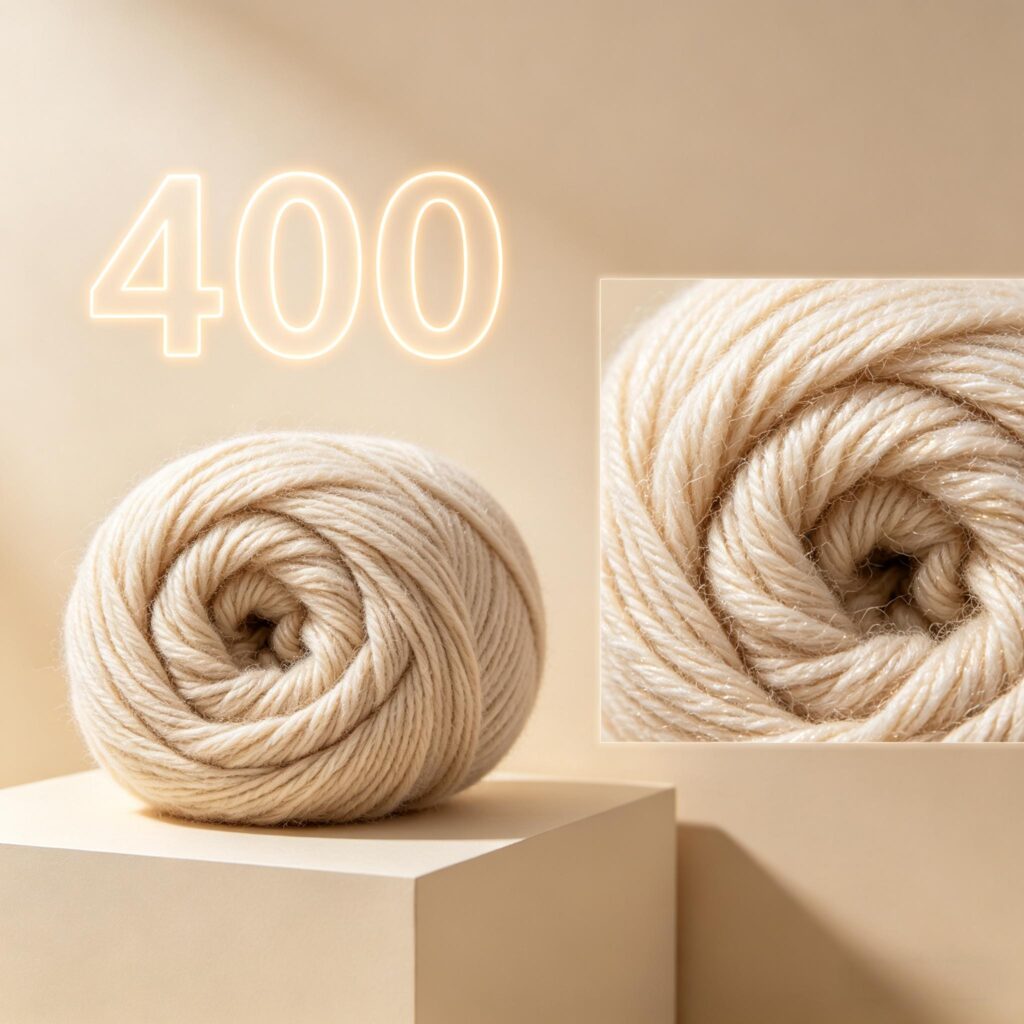
Visually, if you stack four standard 100g skeins together, that’s 400g. But here’s where it gets tricky: a 100g skein of fingering weight yarn is roughly the size of a large apple. A 100g skein of bulky yarn is the size of a grapefruit.
So 400g of fingering yarn looks like four apples lined up. 400g of bulky looks like four grapefruits – much bigger in volume even though the weight is identical.
I learned this the hard way when I ordered “400g of chunky wool” and a shoebox-sized package arrived. I was expecting a small box. What I got barely fit in my luggage.
Physical comparison (from my own shelf):
- 400g lace weight (800m per 100g) → a loose pile the size of a loaf of bread
- 400g worsted weight (200m per 100g) → two softballs
- 400g super bulky (80m per 100g) → a small melon
So weight alone tells you almost nothing about how much space the yarn will take up – or how much knitting you can get out of it.
3. The Big Variable: Yarn Weight Changes Everything
Yarn “weight” (lace, fingering, DK, worsted, bulky) doesn’t refer to grams. It refers to thickness. And thickness determines how many meters you get per gram.
The thicker the yarn, the fewer meters per gram. Simple physics.
But here’s what nobody told me: the difference is massive.
Table 1 – How Many Meters You Get Per 100g (by Yarn Weight Category)
| Yarn Weight Category | Typical Meters per 100g | Meters in 400g | Typical Gauge (sts per 10cm) |
|---|---|---|---|
| Lace (1 ply) | 800 – 1000 | 3,200 – 4,000 | 28-34 sts |
| Fingering / Sock (2 ply) | 350 – 450 | 1,400 – 1,800 | 26-30 sts |
| Sport (3 ply) | 250 – 320 | 1,000 – 1,280 | 24-26 sts |
| DK / Light Worsted | 200 – 250 | 800 – 1,000 | 22-24 sts |
| Worsted / Aran | 150 – 200 | 600 – 800 | 18-20 sts |
| Bulky (5 ply) | 100 – 140 | 400 – 560 | 12-15 sts |
| Super Bulky (6 ply) | 50 – 80 | 200 – 320 | 8-10 sts |
| Jumbo (7+ ply) | 30 – 50 | 120 – 200 | 5-7 sts |
Look at that range. 400g of lace can give you up to 4,000 meters. That’s enough for a full lace shawl, a top, and maybe a small accessory. 400g of jumbo gives you barely 200 meters. That’s one short scarf or half a baby blanket.
When I first saw this table, I felt stupid for all the yarn I’d mis-bought. But honestly? The industry doesn’t make this clear. Most online shops just say “400g” in the title and bury the yardage in the fine print.
4. By the Numbers: How Many Meters Are in 400g? (Fiber-by-Fiber Breakdown)
Yarn weight category is one thing. But fiber type also matters. Wool is lighter than cotton for the same thickness. Alpaca is lighter than wool. Acrylic is all over the place.
I spent an afternoon weighing and measuring yarns from my stash (yes, I’m that kind of person). Here’s what I found for 400g of each, assuming a standard DK thickness (around 220m per 100g for wool).
But first, a table that actually helps you compare:
Table 2 – 400g of Yarn by Fiber Type (DK weight, approximate)
| Fiber | Typical m per 100g (DK) | Total meters in 400g | Feel / Memory | Price per 400g (USD typical) |
|---|---|---|---|---|
| Merino wool | 210 – 230 | 840 – 920 | Springy, warm | $28 – 60 |
| Cotton | 160 – 180 | 640 – 720 | Heavy, no stretch | $16 – 35 |
| Acrylic | 200 – 240 | 800 – 960 | Slippery, stiff | $10 – 20 |
| Alpaca | 180 – 200 | 720 – 800 | Drapey, fuzzy | $35 – 70 |
| Linen | 250 – 280 | 1,000 – 1,120 | Stiff at first | $30 – 55 |
| Bamboo / Rayon | 200 – 220 | 800 – 880 | Slick, cool | $20 – 40 |
| Silk blend (30% silk) | 200 – 215 | 800 – 860 | Lustrous | $50 – 100 |
The cotton number surprised me. For the same weight (400g) and same thickness (DK), cotton gives you about 20% fewer meters than wool. That means a cotton sweater needs more grams than a wool sweater for the same size.
I learned this making a summer top. I used a cotton DK pattern that assumed wool yardage. Ran out of yarn with one sleeve left. Had to order more. Waited two weeks. Never again.
5. 400g Across 6 Common Yarn Types
Let’s get more practical. Most people don’t buy yarn in a vacuum. You’re choosing between a wool sweater, a cotton blanket, or an acrylic cardigan. So here’s a side-by-side comparison of what 400g actually delivers across six real-world dimensions.
Table 3 – Multi-Dimensional Comparison: What You Get From 400g
| Yarn Type (DK weight) | Meters | Approx. Cost (USD) | Typical Project (Adult size) | Washability | Durability | My personal rating |
|---|---|---|---|---|---|---|
| Merino wool | 900 | $45 | Long-sleeve sweater (S/M) | Hand wash | 4/5 | ⭐⭐⭐⭐ |
| Superwash merino | 880 | $50 | Same sweater + easier care | Machine gentle | 3.5/5 | ⭐⭐⭐⭐ |
| Cotton | 680 | $25 | T-shirt or short-sleeve top | Machine | 4/5 | ⭐⭐⭐ |
| Acrylic | 920 | $15 | Full hoodie + hat | Machine | 5/5 (pills though) | ⭐⭐ (feels cheap) |
| Alpaca | 760 | $55 | Lightweight cardigan | Hand wash | 3/5 (sheds) | ⭐⭐⭐⭐ (so soft) |
| Linen | 1,060 | $45 | Loose tank top or beach cover-up | Machine | 5/5 (gets softer) | ⭐⭐⭐ (stiff at first) |
If you want the most meters for your 400g, choose linen or acrylic. If you want warmth, choose wool or alpaca (they trap more air per meter). If you want a sweater that actually fits without running out, wool gives you the safest margin. Cotton will leave you short.
I once tried to make a men’s XL sweater from 400g of cotton DK. The pattern called for 1,100 meters. I had 680. That sweater became a vest. A very short vest.
6. Real-Life Projects: What Can You Actually Make With 400g? – My Personal Experience
Let me give you straight answers based on projects I’ve actually finished (or failed to finish).
With 400g of fingering weight yarn (approx. 1,600m):
- One adult large shawl (like a half-circle or triangle) with leftovers for a headband.
- One pair of men’s socks (size 10) plus a matching beanie.
- One women’s short-sleeve tee (size S) – barely.
- Not enough for a full adult sweater unless you’re size XS or use a very open gauge.
With 400g of DK weight (approx. 900m):
- One women’s long-sleeve sweater (size S/M) comfortably.
- One men’s sweater (size L) if cropped or short-sleeved.
- Two baby sweaters (0-6 months) plus a hat.
- One large blanket for a pet or a stroller.
- I made a DK weight cardigan for myself (size M, 3/4 sleeves) with 380g. Tight.
With 400g of worsted weight (approx. 700m):
- One cropped women’s sweater (size S).
- One men’s hat and scarf set.
- Half of a lap blanket (you’d need 600-800g total).
- I tried a worsted pullover for my husband (size L). Ran out at the neckline. Used a contrasting color for the collar. Saved it, but barely.
With 400g of bulky weight (approx. 480m):
- One women’s cropped boxy sweater (size S/M).
- One men’s beanie and cowl set.
- Two-thirds of a baby blanket.
- I made a bulky cowl that used 180g. The remaining 220g became a matching hat and fingerless gloves.
The biggest surprise:
400g of super bulky (approx. 280m) barely makes a scarf. A short, chunky scarf. I knitted one in an evening. Felt like I’d accomplished nothing. 400g looked like so much in the skein, but it knit up in two hours.
7. The Cost Factor: What Should You Expect to Pay for 400g? (Table 3)
Price varies wildly. I’ve paid $12 for 400g of acrylic and $120 for 400g of hand-dyed cashmere blend. But for normal, good-quality yarn you’d actually use, here’s a realistic range.
Table 4 – Typical Price Range for 400g (by yarn type, mid-range quality)
| Yarn Type | Budget (USD) | Mid-range | Premium | What you get for mid-range |
|---|---|---|---|---|
| Acrylic | $8 – 12 | $12 – 18 | $20+ | Soft-ish, good for kids/beginners |
| Cotton | $12 – 20 | $20 – 30 | $40+ | Mercerized, consistent twist |
| Wool (non-superwash) | $20 – 35 | $35 – 55 | $80+ | Non-itchy, good stitch definition |
| Superwash wool | $25 – 40 | $40 – 65 | $90+ | Machine-washable, slightly slippery |
| Alpaca | $30 – 50 | $50 – 75 | $120+ | Soft, halo, sheds a bit |
| Merino/nylon blend (sock) | $20 – 35 | $35 – 50 | $70+ | Durable for socks |
| Luxury (cashmere, qiviut) | $80 – 150 | $150 – 250 | $400+ | One skein is a splurge |
If I see 400g of 100% wool for under $25, I get suspicious. Either it’s rough, or the yardage is inflated, or it’s a closeout for a reason. I’ve been burned twice on “too good to be true” wool. One batch smelled like a farm. The other had so many knots I stopped counting at 12.
On the flip side, paying over $70 for 400g of superwash merino? Only if it’s from a dyer I trust. Otherwise, you’re paying for branding, not fiber.
8. The Trap I Fell Into: Why Weight Alone Is a Terrible Way to Buy Yarn
I’ll say it plainly: buying yarn by grams is like buying fabric by pounds. It tells you almost nothing useful.
Here’s what weight doesn’t tell you:
- How many meters you get
- How thick the yarn is
- How drapey or stiff the finished fabric will be
- Whether you have enough for your pattern
I once bought 400g of a gorgeous bulky alpaca. Thought I’d make a sweater. The pattern needed 600g. I didn’t check. I just saw “400g” and assumed. That sweater became a vest. A very soft, expensive, vest.
Now I have a rule: ignore the gram number until you’ve checked the meters.
Most patterns list yarn requirements in meters or yards. Some list them in grams – but only for a specific yarn. If you substitute yarn, the gram number is useless.
Example: A pattern calls for 400g of Brand X worsted wool (160m per 100g = 640m total). You buy 400g of Brand Y bulky wool (100m per 100g = 400m total). You’re short by 240 meters. That’s a whole sleeve.
I did exactly this last winter. Had to rip back, change the pattern, and make a cropped sweater. It worked, but I was annoyed the whole time.
9. Pro Tips: How to Estimate Yardage Without a Scale (When You’re Stuck)
Sometimes you’re in a yarn store (or your own stash) and there’s no scale. Or the yarn is vintage with no label. Here’s what I’ve learned to do.
Method 1: The wrap test
Wrap the yarn around a ruler or a 30cm piece of cardboard. Count how many wraps per cm. Compare to known standards:
- Lace: 25+ wraps per cm
- Fingering: 15-20 wraps per cm
- DK: 11-14 wraps per cm
- Worsted: 8-10 wraps per cm
- Bulky: 5-7 wraps per cm
- Super bulky: 3-4 wraps per cm
Once you know the thickness, estimate meters based on a 100g ball of typical yarn for that weight (see Table 1). Then multiply.
Method 2: The known skein comparison
If you have a similar yarn with a label, hold them side by side. Does the mystery ball feel denser? Lighter? A laceweight 400g is huge. A bulky 400g is small. Compare volume.
Method 3: Knit a gauge swatch and weigh it
This is the nerd method, but it works. Knit a 10x10cm swatch. Weigh it on a kitchen scale. Calculate:
(Weight of swatch in grams ÷ 100) × meters per 100g of similar yarn = meters used in swatch.
Then estimate total meters of your mystery ball by proportion.
I used this to salvage a thrift-store find: 400g of unlabeled beige wool. Turned out to be DK weight, about 850m total. Made a lovely vest.
10. Is 400g the “Sweet Spot” for Most Knitters?
After all this – the tables, the mistakes, the math – here’s my honest opinion.
Yes, 400g is a very useful amount for most knitters. But only if you know what weight you’re buying.
- For fingering: 400g is generous. You can make socks plus a shawl or a small garment.
- For DK: 400g is the sweet spot for adult women’s sweaters (size S/M) and large accessories.
- For worsted: 400g is enough for a cropped sweater or a child’s garment, but tight for a full adult men’s sweater.
- For bulky: 400g is an awkward amount – enough for accessories, not enough for most sweaters.
- For super bulky: 400g is barely a scarf. Disappointing.
My personal 400g rule of thumb:
- Under 600m total → accessories only (hats, cowls, mitts)
- 600-800m → cropped top, vest, or baby item
- 800-1,000m → adult sweater (S/M) or large shawl
- Over 1,000m → generous adult sweater, long cardigan, or small blanket
I keep this printed out in my knitting bag. No more guessing.
And for the love of wool: check the meters before you buy. Don’t be me. Don’t buy 400g of bulky alpaca thinking it’s a sweater. It’s not. It’s a vest with regrets.
11. FAQ
1. How many meters is 400g of yarn?
It depends entirely on yarn thickness. 400g of lace can be 4,000m. 400g of super bulky can be 200m. Always check the meters per gram on the label.
2. Is 400g enough for a sweater?
For a women’s size S/M in DK or worsted, usually yes. For a men’s size L in bulky, no. For a detailed answer, see Table 1 and my project notes above.
3. How many skeins is 400g?
If each skein is 100g → 4 skeins. If each is 50g → 8 skeins. If it’s a single 400g jumbo skein (common for bulky), then 1 skein.
4. Is 400g of cotton the same as 400g of wool?
No. Cotton is heavier per meter. 400g of cotton DK gives you about 20% fewer meters than wool DK. You’ll need more grams of cotton for the same project size.
5. How much does 400g of yarn cost?
Acrylic: $10-20. Wool: $30-55. Luxury fibers: $80-200+. See Table 4 for full breakdown.
6. Can I make a blanket with 400g?
A small baby blanket or pet blanket, yes. A lap blanket for an adult? No – you’d need 600-800g for worsted weight, more for bulky.
7. What’s the most common yarn weight for 400g projects?
DK and worsted. They’re the sweet spot for adult garments. Most sweater patterns for women’s S/M use 350-450g of DK or worsted.
8. Why do some yarns list grams and others list meters?
Grams are for weight (shipping, inventory). Meters are for knitting (pattern planning). Always prioritize meters. Ignore grams until you’ve done the math.
What Are Functional Waterproof Yarns? (And Which Ones Actually Work for Your Factory)
