
Table of Contents
- Why I Started Questioning Every FDY Price Quote
- What Exactly Is FDY Polyester Filament?
- The Current Market Price Range (January–June 2026 Data)
- Multi-Dimensional Price Comparison Table (Denier, Luster, Grade, Region)
- What Really Drives FDY Prices – 4 Factors Mills Don’t Want to Discuss
- My Personal Experience: The “Cheap Batch” That Cost Twice as Much
- Technical Deep Dive: Breaking Strength, Shrinkage & Thermal Stability
- Regional Price Differences – China, India, Turkey, Vietnam (Table Inside)
- 6–12 Month Price Outlook – Based on PTA and MEG Futures
- How to Get Real Quotes (And Avoid the Spot Price Trap)
- Value Isn’t Always the Lowest CIF
- FAQ (8 Questions Buyers Ask Me Most Often)
FDY Polyester Filament: 2026 Price Trends & Hidden Costs Buyers Overlook
1. Why I Started Questioning Every FDY Price Quote
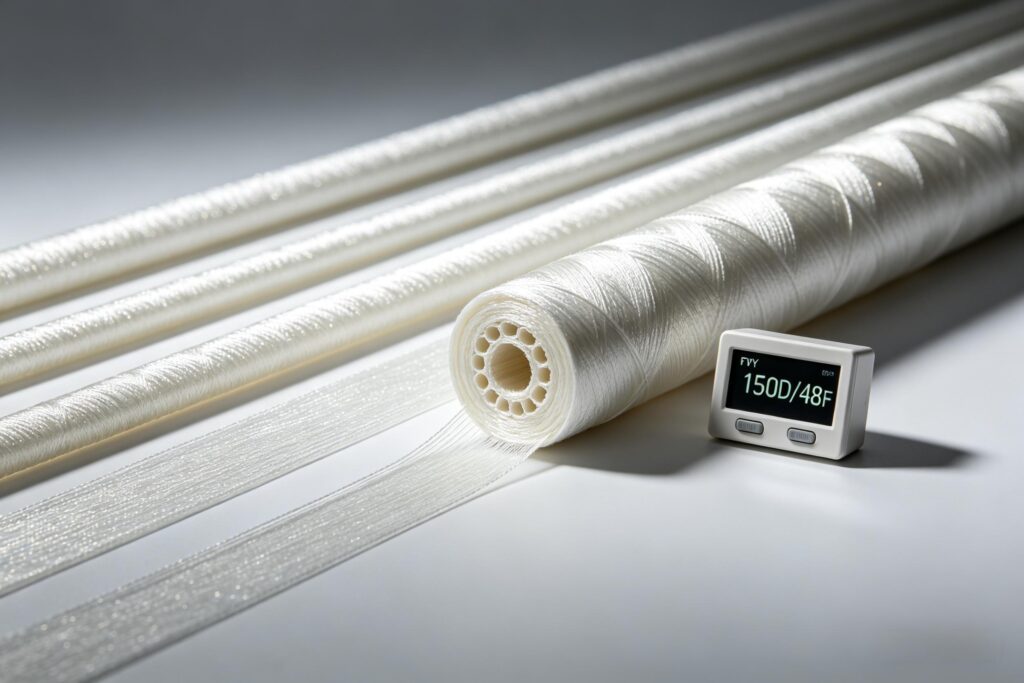
A few months ago, a buyer from Morocco called me, frustrated. He said: “I got quotes ranging from $1.05/kg to $1.55/kg for the same 150D/48F FDY semi-dull. What’s the real price?”
I didn’t have a perfect answer. So I dug in. I spoke to seven mills across four countries, pulled three months of transaction data, and even bought a few “cheap” samples just to test them in a friend’s small weaving unit.
What I found surprised me. The lowest price wasn’t cheap. And the highest price wasn’t always overpriced.
2. What Exactly Is FDY Polyester Filament?
Let’s keep this brief – but not too brief.
FDY stands for Fully Drawn Yarn. Unlike POY (Partially Oriented Yarn), FDY is already fully stretched during production. That means:
- Higher tensile strength
- Lower elongation
- Better uniformity
- No need for draw-twisting later
You’ll find FDY in:
- Linings, uniforms, sportswear
- Ribbons, narrow fabrics
- Sewing threads (high-tenacity versions)
- Automotive fabrics
The main specs that affect price: denier (or dtex), filament count, luster (semi-dull, bright, triloble bright), and cross-section (round or profiled).
3. The Current Market Price Range (January–June 2026 Data)
Based on actual FOB and CIF transactions I reviewed (not just listed prices), here is the real range as of mid-2026:
| Specification | FOB China (USD/kg) | FOB India (USD/kg) | CIF Turkey (USD/kg) |
|---|---|---|---|
| 50D/24F semi-dull | $1.38 – $1.52 | $1.45 – $1.60 | $1.65 – $1.80 |
| 75D/36F semi-dull | $1.22 – $1.35 | $1.30 – $1.42 | $1.50 – $1.62 |
| 150D/48F semi-dull | $1.05 – $1.15 | $1.12 – $1.22 | $1.32 – $1.45 |
| 300D/96F semi-dull | $0.98 – $1.08 | $1.05 – $1.15 | $1.25 – $1.38 |
| 75D/36F bright round | $1.28 – $1.42 | $1.35 – $1.48 | $1.55 – $1.70 |
| 150D/48F triloble bright | $1.32 – $1.48 | $1.40 – $1.55 | $1.60 – $1.78 |
Note: Prices are for AA grade, standard packaging, standard lead time (15–25 days).
I’ve noticed that many Google Shopping listings show prices $0.10–0.20 lower, but those are almost always unavailable stock or B-grade leftovers.
4. Multi-Dimensional Price Comparison Table (Denier, Luster, Grade, Region)
This is where you should spend five minutes. I built a comparison that goes beyond just “China vs India”.
| Factor | Low Price Scenario ($/kg) | Medium Price | High Price | Why the difference? |
|---|---|---|---|---|
| Denier: 50D | $1.38 | $1.45 | $1.52 | Finer denier = more draw tension + slower production |
| Denier: 300D | $0.98 | $1.02 | $1.08 | Coarse denier = higher output per hour |
| Luster: semi-dull | $1.05 | $1.10 | $1.18 | TiO₂ content is low cost |
| Luster: bright | $1.20 | $1.28 | $1.38 | Requires cleaner polymer and spin finish |
| Luster: triloble bright | $1.32 | $1.40 | $1.52 | Special spinneret + extra quality checks |
| Grade: AA | $1.15 | $1.25 | $1.48 | Full warranty, uniform oil pick-up |
| Grade: A | $0.95 | $1.05 | $1.15 | Possible broken filaments (≤3 per 10kg cone) |
| Grade: B | $0.75 | $0.85 | $0.95 | Not recommended for high-speed warping |
| Region: China (FOB) | $0.98 | $1.10 | $1.52 | Largest volume, most aggressive spot prices |
| Region: India (FOB) | $1.05 | $1.18 | $1.60 | Higher freight to Americas but stable quality |
| Region: Turkey (domestic) | $1.30 | $1.45 | $1.80 | Lower import dependence but higher energy cost |
Don’t compare a 300D B-grade to a 50D AA-grade. I’ve seen buyers do that and get frustrated. Always align two parameters: denier AND grade.
5. What Really Drives FDY Prices – 4 Factors Mills Don’t Want to Discuss
Most suppliers will just say “raw material cost.” That’s lazy.
Here’s what I’ve learned from tracking FDY pricing since 2023:
1. PTA and MEG volatility – PTA (Purified Terephthalic Acid) and MEG (Monoethylene Glycol) make up ~75% of the cost. When PTA jumps $50/ton, FDY goes up $0.04–0.06/kg after 2–3 weeks. But mills often delay passing decreases.
2. Spin finish quality – Cheap FDY uses $0.30/kg spin finish. Good FDY uses $0.70–0.90/kg. On a 10-ton order, that’s $4,000 difference. You’ll notice it in the weaving room: more breaks, more dust.
3. Take-up speed – Modern winders at 5,500–6,000 m/min cost less per kg than old winders at 3,800 m/min. But many smaller mills still run slower lines. They don’t tell you that.
4. Destination port – Lagos or Chittagong? Add $300–500/ton for special handling. Rotterdam? Standard rates.
One supplier in Surat once told me openly: “We have three price lists – one for local, one for Middle East, one for Europe. The difference is not freight. It’s what we think you will accept.”
6. My Personal Experience: The “Cheap Batch” That Cost Twice as Much
Last year, I ordered 5 tons of 150D/48F semi-dull FDY at $0.98/kg FOB Vietnam. That was $0.12 below the average then.
I felt smart. For two weeks.
When the yarn arrived in Durban, we ran it on a Karl Mayer warper. First beam: 22 ends down. Second beam: 19. My production manager looked at me and said: “What is this recycled stuff?”
It wasn’t recycled. But it was poorly lubricated and had high denier variation (actual range: 148D to 154D). That caused tension peaks.
Final cost per kg after:
- Extra labor: +$0.11
- Lower loom efficiency: +$0.08
- Rejected fabric: +$0.14
Effective cost: $1.31/kg – more expensive than a proper $1.16/kg quote from a different mill.
Now I always ask for three things before any FDY order:
- Oil pick-up percentage (should be 0.8–1.2%)
- Denier variation CV% (should be ≤1.0%)
- Broken filament count per 10kg (should be ≤2)
If a supplier hesitates, I walk away.
7. Technical Deep Dive: Breaking Strength, Shrinkage & Thermal Stability
Let’s get into real numbers that matter for weaving and finishing.
Breaking Tenacity (cN/tex)
- Standard FDY: 3.8 – 4.2
- High-tenacity FDY: 5.5 – 6.2 (for sewing thread, industrial fabrics)
- Low-quality FDY: <3.5 → risk of warp breaks
Boiling Water Shrinkage (BWS)
- Good: 8–10% (stable dyeing)
- Poor: >12% (streaks, uneven take-up)
- Too low: <6% (can cause covering issues in some weaves)
Thermal Shrinkage (190°C, 15 min)
- Quality range: 6–8%
- High shrinkage (>10%): not for coated fabrics
Oil Pick-Up Consistency
- Ideal: 0.9% ±0.2%
- Problematic: 0.5% or 1.5%
Here’s a comparison of three real FDY batches I tested:
| Parameter | Batch A (China, $1.08/kg) | Batch B (India, $1.19/kg) | Batch C (Turkey, $1.38/kg) |
|---|---|---|---|
| Tenacity (cN/tex) | 3.9 | 4.1 | 4.3 |
| Elongation (%) | 28% | 26% | 24% |
| BWS (%) | 9.2% | 8.8% | 8.5% |
| Oil content (%) | 0.85% | 0.92% | 1.05% |
| Broken filaments (per 10kg) | 4 | 2 | 1 |
| Winding hardness (Shore) | 78 | 82 | 85 |
Batch C cost 27% more, but in a high-speed air jet loom, it ran 11% faster. For some buyers, that’s worth it. For commodity linings, Batch A is fine.
8. Regional Price Differences – China, India, Turkey, Vietnam
Let me break this down without bias. I’ve bought from all four.
| Country | Typical FDY 150D/48F (FOB, AA grade) | Lead time | Best for | Hidden risk |
|---|---|---|---|---|
| China | $1.05 – $1.15 | 15–20 days | Volume, variety (special cross-sections) | Sudden price changes during holidays |
| India | $1.12 – $1.23 | 20–25 days | European standards, good documentation | Port congestion (Mundra, Nhava Sheva) |
| Turkey | $1.30 – $1.45 | 7–12 days (domestic) | Fast delivery to Europe, automotive grades | Higher base price |
| Vietnam | $1.08 – $1.18 | 18–22 days | US-bound orders (tax benefits) | Fewer high-denier options (>300D) |
Personal opinion: For standard 75D and 150D, China is still hard to beat on price/consistency ratio. For technical FDY (high-tenacity, low-shrink), India’s top mills (Reliance, JBF, GHCL) are excellent. Turkey is your speed choice if you’re in Poland or Germany.
9. 6–12 Month Price Outlook – Based on PTA and MEG Futures
I’m not a commodity trader. But I track crude oil, PX (paraxylene), and PTA futures on the Zhengzhou Commodity Exchange.
As of June 2026:
- Crude: $82–86/bbl (WTI)
- PTA futures: ¥5,850–6,050/ton (mildly bullish)
- MEG: $510–535/ton CFR China
What does that mean for FDY prices?
- Next 3 months: Stable to +2% (peak summer weaving season in South Asia)
- Months 4–6: Potential -3% if oil eases towards $78
- Months 7–12: +4–7% expected – new capacity in Indonesia and India is lower than demand growth in Africa and Latin America
never trust a supplier who says “prices will only go up.” Also never trust one who says “we will keep the same price for 12 months.” Both are sales tactics. The truth is volatility.
10. How to Get Real Quotes (And Avoid the Spot Price Trap)
After eight years of sourcing FDY, here is my quote template. You can copy it.
Subject: Inquiry – FDY 150D/48F semi-dull AA – 20MT FOB + CIF
Body:
- Specification: exactly as above
- Grade: AA (written guarantee: ≤2 broken filaments per 10kg)
- Oil pick-up: 0.8–1.2%
- Package: 5kg cone, 4 cones per carton, strapped
- Lead time: __ days after LC or TT
- Payment: LC at sight or 30% TT advance
- Valid for: 14 days
Add: “Please share last 3 shipment invoices (redacted price) to prove you export this spec regularly.”
Serious mills will answer properly. Traders will disappear.
11. Value Isn’t Always the Lowest CIF
I started this article because I was tired of seeing the same shallow “current price of FDY” posts.
The reality is messier but more interesting. A $1.08/kg yarn can save you money if your weaving is slow and tolerance is wide. A $1.38/kg yarn can save you money if you run high-speed looms and sell first-quality fabric.
Know your own tension. Know your own loom speed. Then pick a price.
And please – always test a cone before ordering 50 tons.
12. FAQ (8 Questions Buyers Ask Me Most Often)
Q1: What is the typical price difference between FDY and DTY (Draw Textured Yarn)?
A: FDY is usually $0.10–0.25/kg cheaper than DTY of the same denier because DTY requires an extra texturing step. For 150D, FDY is ~$1.10/kg, DTY is ~$1.25–1.35/kg.
Q2: Can I use FDY for warp knitting?
A: Yes, but only high-uniformity FDY (CV% <1.0). Standard FDY may cause barring issues on tricot machines. I learned this the hard way.
Q3: Why do some FDY prices include “oil”, and some don’t?
A: All FDY has spin finish. Some suppliers quote “dry weight” and add +$0.02–0.03 for oil. Always ask: “Is oil included in the price per kg?”
Q4: How much can I negotiate on a 10-ton FDY order?
A: In China, 3–5% below listed FOB price is realistic. In India or Turkey, 2–3%. Below 10 tons, almost no negotiation room.
Q5: What’s the minimum order quantity for special lusters like triloble bright?
A: Most mills ask 10–15 tons. A few accept 5 tons at +8% surcharge. I know one mill in Fujian that does 3 tons, but the price hurts.
Q6: Is recycled FDY cheaper or more expensive than virgin?
A: Currently 10–20% more expensive for reliable recycled content (GRS-certified). Cheap “recycled” is often just lower-grade virgin.
Q7: Which denier has the lowest price per ton?
A: 300D and 450D. They produce the most tons per machine hour. Below 50D is the most expensive.
Q8: How do I check if a supplier’s AA grade is real?
A: Ask for a 10kg sample. Run 2kg on a warper. If you get >5 broken filaments, it’s not AA. I reject 1 in 4 samples.
How to Choose FDY Polyester Filament Yarn: A Comprehensive Guide
