
Title: Demystifying Virgin & Recycled Polyester: Advanced Identification Techniques, Data-Driven Insights & Strategic Sourcing Guide
Table of Contents
- The Critical Need for Accurate Polyester Identification
- The Market Landscape: Sustainability Claims vs. Material Integrity
- Financial and Compliance Risks of Misidentification
- Fundamental Differences: Virgin vs. Recycled Polyester (rPET)
- Polymer Science Overview: Molecular Chain Structure, Crystallinity, and Impurities
- The Impact of the Recycling Process on Fiber Properties
- Industry-Standard Laboratory Identification Methods
- Fourier-Transform Infrared Spectroscopy (FTIR): Fingerprint Analysis
- Differential Scanning Calorimetry (DSC): Measuring Thermal Behavior
- Intrinsic Viscosity (IV) Testing: Determining Molecular Weight
- Trace Element Analysis: Identifying Catalysts and Additives
- Practical In-House and Supply Chain Verification Techniques
- Burn Test Refinements: Observation Guidelines and Limitations
- Density Gradient Testing: A Simple Yet Effective Tool
- Microscopic Examination: Longitudinal and Cross-Sectional Views
- Certificate Analysis: Decoding GRS, RCS, and OEKO-TEX Certificates
- Comparative Performance & Sourcing Data
- Comprehensive Property Comparison Table
- Cost Structure Analysis: Raw Material, Processing, and Certification
- Lead Time and Supply Chain Reliability Metrics
- Application-Specific Identification Challenges & Solutions
- Apparel (Performance Wear, Fashion): Blends and Finish Interference
- Home Textiles & Carpets: Bulked Continuous Filament (BCF) Yarns
- Plush Toys & Nonwovens: Staple Fiber Complications
- Blockchain, Isotope Testing, and AI-Powered Authentication
- The Role of Digital Product Passports (DPP)
- Emerging Technologies for Seamless Verification
- Building a Robust Verification Protocol
- Frequently Asked Questions (FAQs)
1. The Critical Need for Accurate Polyester Identification
The global shift towards circular economy models has propelled recycled polyester (rPET) into the spotlight. Brands are making bold sustainability commitments, and procurement managers across apparel, textiles, carpets, and toy manufacturing are under increasing pressure to source rPET. However, this demand surge brings a significant challenge: guaranteeing the authenticity of recycled content. Mislabeled or adulterated material carries severe risks—from greenwashing accusations and failed compliance audits to inconsistent production quality and eroded brand trust. For a procurement manager, distinguishing between virgin and recycled polyester is no longer just a technical exercise; it’s a critical component of risk management, cost control, and brand protection. This guide provides the advanced knowledge and practical tools necessary to navigate this complex landscape confidently.
2. Fundamental Differences: Virgin vs. Recycled Polyester (rPET)
At a chemical level, both are polyethylene terephthalate (PET). The core differences lie in their history and resulting physical structure.
- Virgin Polyester: Synthesized directly from purified petrochemical monomers (PTA and MEG). It has long, uniform polymer chains, high intrinsic viscosity, and consistent crystallinity. Additives (UV stabilizers, delustrants) are introduced in a controlled manner.
- Recycled Polyester (rPET): Derived primarily from post-consumer PET bottles or post-industrial waste. The mechanical recycling process (sorting, washing, melting, re-polymerization) subjects the polymer to thermal and mechanical stress. This causes:
- Polymer Chain Degradation: Reduction in average molecular chain length.
- IV Drop: A measurable decrease in intrinsic viscosity (typically 0.05-0.15 dl/g lower than virgin).
- Contaminant Presence: Micro-traces of labels, adhesives, other plastics, or colorants.
- Molecular Irregularities: Altered crystallization behavior and thermal profile.
These inherent differences form the basis for all identification methods.
3. Industry-Standard Laboratory Identification Methods
For definitive proof, especially in dispute resolution or certification audits, laboratory testing is essential.
- Fourier-Transform Infrared Spectroscopy (FTIR): While the primary spectra are identical, sophisticated analysis can detect subtle absorbance variations indicating oxidative degradation products (like carbonyl groups) more common in rPET. Library comparisons are key.
- Differential Scanning Calorimetry (DSC): This is a highly effective method. It measures the heat flow associated with thermal transitions.
- Melting Temperature (Tm): rPET often shows a slightly broader and lower melting peak (e.g., 250-254°C) compared to virgin (255-260°C).
- Glass Transition Temperature (Tg): Can be marginally lower for rPET.
- Cold Crystallization Peak: The shape and temperature of this peak can indicate differences in nucleation behavior due to chain scission or residual contaminants.
- Intrinsic Viscosity (IV) Testing: A direct measure of polymer chain length. Virgin fiber-grade PET typically has an IV of 0.60-0.70 dl/g. rPET from bottle flakes usually ranges from 0.55 to 0.65 dl/g before solid-state polymerization (SSP). Note: High-quality rPET undergoes SSP to raise IV, narrowing this gap.
- Trace Element Analysis (ICP-MS/OES): Virgin PET uses specific catalysts (e.g., Antimony, Germanium). rPET from bottles may show traces of elements from bottle caps (aluminum), pigments (titanium, cobalt), or other historical additives, providing a forensic “fingerprint.”
4. Practical In-House and Supply Chain Verification Techniques
Not every batch can go to a lab. Here are practical steps for supply chain due diligence.
- Enhanced Burn Test: Go beyond basic observation. Caution: Perform safely.
- Virgin PET: Sharp, sooty smoke, slow drip, hard black bead.
- rPET: May have a slightly different odor (due to contaminants), potentially more variable drip behavior. This test is highly subjective and inconclusive for blends.
- Density Gradient Column: A simple, more objective test. Fibers are placed in a column with a density gradient liquid. Virgin PET density is ~1.38 g/cm³. The presence of other materials (e.g., PVC from labels, density ~1.3) in rPET can cause fibers to settle at different levels.
- Microscopic Examination:
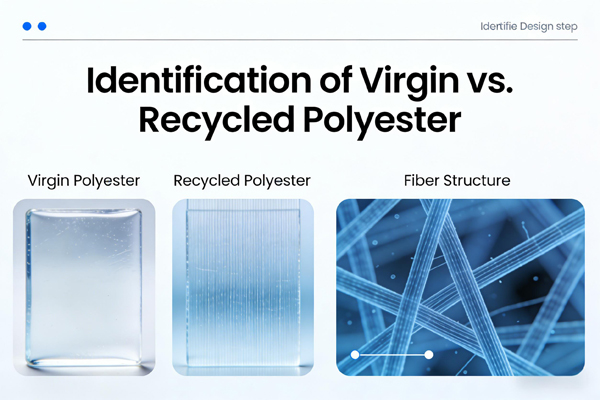
- Longitudinal View: rPET filament may show more surface pitting or irregularities from residual particles.
- Cross-Sectional View: Inconsistent shape or voids not typical of the specified spinneret shape can indicate recycled content mixed with incompatible polymers.
- Certificate Analysis: Scrutinize, don’t just file.
- GRS/RCS Certificates: Verify the scope certificate of the supplier and the transaction certificate (TC) for your specific shipment. The TC must have a valid chain of custody linking back to the recycler. Check the percentage claimed (e.g., GRS 50%, 100%).
- Test Reports: Review full laboratory reports, not just summaries, for the methods used (e.g., DSC, IV) and the actual numerical results.
5. Comparative Performance & Sourcing Data
Table 1: Property & Sourcing Comparison Matrix
| Parameter | Virgin Polyester | Recycled Polyester (rPET) | Implication for Procurement |
|---|---|---|---|
| Typical IV (dl/g) | 0.62 – 0.72 | 0.58 – 0.68 (post-SSP) | Affects fiber strength & processing speed. |
| Tenacity (cN/dtex) | High, Very Consistent | Slightly Lower (5-10%), More Variable | Critical for technical textiles, seat belts. |
| Color Consistency | Excellent | Can be Off-White/Yellowish Tinge | Higher dye costs for bright whites/pastels. |
| Batch-to-Batch Uniformity | Very High | Moderate (depends on feedstock) | Risk of shade variation in large apparel runs. |
| Relative Raw Material Cost | Benchmark (100%) | Currently at 90-110% of Virgin | rPET premium fluctuates with oil & bottle flake prices. |
| Key Supply Chain Risk | Petrochemical Price Volatility | Feedstock (Bottle Flake) Availability & Quality | Dual-sourcing strategy may be prudent. |
| Standard Lead Time | Consistent | Can be Extended (certification, flake sourcing) | Plan further ahead for rPET programs. |
6. Application-Specific Identification Challenges & Solutions
- Apparel & Fashion (Blends): Identifying rPET in a 50/50 cotton blend is notoriously difficult. Demand component-level certification (e.g., GRS for the polyester portion only) and consider PCRD testing for finished fabrics.
- Carpets (BCF Yarns): The heavy dyeing and texturizing processes can mask indicators. Supplier audits are crucial here. Verify the polymer chip source before extrusion and request DSC data on the raw chip.
- Plush Toys (Staple Fiber): Staple fiber production involves multiple blending stages. The most reliable method is to audit the staple fiber producer and implement a mass balance chain of custody with robust documentation from recycler to spinner.
7. Blockchain, Isotope Testing, and AI-Powered Authentication
The future lies in digitization and advanced science.
- Blockchain & Digital Product Passports (DPP): Immutable ledgers will provide a transparent journey from bottle to finished product, with certificates and test data embedded in QR codes.
- Isotope Ratio Mass Spectrometry (IRMS): This can differentiate between fossil-based (virgin) and bio-based (potentially future rPET) carbon, adding another layer of verification.
- AI-Powered Spectral Analysis: Machine learning models trained on thousands of FTIR or DSC results will provide instant, highly accurate composition predictions from simple scans.
8.Building a Robust Verification Protocol
Relying on a single method is insufficient. A robust protocol is multi-layered:
- Supplier Qualification: Audit key suppliers, review their certification bodies and testing protocols.
- Contractual Clarity: Include material specification sheets with defined IV, DSC parameters, and certification requirements with penalties for non-compliance.
- Random Sampling & Testing: Implement a program of random batch testing using a combination of in-house checks (density) and periodic third-party lab analysis (DSC, IV).
- Documentation Trail: Maintain a perfect chain of certificates, test reports, and shipping documents for every order.
By adopting this strategic approach, sourcing professionals can ensure material integrity, mitigate risk, and build truly sustainable and reliable supply chains.
Frequently Asked Questions (FAQs)
- Can a fabric be certified as recycled if it contains both virgin and rPET?
Yes. Standards like GRS allow for “blended” products under a mass balance or percentage-based claim (e.g., “Product contains 50% GRS-certified recycled material”). The Transaction Certificate must state the exact percentage. - Is the “burn test” reliable enough for quality control?
No. It is a preliminary, highly subjective field test useful for spotting gross misrepresentation (e.g., cotton vs. polyester) but is ineffective and unsafe for accurately distinguishing virgin from recycled polyester or detecting blends. - What is the single most telling lab test for identifying rPET?
Differential Scanning Calorimetry (DSC) is often considered the best balance of cost, speed, and information. It directly measures the thermal history imprinted on the polymer, revealing effects of degradation characteristic of recycling. - Why does some rPET perform as well as virgin, while other batches are problematic?
It depends entirely on the feedstock quality and the recycling technology. “Bottle-to-fiber” processes using clean, sorted flakes and advanced SSP can produce high-quality rPET. Processes using mixed-color or contaminated waste stream produce lower, more variable quality. - Who is responsible for the cost of verification testing?
This should be defined in the supply contract. Often, the buyer pays for routine random testing. However, if a shipment fails to meet the agreed specification, the cost of the failure analysis and any replacements typically falls on the supplier. - How can I verify rPET in a dyed or finished fabric?
It becomes more challenging. Lab tests like DSC can still be performed on the base fiber, but may require expertise to interpret results if dyes/finishes interfere. The most straightforward method is a strong chain of custody documentation from the certified polymer chip to the finished fabric mill. - Are there quick test kits available for polyester identification?
There are no consumer-grade “litmus paper” type tests. Some companies offer portable FTIR or Raman spectrometers, but these require significant capital investment and trained operators to interpret the complex data. - Does recycled polyester always have a lower melting point?
Not always, but it’s a common trend. The melting point range is often broader and slightly depressed (by 2-8°C) due to shorter polymer chains and irregularities. High-quality rPET after SSP may have a melting point very close to virgin. - What questions should I ask my supplier to gauge reliability?
- “Can you provide the GRS scope certificate for the recycling facility and the spinner?”
- “Can I see the DSC and IV test reports for the polymer chips used in this batch?”
- “What is your process for controlling feedstock consistency?”
- “What is your protocol if a batch fails internal quality control?”
- Is chemical recycling producing a polyester identical to virgin?
Yes, in theory. Depolymerization back to monomers (PTA/MEG) and re-polymerization creates a polymer chemically identical to virgin. Distinguishing this “chemically recycled” PET from virgin petrochemical PET is extremely difficult and may require isotope tracing, as the molecular structure is fully renewed.
