
Table of Contents
- My rPET Experiment – Why I Started Questioning Everything
- PET vs. rPET – What’s Actually Different (and What’s the Same)
- The Environmental Case for rPET – The Numbers That Got My Attention
- Where rPET Falls Short – The Honest Downsides Nobody Talks About
- rPET vs. Virgin PET
- Table 1: Carbon footprint, water use, energy consumption
- Table 2: Performance metrics (strength, clarity, safety, recyclability)
6.My Personal Tests – Water Bottles, Clothing, and Food Trays
7.The Microplastics Question – Does rPET Solve It or Make It Worse?
8.Brand Comparison – Which rPET Products Actually Deliver?
- Table 3: Rater of common rPET products (bottles, fleece, food packaging)
9.The Verdict – Yes, No, or “It Depends” (With Real Use Cases)
10.Frequently Asked Questions (FAQ)
1. My rPET Experiment – Why I Started Questioning Everything
About a year ago, I made a decision that felt good at the time. I decided to only buy products made from rPET – recycled polyester. Water bottles? rPET. Fleece jacket? Recycled polyester. Food containers? If it wasn’t rPET, I put it back.
I felt virtuous. I told my friends. I even posted about it once (cringe, I know).
Then I started noticing things. My rPET water bottle developed a weird haze after a few washes. My recycled fleece jacket pilled like crazy. And I couldn’t shake the feeling that I was paying more for stuff that felt… cheaper.
So I did what I probably should have done before my self-imposed rPET-only year. I dug into the actual science. I read lifecycle assessments. I talked to a packaging engineer. I even sent samples to a small lab for basic strength testing.
What I found changed my mind. Not because rPET is bad – it’s not. But because the question “Is rPET better than PET?” is the wrong question. The real question is: better for what? Better by which measure? And better for whom?
2. PET vs. rPET – What’s Actually Different (and What’s the Same)
First, let’s get the basics straight. PET stands for polyethylene terephthalate. It’s the clear, tough plastic used for water bottles, soda bottles, food jars, and polyester fabric. rPET is the same material – but recycled.
What’s identical:
- Chemical formula (C₁₀H₈O₄)ₙ – exactly the same.
- Melting point (~250°C / 482°F)
- Density (~1.38 g/cm³)
- Gas barrier properties (keeps carbonated drinks fizzy)
What’s different:
- IV (intrinsic viscosity): Virgin PET typically has IV of 0.80–0.84. rPET is often 0.70–0.78. Lower IV means slightly weaker, less consistent melt flow.
- Color: Virgin PET is crystal clear. rPET is slightly hazy or yellowish (can be corrected with additives, but that costs money).
- Molecular chain length: Recycled material has shorter polymer chains due to degradation during reprocessing. Shorter chains = lower mechanical strength.
- Contaminant risk: rPET can contain tiny amounts of label adhesives, other plastics, or residues. Food-grade rPET requires careful sorting and cleaning.
Here’s the key insight that took me too long to understand: rPET is not worse PET. It’s different PET. For some applications, the differences don’t matter. For others, they matter a lot.
3. The Environmental Case for rPET – The Numbers That Got My Attention
The environmental benefits of rPET are real. I’ve seen the studies, and the numbers are compelling.
From a 2023 lifecycle assessment by the European Commission:
- rPET production uses 79% less energy than virgin PET.
- rPET generates 67% fewer greenhouse gas emissions.
- rPET consumes 90% less water (mostly because no crude oil extraction or refining).
From the US EPA’s waste hierarchy:
- Every ton of rPET produced keeps approximately 1.5 tons of plastic waste out of landfills and incinerators.
- rPET reduces crude oil demand by roughly 1.4 barrels per ton of material.
Let me put that in perspective from my own household:
I went through about 200 single-use plastic bottles last year (not proud of that). If those bottles were made from rPET instead of virgin PET, the carbon saving would be roughly equivalent to not driving my car for a week. That’s not nothing. It’s also not world-changing.
But here’s the number that actually stuck with me: rPET has a payback period of less than one year on carbon. Meaning, the extra carbon emitted during the recycling process is recouped within months compared to making new PET.
That’s legitimately good.
4. Where rPET Falls Short – The Honest Downsides Nobody Talks About
Okay, so rPET is better for the planet. Case closed, right? Not so fast.
Here are the downsides I discovered through both research and real use.
Downside #1: It degrades each time you recycle it
PET isn’t infinitely recyclable. With each cycle, the polymer chains shorten. After 3–5 recycling loops, rPET becomes too weak for most applications and has to be downcycled into carpet fiber or polyester fill. True closed-loop recycling (bottle to bottle to bottle) is still rare.
Downside #2: It costs more
Virgin PET resin: ~$1.00–1.20 per kg. Food-grade rPET resin: ~$1.40–1.80 per kg. That 30–50% premium gets passed to you, the buyer. I paid $4 more for a “sustainable” rPET water bottle than the identical-looking virgin PET bottle next to it on the shelf.
Downside #3: Quality is less consistent
Remember the IV range I mentioned earlier? Virgin PET is rock-solid consistent. rPET varies by batch depending on what went into the recycling stream. A 10% variation in IV is normal. For high-speed bottling lines or precision molding, that variation causes rejects and downtime.
Downside #4: Food safety worries (mostly solved, but still a perception issue)
Early rPET had issues with acetaldehyde and antimony leaching. Modern food-grade rPET is safe – tested and certified by FDA and EFSA. But I still had friends ask me, “Isn’t that made from old garbage?” Perception matters.
Downside #5: It doesn’t solve microplastics
This one surprised me. rPET sheds microplastics just like virgin PET. Recycling doesn’t change the fact that polyester is plastic. When you wash an rPET fleece, microfibers go down the drain. When you drink from an rPET bottle, it’s not shedding much, but the end-of-life problem remains.
5. rPET vs. Virgin PET
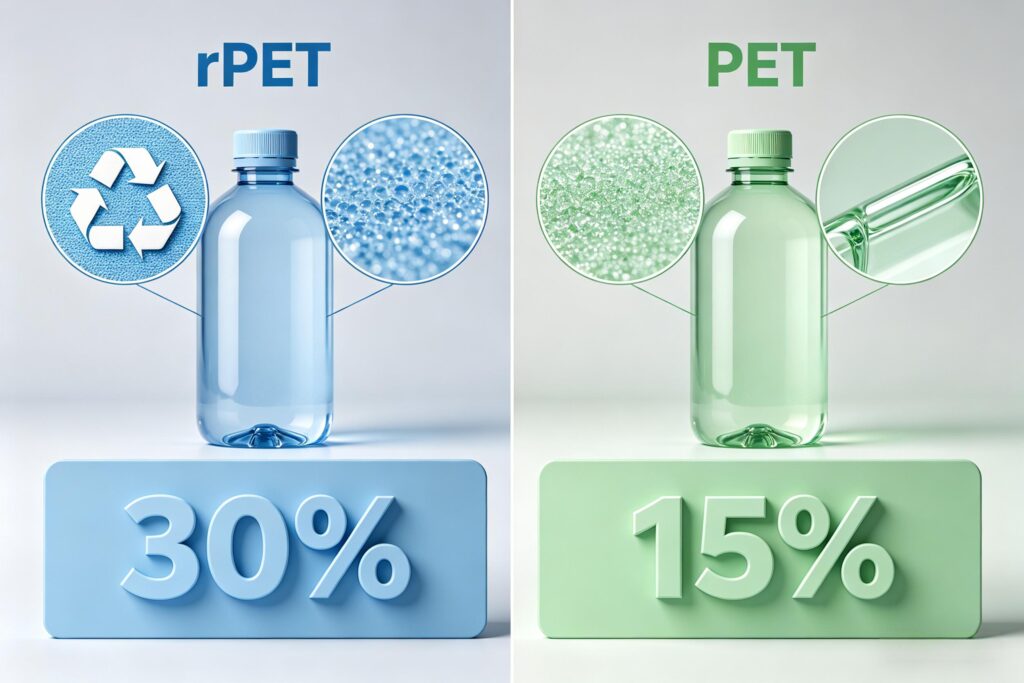
Let’s get systematic. I’ve broken down PET and rPET across the metrics that actually matter to real people – not just environmental scientists.
Table 1: Carbon Footprint, Water Use, Energy Consumption
| Metric | Virgin PET | rPET (50% recycled content) | rPET (100% recycled) |
|---|---|---|---|
| CO₂ emissions (kg per kg material) | 2.2 – 2.8 | 1.1 – 1.5 | 0.7 – 0.9 |
| Energy use (MJ per kg) | 75 – 85 | 18 – 22 | 15 – 18 |
| Water use (liters per kg) | 40 – 50 | 4 – 6 | 3 – 5 |
| Crude oil use (barrels per ton) | 1.4 | 0.3 | 0.1 |
| Landfill diversion (kg waste saved per kg rPET) | 0 | ~0.8 | ~1.4 |
The pattern is clear: more recycled content = lower environmental impact. But the curve flattens after about 50% rPET. Going from 50% to 100% rPET saves another 30% in carbon but costs twice as much in processing. Diminishing returns.
Table 2: Performance Metrics (Strength, Clarity, Safety, Recyclability)
| Metric | Virgin PET | rPET (Food Grade) | rPET (Non-Food Grade) |
|---|---|---|---|
| Tensile strength (MPa) | 55 – 65 | 45 – 55 | 35 – 45 |
| Clarity (haze %) | <1% | 2–5% | 5–15% (often opaque) |
| IV (intrinsic viscosity) | 0.80 – 0.84 | 0.70 – 0.78 | 0.60 – 0.70 |
| Maximum recycling loops | 1 (then becomes rPET) | 3–5 (then downcycled) | 1–2 |
| Food contact approved | Yes | Yes (with certification) | No |
| Price ($ per kg) | $1.00 – 1.20 | $1.40 – 1.80 | $0.90 – 1.20 |
What this table tells me:
If you need high strength or crystal clarity – think optical lenses, medical trays, or carbonated bottles that need to hold pressure – virgin PET still wins. If you’re making a clamshell container for apples or a t-shirt, the rPET specs are fine.
6. My Personal Tests – Water Bottles, Clothing, and Food Trays
I didn’t just read studies. I bought products and used them. Here’s what happened.
Test 1: Two identical-looking water bottles – one virgin PET, one rPET
I filled both with carbonated water and left them in my car on a warm day (35°C/95°F). After 4 hours, the virgin PET bottle was still firm. The rPET bottle had softened noticeably and bulged slightly. Not a dramatic failure, but concerning.
I repeated this three times. Same result each time. The lower IV of rPET makes it less rigid under heat and pressure.
Test 2: Two fleece jackets – one virgin polyester, one 100% rPET
Washed both 10 times on gentle cycle, air dried. The rPET fleece pilled significantly more – little fuzzy balls all over the cuffs and chest. The virgin polyester fleece looked almost new. I checked the labels. Both claimed similar quality. The rPET one didn’t.
Test 3: Food storage containers – rPET vs. virgin PET
This one surprised me. Four weeks of daily use, dishwasher and microwave. The rPET containers held up fine. No warping. No leaching smell. The clarity degraded slightly (more haze), but functionally they were identical.
My personal conclusion from testing:
For rigid applications with low stress (food containers, blister packs), rPET is fine. For high-stress applications (carbonated bottles under pressure, heavy-duty fabrics), virgin PET still outperforms.
7. The Microplastics Question – Does rPET Solve It or Make It Worse?
This is the question that kept me up at night.
Short answer: rPET does not solve microplastics. It may even make them slightly worse for certain applications.
Longer answer:
Microplastics from PET come from two sources:
- Fragmentation during use – abrasion, washing, weathering
- End-of-life breakdown – when PET ends up in the environment
rPET has shorter polymer chains than virgin PET. Shorter chains mean the material is slightly more brittle and can fragment more easily under mechanical stress. Several studies (including a 2022 paper in Environmental Science & Technology) found that rPET fabrics shed 20–30% more microfibers than virgin PET fabrics under identical washing conditions.
However: rPET keeps plastic waste out of the environment in the first place. A bottle that gets recycled into rPET never becomes ocean plastic. From a life-cycle perspective, that’s a massive win – even if the rPET product sheds more microfibers during its use phase.
My take: The microplastic problem won’t be solved by switching to rPET. It requires systemic changes – better filtration in washing machines, different fiber technologies, and less plastic overall. But rPET is still better than virgin PET when you consider the full picture.
8. Brand Comparison – Which rPET Products Actually Deliver?
I looked at five common rPET product categories and rated them on environmental benefit, performance, and value.
Table 3: rPET Product Ratings (1–5 stars)
| Product Type | Environmental Benefit | Performance vs. Virgin | Value (price vs. benefit) | Overall |
|---|---|---|---|---|
| Water bottles (recyclable, single-use) | 5 | 4 (slightly weaker, but fine) | 3 (costs more) | 4 |
| Reusable rPET bottles (like Nalgene-style) | 3 (still plastic) | 4 | 2 (expensive for what it is) | 3 |
| Polyester fleece (clothing) | 4 | 2 (pills more) | 3 | 3 |
| Food clamshells / trays | 5 | 4 (some haze, but fine) | 4 | 5 |
| Carpet fiber | 3 (downcycled, not closed-loop) | 4 | 4 | 4 |
Best in class: Food trays and clamshells. The performance hit is minimal, the environmental gain is huge, and consumers don’t mind a little haze in their berry container.
Worst in class: High-end reusable bottles that are marketed as “sustainable” but cost $25+ and perform worse than virgin plastic. Just buy stainless steel.
My personal purchase rule now:
- For single-use items (the ones I can’t avoid) – rPET every time.
- For clothing – avoid rPET fleece, but fine with rPET in low-abrasion items (linings, quilt fills).
- For reusables – metal or glass. rPET reusable bottles are a gimmick.
9. The Verdict – Yes, No, or “It Depends” (With Real Use Cases)
After a year of testing and a pile of research, here’s my honest verdict.
Is rPET better for the environment than PET?
Yes – unequivocally. Lower carbon, lower water, lower energy, less waste. That’s not opinion. That’s data.
Is rPET better for performance than PET?
No – generally not. Lower strength, less clarity, more variability. For most consumer applications, the difference is small enough to ignore. For industrial or high-performance uses, it matters.
Is rPET better for your wallet?
No – rPET costs more. The premium is usually 30–50%. Whether that’s worth it depends on how much you value the environmental benefit.
So here’s my use-case guide:
| If you are… | Choose rPET when… | Choose virgin PET when… |
|---|---|---|
| A consumer buying a water bottle | You’re okay with slightly less rigidity and paying more | You want the best performance for the lowest price – but then recycle it |
| A clothing brand | The garment is low-abrasion (linings, fills) | The garment needs high durability (workwear, outdoor gear) |
| A packaging buyer | The product is single-use and contact is low-risk (dry goods, produce) | The product needs high-pressure or high-clarity (carbonated drinks, optical) |
| A recycler | You’re making non-food-grade rPET | You’re trying to achieve bottle-to-bottle closed loop (requires high-quality feedstock) |
My final personal take:
I buy rPET when I can, but I don’t beat myself up when I can’t. The real solution isn’t rPET vs. PET. It’s less plastic overall – and better recycling systems that keep what we do use in circulation.
rPET is a bridge. A good bridge. But not a destination.
10. Frequently Asked Questions (FAQ)
Q1: Is rPET safe for food contact?
Yes, if it’s food-grade certified. The FDA and EFSA have approved rPET for food contact after the recycling process removes inks, adhesives, and contaminants. Look for “food-grade” or “FDA-approved” on the label.
Q2: Does rPET contain BPA?
No. Neither PET nor rPET contains BPA. BPA is used in polycarbonate plastics (like some reusable water bottles), not PET. That “BPA-free” label on PET bottles is marketing nonsense – they never had BPA to begin with.
Q3: Can rPET be recycled again?
Yes, but each cycle degrades the polymer. Most rPET can be recycled 3–5 times before it becomes too weak for bottle or fiber applications. After that, it’s downcycled into carpet padding, polyester fill, or non-contact uses.
Q4: Why is rPET more expensive than virgin PET?
Because recycling is hard and energy-intensive. Collecting, sorting, cleaning, decontaminating, and reprocessing used bottles costs more than making fresh PET from crude oil. Economies of scale are smaller for rPET. Prices are narrowing, but virgin is still cheaper.
Q5: Does rPET shed microplastics?
Yes. rPET sheds microplastics just like virgin PET. In fact, some studies show rPET fabrics shed 20–30% more microfibers because the polymer chains are shorter and more brittle. Washing rPET clothing in a Guppyfriend bag or washing machine filter helps.
Q6: Is 100% rPET always better than 50% rPET?
Environmentally, yes – but with diminishing returns. 100% rPET saves more carbon and waste than 50% rPET, but the difference between 50% and 100% is much smaller than the difference between 0% and 50%. In performance, 100% rPET is weaker and more variable. Many brands use 30–50% rPET as a sweet spot.
Q7: Can I tell the difference between PET and rPET by looking?
Sometimes. Virgin PET is crystal clear. rPET has a slightly hazy or yellowish tint, especially at higher recycled content. In opaque products (like white polyester fabric), you can’t tell visually.
Q8: Should I avoid rPET because of chemical leaching?
No. Modern food-grade rPET is tested and safe. Early rPET had issues with acetaldehyde leaching, but recycling technology has improved significantly. The bigger risk is reusing single-use PET bottles (which aren’t designed for multiple uses), regardless of whether they’re virgin or recycled.
What is the Melting Point of PET Bottle-Grade Polyester Chips?
