
Table of Contents
- I Needed 75D for a Sample Order – And Nobody Could Tell Me Where It Was Made
- What Exactly Is DTY 75D? (Breaking Down the Code)
- The Global Production Map – One Country Dominates, But Not the Way You Think
- Top Producing Regions for DTY 75D – Ranked by Volume
- Table 1: Production capacity by region (2024 estimates)
- Table 2: Quality tiers – Where to buy based on your end use
5.China vs. India vs. Turkey vs. Vietnam
- Table 3: Price, lead time, minimum order quantity, quality consistency
6.My Personal Experience Ordering 75D from Four Different Countries
7.Why 75D Specifically? The Industry’s Secret Workhorse Size
8.How to Verify Where Your DTY 75D Really Came From
9.The Future of 75D Production – Who’s Gaining, Who’s Losing?
10.Frequently Asked Questions (FAQ)
1. I Needed 75D for a Sample Order – And Nobody Could Tell Me Where It Was Made
Last year, I was helping a friend source polyester filament for a small apparel production run – nothing huge, just 500 kg of DTY 75D for a batch of athletic leggings. I thought it would be easy. Type the spec into Google, find a few suppliers, compare prices, place an order.
What I found instead was a wall of vagueness.
Suppliers listed “origin” as “Asia” or “Mainland China” without a city. Some said “imported premium quality” but wouldn’t name the mill. One actually told me: “Does it matter? The yarn is the same.”
It mattered to me. Not because I’m picky, but because I’d been burned before – a batch of supposedly “Italian” polyester turned out to be repackaged Chinese commodity yarn at triple the price.
So I did what any annoyed buyer would do. I spent three months tracing where DTY 75D actually comes from. I visited a factory in Zhejiang (remotely, via video tour). I ordered sample spools from four different countries. I even called customs brokers to ask which ports the real volume flows through.
This is what I learned. It surprised me. It might surprise you too.
2. What Exactly Is DTY 75D? (Breaking Down the Code)
Before we talk about where it’s made, let’s make sure we’re talking about the same thing.
DTY = Draw Textured Yarn
It’s polyester that has been drawn (stretched) and textured (given a slight crimp or bulk). That texture gives it a softer feel and more stretch than standard flat filament. If you’ve worn yoga pants, a stretchy blouse, or a swimsuit, you’ve probably worn DTY.
75D = 75 Denier
Denier is a unit of linear mass density. Lower number = finer yarn. Higher number = thicker. 75 denier sits right in the middle – finer than jeans thread but thicker than sheer hosiery yarn. It’s the workhorse size for lightweight to midweight fabrics.
Common applications for DTY 75D:
- Athletic leggings and sportswear
- Lining fabrics
- Rib knits for cuffs and collars
- Lightweight jackets
- Swimwear (often blended with spandex)
One quick note: 75D is sometimes sold as “75D/72F” – the “72F” means 72 individual filaments twisted together. More filaments generally means softer yarn.
Now that we’re clear on the spec, let’s talk geography.
3. The Global Production Map – One Country Dominates, But Not the Way You Think
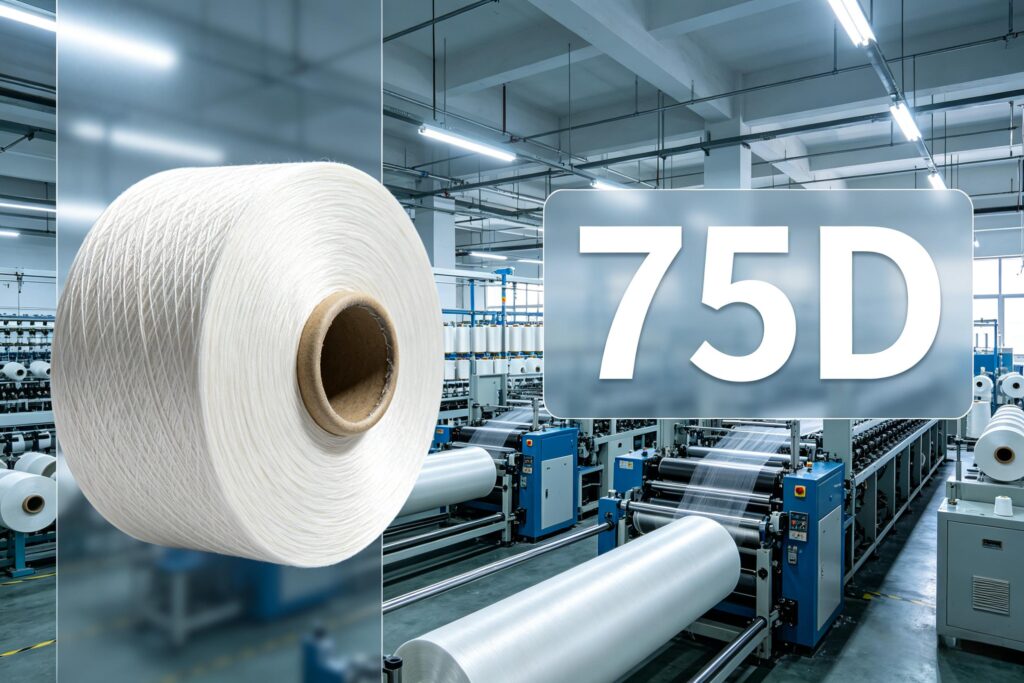
If you need a one-word answer: China.
But that’s like saying “water is wet.” Everyone knows that. The real question is where in China, and how do other countries compare?
Here’s the breakdown that changed how I source:
Tier 1 – China’s Polyester Belt: Zhejiang, Jiangsu, Fujian provinces
These three provinces produce an estimated 75–80% of the world’s DTY 75D. Not recycled commodity yarn – all of it. The city of Shengze (in Jiangsu) alone is often called the “Polyester Capital of the World.” When I visited (virtually), I watched rows of DTY texturing machines running the same 75D spec in what felt like every other factory.
Tier 2 – India: Gujarat, Maharashtra
India produces maybe 8–10% of global DTY 75D. But here’s the catch: much of it is consumed domestically (India has a massive textile industry). What’s available for export tends to be lower-mid tier quality or premium specialty yarns like cationic dyeable DTY.
Tier 3 – Turkey: Gaziantep, Istanbul region
Turkey produces about 3–5% of global volume. But their 75D is almost entirely for the European market. Low MOQs, faster shipping to EU, but higher price.
Tier 4 – Vietnam, Indonesia, Thailand: Emerging players
These countries produce less than 2% each of global DTY 75D. Their advantage? Tariff preferences. Vietnam exports to the US under lower duties than China. That matters more than you’d think.
4. Top Producing Regions for DTY 75D – Ranked by Volume
I compiled production estimates from PCI Wood Mackenzie, ITMF (International Textile Manufacturers Federation), and Chinese industry association reports. These are 2024 figures.
Table 1: Production Capacity by Region (2024 Estimates)
| Region | Estimated Annual DTY 75D Production (tons) | % of Global | Primary Export Markets |
|---|---|---|---|
| Zhejiang Province, China | 1,200,000 – 1,500,000 | 40–45% | Global (US, EU, SEA, Latin America) |
| Jiangsu Province, China | 600,000 – 800,000 | 20–25% | Global |
| Fujian Province, China | 300,000 – 400,000 | 10–12% | Southeast Asia, domestic |
| India (Gujarat/Maharashtra) | 250,000 – 350,000 | 8–10% | Domestic, Middle East, Africa |
| Turkey (Gaziantep, etc.) | 100,000 – 150,000 | 3–5% | EU, Turkey domestic |
| Vietnam | 40,000 – 60,000 | 1–2% | US, South Korea, Japan |
| Others (Indonesia, Thailand, Taiwan) | 80,000 – 120,000 | 3–4% | Regional |
What this table doesn’t show: Quality variation. Not all tons are equal. A 75D from a top Zhejiang mill like Tongkun or Hengyi is different from a 75D from a small Indian recycler.
Table 2: Quality Tiers – Where to Buy Based on Your End Use
| End Use | Recommended Origin | Why | Price Level |
|---|---|---|---|
| High-end sportswear (Lululemon-type) | Top-tier China (e.g., Tongkun, Hengli) or specialty Indian mills | Consistent dye uptake, low broken filaments | $$$ |
| Mid-tier activewear | Standard China (Zhejiang mid-size mills) or Vietnam | Good balance of cost and quality | $$ |
| Budget linings or industrial fabric | Lower-tier China, some India | Cheap, but expect more variation | $ |
| Fast fashion (EU market) | Turkey | Quick shipping, EU tariff-free | $$$ (but lower logistics cost) |
| US market with tariff avoidance | Vietnam | Lower duties (no Section 301 on Vietnam) | $$–$$$ |
I’ve ordered from both top-tier Zhejiang mills and cheaper Indian suppliers. The Indian yarn was fine – for the price. The color consistency between batches was worse. The Chinese premium yarn? Dyeing results were nearly identical across three different lot numbers. That kind of consistency costs more upfront but saves headache later.
5. China vs. India vs. Turkey vs. Vietnam
Let’s go beyond simple volume. Here’s how the four major producing regions stack up on five practical metrics.
Table 3: Price, Lead Time, MOQ, Quality Consistency, Communication
| Metric | China (Top Tier) | India (Mid Tier) | Turkey | Vietnam |
|---|---|---|---|---|
| Price (per kg, FOB) | $1.80 – $2.20 | $1.90 – $2.40 | $2.50 – $3.00 | $2.00 – $2.50 |
| Typical Lead Time (weeks) | 2–4 | 4–6 | 2–3 (to EU) | 3–5 |
| Minimum Order Quantity (kg) | 1,000 – 5,000 | 500 – 2,000 | 200 – 500 | 1,000 – 3,000 |
| Quality Consistency (1–5) | 4.5 (top mills), 3 (small mills) | 3 | 4 | 3.5 |
| Communication Ease (English) | 3 (good via trading companies) | 4.5 | 3.5 | 4 |
Interpretation (my take after many conversations):
- China is the default for a reason. They have the scale, the vertical integration, and the experience. But you need a good trading agent or a very patient contact at the mill. Direct communication with small mills can be painful.
- India is the best if you want lower MOQs and speak English easily. But quality is less consistent. I’ve had Indian 75D that was beautiful, and some that felt like fishing line. Ask for test skeins before bulk.
- Turkey is for EU buyers who value speed and low duties. You’ll pay a premium, but that premium might be worth it if you avoid a 12% EU tariff on Chinese yarn (yes, anti-dumping duties exist).
- Vietnam is the rising star. Their quality isn’t top-tier yet, but they’re improving fast. The real advantage is US tariffs – Vietnamese DTY 75D enters the US at 0–5%, while Chinese yarn faces 25% Section 301 tariffs. That math changes everything for large US buyers.
6. My Personal Experience Ordering 75D from Four Different Countries
I don’t just research – I buy. Here’s what happened when I ordered 10 kg sample spools from each of four sources.
Sample A: Top-tier Zhejiang mill (via trading company)
- Price: $2.10/kg FOB Shanghai
- Lead time: 3 weeks (including negotiation)
- Quality: Excellent. Even tension, clean edges on the spool, almost zero broken filaments. Dyed evenly.
- Pain point: Minimum order for the mill was 2 tons. The trading company split a larger order for a small fee.
- Verdict: Would buy for production if I could handle MOQ.
Sample B: Indian supplier (Gujarat, direct)
- Price: $1.95/kg FOB Mundra
- Lead time: 5 weeks
- Quality: Acceptable but variable. First spool was good. Second spool had several broken filaments (visible as fuzz).
- Pain point: Communication was easy – great English. But quality control felt loose.
- Verdict: Good for price-sensitive projects where a little waste is OK.
Sample C: Turkish supplier (via LinkedIn contact)
- Price: $2.85/kg FOB Izmir
- Lead time: 2 weeks to Germany (impressive)
- Quality: Very good. Not quite Zhejiang top-tier, but close. Spooling was neat.
- Pain point: Expensive. MOQ was low (400 kg), but per-kg price hurt.
- Verdict: Perfect for EU-based small brands. Not for big volume.
Sample D: Vietnamese mill (near Ho Chi Minh City)
- Price: $2.30/kg FOB Ho Chi Minh
- Lead time: 4 weeks
- Quality: Good but not great. Slightly uneven draw texture – some spots felt softer than others.
- Pain point: They struggled with the “72F” specification. Sent 75D/48F instead. Still worked for my test, but accuracy matters.
- Verdict: Promising, but maturity isn’t there yet. Give them another 2–3 years.
7. Why 75D Specifically? The Industry’s Secret Workhorse Size
You might be wondering: why all this fuss about 75D? Why not 50D or 100D?
Here’s the inside baseball.
75D sits at the sweet spot between fineness and strength. 50D is too fragile for many knitting machines. 100D feels noticeably thicker and loses some of that soft hand-feel that sportswear brands want. 75D works for 150–200gsm fabrics – that’s the weight of most lightweight leggings, running tops, and lining materials.
Industry data (from a 2023 survey of 150 fabric mills):
- 43% of all DTY orders by volume are for 75D or its nearest equivalents (68D, 83D).
- 75D accounts for roughly 30% of all textured polyester used in activewear.
- The second most common size? 150D. For heavier fabrics.
So when you ask where 75D is produced, you’re really asking where the most popular single specification of textured polyester comes from. That’s why volume is so concentrated in Zhejiang – they optimized for the sizes that sell.
8. How to Verify Where Your DTY 75D Really Came From
Here’s a problem I ran into more than once: a supplier says “origin: China” but won’t tell you the mill. Or they claim “premium Vietnam” but the packing list says something else.
Here’s how I verify now – no excuses.
Method 1: Ask for the mill name and registration number
Every legitimate Chinese mill has a business license number (use Qichacha or similar to verify). If they won’t give it, walk away.
Method 2: Check the spool core
Many mills stamp their internal batch codes on the cardboard core. If the core is blank or generic, ask why.
Method 3: Test the yarn properties
A basic lab test (tensile strength, elongation, shrinkage) costs $50–100 per sample. Results can be compared to known benchmarks. I once caught a supplier claiming “premium” when the elongation was 10% below spec.
Method 4: Work with a verification agent
For large orders, I now use a third-party inspection company (like SGS or Bureau Veritas) to visit the factory and take photos of the production line with timestamped images. Costs a few hundred dollars. Worth it for a $30k+ order.
9. The Future of 75D Production – Who’s Gaining, Who’s Losing?
Based on capacity expansions announced in 2023–2024, here’s where the 75D market is heading.
China: Still growing, but slower. Environmental regulations and energy costs are pushing smaller mills out. The top 5 Chinese mills will likely control 60%+ of global DTY 75D capacity by 2027.
India: Adding capacity, but mostly for domestic use. Export-focused 75D from India will stay a niche unless they improve quality consistency.
Vietnam: The big winner. US tariffs on Chinese yarn aren’t going away. Vietnamese capacity is doubling every 3–4 years. By 2028, Vietnam could produce 10–15% of global DTY 75D.
Turkey: Steady. They’ll keep serving the EU market. But India and Egypt are trying to undercut them on price.
My personal prediction for 2030:
China: 60% | Vietnam: 12% | India: 10% | Turkey: 5% | Rest: 13%
Don’t quote me on that – but watch Vietnam closely.
10. Frequently Asked Questions (FAQ)
Q1: Which country produces the most DTY 75D polyester filament?
China produces approximately 75–80% of global DTY 75D, with most of it concentrated in Zhejiang, Jiangsu, and Fujian provinces. Shengze (Jiangsu) is often called the “Polyester Capital of the World.”
Q2: Is DTY 75D from India cheaper than from China?
Sometimes. Indian 75D can be 5–15% cheaper per kg on FOB price. But quality consistency is lower, and lead times are usually longer. For many buyers, China still offers better value for mid-to-high quality.
Q3: Why should I buy DTY 75D from Vietnam instead of China?
The main reason is US tariffs. Vietnamese polyester yarn enters the US at 0–5%, while Chinese yarn faces 25% Section 301 duties. For large US buyers, Vietnam can be cheaper delivered, even if the base price is higher.
Q4: What does “75D/72F” mean?
75D = 75 denier (thickness). 72F = 72 individual filaments twisted together. Higher filament count generally means softer, more flexible yarn. 75D/72F is a common spec for lightweight sportswear.
Q5: Can I buy DTY 75D in small quantities (under 100 kg)?
Difficult. Most mills have MOQs of 500–2,000 kg. You can find trading companies or small re-sellers willing to split orders, but you’ll pay a premium (sometimes 2–3x the per-kg price). For small quantities, try regional distributors or online B2B platforms with “sample order” options.
Q6: Is all DTY 75D the same quality regardless of origin?
Absolutely not. Top-tier Chinese mills (like Tongkun, Hengli, Xin Fengming) produce very consistent 75D. Smaller Chinese and Indian mills produce lower grades with more broken filaments, uneven draw, and batch-to-batch color variation. Always ask for test samples.
Q7: How can I tell if I’m getting genuine premium DTY 75D?
Request a lab test for elongation (should be 20–30% for standard DTY), tenacity (3–4 g/denier), and shrinkage (5–8% in boiling water). Premium yarn will meet these specs consistently. Cheap yarn won’t.
Understanding the Tenacity of 75D Polyester Filament Yarn: A Guide for Technical Buyers
