
Table of Contents
1. Introduction: The Global Dominance and Advantages of Polyester Filament Fabrics
2. The Core Fabrication Method: Woven Fabric Production
2.1. The Front-End Process: Essential Pre-Weaving Preparations
2.2. The Weaving Stage: Selecting the Optimal Technology for the Job
2.3. Key Considerations in Woven Fabric Production
3. An Alternative Path: The Knitting Fabrication Method
3.1. The Realm of Warp Knitting
3.2. The Versatility of Weft Knitting
4. Post-Weaving Operations: Finishing and Value Addition
5. Navigating the Modern Market: Industry Trends and Strategic Sourcing
6. Conclusion: Making an Informed Choice for Your Product Line
1. Introduction: The Global Dominance and Advantages of Polyester Filament Fabrics
Polyester filament yarn (PFY) has established itself as the undisputed cornerstone of the global textile industry. As a key subset of chemical filaments, it is a continuous fiber spun from synthetic polymers, renowned for its remarkable strength, exceptional durability, dimensional stability, and resistance to wrinkles and shrinkage. This versatility translates directly into market dominance. In 2024, China, a global textile powerhouse, produced a staggering 69.2 billion meters of chemical filament fabric, a year-on-year increase of 9.7%, with polyester fabrics accounting for the lion’s share of both production and a $20.65 billion export market.
For international apparel brands, retailers, and procurement specialists, understanding the journey of PFY from yarn to fabric is not merely academic—it is a strategic business necessity. The chosen fabrication process fundamentally dictates the final fabric’s aesthetic, hand feel, performance characteristics, and cost structure. This guide provides a detailed, data-backed exploration of the primary fabric formation technologies for polyester filament, empowering you to make informed sourcing and product development decisions.
2. The Core Fabrication Method: Woven Fabric Production
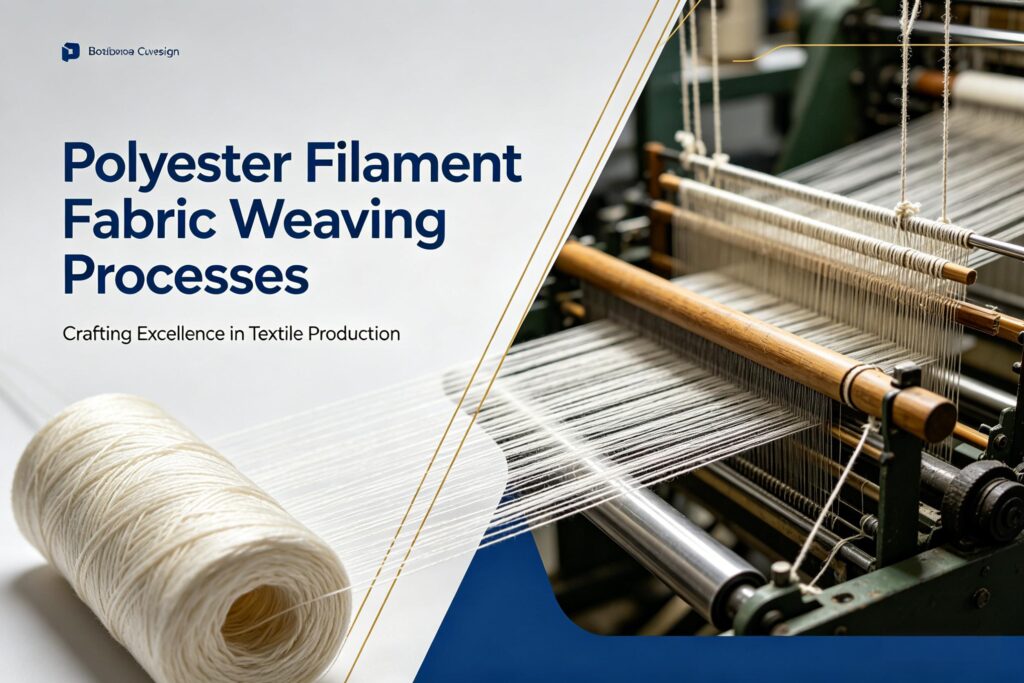
Weaving, the interlacing of lengthwise (warp) and crosswise (weft) yarns at right angles, is the most prevalent method for creating structured, stable fabrics from PFY. The process is a symphony of precision engineering, divided into critical stages.
2.1. The Front-End Process: Essential Pre-Weaving Preparations
Before weaving commences, warp yarns must be meticulously prepared to withstand the high stresses of the loom. This sequence is non-negotiable for quality production:
- Warping: Thousands of individual filament yarns from multiple packages (cones or cheeses) are wound in parallel onto a large beam, creating a sheet of yarns of precise length and uniform tension.
- Sizing (Slashing): This is a crucial step, especially for fine-denier or low-twist filaments. The warp sheet is coated with a protective polymeric size (e.g., modified starch or PVA). As noted in production practices, a specialized sizing recipe and process are vital to bind the filaments, reduce hairiness, and dramatically increase abrasion resistance during weaving. The sized yarns are then dried and wound onto the weaver’s beam.
- Drawing-In: Each warp yarn is then threaded through specific elements: a drop wire (for break detection), a heddle eye on a harness frame (which controls the weave pattern), and a dent in the reed (which determines ends per inch and beats the weft into place).
2.2. The Weaving Stage: Selecting the Optimal Technology for the Job
The choice of loom technology is dictated by the target fabric, yarn type, and production efficiency requirements. Modern, high-speed shuttleless looms are the industry standard.
| Loom Type | Working Principle | Key Advantages | Ideal Polyester Filament Fabric Applications |
|---|---|---|---|
| Water-Jet Loom | Propels weft yarn across warp with a high-pressure water jet. | Highest speed, low energy consumption, minimal yarn abrasion. | Dominant for standard fabrics: taffeta, linings, plain Oxford, taffetas, some microfiber fabrics. |
| Air-Jet Loom | Propels weft yarn with compressed air. | Very high speed, excellent for wide fabrics. | Lightweight to medium-weight fabrics, sheetings, certain fashion fabrics. |
| Rapier Loom | Uses rigid or flexible rods (rapiers) to grip and transfer weft. | Extreme versatility, gentle handling, excellent for fancy yarns and color patterns. | Complex fabrics like taffetas, dobby and jacquard designs, heavy industrial fabrics, blends. |
| Projectile Loom | Uses a small metal projectile to carry the weft. | Robust, suitable for very heavy and wide fabrics. | Technical textiles, canvas, heavyweight upholstery. |
2.3. Key Considerations in Woven Fabric Production
- Yarn Selection: The fabric’s destiny is shaped by the yarn. Using air-textured nylon as weft with a polyester warp creates a durable, wrinkle-resistant fabric with a cotton-like feel suitable for rugged outerwear.
- Overcoming Challenges: Pure polyester’s smooth surface and lack of absorbency can pose challenges in sizing adhesion and static generation. Best practices include using dedicated sizing agents, ensuring perfect warping tension, and maintaining precise loom humidity. For blended yarns like viscose-wrapped polyester, adjustments in sizing concentration and weaving tension are critical to preserve the yarn’s structure and final fabric quality.
- Post-Weaving (Greige Goods): The freshly woven “grey” or “greige” fabric contains size, oils, and natural impurities, and is often in an unstable state. It must proceed to finishing for commercialization.
3. An Alternative Path: The Knitting Fabrication Method
Knitting forms fabric by interlooping yarns, creating structures that are inherently more flexible, stretchable, and drapeable than wovens.
3.1. The Realm of Warp Knitting
In warp knitting, each yarn is fed from a warp beam and formed into loops along the fabric’s length (wale) direction. Modern machines, like high-speed tricot and raschel units, are highly automated. A notable example is the YJKS3 high-speed warp knitting machine, which can achieve speeds up to 1,500 rpm and utilizes electronic let-off and take-up (EBA/EAC) systems for precise control. This technology is ideal for producing:
- Lingerie and swimwear fabrics (often with elastane).
- Meshes and nets for apparel and industrial use.
- High-performance linings and seamless shaping components.
- Upholstery, mattress ticking (tick), and curtain fabrics.
3.2. The Versatility of Weft Knitting
In weft knitting, a single yarn is fed across the width of the machine to form rows of loops (courses). This includes:
- Circular Knitting: Produces continuous tubes of fabric for T-shirts, polo shirts, and activewear.
- Flat Knitting: Offers great design flexibility for sweaters, trims, and fully fashioned garments.
Knitting typically requires less yarn preparation than weaving (no sizing needed) and allows for rapid style changes, making it excellent for responsive, small-batch production.
4. Post-Weaving Operations: Finishing and Value Addition
Greige fabric is transformed into a finished product through a series of wet and dry processes:
- Desizing: The protective size applied before weaving is removed.
- Scouring & Heat Setting: Fabrics are cleaned and heated to stabilize the polyester fibers, setting their dimensions and crystallinity.
- Dyeing & Printing: Polyester is typically dyed with disperse dyes at high temperature (HT) for vivid, wash-fast colors. For fabrics like taffetas, the finishing process may include alkali reduction treatment to create a softer, more natural hand.
- Functional Finishing: This step adds performance properties like moisture-wicking (via hydrophilic agents), anti-static, water-repellency, or flame retardancy. Innovations like anti-static polyester filament require specialized equipment to maintain these properties during processing.
- Final Drying & Calendering: The fabric is dried and may be pressed through heated rollers (calendared) to achieve a specific surface sheen, smoothness, or texture.
5. Navigating the Modern Market: Industry Trends and Strategic Sourcing
The PFY fabric industry is undergoing a significant transformation driven by technology and sustainability:
- Intelligent Manufacturing: Smart machinery is becoming the norm. For example, intelligent two-for-one twisters now feature PLC control and servo drives, allowing operators to set and monitor twist, speed, and winding patterns via touchscreen, ensuring unprecedented consistency and flexibility for high-end yarns.
- Sustainability Imperative: The market for recycled polyester (rPET) is booming. Advanced technologies now allow for the production of high-quality bulked continuous filament (BCF) from recycled bottle flakes, used in carpets and home textiles, meeting stringent global eco-certifications and consumer demand.
- Functional Innovation: Beyond recycling, R&D focuses on intrinsic fiber enhancement. Technologies exist to spin hollow, micro-porous polyester filaments that offer superior moisture management for activewear.
Strategic Sourcing Checklist:
- Define Specifications: Clearly outline fabric weight (GSM), width, weave/knit type, physical properties (tenacity, tear strength), and functional needs (UPF, moisture management).
- Audit Supplier Capability: Ensure your supplier has the appropriate loom/knitting machinery, in-house finishing capacity, and lab facilities for quality control.
- Request Samples & Data: Always evaluate physical fabric samples (greige and finished) and insist on mill test reports for key performance indicators.
- Consider Total Value: While price is critical, factor in minimum order quantities (MOQs), lead time reliability, compliance standards (OEKO-TEX, GRS), and the supplier’s ability to collaborate on development.
6. Conclusion: Making an Informed Choice for Your Product Line
The selection between weaving and knitting for your polyester filament fabric project hinges on the desired end-product characteristics. Choose weaving for structured, stable, and durable applications like shirts, trousers, outer shells, technical gear, and home furnishings. Opt for knitting when you require stretch, comfort, drape, and seamlessness, as in activewear, intimate apparel, casualwear, and certain technical substrates.
As a global buyer, your leverage lies in knowledge. Understanding these core processes—from the precision of warp preparation to the high-speed interlacing on a water-jet loom or the electronic precision of a modern warp knitter—enables you to communicate effectively with mills, specify accurately, and source fabrics that truly meet your design and performance goals. In an era of smart manufacturing and green materials, partnering with forward-thinking suppliers who invest in these technologies is the surest path to a competitive and sustainable product portfolio.
