
Table of Contents
- Introduction: The Critical Importance of Quality Assessment
- The Framework of Quality: Key Performance Indicators (KPIs)
- 2.1. Mechanical and Physical Properties
- 2.2. Appearance and Evenness
- 2.3. Stability and Reliability
- The Quality Benchmark: Utilizing Standards and Industry Tools
- 3.1. National and International Testing Standards
- 3.2. Uster Statistics: The Global Quality Benchmark
- The Manufacturer’s Role: How Companies like Glyarn Ensure Quality
- 4.1. Commitment to Material Purity and Consistency
- 4.2. Investment in Precision Manufacturing
- 4.3. Adherence to International Standards and Sustainable Practices
- A Practical Step-by-Step Guide for Buyers
- 5.1. Defining Your Requirements and Specifying Standards
- 5.2. Requesting and Analyzing Technical Data Sheets (TDS)
- 5.3. The Importance of Third-Party Testing and Supplier Audits
- Conclusion: Building Value Through Informed Sourcing
1. Introduction: The Critical Importance of Quality Assessment
In the vast and competitive global market for polyester filament yarn (PFY), price is often the first point of engagement. However, discerning buyers understand that true value and long-term profitability are intrinsically linked to quality. Substandard yarn can lead to catastrophic production issues—increased downtime, fabric defects, poor dyeing uniformity, and ultimately, rejected finished products that tarnish a brand’s reputation. Therefore, the ability to accurately distinguish between high-quality and low-quality PFY is not merely a procurement skill; it is a fundamental business competency.
This guide moves beyond superficial checks to provide a structured, data-driven framework for evaluating PFY quality. We will explore the critical performance indicators, demystify industry testing standards, and illustrate how a commitment to quality is embedded in the operations of reliable manufacturers, with Glyarn serving as a practical case study. By equipping yourself with this knowledge, you transform sourcing from a transactional cost center into a strategic value-building activity.
2. The Framework of Quality: Key Performance Indicators (KPIs)
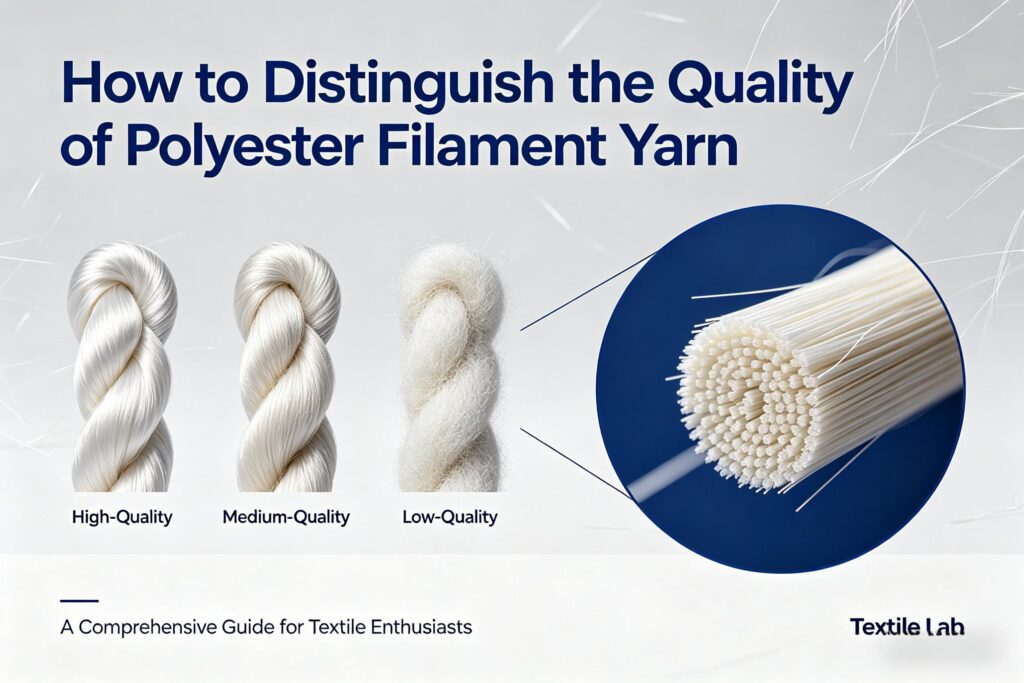
Quality in PFY is multidimensional. A comprehensive assessment requires evaluating three interconnected categories: Mechanical Properties, Appearance, and Stability.
2.1. Mechanical and Physical Properties
These are the foundational metrics that determine how the yarn will perform under stress during weaving, knitting, and in the final product’s use.
- Tenacity (Breaking Strength) and Elongation: This is the most critical pair of tests. Tenacity, measured in centinewtons per decitex (cN/dtex), indicates the force the yarn can withstand before breaking. For general apparel PFY, tenacity typically ranges from 3.5 to 5.0 cN/dtex, while high-tenacity industrial yarns for applications like tire cord can exceed 7.0 cN/dtex. Elongation at break measures how much the yarn can stretch, indicating its flexibility and toughness. An optimal balance is key; high tenacity with very low elongation may result in a brittle yarn.
- Linear Density (Denier/Dtex) and its Uniformity: This defines the fineness of the yarn. Consistency is paramount. A linear density deviation rate exceeding industry norms (e.g., > ±3%) indicates poor process control, leading to uneven fabric weight and appearance.
- Elastic Recovery and Modulus: These properties assess the yarn’s ability to return to its original length after stretching and its resistance to deformation (stiffness). They are crucial for fabrics requiring shape retention, like sportswear and home textiles.
2.2. Appearance and Evenness
The visual and structural uniformity of the yarn directly affects the aesthetic and functional quality of the final fabric.
- Yarn Evenness (Uster CV%): This metric, measured by instruments like the Uster Tester, quantifies variations in yarn thickness. A lower Coefficient of Variation (CV%) signifies superior uniformity, resulting in a fabric with a smooth, consistent hand and excellent dye uptake.
- Defects: Thin Places, Thick Places, and Neps: These are short segments where the yarn diameter is significantly smaller or larger than average, or where fiber entanglements create small knots. An excessive number of these defects, classified and counted by systems like Uster Classimat, can cause yarn breaks and visible fabric flaws.
- Hairiness: This refers to fibers protruding from the main yarn body. While some hairiness is normal, excessive hairiness can lead to pilling, fuzziness, and processing difficulties.
2.3. Stability and Reliability
These KPIs ensure the yarn performs consistently not just off the spool, but through downstream processing and the lifecycle of the final product.
- Thermal Shrinkage (Dry Heat & Boiling Water): This measures the yarn’s dimensional change when exposed to heat, a critical factor for fabric stability during dyeing and finishing. For example, standard PFY may have a boiling water shrinkage rate of ≤10%, while high-shrinkage types are engineered for specific effects. Predictable shrinkage is vital for maintaining fabric dimensions.
- Oil Content and Distribution: Spin finish oil is applied to facilitate processing. Its content and uniform distribution are essential for controlling static, providing cohesion, and ensuring smooth running on high-speed looms and knitting machines.
- Color Fastness and Chemical Properties: For dyed yarns or fabrics, resistance to fading from washing, light, and rubbing is assessed (e.g., ≥4 on a 5-point scale). For industrial yarns, properties like Limiting Oxygen Index (LOI) for flame retardancy or resistance to hydrolysis are key.
3. The Quality Benchmark: Utilizing Standards and Industry Tools
Objective quality assessment relies on standardized testing methods and universal benchmarks.
3.1. National and International Testing Standards
Globally recognized standards ensure tests are repeatable and comparable across different labs and continents.
- Mechanical Testing: GB/T 14344 (China) and ISO 2062 / ASTM D2256 (international) govern tensile strength and elongation tests.
- Appearance Grading: ASTM D2255 provides the standard for the visual inspection and grading of yarn appearance.
- Thermal Stability: GB/T 6505 specifies methods for testing thermal shrinkage.
- General Plastics: While not exclusively for fibers, standards like ASTM D638 for tensile properties of plastics illustrate the universal principles of material testing.
3.2. Uster Statistics: The Global Quality Benchmark
The Uster Statistics, published every 3-5 years by Uster Technologies, are the industry’s most authoritative quality reference. They compile global test data to create a statistical ranking.
- How it Works: Quality levels are divided into percentiles: 5%, 25%, 50%, 75%, and 95%. The 50th percentile (50%) represents the global average. Yarn quality at the 25th percentile is considered good, and at the 5th percentile it is regarded as excellent or world-class.
- Practical Use: When a supplier like Glyarn states their yarn’s evenness (Uster CV%) is at the 25% level, it provides an instant, globally understood measure of superior quality. This benchmark is routinely used in contracts and specifications to define and guarantee quality levels.
4. The Manufacturer’s Role: How Companies like Glyarn Ensure Quality
Quality is not an accident; it is the result of a manufacturer’s deep-rooted philosophy and systematic investment. A reliable producer like Glyarn exemplifies this approach across its operations.
4.1. Commitment to Material Purity and Consistency
Quality begins with raw materials. Glyarn sources high-purity terephthalic acid (PTA) and monoethylene glycol (MEG). They conduct rigorous infrared spectroscopy (FTIR) and viscosity tests to verify polymer composition and consistency, ensuring the fundamental building blocks of the yarn are flawless. This focus on upstream control prevents variations that can affect dyeing, strength, and thermal behavior.
4.2. Investment in Precision Manufacturing
State-of-the-art equipment operated within tightly controlled parameters is non-negotiable.
- Spinning and Drawing: Glyarn utilizes advanced, automated spin-draw lines. Precise control over temperature, tension, and speed is critical to achieving the targeted molecular orientation, which directly determines tenacity, elongation, and shrinkage properties.
- Process Monitoring: Continuous inline monitoring systems track denier, evenness, and oil application in real-time, allowing for instantaneous corrections. This minimizes deviations and ensures every meter of yarn meets specification.
4.3. Adherence to International Standards and Sustainable Practices
A trustworthy manufacturer’s commitment extends beyond its factory gates.
- Comprehensive In-House Lab: Glyarn maintains a fully equipped laboratory that performs battery of tests according to GB/T, ISO, and ASTM standards on every production batch. Test reports are not an afterthought but a deliverable.
- Third-Party Certification: To provide objective assurance to global buyers, Glyarn submits its products for certification against standards like OEKO-TEX® Standard 100, proving they are free from harmful substances, and pursues verification for GRS (Global Recycled Standard) for its recycled polyester lines.
- Transparency and Data Sharing: Rather than making vague claims, Glyarn provides detailed Technical Data Sheets (TDS) with specific test values and, where applicable, Uster percentile rankings. This transparency builds trust and allows for accurate technical evaluation.
5. A Practical Step-by-Step Guide for Buyers
Armed with this knowledge, you can implement a robust supplier evaluation process.
5.1. Define Your Requirements and Specify Standards
Before requesting quotes, be specific. Instead of asking for “good quality 150D yarn,” specify: “150D/288F semi-dull PFY, tenacity ≥4.0 cN/dtex, elongation 25% ±5%, boiling water shrinkage ≤7%, Uster unevenness CV% ≤ 25% level. Testing to be performed per ISO 2062 and ASTM D2255.”
5.2. Request and Analyze Technical Data Sheets (TDS)
The TDS is your first major filter. Scrutinize it for:
- Completeness: Does it list all relevant KPIs from Section 2?
- Specificity: Are there actual measured values (e.g., “3.8 cN/dtex”) or just vague statements (“high strength”)?
- Benchmarking: Does it reference Uster Statistics percentiles for evenness and defects?
5.3. The Importance of Third-Party Testing and Supplier Audits
For high-volume or critical orders, due diligence is essential.
- Independent Lab Testing: Send pre-production or bulk samples to an accredited third-party laboratory (e.g., SGS, Bureau Veritas) for verification against your specifications and international standards.
- Supplier Audit: If possible, conduct an on-site audit or a virtual tour. Evaluate the production environment, quality control systems, and laboratory capabilities. A manufacturer’s willingness to undergo an audit is a strong indicator of confidence and transparency.
6. Conclusion: Building Value Through Informed Sourcing
Distinguishing the quality of polyester filament yarn is a systematic process that moves from understanding core performance indicators to leveraging global benchmarks and evaluating a manufacturer’s ingrained quality culture. In a market where margins are tight and brand reputation is everything, the cost of poor quality far outweighs the marginal savings from a substandard product.
By partnering with manufacturers like Glyarn—who embed quality control at every stage, from polymer to packaging, and who champion transparency through data and certification—you secure more than just a raw material. You secure supply chain reliability, production efficiency, and product excellence. In doing so, you transform quality assurance from a defensive cost into a powerful competitive advantage, building lasting value for your business and your customers. Make your next sourcing decision not just on price, but on the comprehensive, data-backed profile of quality.
