
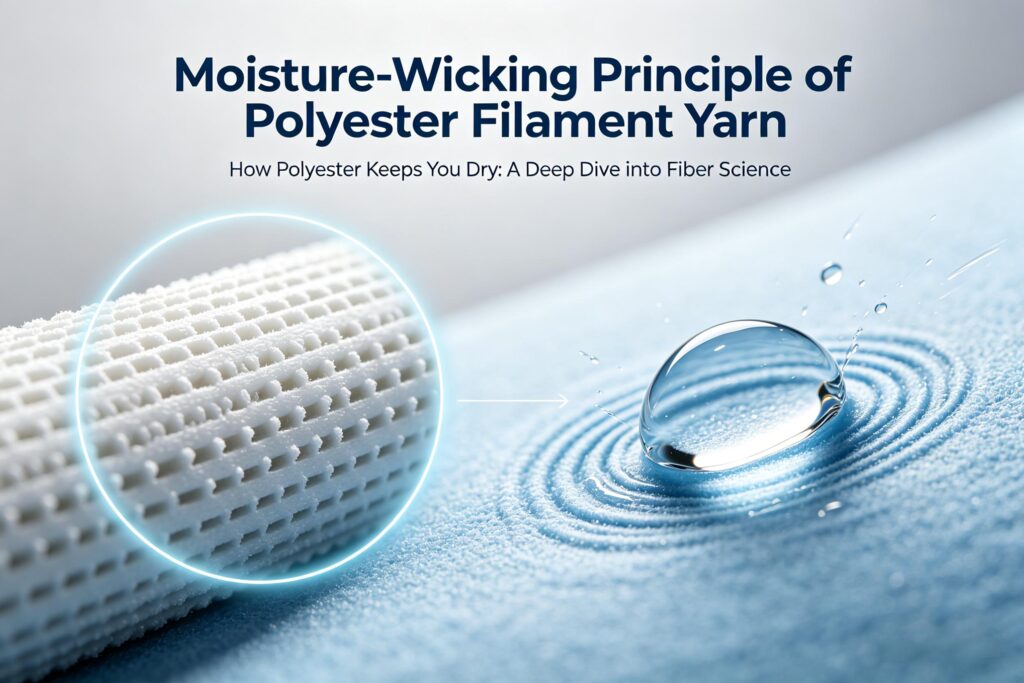
The Science of Moisture-Wicking Polyester: Innovation, Mechanisms, and Market Applications
Table of Contents
- Introduction: Redefining Performance in Synthetic Fibers
- The Core Science: How Does Polyester Filament Wick Moisture?
- 2.1. The Inherent Hydrophobic Nature
- 2.2. Engineering Wicking: The Role of Cross-Sectional Geometry and Micro-Texturing
- 2.3. The Crucial “Siphoning Effect” in Yarn and Fabric Construction
- Beyond Wicking: Key Performance Metrics and Comparative Data
- Manufacturing Innovation: How Producers Like Glyarn Engineer Advanced Wicking Fibers
- Market Applications and Consumer Demand Insights
- Future Trends and Strategic Recommendations for Buyers
- Conclusion: Building Value with Engineered Performance
1. Introduction: Redefining Performance in Synthetic Fibers
Polyester filament yarn (PFY) has undergone a remarkable transformation. No longer synonymous with the uncomfortable, non-breathable fabrics of the past, today’s advanced polyester is at the forefront of high-performance activewear, intimate apparel, and technical workwear. This revolution is driven by one key engineered property: effective moisture-wicking. For international buyers and brands, understanding the sophisticated science behind this functionality is no longer optional—it is essential for product development, marketing, and meeting stringent consumer expectations. This article demystifies the moisture-wicking principle of polyester, explores the manufacturing innovations that make it possible, and examines its significant market value.
2. The Core Science: How Does Polyester Filament Wick Moisture?
Contrary to natural fibers like cotton, which absorb moisture, high-performance polyester is designed to transport it. This process is not a single property but a carefully engineered system.
2.1. The Inherent Hydrophobic Nature
At a molecular level, standard polyester is hydrophobic—it repels water. This characteristic prevents the fiber from absorbing and holding liquid into its core, which is the first step towards avoiding a soaked, clammy feel.
2.2. Engineering Wicking: The Role of Cross-Sectional Geometry and Micro-Texturing
Manufacturers alter the physical structure of the fiber to create pathways for moisture. This is where engineering takes center stage:
- Capillary Action via Specialized Cross-Sections: By spinning filaments into shapes like cruciform, C-shaped, or multi-grooved channels, manufacturers create microscopic capillaries along the fiber’s surface and between filaments in a yarn bundle. These capillaries leverage capillary action—the same principle that draws water up a narrow tube—to pull liquid (sweat) along the fiber’s surface.
- Surface Area Enhancement: These complex shapes also dramatically increase the surface area-to-volume ratio of the fiber. More surface area provides a greater “highway” for moisture to spread and evaporate.
2.3. The Crucial “Siphoning Effect” in Yarn and Fabric Construction
Wicking at the fiber level must be amplified at the fabric level. This is achieved through fabric engineering:
- Dual-Knit or Woven Structures: High-performance fabrics often use a bi-component construction. The inner layer (against the skin) is made of engineered wicking PFY to grab and move moisture. The outer layer features a more open structure or different fiber to facilitate rapid evaporation.
- Yarn Engineering: Using fine-denier filaments or specific texturing processes (like false-twist texturing for DTY) increases the interstitial spaces within the yarn, enhancing capillary flow.
Key Insight: Effective moisture management in polyester is a three-tiered system: 1) Hydrophobic core to resist absorption, 2) Engineered geometry for capillary transport, and 3) Fabric construction for directional movement and evaporation.
3. Beyond Wicking: Key Performance Metrics and Comparative Data
For buyers, performance must be quantifiable. When evaluating moisture-wicking PFY, consider these critical metrics, often tested against standards like AATCC TM 197 or ISO 9073-10:
| Performance Metric | Typical Benchmark for Wicking PFY | Comparative Note (vs. Standard PFY/Cotton) |
|---|---|---|
| Vertical Wicking Height | > 10 cm in 30 minutes | Standard polyester may show little to no wicking. Cotton wicks but retains moisture. |
| Drying Rate (Time to 80% Dry) | 30-50% faster than standard polyester | Can be over 100% faster than heavy cotton fabrics, which hold water. |
| Moisture Vapor Transmission Rate | High (> 2000 g/m²/24h) | Superior to standard polyester; competitive with specialized membranes. |
| Liquid Moisture Management | High “Overall Moisture Management Capability” (OMMC) Rating | Engineered to move liquid rapidly across the fabric plane, unlike absorbing fibers. |
4. Manufacturing Innovation: How Producers Like Glyarn Engineer Advanced Wicking Fibers
Not all polyester is created equal. The difference between a basic filament and a high-performance wicking yarn lies in precision engineering and quality control. This is where specialized manufacturers such as Glyarn distinguish themselves in the global supply chain.
Glyarn’s approach exemplifies the technical expertise required:
- Proprietary Polymer and Spin Finish Chemistry: They utilize tailored polymer blends and apply specialized spin finishes—lubricants applied during spinning. These finishes are crucial; they modify the fiber’s surface energy to enhance initial water attraction (strike-through) while maintaining the underlying hydrophobic transport.
- Precision in Cross-Section Spinning: Operating state-of-the-art spinnerets, Glyarn consistently produces filaments with complex, uniform cross-sectional shapes (e.g., hexagonal or octagonal with deep grooves) that optimize capillary channels. Consistency here is key to predictable batch-to-batch performance.
- Integrated Quality Assurance: Glyarn understands that wicking performance can be compromised by contaminants or inconsistent drawing temperatures. Their in-line monitoring and rigorous testing ensure that every lot meets specified wicking and tenacity standards before shipment. For an international buyer, this level of control translates to reliable fabric performance and minimized production risks.
5. Market Applications and Consumer Demand Insights
The demand for moisture-wicking polyester is fueled by clear consumer trends and extends across diverse sectors:
- Sportswear & Activewear (Largest Segment): The global sports apparel market, heavily reliant on technical fibers, is projected to reach ~$250 billion by 2028. Within this, demand for “thermoregulating” properties is a top driver.
- Intimate Apparel & Socks: This segment seeks everyday comfort and hygiene, moving moisture away from the skin to prevent irritation.
- Technical Workwear & Uniforms: For healthcare, hospitality, and industrial workers, moisture-wicking uniforms contribute to occupational comfort, safety, and professionalism.
- Fashion: Performance attributes are now seamlessly integrated into mainstream fashion, driving demand for “invisible technology” in everyday clothing.
6. Future Trends and Strategic Recommendations for Buyers
The future of wicking polyester lies in multifunctionality and sustainability.
- Trend 1: Bio-based and Recycled Polyester: Wicking technology is being successfully applied to rPET (recycled polyester) and bio-PTT fibers, meeting the demand for eco-performance.
- Trend 2: Smart Integration: Fibers are being developed with phase-change materials or conductive elements for enhanced thermal regulation.
- Trend 3: Enhanced Durability: Technologies that make wicking properties resistant to repeated washing are a key R&D focus.
Strategic Buyer Recommendations:
- Specify, Don’t Just Assume: When sourcing, request technical data sheets with specific wicking test results (e.g., AATCC 197) for the exact yarn, not just generic claims.
- Partner with Technical Experts: Engage with suppliers like Glyarn early in the design process. Their expertise can guide you on the optimal yarn denier, cross-section, and fabric structure for your specific end-use.
- Consider Total Value: While advanced wicking yarn may carry a 15-25% premium over standard PFY, it justifies itself through enhanced brand value, customer satisfaction, and the ability to command higher price points in performance markets.
7. Conclusion: Building Value with Engineered Performance
The moisture-wicking capability of modern polyester filament is a triumph of materials science over raw material properties. It is a deliberate, engineered function built through sophisticated manipulation of fiber geometry, chemistry, and fabric architecture. For global buyers, a deep understanding of this principle is a powerful tool. It enables informed sourcing decisions, fosters innovation in product lines, and provides compelling narratives for end consumers.
By partnering with technically proficient manufacturers who control the entire spinning process—from polymer to finished yarn—brands can reliably integrate this crucial performance attribute. In a market where comfort and function are paramount, specifying advanced moisture-wicking polyester is not just a technical choice; it is a strategic business decision that builds long-term product credibility and consumer trust.
