
Introduction
In the highly competitive world of textile sourcing, few questions are as practical and pressing as “How much is Mexican yarn, and is it cheaper compared to China or Vietnam?” The answer is rarely a simple one. Global buyers must look beyond the surface price tag to understand a complex matrix of direct costs, supply chain logistics, trade policies, and strategic advantages. This article provides a detailed, evidence-based comparison of yarn sourcing from these three manufacturing powerhouses, empowering you to make informed decisions that balance cost, compliance, speed, and risk.
Table of Contents
- Part 1: The Direct Cost Comparison: An Analysis of Base Prices
1.1 China: The Benchmark for Price Volatility and Scale
1.2 Vietnam: The Challenger with Growing Consistency
1.3 Mexico: A Premium Price with Strategic Justification - Part 2: Deconstructing the Total Landed Cost
2.1 Tariffs and Trade Policy: The USMCA Advantage vs. Uncertainty
2.2 Logistics and Lead Times: The Geography of Speed
2.3 Hidden Operational Costs: Labor, Energy, and Infrastructure - Part 3: Beyond Price: Strategic Value Propositions
3.1 Supply Chain Resilience and Risk Diversification
3.2 Quality, Compliance, and Market Access
3.3 The Shift from “Lowest Cost” to “Optimal Value” - Part 4: Practical Sourcing Guide and Recommendations
4.1 How to Request and Compare Quotations Effectively
4.2 Matching the Right Origin to Your Product and Market
4.3 Future Outlook and Key Trends to Monitor
Part 1: The Direct Cost Comparison: An Analysis of Base Prices
To compare yarn prices effectively, we need a consistent reference point. We’ll focus on a widely used commodity: medium-count (e.g., C32S or Ne 30) cotton or blended yarn, which forms the backbone of much apparel manufacturing.
1.1 China: The Benchmark for Price Volatility and Scale
As the world’s largest textile producer, China sets a global price benchmark. Recent market data shows significant price movements, with spun yarn prices falling sharply in late 2025 due to declining raw material costs.
- Price Snapshot: The price is highly dynamic. As a reference, neighboring Vietnam’s C32S yarn was priced around $2,863 per ton (¥20,630/ton) in August 2025. Chinese domestic prices for similar grades are highly competitive and often set the floor for regional prices.
- Cost Drivers: China’s advantage lies in its unparalleled economies of scale and a fully integrated supply chain, from raw cotton to finished fabric. However, its prices are susceptible to fluctuations in domestic demand, government policies (like cotton stockpiling), and global commodity markets.
1.2 Vietnam: The Challenger with Growing Consistency
Vietnam has rapidly become a primary alternative to China for mid-to-low-range yarn sourcing. According to a 2023 ITMF report, the cost of producing 1kg of Ne 30 ring-spun yarn in Vietnam was approximately $1.19/kg, placing it among the lower-cost producers globally.
- Price Snapshot: Public listings for yarn from Vietnamese manufacturers can be very competitive; for example, specific OE cotton yarns have been advertised in a wide range, from approximately $0.20 to $0.50 per kg, though these prices depend heavily on specifications and MOQ.
- Cost Drivers: Vietnam’s primary advantage is lower labor costs. While not as low as Bangladesh’s ($0.02/kg), its labor cost is significantly below China’s. The country also benefits from numerous free trade agreements and heavy investment in modern spinning facilities, improving quality consistency.
1.3 Mexico: A Premium Price with Strategic Justification
Mexican yarn is not positioned as the cheapest option. Its cost structure is higher due to regional factors.
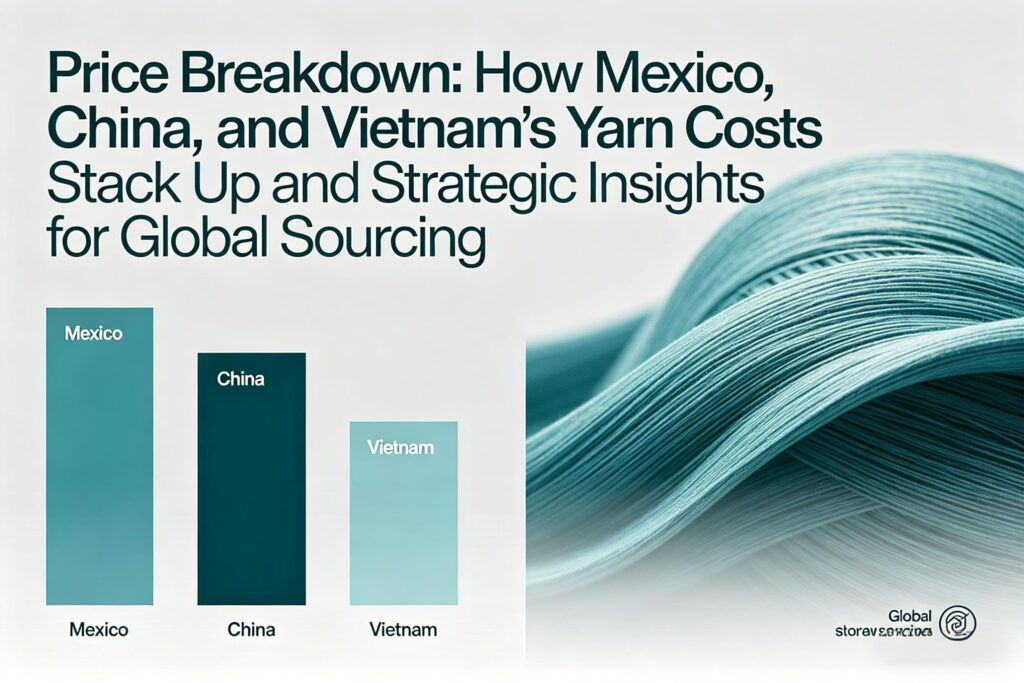
- Price Snapshot: Published official reference prices provide a guideline. For instance, the Mexican government lists an import reference price for cotton sewing thread at $12.8 per kilogram. Analysis from industry sources indicates that the overall manufacturing cost in Mexico can be at least 50% higher than in China.
- Cost Drivers: The higher cost is attributed to expensive local labor (significantly higher than in Asia), high energy costs (electricity is a major component), and a less dense local supply chain, which can increase input material costs.
Part 2: Deconstructing the Total Landed Cost
The factory-gate price is just the beginning. The “Total Landed Cost”—the final cost to have goods ready at your warehouse—reveals the true picture.
| Cost Component | China | Vietnam | Mexico (for U.S. Market) |
|---|---|---|---|
| Typical Base Yarn Price | Very Competitive (Market benchmark, currently soft) | Competitive (Lower than China in some cases) | Premium (Can be 50%+ higher than China) |
| U.S. Tariffs | High (General 7.5%-25% on most textiles) | Moderate (Varies by product, often lower) | Zero (Under USMCA, if rules of origin are met) |
| Ocean Freight & Time | Moderate Cost, Long Lead Time (4-6 weeks) | Moderate Cost, Long Lead Time (4-5 weeks) | Very Low Cost, Very Short Time (Days to weeks by truck) |
| Supply Chain Agility | Lower (Longer shipping, port congestion risks) | Lower | Very High (Nearshoring allows for quick response) |
2.1 Tariffs and Trade Policy
This is Mexico’s defining advantage for the North American market. Under the United States-Mexico-Canada Agreement (USMCA), yarn and textiles that meet the rules of origin can be imported duty-free into the U.S.. For shipments from China, tariffs of up to 25% are a significant and persistent cost. Vietnam benefits from more favorable tariff treatment than China but does not have a duty-free pact with the U.S.
2.2 Logistics and Lead Times
Mexico’s geographical proximity to the U.S. is a game-changer. Shipping is measured in days via truck or rail, compared to weeks via ocean freight from Asia. This drastically reduces shipping costs, minimizes inventory capital, and enables a fast-fashion or just-in-time production model.
2.3 Hidden Operational Costs
- Labor: Vietnamese labor offers a clear cost advantage. Mexican labor, while cheaper than in the U.S., is more expensive and can be less efficient than in Asia, with reports suggesting productivity can be 50% of Chinese levels.
- Energy & Infrastructure: Mexico’s industrial electricity costs are notably high, a significant factor for energy-intensive spinning mills. Furthermore, infrastructure like stable water supply can be a challenge and an added cost.
Part 3: Beyond Price: Strategic Value Propositions
In today’s volatile world, strategic value often outweighs minor cost savings.
3.1 Supply Chain Resilience
Over-reliance on any single region, like East Asia, poses risks from geopolitical tensions, pandemics, or logistics disruptions. Diversifying sourcing to include Mexico builds a more resilient and responsive supply chain for the Americas.
3.2 Quality, Compliance, and Market Access
- “Made in Mexico” for the U.S. Market: For brands marketing to U.S. consumers, a North American supply chain is a strong selling point. It assures compliance with regional safety and environmental standards and aligns with “nearshoring” trends.
- Avoiding Tariff Headaches: Sourcing from Mexico essentially eliminates the complex and costly issue of U.S. Section 301 tariffs on Chinese goods.
3.3 The Shift in Sourcing Philosophy
The question is evolving from “Which is cheapest?” to “Which provides the optimal total value for my specific business?” For time-sensitive, high-margin, or compliance-focused products, Mexico’s premium can be easily justified. For high-volume, basic commodities where price is paramount, Asia remains dominant.
Part 4: Practical Sourcing Guide and Recommendations
- Define Your Priority Matrix: Before seeking quotes, decide what matters most: Is it absolute lowest cost, speed to market, tariff avoidance, or risk mitigation? Your priorities will point you to the right region.
- Request Detailed, Comparable Quotes: When asking for prices, insist that quotations are broken down and include: FOB price, yarn specifications (count, fiber blend), estimated shipping cost and time to your port, and a clear statement on tariff liabilities.
- Match Origin to Product and Market:
- For the U.S. Market: Use Mexican yarn for products where speed, USMCA compliance, and “Made in North America” branding are critical.
- For Global or Price-Driven Markets: Use Vietnamese or Chinese yarn for high-volume basics, where lead time is flexible, and minimizing unit cost is essential.
- Future Outlook: Monitor political developments regarding U.S. trade policy, which can change tariff landscapes overnight. Also, watch for investments in automation in Mexico, which could help bridge the productivity gap with Asia over time.
In conclusion, there is no universal winner. Vietnam generally offers the most competitive direct prices for Asian sourcing, while China provides scale and a full supply chain at volatile prices. Mexico is not the cheapest but offers indispensable strategic value for the North American market through tariff-free access, unparalleled speed, and supply chain security. The smartest sourcing strategy will likely involve a diversified portfolio, leveraging the unique strengths of each region to build a robust, responsive, and cost-optimized global supply chain.
I hope this comprehensive comparison provides a clear framework for your sourcing decisions. For a more tailored analysis, please feel free to provide the specific yarn types and target markets you are focused on.
