
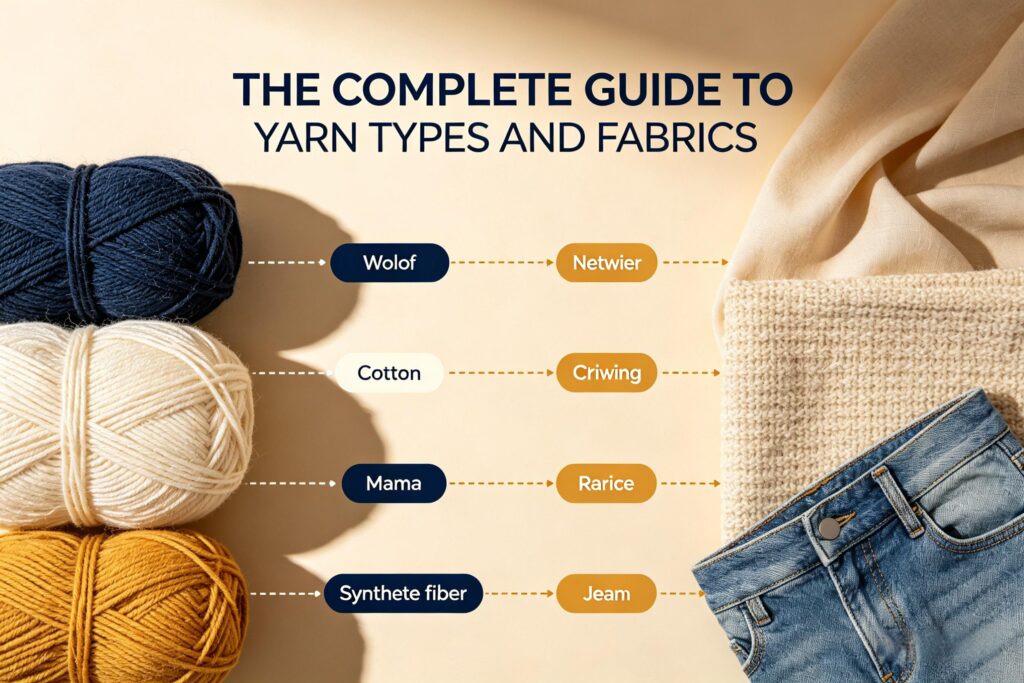
Table of Contents
- Introduction: The Fabric of Our World – Why Yarn Knowledge is Power
- Part 1: The Genesis of Texture – Classifying Fabrics by Construction
- Woven Fabrics: The Interlaced Foundation
- Knitted Fabrics: The Engineered Stretch
- Non-Woven & Other Constructions
- Part 2: The Thread of Choice – The Ultimate Yarn Catalog
- The Natural Fiber Pantheon
- The Synthetic & Manufactured Fiber Universe
- The Art of the Blend: Hybrid Yarns for Enhanced Performance
- Part 3: The Weave & Knit Codex – A Buyer’s Reference to Key Fabric Types
- The Woven Hall of Fame: Poplin, Twill, Denim, Satin, Canvas
- The Knit Power Players: Jersey, Rib, Interlock, Ponte di Roma, French Terry
- Niche & Technical Constructions
- Part 4: The Strategic Selection Matrix – Matching Fiber, Yarn, and Fabric to Application
- Part 5: Sourcing Intelligence – Navigating Quality, Cost, and Compliance
- Conclusion: Weaving Success – Building a Cohesive Material Strategy
1. Introduction: The Fabric of Our World – Why Yarn Knowledge is Power
For any brand, designer, or sourcing professional in the global textile industry, the question “What types of yarn and fabric are there?” is not merely academic—it is the foundational query upon which successful products are built. The selection of yarn and its transformation into fabric directly dictates a product’s aesthetic, performance, cost, comfort, and sustainability profile. In an era where consumers are increasingly discerning and regulations more stringent, a deep, practical understanding of these materials is a critical competitive advantage.
This guide serves as a comprehensive masterclass. It will move you from basic definitions to a strategic understanding of how fiber choice, yarn structure, and fabric construction intertwine to create materials for specific markets—from luxury fashion and high-performance sportswear to durable contract furnishings. By providing clear classifications, actionable data, and application-focused insights, this resource will empower you to communicate effectively with mills, evaluate suppliers like Glyarn with a critical eye, and make sourcing decisions that align perfectly with your brand’s vision and commercial objectives.
2. Part 1: The Genesis of Texture – Classifying Fabrics by Construction
Before exploring yarns, one must understand the primary architectures that turn them into cloth. The construction method is the single greatest determinant of a fabric’s inherent behavior.
1. Woven Fabrics: The Interlaced Foundation
Woven fabrics are created on a loom by interlacing two sets of yarns at right angles: the warp (lengthwise) and the weft (crosswise). This structure yields fabrics that are generally stable, strong, and prone to fraying, with little inherent stretch unless elastic fibers are incorporated.
- Common Characteristics: Dimensional stability, structured drape, wind resistance.
- Key Data Point: Fabric density is measured in thread count (ends per inch x picks per inch). A high-quality cotton percale sheet, for example, typically has a thread count of 200-400.
2. Knitted Fabrics: The Engineered Stretch
Knitted fabrics are formed by interlocking loops of yarn with needles. This looped structure gives knits their signature elasticity, drape, and comfort.
- Common Characteristics: Inherent stretch and recovery, breathability, wrinkle resistance, comfort.
- Key Data Point: Stretch is quantified as a percentage. A lightweight jersey may have 20-30% crosswise stretch, while a performance knit with spandex can achieve 50%+.
- Weft vs. Warp Knit: Weft knits (e.g., jersey) are made from a single yarn and can unravel. Warp knits (e.g., tricot, mesh) are made from multiple yarns and are more stable and run-resistant.
3. Non-Woven & Other Constructions
This category includes fabrics made by bonding fibers together through mechanical, chemical, or thermal means (e.g., felting, needle-punching). They are typically not made from yarns but directly from fibers.
- Applications: Interlinings, wipes, filters, medical textiles, insulation.
- Key Trait: Isotropic properties (same strength in all directions), cost-effective for disposable/single-use items.
3. Part 2: The Thread of Choice – The Ultimate Yarn Catalog
The fiber is the DNA of the fabric. Yarns can be spun from a vast array of sources, each with distinct properties.
1. The Natural Fiber Pantheon
- Cotton: The world’s most prevalent natural fiber. Prized for its breathability, softness, and absorbency. Supima or Egyptian cottons offer extra-long staples (ELS) for superior strength and luster.
- Wool: An umbrella term for hair fibers from sheep. Merino wool is fine (<24 microns) and soft for next-to-skin wear. Wool provides excellent warmth, moisture-wicking, and natural flame resistance.
- Silk: A continuous protein filament spun by silkworms. It is the epitome of luxury, known for its unparalleled luster, smooth hand-feel, and high tensile strength.
- Linen: Made from the flax plant. It is extremely strong, highly breathable, and quick-drying, but wrinkles easily, which is part of its aesthetic.
2. The Synthetic & Manufactured Fiber Universe
- Polyester: The dominant synthetic. It is strong, durable, quick-drying, wrinkle-resistant, and cost-effective. It can be engineered into microfibers for a soft touch or high-tenacity yarns for technical use.
- Nylon (Polyamide): Known for its exceptional strength, elasticity, and abrasion resistance. It is the fiber of choice for hosiery, activewear, and luggage.
- Viscose/Rayon: A semi-synthetic made from regenerated cellulose (often wood pulp). It offers a silky drape, bright color saturation, and breathability but can lose strength when wet.
- Elastane/Spandex (e.g., Lycra®): A synthetic fiber providing exceptional elasticity (able to stretch over 500% and recover). It is never used alone but blended in small percentages (2-20%) to provide stretch and recovery to other fabrics.
3. The Art of the Blend: Hybrid Yarns for Enhanced Performance
Blending fibers in a single yarn combines their best attributes.
- Polyester/Cotton (65/35 or 50/50): Balances cotton’s comfort with polyester’s durability and easy care. The industry standard for casual apparel and workwear.
- Wool/Synthetic (e.g., Wool/Nylon): Adds durability and abrasion resistance to wool, ideal for socks and performance knitwear.
- Core-Spun Yarns: A technical yarn where a filament core (often spandex or high-strength polyester) is wrapped with staple fibers (e.g., cotton). This provides hidden stretch or strength.
4. Part 3: The Weave & Knit Codex – A Buyer’s Reference to Key Fabric Types
Here is a practical guide to some of the most commercially important fabric types derived from specific weaves or knits.
| Fabric Name | Construction Type | Typical Yarn/Fiber Used | Key Characteristics & Common Applications |
|---|---|---|---|
| Poplin | Plain Weave | Combated Cotton, Cotton/Poly | Fine ribs, crisp hand, lightweight. Shirts, dresses, lightweight jackets. |
| Twill (e.g., Gabardine) | Twill Weave | Wool, Cotton, Polyester | Diagonal wale, durable, drapeable, resists wrinkles. Chinos, suits, uniforms. |
| Denim | Twill Weave (usually 3×1) | Ring-Spun Cotton (indigo warp, white weft) | Durable, develops fades. Jeans, jackets, casual wear. |
| Satin | Satin Weave | Silk, Polyester, Viscose | Lustrous face, dull back, drapeable. Lingerie, eveningwear, linings. |
| Jersey | Weft Knit (Plain) | Cotton, Polyester, Viscose, Blends | Smooth face, curled edges, comfortable stretch. T-shirts, dresses, lightweight knitwear. |
| Rib Knit | Weft Knit | Cotton, Cotton/Spandex | Vertical raised cords, excellent crosswise stretch and recovery. Cuffs, collars, waistbands, turtlenecks. |
| French Terry | Weft Knit | Cotton, Blends | Loops on the backside (can be sheared to make fleece), absorbent. Sweatshirts, athleisure, loungewear. |
5. Part 4: The Strategic Selection Matrix – Matching Fiber, Yarn, and Fabric to Application
Choosing the right material is a three-dimensional puzzle. Use this logic chain:
- Define the Primary Need: What is the single most important function? (e.g., Moisture-wicking for sportswear, Durability for workwear, Luxury drape for eveningwear).
- Select the Fiber Engine: Match the need to a fiber’s innate property (e.g., Polyester for moisture-wicking and durability, Wool for natural temperature regulation, Silk for luxury).
- Choose the Construction for Behavior: Decide on the required structure (e.g., a breathable mesh knit for sportswear ventilation, a tight, durable twill weave for workwear abrasion resistance, a fluid satin weave for drape).
- Specify the Yarn Details: This is where technical partnership is key. For a high-end T-shirt, you don’t just want “cotton jersey.” You should specify: “Heather Grey Jersey, 180 GSM, made from 40s compact ring-spun combed cotton for superior softness and pilling resistance.“
6. Part 5: Sourcing Intelligence – Navigating Quality, Cost, and Compliance
- Beyond the Price per Kg: True cost includes consistency, minimum order quantities (MOQs), lead times, and compliance. A cheaper yarn that causes dyeing inconsistencies is far more costly in the long run.
- The Language of Quality: Understand and request specifications.
- Yarn Count (Ne, Nm, Tex): Defines thickness.
- GSM (Grams per Square Meter): Defines fabric weight and substance.
- Shrinkage Allowance: Industry standard is often ±3-5% after washing.
- Colorfastness & Pilling Tests: Request lab test results against standards like AATCC or ISO.
- The Supplier as Strategic Partner: A technical yarn specialist like Glyarn provides immense value beyond transaction. They can:
- Recommend Optimized Blends: Advise on a core-spun construction or a specific wool/synthetic blend to hit a performance target.
- Ensure Traceability & Certification: Provide yarns with OEKO-TEX Standard 100 (safe from harmful substances) or GRS (Global Recycled Standard) certification.
- Guarantee Consistency: Offer batch-to-batch uniformity, which is critical for large-scale production and color matching.
7. Conclusion: Weaving Success – Building a Cohesive Material Strategy
Mastering the interconnected worlds of yarn and fabric is what separates commodity products from brand-defining ones. It transforms sourcing from a reactive cost-center activity into a proactive, value-creating strategy. By applying the structured framework outlined in this guide—moving systematically from application needs to fiber science to construction mechanics—you empower your team to make confident, specification-driven decisions.
This knowledge allows you to engage in meaningful technical dialogue with mills and suppliers, leveraging the expertise of partners like Glyarn to solve problems and innovate. In doing so, you build not just a collection of garments or products, but a cohesive material identity that delivers on your brand promise to the end consumer, ensuring quality, performance, and satisfaction at every touchpoint. Let this understanding be the thread that weaves through your entire development process, from initial sketch to final stitch.
