
Table of Contents
- Executive Summary: The Transformative Journey from PTA to Garment
- Introduction: Polyester’s Dominance and the Importance of Filament
- Stage 1: The Chemical Genesis – Creating the Raw Polymer
- 3.1 From Fossil Fuels to Feedstock: PX, PTA, and MEG
- 3.2 Polymerization: Forming Polyethylene Terephthalate (PET)
- Stage 2: The Physical Transformation – Spinning into Filament
- 4.1 Melt Spinning: The Core Technology
- 4.2 Yarn Types: POY, FDY, and DTY Explained
- Stage 3: From Yarn to Fabric – Weaving and Knitting
- 5.1 The Warp and Weft of Weaving
- 5.2 The Interlocking Loops of Knitting
- 5.3 Alternative Fabric Formation: Warp Knitting and Nonwovens
- Stage 4: The Finishing Touch – Dyeing, Printing, and Functional Treatment
- 6.1 Preparing the Fabric: Scouring and Heat Setting
- 6.2 Imparting Color: Dyeing and Printing Technologies
- 6.3 Enhancing Performance: Functional Finishes
- Stage 5: Garment Manufacturing – Cutting, Sewing, and Final Assembly
- Industry Insights: Sustainability and the Future of Polyester
- 8.1 The rPET Revolution: Fibers from Recycled Bottles
- 8.2 Innovation in Biopolymers and Circularity
- Conclusion: The Engineered Path of a Modern Fiber
1. Executive Summary: The Transformative Journey from PTA to Garment
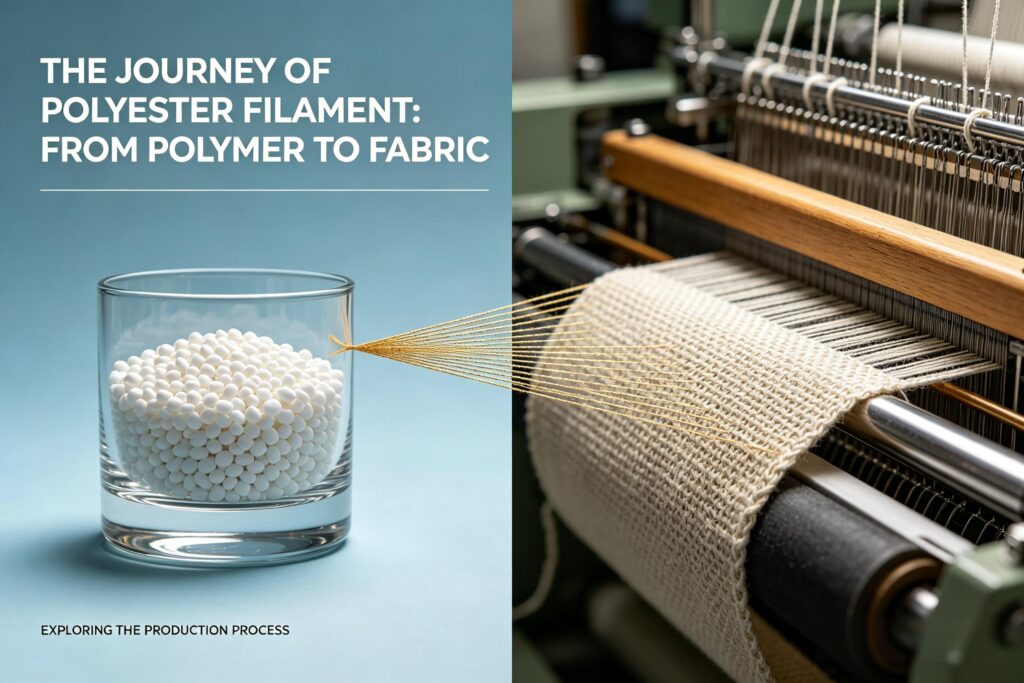
The creation of clothing from polyester filament is a marvel of modern chemical engineering and textile manufacturing. Far from a simple process, it is a sophisticated, multi-stage transformation that turns petrochemical derivatives into the versatile, durable, and affordable fabrics that dominate global apparel. This journey begins with the polymerization of raw materials into Polyethylene Terephthalate (PET), which is then melted and extruded through fine spinnerets to form continuous filaments. These filaments are drawn, textured, and wound into yarns like Partially Oriented Yarn (POY), Fully Drawn Yarn (FDY), and Drawn Textured Yarn (DTY), each with distinct properties for different fabrics. The yarns are then constructed into fabrics through weaving or knitting, subsequently undergoing crucial finishing processes such as scouring, dyeing, and application of functional treatments for moisture-wicking or wrinkle resistance. Finally, these fabrics are cut and sewn into garments. Understanding this complete value chain—from “chip to shirt”—is essential for fashion brands, sourcing professionals, and product developers to make informed decisions about quality, cost, sustainability, and innovation. With the rise of recycled polyester (rPET), this process is also evolving to meet the demands of a circular economy, making the journey from filament to fiber more relevant than ever.
2. Introduction: Polyester’s Dominance and the Importance of Filament
Polyester is the undisputed king of synthetic fibers, accounting for over half of the global fiber production. Its success is built on a foundation of exceptional properties: high strength, excellent abrasion resistance, quick drying, inherent wrinkle resistance, and remarkable versatility. Within the polyester family, filament yarn—a continuous strand of fiber—is distinct from staple fiber, which is cut into short lengths and spun like cotton. Filament yarns are the starting point for smooth, lustrous fabrics like linings, satins, athletic wear, and delicate chiffons. The process of creating fabric from these continuous filaments is a story of precision engineering, transforming a chemical soup into the threads that shape our daily wear.
3. Stage 1: The Chemical Genesis – Creating the Raw Polymer
The journey begins not in a textile mill, but in a petrochemical complex.
- 3.1 From Fossil Fuels to Feedstock: The primary building blocks are Purified Terephthalic Acid (PTA) and Monoethylene Glycol (MEG). These are derived from petroleum through processes like catalytic reforming and oxidation.
- 3.2 Polymerization: PTA and MEG are reacted in a controlled environment under heat and vacuum in a process called polycondensation. This causes the molecules to link together into long, repeating chains, forming the polymer Polyethylene Terephthalate (PET). The molten PET can be directly fed to a spinning plant (direct spin) or solidified, cut into small chips, and later re-melted for spinning (chip spin). The quality of this polymer, including its intrinsic viscosity (IV), dictates the final strength and spinnability of the fiber.
4. Stage 2: The Physical Transformation – Spinning into Filament
This is where polymer becomes fiber.
- 4.1 Melt Spinning: PET chips are dried, melted (~290°C), and the viscous liquid is precisely pumped through a metal plate called a spinneret, which is perforated with dozens to hundreds of tiny holes. As each stream of molten polymer emerges, it is cooled by a flow of air, solidifying into a continuous filament.
- 4.2 Yarn Types: The nascent filaments are then drawn (stretched) to align the polymer molecules, which greatly increases their strength. The specific drawing process creates the main yarn types:
- POY (Partially Oriented Yarn): Drawn at high speed but only partially, leaving it with high elongation. It is not a final product but the crucial feedstock for texturing.
- FDY (Fully Drawn Yarn): Drawing is completed in one continuous, integrated line with spinning. The result is a smooth, strong, and lustrous yarn ready for weaving or warp knitting.
- DTY (Drawn Textured Yarn): POY is fed into a texturing machine where it is fully drawn and then crimped, coiled, or looped using mechanical force (false-twist texturing). This gives the yarn bulk, stretch, and a soft, cotton-like hand, making it ideal for knits and casual woven fabrics.
5. Stage 3: From Yarn to Fabric – Weaving and Knitting
Yarns are assembled into fabrics through two primary methods.
- 5.1 Weaving: Involves interlacing two sets of yarns—warp (lengthwise) and weft (crosswise)—at right angles on a loom. Common weaves include:
- Plain Weave: The simplest and strongest (e.g., taffeta, shirting).
- Twill Weave: Creates a diagonal rib (e.g., gabardine, denim).
- Satin Weave: Produces a smooth, lustrous surface with long floats (e.g., satin linings, evening wear).
- 5.2 Knitting: Formed by interlocking loops of yarn. It is more flexible and elastic than woven fabric.
- Weft Knitting: A single yarn runs crosswise, forming rows of loops (e.g., T-shirts, sweaters). Machines can be circular (for tubes of fabric) or flat.
- Warp Knitting: Each needle is fed by its own yarn running lengthwise, creating a stable, less stretchy fabric (e.g., tricot for lingerie, mesh for sportswear).
- 5.3 Alternative Methods: Warp knitting is a high-speed method for specific applications, while nonwovens bypass the yarn stage entirely, bonding fibers directly into a fabric web (used in interlinings, wipes, and some disposable apparel).
6. Stage 4: The Finishing Touch – Dyeing, Printing, and Functional Treatment
Greige (gray) fabric is unfinished and must be processed to become usable.
- 6.1 Preparation: Scouring washes out oils, dirt, and sizing agents applied during weaving/knitting. Heat setting uses heat to stabilize the fabric dimensions and reduce future shrinkage.
- 6.2 Coloring: Polyester is hydrophobic and requires specialized methods.
- Dyeing: Typically uses disperse dyes at high temperatures (130°C) in pressurized vessels, forcing dye molecules into the fiber polymer. Methods include jet, beam, and jig dyeing.
- Printing: Transfers patterns onto fabric. Sublimation printing is dominant for polyester, where solid dyes turn to gas and bond directly with the fiber, offering vibrant, durable prints.
- 6.3 Functional Finishes: Applications that add performance:
- Moisture-Wicking: Surface treatments to spread sweat.
- Anti-Microbial: Inhibits odor-causing bacteria.
- Water-Repellent (DWR): Coating that causes water to bead up.
- Flame Retardant: Critical for protective and children’s sleepwear.
7. Stage 5: Garment Manufacturing – Cutting, Sewing, and Final Assembly
The finished fabric roll is sent to a garment factory.
- Pattern Making & Grading: Designers’ sketches are translated into precise paper or digital templates for each garment component, sized for the full size range.
- Spreading & Cutting: Fabric is laid in many piles (a “lay”) and cut simultaneously using computer-controlled knives or lasers for extreme precision and efficiency.
- Sewing & Assembly: Cut pieces are assembled by specialized sewing machines. This complex step involves different stitches, seam types, and attachments for zippers, buttons, and elastics.
- Finishing & Quality Control: Garments are pressed, inspected for defects, labeled, and packaged for distribution.
8. Industry Insights: Sustainability and the Future of Polyester
The industry is undergoing a green transformation.
- 8.1 The rPET Revolution: The most significant shift is the large-scale adoption of recycled polyester. Post-consumer PET plastic bottles are collected, cleaned, shredded, and de-polymerized or melted to form recycled chips, which are then spun into new filament. This closes the loop, reducing reliance on virgin petroleum and plastic waste.
- 8.2 Bio-based Polymers & Circularity: Innovation continues with fibers partially derived from renewable sources (like bio-based MEG from sugarcane). The ultimate goal is full chemical recycling, where old polyester garments can be broken down to their molecular components and repolymerized into virgin-quality fiber indefinitely.
9. Conclusion: The Engineered Path of a Modern Fiber
The transformation of polyester filament into clothing fiber is a testament to human ingenuity in industrial science. It is a seamless integration of chemistry, mechanical engineering, and design. Each stage—polymerization, spinning, fabrication, finishing—is optimized for specific performance outcomes, allowing polyester to mimic the drape of silk, the breathability of cotton, or the durability of canvas. For professionals in the textile and apparel sector, a deep understanding of this pipeline is not merely technical knowledge; it is strategic insight. It enables better sourcing decisions, fosters innovation in sustainable materials, and ensures the creation of garments that meet the ever-evolving demands of function, fashion, and responsibility. As technology advances, this journey from molecule to garment will only become more efficient, more sustainable, and more integral to the fabric of our lives.
