
Table of Contents:
- Introduction to Yarn Dyeing: An Essential Textile Process
- 1.1. Definition and Importance in Textile Manufacturing
- 1.2. Comparison with Fabric Dyeing and Garment Dyeing
- Core Types of Yarn Dyeing Methods: A Detailed Breakdown
- 2.1. Package Dyeing
- Process, Advantages, and Applications
- 2.2. Skein (Hank) Dyeing
- Process, Advantages, and Applications
- 2.3. Space Dyeing
- Process, Advantages, and Applications
- 2.4. Warp Beam Dyeing
- Process, Advantages, and Applications
- 2.1. Package Dyeing
- Dye Classes and Their Application in Yarn Dyeing
- 3.1. Reactive Dyes (for Cellulosic Fibers)
- 3.2. Acid Dyes (for Protein and Polyamide Fibers)
- 3.3. Disperse Dyes (for Synthetic Fibers)
- 3.4. Direct and Vat Dyes
- Technical Considerations and Quality Control
- 4.1. Pre-treatment and Preparation of Yarn
- 4.2. Critical Parameters: Temperature, Time, pH, and Liquor Ratio
- 4.3. Post-Dyeing Processes: Rinsing, Soaping, and Softening
- 4.4. Key Quality Tests: Color Fastness, Evenness, and Strength
- Advantages and Challenges of Yarn Dyeing
- 5.1. Benefits: Design Flexibility, Color Consistency, and Efficiency
- 5.2. Challenges: Cost, Complexity, and Environmental Impact
- Innovations and Sustainable Practices in Yarn Dyeing
- 6.1. Low-Liquor Ratio Dyeing Machines
- 6.2. Digital Yarn Dyeing and Automation
- 6.3. Eco-friendly Dyes and Auxiliaries
- 6.4. Water Recycling and Effluent Management
- Conclusion: The Future of Colored Yarns
Yarn Dyeing: Methods, Technologies, and Sustainable Innovations
1. Introduction to Yarn Dyeing: An Essential Textile Process
Yarn dyeing is a pivotal and specialized stage in the textile manufacturing chain, where threads or yarns are colored before being woven or knitted into fabrics. This process sits strategically between fiber processing and fabric formation, offering distinct advantages in terms of color flexibility, penetration, and consistency.
1.1. Definition and Importance in Textile Manufacturing
Yarn dyeing involves impregnating successive yarn packages, hanks, or warps with dye molecules under controlled conditions of temperature, time, and chemical environment. Its primary objective is to achieve a uniform and durable color that meets specific technical and aesthetic standards. The importance of this process cannot be overstated. It allows for the creation of intricate patterns like stripes, checks, and jacquards in woven fabrics, and heathers, stripes, and other multi-color effects in knitwear. By dyeing at the yarn stage, manufacturers gain tremendous creative freedom, enabling the production of fabrics with complex color structures that are often impossible or less economical to achieve through piece dyeing (dyeing the finished fabric).
1.2. Comparison with Fabric Dyeing and Garment Dyeing
Understanding yarn dyeing requires contrasting it with other dyeing stages.
- Yarn Dyeing: As described, offers maximum design versatility for patterned fabrics. It is typically a bulk process suited for long production runs of specific colored yarns. The color penetration is excellent, and subsequent processes like weaving subject the yarn to tension and abrasion, making color fastness crucial.
- Fabric or Piece Dyeing: This is the dyeing of constructed grey fabric (woven or knitted). It is highly efficient for producing solid-colored fabrics in large volumes. It offers less design complexity for patterns but is cost-effective for single-color applications. The risk of unevenness (side-to-center, fold marks) can be higher compared to yarn dyeing.
- Garment Dyeing: Involves dyeing fully assembled, sewn garments. It is popular for casual wear like t-shirts, sweaters, and denim, offering a unique, vintage, or soft-hand feel. However, it presents challenges in size stability, zipper/metallic component compatibility, and color consistency between different garment sizes.
2. Core Types of Yarn Dyeing Methods: A Detailed Breakdown
The technique chosen depends on yarn type (fiber, count, twist), end-use, required color effect, and order volume.
2.1. Package Dyeing
This is the most common and efficient method for dyeing large volumes of yarn intended for weaving and knitting.
- Process: Yarn is wound onto perforated cylindrical or conical carriers (packages) and mounted on spindles inside a sealed dyeing vessel (autoclave). The dye liquor is forced alternately from inside-to-outside and outside-to-inside through the packages under high pressure and temperature, ensuring uniform penetration.
- Advantages: High automation, excellent reproducibility, large batch capability, and good liquor circulation for level dyeing. Suitable for a wide range of fibers.
- Applications: Cotton, polyester, acrylic, wool, and blended yarns for shirting, suiting, upholstery, and towels.
2.2. Skein (Hank) Dyeing
One of the oldest methods, preferred for yarns that are delicate or where a lofty, soft hand is desired.
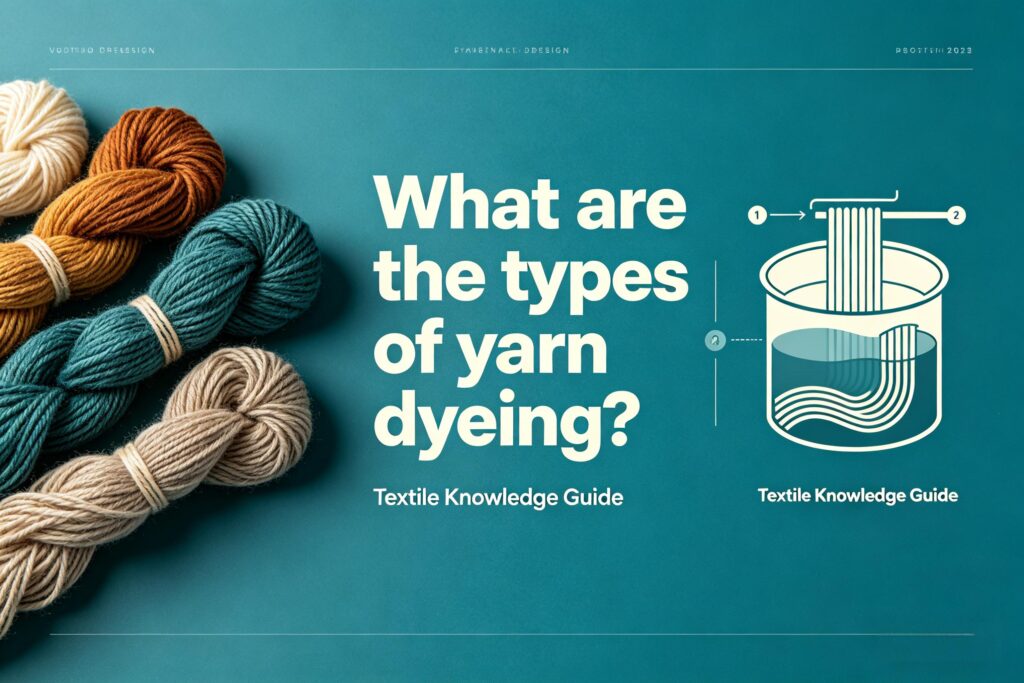
- Process: Yarn is wound into loose, coiled bundles (skeins or hanks). These skeins are hung over sticks and immersed in a dye bath, where paddles gently circulate the liquor. The tension is minimal.
- Advantages: Imparts a very soft handle as the yarn is not under tension on a package. Ideal for yarns that felt or distort easily, such as luxury wool, mohair, angora, and some silk yarns. Also used for space-dyeing effects.
- Applications: Hand-knitting yarns, high-end knitwear, fancy yarns, and yarns for lace and crochet.
2.3. Space Dyeing
This is a specialized technique to produce multicolored patterns along the length of a single yarn.
- Process: Skeins of yarn are looped on a special machine, and different colors are applied intermittently to specific sections via injection nozzles or printing techniques. The dye is then fixed with steam. When woven or knitted, this creates randomized or predetermined colorful patterns like splashes, stripes, or geometric designs.
- Advantages: Creates unique, vibrant multi-color effects in a single yarn that would be impossible with solid dyeing. Efficient for producing patterned fabric from a single yarn type.
- Applications: Eyewear retaining cords, lively upholstery fabrics, novelty knitwear, and carpet yarns.
2.4. Warp Beam Dyeing
A method specifically for dyeing an entire warp sheet uniformly before weaving.
- Process: The warp yarns, wound in parallel onto a large perforated beam (similar to a huge package), are placed in a beam dyeing machine. Dye liquor is circulated through the layers of yarn. This ensures perfect color consistency across all warp ends, critical for solid-colored fabrics like poplin or taffeta.
- Advantages: Eliminates potential color variations between different yarn packages used in the warp. Highly efficient for long runs of fabric requiring a solid-color warp.
- Applications: Solid-colored shirting fabrics, linings, and any fabric where a perfectly uniform warp is essential.
3. Dye Classes and Their Application in Yarn Dyeing
The choice of dye is dictated by the fiber composition of the yarn.
3.1. Reactive Dyes
The premier choice for cellulosic fibers (cotton, linen, viscose, hemp). They form a covalent chemical bond with the fiber, resulting in outstanding wash and light fastness, and brilliant shades. Application requires an alkaline environment and electrolyte (salt).
3.2. Acid Dyes
Used primarily for protein fibers (wool, silk) and polyamide fibers (nylon). They attach to the fiber via ionic bonds in an acidic bath. They offer a very wide range of bright colors with good fastness properties, especially on nylon.
3.3. Disperse Dyes
The only effective dyes for hydrophobic synthetic fibers like polyester and acetate. They are applied from a fine aqueous dispersion at high temperatures (up to 130°C under pressure) where they dissolve and diffuse into the fiber. Excellent fastness to washing and light is achieved.
3.4. Direct and Vat Dyes
- Direct Dyes: Simpler, cheaper dyes for cellulose, applied in a neutral or slightly alkaline salt bath. They have poorer fastness than reactive dyes but are used for less demanding applications.
- Vat Dyes: Among the most fastness dyes for cotton, especially for indigo denim yarns. They are applied in a reduced, soluble form and then oxidized back to an insoluble pigment inside the fiber, ensuring exceptional durability.
4. Technical Considerations and Quality Control
Achieving perfect results requires stringent process control.
4.1. Pre-treatment and Preparation of Yarn
Yarn must be scoured and bleached to remove natural impurities, oils, and sizing agents to ensure perfectly even wettability and dye absorption.
4.2. Critical Parameters: Temperature, Time, pH, and Liquor Ratio
Each dye-fiber system has an optimized temperature profile (ramp rate, holding temperature). Time must be sufficient for diffusion. pH controls the rate of dye fixation. Liquor ratio (weight of water to weight of yarn) affects chemical consumption, energy use, and levelness—trends move towards lower ratios (1:5) for sustainability.
4.3. Post-Dyeing Processes: Rinsing, Soaping, and Softening
After dyeing, unfixed dye and chemicals must be removed through thorough rinsing and soaping to reveal the true shade and achieve maximum fastness. Softening agents may be applied to enhance hand feel.
4.4. Key Quality Tests: Color Fastness, Evenness, and Strength
Rigorous testing is mandatory:
- Color Fastness: Resistance to washing, rubbing (dry/wet), light, and perspiration (ISO/AATCC standards).
- Evenness: Visual and instrumental assessment to detect barre, patches, or streaks.
- Physical Strength: Ensuring the dyeing process has not degraded the yarn’s tensile or abrasion resistance.
5. Advantages and Challenges of Yarn Dyeing
5.1. Benefits:
- Design Flexibility: Enables complex, multi-colored fabric patterns.
- Color Consistency: Large batches of yarn dyed together ensure uniformity in the final fabric.
- Production Efficiency: Weaving/Knitting with pre-dyed yarns allows for faster fabric production and better planning.
- Superior Fastness: Dye penetration is often better than in dense fabrics.
5.2. Challenges:
- Higher Initial Cost: Requires substantial inventory of different colored yarns.
- Production Complexity: Requires careful planning and scheduling of yarn lots.
- Minimum Order Quantities: Often less feasible for small, custom orders.
- Environmental Impact: Traditional processes consume significant water and energy and generate colored effluent.
6. Innovations and Sustainable Practices in Yarn Dyeing
The industry is transforming under pressure for sustainability.
6.1. Low-Liquor Ratio Dyeing Machines: Advanced package dyeing machines now operate at ratios as low as 1:3, drastically reducing water and energy consumption.
6.2. Digital Yarn Dyeing and Automation: Precise computer control of all process parameters ensures reproducibility, reduces errors, and saves resources. Automated dosing and robot-assisted handling are becoming standard.
6.3. Eco-friendly Dyes and Auxiliaries: Development of low-salt reactive dyes, biodegradable leveling agents, and dyes from natural or bio-based sources is accelerating.
6.4. Water Recycling and Effluent Management: On-site water treatment plants allowing for high percentages of water reuse are critical. Technologies like ultrafiltration and reverse osmosis are being employed to treat and recycle dyebath effluent.
7. Conclusion: The Future of Colored Yarns
Yarn dyeing remains an indispensable, dynamic, and technically sophisticated pillar of textile manufacturing. While its core principles are established, the field is undergoing a profound transformation driven by digitalization and the imperative of sustainability. The future lies in smart, connected dye houses where artificial intelligence optimizes recipes and processes, advanced machinery minimizes resource footprints, and circular economy principles guide material choices. The evolution from traditional, resource-intensive methods to closed-loop, efficient systems will ensure that yarn dyeing continues to provide the vibrant colors and innovative patterns the world demands, but in harmony with environmental stewardship. The colored thread of innovation, it seems, is being woven directly into the future of the industry itself.
