
Table of Contents
- The First Time I Held a Bottle That Became a Shirt
- What Exactly Are rPET Chips? (Stop Confusing Them with Recycled Flakes)
- How rPET Chips Are Made – From Dirty Bottles to Clean Polymer
- The Real Data – Price, Quality, and Availability (2026 Update)
- rPET vs Virgin PET vs PLA vs Nylon
- The Honest Pros and Cons – What I’ve Learned After 4 Years of Sourcing rPET
- The rPET Batch That Smelled Like Soda (And Cost Me a Client)
- Technical Deep Dive – IV, Color, Thermal Stability, and Contamination Limits
- Who’s Actually Buying rPET Chips Right Now? (By Region and Industry)
- Certifications You Actually Need – GRS, REACH, FDA, and the Fake Ones
- rPET Isn’t Perfect, But It’s the Best We Have Right Now
- FAQ (7 Questions Buyers Ask Me Before Their First rPET Order)
1. The First Time I Held a Bottle That Became a Shirt
Three years ago, a supplier in Vietnam handed me a small bag of pale blue chips. “This was a Coke bottle last month,” he said. “Now it’s rPET.”
I didn’t believe him at first. The chips looked almost like virgin polyester – slightly less bright, maybe a tiny greyish tint, but clean. No smell. No visible dirt.
Then he showed me the before-and-after photos. Bottles crushed, washed, melted, filtered, chopped. I held the evidence in my hand: a handful of chips that would eventually become filament yarn for a sportswear brand in Germany.
That moment changed how I think about plastic.
Today, rPET chips are everywhere. Your “eco-friendly” t-shirt? Probably rPET. That recycled polyester fabric from Patagonia or H&M? rPET. Even some automotive carpets and industrial strapping.
But here’s what nobody tells you: not all rPET chips are the same. Some are excellent. Some will ruin your extrusion line. And some are just virgin PET with a fake certificate.
2. What Exactly Are rPET Chips? (Stop Confusing Them with Recycled Flakes)
Let me clear up a very common confusion.
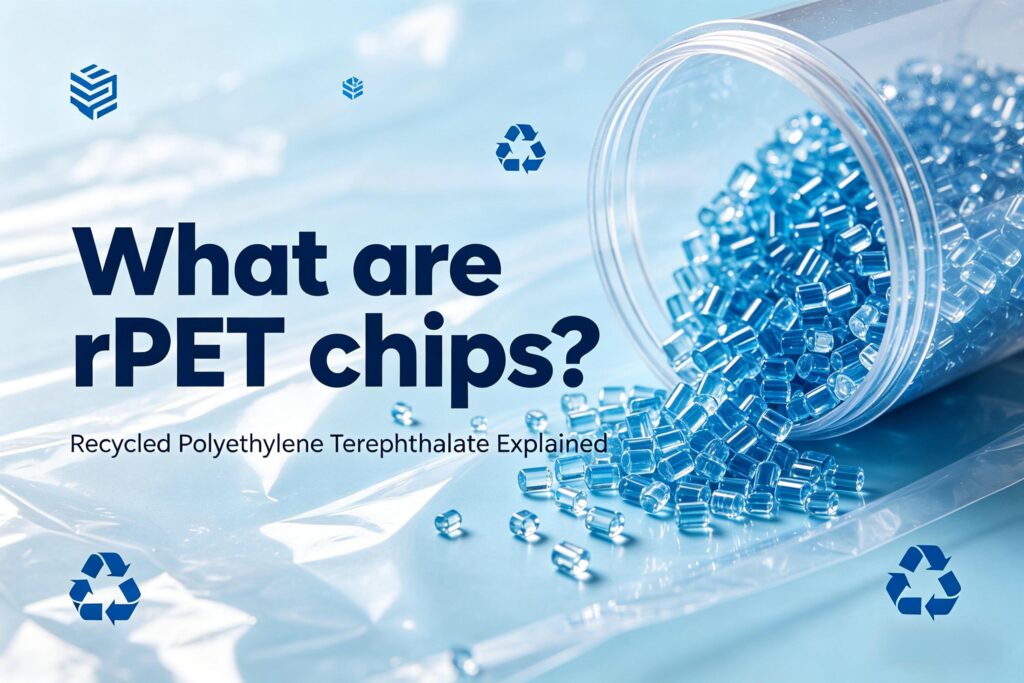
rPET stands for recycled polyethylene terephthalate.
Chips are small pellets (about 2–4mm in diameter) that look like tiny translucent cylinders or discs.
rPET chips are not the same as:
- PET flakes – Those are crushed bottle pieces, uneven in size, still containing labels, glue, and sometimes caps. Flakes are the feedstock for making chips.
- Virgin PET chips – Made from crude oil derivatives (PTA + MEG). No recycled content.
- PCR (Post-Consumer Recycled) powder – Ground rPET, used for different applications like nonwovens.
rPET chips are the finished recycled polymer that can be melted and spun directly into fiber (FDY, POY, DTY) or used for injection molding (bottles, sheets, straps).
Think of it this way:
Flakes are like chopped vegetables. Chips are the frozen meal ready to cook.
Most rPET chips on the market today are post-consumer (from bottles collected from households) rather than post-industrial (factory scrap). Post-consumer is harder to clean, but it’s what big brands want for their sustainability claims.
3. How rPET Chips Are Made – From Dirty Bottles to Clean Polymer
I visited an rPET washing line in Gujarat two years ago. It was louder and smellier than I expected. But the process is fascinating.
Here’s the step-by-step, stripped of marketing fluff:
Step 1: Collection and sorting
Bottles come from municipal waste, deposit schemes, or scrap yards. They’re sorted by color (clear, blue, green) and type (PET only – no PVC, no PS). This step determines 70% of final quality.
Step 2: Grinding into flakes
Bottles are crushed and ground into flakes roughly 8–14mm in size. Hot water and caustic soda remove labels and glue.
Step 3: Intensive washing
Flakes go through friction washers, sink-float tanks (to separate polypropylene caps – PP floats, PET sinks), and sometimes hot wash at 80–90°C to remove contaminants.
Step 4: Drying and extrusion
Clean, dry flakes are melted at 260–280°C, then filtered through one or more screens (typically 40–80 mesh, sometimes multiple stages).
Step 5: Pelletizing
The molten polymer is extruded into strands, water-cooled, and cut into 2–4mm chips. These are your rPET chips.
Step 6: Solid-state polycondensation (SSP) – optional but important
For fiber-grade or bottle-grade rPET, chips undergo SSP to increase intrinsic viscosity (IV) and remove acetaldehyde. Without SSP, you get low IV, poor spinning, and that plastic smell.
Good rPET chips from a decent mill cost $1.10 – 1.45/kg (FOB Asia, 2026). Cheap rPET chips under $0.90/kg? Almost certainly no SSP, high contamination, or fake.
4. The Real Data – Price, Quality, and Availability (2026 Update)
Let me give you actual numbers from recent transactions and offers I’ve reviewed.
| Type of rPET Chip | FOB China (USD/kg) | FOB India (USD/kg) | FOB Vietnam (USD/kg) | Typical IV (dL/g) |
|---|---|---|---|---|
| Clear, hot-washed, SSP (fiber grade) | $1.25 – 1.45 | $1.30 – 1.50 | $1.20 – 1.40 | 0.68 – 0.75 |
| Clear, hot-washed, no SSP (lower grade) | $1.00 – 1.15 | $1.05 – 1.20 | $0.95 – 1.10 | 0.58 – 0.65 |
| Mixed color (green/blue), with SSP | $1.10 – 1.30 | $1.15 – 1.35 | $1.05 – 1.20 | 0.65 – 0.72 |
| Post-industrial (factory scrap) | $0.85 – 1.00 | $0.90 – 1.05 | $0.80 – 0.95 | Varies widely |
| Food-grade (FDA/NAS compliance) | $1.50 – 1.80 | $1.60 – 1.90 | $1.45 – 1.70 | 0.72 – 0.80 |
Availability note:
Clear, fiber-grade rPET chips with SSP are tight in Q2–Q3 2026. Lead times from China are 20–35 days. India is slightly faster (15–25 days) but $0.05–0.10 more expensive.
5. rPET vs Virgin PET vs PLA vs Nylon
If you’re considering rPET, you’ve probably also looked at virgin PET, PLA (bio-based), or even recycled nylon. Here’s how they compare.
| Property | rPET Chips (fiber grade) | Virgin PET Chips | PLA (Ingeo) | Recycled Nylon (PA6) |
|---|---|---|---|---|
| Typical price (USD/kg) | $1.20 – 1.50 | $1.05 – 1.25 | $1.80 – 2.50 | $2.50 – 4.00 |
| Carbon footprint (kg CO2/kg resin) | 1.2 – 1.8 | 2.5 – 3.5 | 1.0 – 1.5 (but land use) | 3.0 – 4.5 |
| Melting point (°C) | 250 – 260 | 255 – 265 | 160 – 170 | 215 – 220 |
| Intrinsic viscosity (IV) range | 0.65 – 0.75 | 0.65 – 0.82 | N/A | N/A |
| Color consistency | Good (clear) to fair (mixed) | Excellent | Good | Fair to good |
| FDA food-contact approval | Possible (with SSP and certification) | Yes | Yes | Rare |
| Best for | Fibers, strapping, sheets | All applications | Compostable packaging | High-end apparel, carpets |
rPET is not a direct drop-in replacement for virgin PET in every line. You need to adjust drying temperature (rPET is more hygroscopic) and filter more aggressively. But for fiber applications, it’s very close – close enough that I’ve seen mills run 30% rPET blend with no visible difference in yarn quality.
6. The Honest Pros and Cons – What I’ve Learned After 4 Years of Sourcing rPET
I’ve made mistakes with rPET. I’ve also seen it work beautifully. Here’s my honest list.
Pros (the reasons people switch):
- Lower carbon footprint – About half the CO2 of virgin PET. That’s real, not marketing.
- Brand value – H&M, Adidas, Nike, and Walmart all have recycled content targets. Using rPET opens doors.
- Price stability – rPET prices fluctuate less than virgin PET, because bottle collection is less volatile than crude oil.
- GRS certification – Helps with export to Europe (they’re tightening rules on “recycled” claims).
Cons (what nobody puts in the brochure):
- Batch-to-batch variability – One month your rPET is perfect. Next month, same supplier, different color, different IV. Virgin PET doesn’t do this.
- Higher contamination risk – Melted aluminum from caps, glue residues, and even small amounts of PVC can survive washing. PVC in particular releases HCl gas when melted – it corrodes your screw and barrel.
- Drying requirements – rPET absorbs moisture 20–30% faster than virgin. If your dryer isn’t good, you get hydrolytic degradation and weak filaments.
- Acetaldehyde (AA) issues – Poorly made rPET smells like acetaldehyde (fruity, sharp). In fibers, it’s less critical. In bottles, it’s a deal-breaker.
I learned about the acetaldehyde problem the hard way. That’s next.
7. The rPET Batch That Smelled Like Soda (And Cost Me a Client)
Last year, a regular client in Turkey asked me to find rPET chips for PET strap extrusion. He didn’t need fiber grade – just decent IV (≥0.68) and good melt stability.
I found a supplier in northern China. Price was good: $1.18/kg FOB. Half the price of virgin. The supplier had decent credentials – an audit report, some photos of their washing line, even a GRS certificate (I later learned it was expired, but they didn’t tell me).
We ordered 20 tons.
When the chips arrived in Mersin, my client’s production manager called me. His voice was tense.
“Did you actually see these chips before shipping?”
“No, just photos and a small sample,” I said.
“Come look.”
I flew to Mersin (yes, I spent my own money on this). When I opened the bag, I noticed it immediately: a faint but unpleasant sweet-sour smell. Like flat soda mixed with vinegar.
We ran a small batch on their single-screw extruder. Within 30 minutes, the melt pressure started fluctuating. Die swell was inconsistent. And the smell – now strong enough to fill the production hall – was coming from the melt.
The problem: acetaldehyde. The supplier had skipped SSP (solid-state polycondensation) and used poor drying. The chips looked okay, but the chemistry was wrong.
We couldn’t use the material. The client had to buy emergency virgin PET at 30% higher cost.
The supplier refused a refund. I covered part of the loss myself. That batch cost me $8,000 and almost lost me a client.
Now I never buy rPET without:
- An IV test report (actual lab result, not “typical”)
- A smell test on a 5kg sample
- SSP confirmed in writing
8. Technical Deep Dive – IV, Color, Thermal Stability, and Contamination Limits
Let me give you the technical parameters that actually matter. This is what I check before any rPET order.
Intrinsic Viscosity (IV) – The single most important number
- Fiber grade: 0.68 – 0.75 dL/g
- Bottle grade: 0.72 – 0.80 dL/g
- Strapping grade: 0.65 – 0.72 dL/g
- Below 0.60: Don’t buy. Won’t spin.
How to verify: Ask for a lab report from a third party (SGS, Intertek, or similar). Don’t trust in-house tests. I once saw an in-house report claiming 0.72. Independent test came back 0.58.
Color (L, a, b* values)
rPET is never perfectly white like virgin. But here’s acceptable range for fiber-grade:
- L* (brightness): ≥70 (good), ≥75 (excellent)
- b* (yellowness): ≤8 (good), ≤5 (excellent)
If b* is above 12, your yarn will look visibly yellow. Fine for black or dark fabrics. Not fine for white.
Thermal stability (TGA, weight loss at 280°C, 30 min)
- Good: ≤0.5% weight loss
- Acceptable: 0.5 – 1.0%
- Poor: >1.0% (degradation during spinning)
Contamination limits (by weight)
| Contaminant | Maximum acceptable | What happens if exceeded |
|---|---|---|
| PVC | 50 ppm | HCl gas, corrosion, screw damage |
| Aluminum (from caps) | 100 ppm | Clogged filters, melt streaks |
| Paper/glue | 200 ppm | Black specks in yarn |
| Polyolefins (PP, PE) | 50 ppm | Gel particles, breaks |
| Moisture (before drying) | <0.5% | Hydrolysis, IV drop |
I pay extra for suppliers who can guarantee PVC <20 ppm. It’s worth it.
9. Who’s Actually Buying rPET Chips Right Now? (By Region and Industry)
This isn’t theoretical. Here’s where real demand is coming from in 2026.
Europe (Germany, Italy, Spain) – Biggest and most demanding market. They want GRS-certified, clear rPET with IV ≥0.70. Price sensitive? Less than you think. They’ll pay premium for provenance.
North America (US, Canada) – Growing fast, driven by California’s recycled content mandates (15% by 2025, 25% by 2030 for beverage bottles). For fiber, demand is from outdoor brands (Patagonia, The North Face).
Turkey – Major PET strap and fiber producer. They buy lower-cost rPET (mixed color, IV 0.62–0.68) for industrial applications.
India – Both producer and buyer. Indian rPET chips are improving in quality, but they still import high-IV clear chips from Vietnam and China.
Southeast Asia (Vietnam, Indonesia, Thailand) – Mostly selling rPET, not buying. They have abundant bottle waste and lower labor costs.
If you’re selling rPET chips to Europe, you need GRS and low AA. If you’re selling to Turkey or India for strapping, price matters more than color.
10. Certifications You Actually Need – GRS, REACH, FDA, and the Fake Ones
I’ve seen certificates that look impressive but mean nothing. Let me save you time.
GRS (Global Recycled Standard) – Actually useful
Why: It tracks recycled content from source to final product. Europe’s regulators trust it.
Red flag: GRS without a scope certificate (ask for the actual SC). Many suppliers just download a logo.
REACH compliance – Required for Europe
What it covers: SVHC (Substances of Very High Concern). rPET passing REACH means no illegal additives or contaminants.
Without REACH? Your shipment will be stopped at Rotterdam.
FDA Letter of No Objection (LNO) – For food-contact rPET
Only needed if you make bottles or food packaging. Very few fiber buyers need this.
Fake warning: Some suppliers claim “FDA approved” – the FDA doesn’t approve, they issue opinions. Real LNOs are rare.
OEKO-TEX Standard 100 – For textile applications
Not strictly necessary for chips, but downstream buyers (fabric mills) want it. If your rPET claims OEKO-TEX, it should be tested for harmful substances.
What’s usually fake:
- “ISO 14001” slapped on a one-page PDF (real ISO certificates have a certificate number and issuing body)
- “Self-declared recycled content” without third-party audit
- Expired GRS certificates presented as active
If a supplier can’t produce a certificate issued within the last 12 months, assume it’s expired or fake.
11. rPET Isn’t Perfect, But It’s the Best We Have Right Now
After four years of buying rPET chips – good batches and bad ones – I’ve come to a balanced view.
rPET is not a miracle material. It has higher variability than virgin. It requires better drying. It can smell bad if made poorly. And some suppliers will absolutely lie to you.
But it’s also the most practical way to reduce plastic waste today. Virgin PET takes centuries to break down. rPET turns bottles into a resource.
If you’re a fiber producer, strap maker, or sheet extruder, rPET is worth serious consideration – but only if you test, verify, and don’t chase the cheapest price.
Start with a 5-ton trial. Run it on your line. Check IV before and after extrusion. Smell it cold and hot. Then decide.
I still buy rPET. But I buy it with my eyes wide open.
12. FAQ
Q1: Can I use rPET chips on my existing extrusion line without modifications?
Usually yes, but you’ll need better drying (dew point ≤ -40°C) and finer filters (80–120 mesh instead of 40–60 mesh for virgin). I’ve seen lines run 100% rPET, but most start with 20–30% blend.
Q2: Why does rPET sometimes have a sweet or chemical smell?
That’s acetaldehyde (AA). It forms when PET degrades thermally. Good rPET with proper SSP has AA below 10 ppm and no noticeable smell. Cheap rPET without SSP can have AA over 50 ppm – that’s the smell you’re noticing.
Q3: Is rPET cheaper than virgin PET?
Sometimes yes, sometimes no. In mid-2026, fiber-grade virgin PET is $1.05–1.25/kg. Good rPET (clear, SSP, fiber-grade) is $1.25–1.45/kg – slightly more expensive. Lower-grade rPET (mixed color, no SSP) can be $0.95–1.10/kg, cheaper but riskier.
Q4: What’s the difference between rPET flakes and rPET chips?
Flakes are crushed bottle pieces – size varies, contamination higher. Chips are melted, filtered, and pelletized – uniform size, cleaner, ready for extrusion. Never buy flakes unless you have your own extruder and filtration.
Q5: Can rPET chips be used for food contact (bottles, sheets)?
Yes, but only if they’re made through SSP and have FDA or EFSA approval. “Super-clean” rPET exists, but it costs $1.50–1.80/kg – almost as much as virgin. Most fiber-grade rPET is not food-contact approved.
Q6: How much recycled content is actually in rPET chips?
If it’s GRS-certified rPET, typically 95–100% post-consumer content. Some chips are blended with virgin (e.g., 70% rPET + 30% virgin) but must be labeled as such. Ask for the GRS TC (Transaction Certificate) to verify percentages.
Q7: Which country has the best rPET chips right now?
For high-end fiber-grade (clear, high IV, low AA): Vietnam and China (certain provinces like Zhejiang and Jiangsu). For cost-effective mixed-color strapping grade: India (Gujarat) and Turkey. For US buyers: domestic rPET exists but is $0.20–0.30/kg more expensive than Asian imports.
Flakes, Monomers, and a Circular Future: Understanding rPET and rPTA
