
Table of Contents
- The Moment I Realized PET Chips Are Everywhere
- What Are PET Chips? (Quick, Painless, No PhD Required)
- Application #1 – Polyester Staple Fiber (Clothing, Stuffing, Non-wovens)
- Application #2 – Polyester Filament Yarn (Textiles, Sewing Thread, Industrial)
- Application #3 – PET Bottles & Food Packaging (The One You See Most)
- Application #4 – Sheet & Film (Thermoforming, Blister Packs, X-ray Films)
- Application #5 – Strapping Tape (The Strong Green/Grey Banding You Get on Boxes)
- Application #6 – Engineering Plastics (Car Parts, Electronics, Medical Devices)
- 6 Applications Side-by-Side
- Which PET Chip Grade Goes Where – The Quick Guide
- My Personal Take After 8 Years of Watching This Industry
- FAQs – 8 Questions Buyers Actually Ask Me
1. The Moment I Realized PET Chips Are Everywhere
I remember the exact moment I felt stupid about PET chips.
I was visiting a client’s factory in Vietnam. They made polyester yarn. The owner pointed at a silo full of small, beige-colored pellets the size of rice grains.
“That’s PET chip,” he said.
I nodded like I knew what he was talking about. I didn’t.
Later that day, I bought a bottle of water at a convenience store. Then I looked at my polyester shirt. Then at the plastic tray holding my lunch. Then at the strap around a cardboard box in the corner.
All of them started as PET chips. All of them.
That’s when it hit me: PET chips are one of those things nobody thinks about, but almost everyone uses something made from them every single day.
Since that day, I’ve learned a lot. I’ve seen PET chips turned into bottles in China, into fibers in India, into strapping in Turkey, into sheets in Europe.
If you’re a buyer, a manufacturer, or just someone who wants to understand the supply chain behind half the plastic and polyester in your life – read this.
2. What Are PET Chips? (Quick, Painless, No PhD Required)
Let me keep this simple.
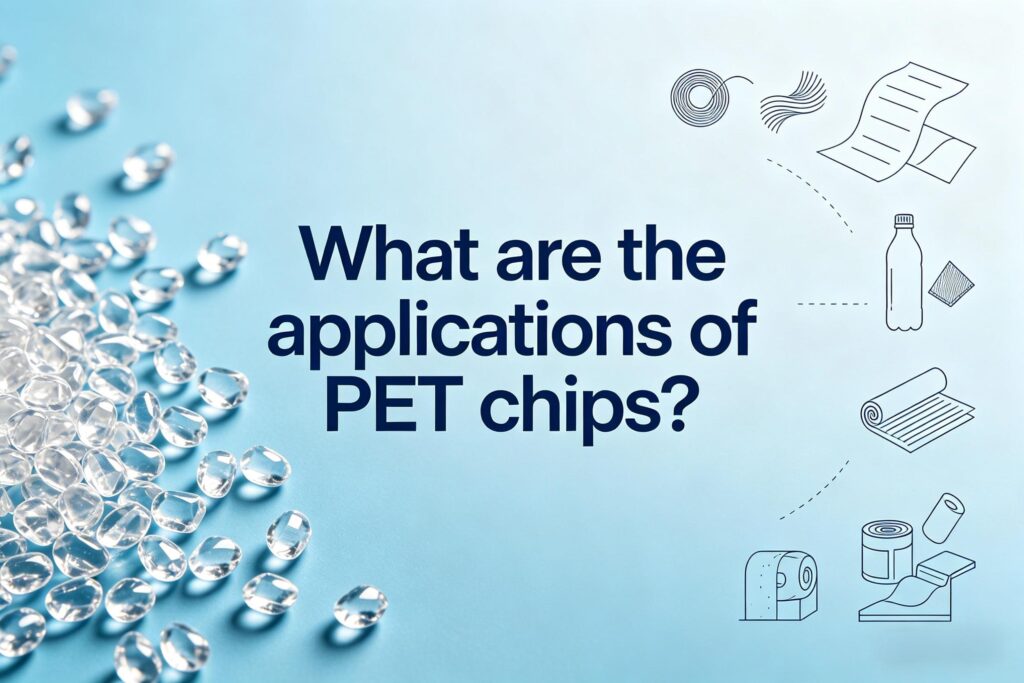
PET stands for Polyethylene Terephthalate. It’s a type of polyester resin. Before it becomes a bottle, a shirt, or a plastic tray, it starts as small, solid pellets about the size of a grain of rice.
Those pellets are PET chips.
They’re made by reacting purified terephthalic acid (PTA) with monoethylene glycol (MEG). Heat them up. Stir them. You get a molten polymer. Then you cut it into chips.
The chips are then sold to factories that melt them down again and shape them into whatever they need – fiber, sheet, bottle preform, strap, or part.
Two main categories matter for buyers:
| Grade Type | Viscosity | Best For |
|---|---|---|
| Fiber-grade | Lower IV (0.4–0.7) | Textiles, stuffing, non-wovens |
| Bottle-grade | Higher IV (0.7–0.85) | Bottles, sheets, straps, engineering plastics |
Higher IV means longer molecular chains. That means stronger, more durable end products.
I learned this the hard way when I tried to spin bottle-grade chips into fine yarn. The viscosity was too high. The nozzles kept clogging. Cost me a week of production.
Don’t make that mistake. Match the grade to the application.
3. Application #1 – Polyester Staple Fiber (Clothing, Stuffing, Non-wovens)
This is the biggest use of PET chips by volume. About 60–65% of all PET chips go into fiber production.
What is staple fiber?
Short lengths of polyester fiber, usually 20–50mm long, similar to cotton. These are spun into yarn or used directly for filling.
What gets made from it:
- Clothing – Most polyester clothing starts as staple fiber (often blended with cotton or other fibers). T-shirts, hoodies, workwear.
- Stuffing for toys and pillows – Hollow conjugate fiber (HC fiber) is a special type of staple fiber that’s soft, springy, and lightweight. That fluffy stuff inside your stuffed animal? PET chips.
- Non-woven fabrics – Think wet wipes, diaper backsheets, disposable medical gowns, furniture padding. These are made directly from staple fiber without spinning into yarn.
Data point: Global production of polyester staple fiber was roughly 22 million metric tons in 2024. China makes about 70% of it.
My personal observation:
The quality range for polyester staple is enormous. Cheap stuffing for budget toys? It works fine but compresses fast. High-quality hollow fiber for premium pillows? Much better recovery and softness.
If you’re making stuffed toys, don’t buy the cheapest staple fiber you can find. I’ve seen toys go flat in three months. Your customers will hate it. Spend an extra 5–10% on better fiber. Worth every cent.
4. Application #2 – Polyester Filament Yarn (Textiles, Sewing Thread, Industrial)
Filament yarn is the other major textile use of PET chips. Instead of short fibers twisted together, filament yarn is made of long continuous fibers.
What gets made from it:
- Polyester DTY (Drawn Textured Yarn) – The soft, stretchy yarn used for hoodies, sportswear, fleece blankets, and socks.
- Polyester FDY (Fully Drawn Yarn) – Smooth, strong, low-stretch yarn used for sewing thread, linings, curtains, and high-tenacity applications.
- Industrial yarn – High-tenacity polyester for car seatbelts, airbags, conveyor belts, ropes, and geotextiles.
Data point: Filament yarn accounts for about 30–35% of PET chip consumption globally.
What surprised me:
Not all filament yarn is the same. The same PET chips can produce DTY that feels like cotton or industrial yarn that can lift a car. The difference is in the drawing and texturing process, not the chips themselves.
But chip quality matters. Contaminated chips create broken filaments. And broken filaments mean production stoppages. I’ve sat next to factory managers watching breakage counters. A bad batch of chips can cost them thousands of dollars an hour.
If you’re buying filament yarn, ask your supplier where their chips come from. If they can’t tell you, walk away.
5. Application #3 – PET Bottles & Food Packaging (The One You See Most)
This is the application most people know.
What gets made from it:
- Water and soda bottles – Clear, strong, lightweight. The classic PET bottle.
- Food containers – Salad bowls, fruit trays, takeout containers. Clear plastic with a recycling symbol 1 inside a triangle.
- Cosmetic and personal care bottles – Shampoo, lotion, liquid soap.
How it works:
PET chips are dried, melted, and injected into a mold to create a “preform” – a test-tube-shaped piece of plastic with a threaded neck. Then the preform is heated and blown into a bottle using high-pressure air. It takes less than two seconds.
Data point: About 25–30 million tons of PET chips go into bottle production globally each year.
My personal take on bottle-grade PET:
The push for recycled content has changed this industry massively. rPET chips (recycled from used bottles) are now a huge market. In the EU, regulations require increasing amounts of recycled content in new bottles.
For buyers: virgin PET chips give you the cleanest, most consistent bottles. But rPET is getting much better. The gap in quality is shrinking fast. If you’re not at least testing rPET, you’re falling behind.
6. Application #4 – Sheet & Film (Thermoforming, Blister Packs, X-ray Films)
PET sheets and films are everywhere. You just don’t notice them.
What gets made from it:
- Thermoformed trays – The clear plastic clamshells around strawberries, the tray under cookies, the blister pack for batteries. A PET sheet is heated and vacuum-formed over a mold.
- Graphic films – Flexible, clear film used for signs, displays, and laminating.
- X-ray and medical films – High-clarity, dimensionally stable film for medical imaging.
- Electrical insulation – Thin PET film (Mylar is a brand name) used in electronics, motors, and capacitors.
Data point: Sheet and film applications consume roughly 5–8% of global PET chips.
What I learned the expensive way:
Not all PET sheet is the same. Some is amorphous (APET) – clear, flexible, good for thermoforming. Some is crystallized (CPET) – cloudy, heat-resistant, made for ovenable trays.
I once ordered CPET trays without checking the spec. They melted in a customer’s oven because the crystallization wasn’t high enough. Embarrassing and expensive.
If you’re buying PET sheet, know your end use. Room-temperature salad containers? APET is fine. Hot-food trays or oven-safe packaging? You need CPET with proper crystallization.
7. Application #5 – Strapping Tape (The Strong Green/Grey Banding You Get on Boxes)
This one surprised me when I first learned it.
What gets made from it:
The strong, rigid banding used to strap pallets, cardboard boxes, and heavy loads. Usually green, grey, or black.
Why PET strapping instead of steel or polypropylene:
| Property | PET Strapping | Steel Strapping | Polypropylene Strapping |
|---|---|---|---|
| Strength | High | Very high | Low-medium |
| Weight | Light | Heavy | Very light |
| Safety | No sharp edges | Dangerous edges | Safe |
| Stretch recovery | Excellent | None | Poor |
| Cost | Medium | Medium-high | Low |
Data point: PET strapping is the fastest-growing strapping material. It’s replaced steel in many applications because it’s safer and easier to handle.
My take:
I’ve stood in a warehouse watching a pallet of bricks strapped with PET. The strap stretched slightly under load, then held. Steel would have held too, but one wrong move and a worker gets cut.
For heavy industrial loads, steel still has a place. For everything else – boxes, pallets, bundled goods – PET strapping is often the smart choice. It comes from the exact same PET chips as your water bottle. Just processed differently.
8. Application #6 – Engineering Plastics (Car Parts, Electronics, Medical Devices)
This is the high-performance side of PET chips.
What gets made from it:
- Automotive parts – Headlight reflectors, fuse boxes, air intake manifolds, sensor housings. PET is reinforced with glass fiber to make it strong and heat-resistant.
- Electrical components – Connectors, circuit breaker housings, relay bases. PET has good electrical insulation properties.
- Medical devices – Surgical instrument handles, dental tools, diagnostic equipment housings. Medical-grade PET is biocompatible and can be sterilized.
- Consumer electronics – Phone cases (the hard ones), laptop components, power tool housings.
How it’s different:
For engineering plastics, PET chips are usually compounded with additives – glass fiber, impact modifiers, flame retardants, UV stabilizers. Then it’s injection-molded into parts.
Data point: Engineering plastics consume about 5% of global PET chips, but this segment has the highest growth rate (about 7–9% annually).
My observation:
This is where the highest-value PET products live. A ton of PET chips at $1,200 becomes fiber worth maybe $1,500. That same ton, compounded with glass fiber and molded into automotive parts, can be worth $3,000–5,000.
If you’re in this industry, you already know this. If you’re a supplier looking for higher margins, this is the direction to explore. But it requires technical expertise. You can’t just melt chips and hope.
9. 6 Applications Side-by-Side
| Application | Share of PET Chip Market | Typical IV Grade | Typical Product Form | Average Margin (Low to High) | End User Industries | Key Quality Requirement |
|---|---|---|---|---|---|---|
| Staple fiber | 60–65% | Fiber-grade (0.4–0.7) | Short fibers | Low | Apparel, home textiles, toys, non-wovens | Denier consistency, whiteness |
| Filament yarn | 30–35% | Fiber-grade (0.4–0.7) | Continuous yarn | Low-medium | Sportswear, industrial, sewing thread | Tenacity, elongation, breakage rate |
| Bottles & packaging | 25–30 million tons | Bottle-grade (0.7–0.85) | Preforms > bottles | Medium | Beverage, food, personal care | Clarity, IV retention, acetaldehyde level |
| Sheet & film | 5–8% | Bottle-grade (0.7–0.85) | Rolled sheet/film | Medium-high | Food packaging, medical, electrical | Thickness tolerance, haze, heat stability |
| Strapping | 2–4% | Bottle-grade (0.7–0.85) | Extruded strap | Medium | Logistics, warehousing, construction | Tensile strength, elongation at break |
| Engineering plastics | 5% | Bottle-grade (often modified) | Molded parts | High | Automotive, electronics, medical | Heat deflection, impact resistance, flame rating |
Key takeaways from the table:
- Largest volume – Staple fiber (over half of all PET chips)
- Highest margin potential – Engineering plastics (but requires technical capability)
- Fastest growing – Bottles (driven by rPET regulations) and strapping (replacing steel)
- Lowest margin – Commodity staple fiber (brutal competition)
Most of the world’s PET chips go into things you wear or sit on. The smaller-volume applications make higher margins. That’s the trade-off.
10. Which PET Chip Grade Goes Where – The Quick Guide
If you’re buying PET chips or products made from them, here’s a simple cheat sheet.
| You’re Making… | PET Chip Grade | Additional Notes |
|---|---|---|
| Cheap stuffed toy filling | Fiber-grade, low IV | It’ll work, but compresses fast |
| Premium pillow filling | Fiber-grade, hollow conjugate fiber | Better recovery, more expensive |
| Basic T-shirt fabric | Fiber-grade, standard | Blended with cotton usually |
| High-strength sewing thread | Fiber-grade, high-tenacity | Drawn more during spinning |
| Water bottle | Bottle-grade, high IV | Needs low acetaldehyde (taste issues) |
| Hot-fill bottle (juice, tea) | Bottle-grade, heat-set grade | Withstands 85–95°C filling |
| Thermoformed salad tray | Bottle-grade, APET | Clear, flexible, not heat-resistant |
| Ovenable food tray | Bottle-grade, CPET | Crystallized, withstands 200°C |
| Strapping tape | Bottle-grade | Needs high tensile strength |
| Car headlight reflector | Bottle-grade + glass fiber | Engineering compound, not pure chip |
| rPET (recycled) for any use | rPET flake or pellet | Quality varies widely. Test before buying |
My advice: Don’t assume one grade works for everything. I’ve made that mistake with sheet and bottle grades. The wrong chip can ruin a production run.
11. My Personal Take After 8 Years of Watching This Industry
Here’s what I’ve learned about PET chips that nobody told me when I started.
First: Most people who use PET chips don’t understand them.
I’ve met factory owners who’ve been buying chips for ten years but couldn’t tell you the difference between fiber-grade IV and bottle-grade IV. They buy on price. Sometimes it works. Sometimes it burns them.
Don’t be that person. Spend an hour learning the basics. It will save you money.
Second: The recycled market is growing faster than most buyers realize.
Three years ago, rPET chips were noticeably lower quality. Today? The top-tier recycled chips are very close to virgin. For many applications – bottles, strapping, low-end fiber – I’d use good rPET without hesitation.
But here’s the catch: rPET quality varies wildly. Some recyclers produce clean, consistent chips. Others produce garbage. You must test.
Third: The bottleneck isn’t chip production anymore. It’s drying and processing.
I’ve seen more production problems from poor drying than from bad chips. PET chips absorb moisture from the air. If you don’t dry them properly before processing, the molecular chains degrade. Your yarn breaks. Your sheet has bubbles. Your bottle is weak.
Invest in good drying equipment. It matters more than squeezing the last penny out of your chip price.
Fourth: China still dominates, but don’t ignore India and Vietnam.
China makes about 70% of the world’s PET chips. That’s not changing soon. But India’s rPET industry is excellent. Vietnam’s processing capacity is growing fast. If you want to diversify your supply chain, those are the places to look.
12. FAQs – 8 Questions Buyers Actually Ask Me
1. What’s the difference between fiber-grade and bottle-grade PET chips?
Viscosity. Fiber-grade has lower IV (0.4–0.7), bottle-grade has higher IV (0.7–0.85). Higher IV means stronger final products but harder to process into fine fibers.
2. Can I use bottle-grade chips to make fiber?
Technically yes, but it’s inefficient. The higher viscosity makes spinning difficult. Nozzles clog. Breakage increases. Stick to fiber-grade for fiber applications.
3. What does IV stand for, and why should I care?
Intrinsic Viscosity. It measures the average molecular chain length. Higher IV = stronger but harder to process. Match IV to your application or you’ll have problems.
4. Is recycled PET (rPET) as good as virgin?
For many applications, yes – good-quality rPET is very close to virgin. For high-clarity bottles or fine-denier fibers, virgin still wins. Test before switching.
5. Why do my PET sheets have bubbles?
Moisture. You didn’t dry the chips enough. PET absorbs atmospheric moisture. Dry it to below 50ppm (parts per million) before processing, or bubbles will appear.
6. Which PET chip application has the highest profit margin?
Engineering plastics (automotive, electronics, medical). But you need compounding and molding capabilities. Selling raw chips into commodity fibers has very thin margins.
7. Where are most PET chips made?
China dominates with about 70% of global production. India, Vietnam, and the Middle East (Saudi Arabia, UAE) are the other major regions.
8. Can I buy PET chips directly from a producer, or do I need a trader?
You can buy directly, but many producers require large MOQs (500+ tons). Traders can consolidate smaller orders or offer spot prices. Verify any trader before sending money. I’ve seen too many scams in this business.
