
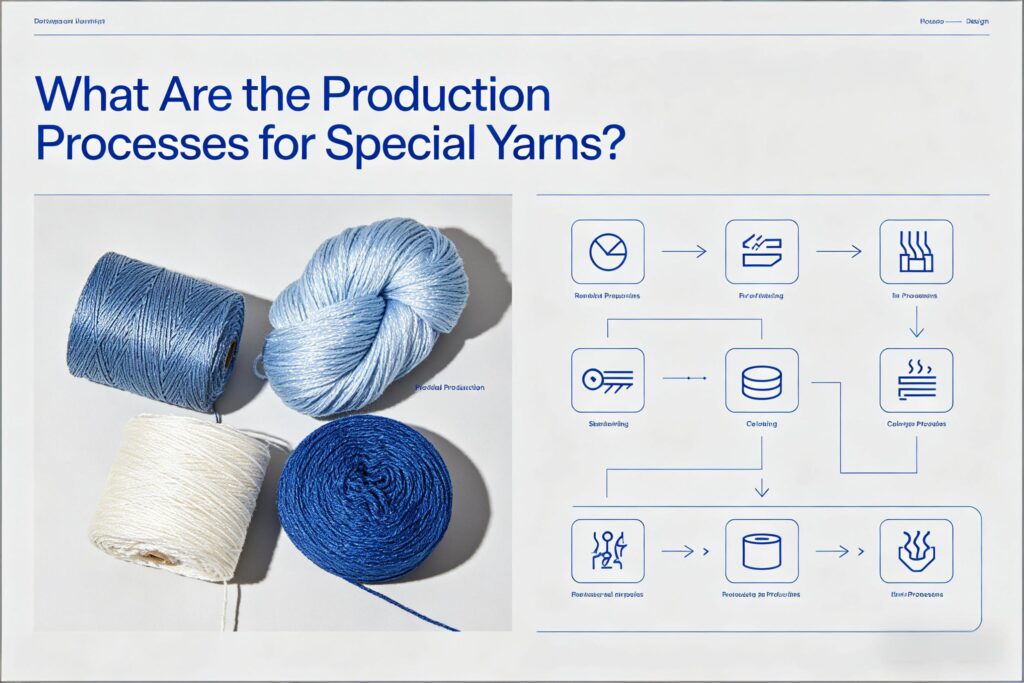
Specialty yarns, also known as technical or engineered yarns, represent the pinnacle of fiber innovation, designed to deliver performance beyond the capabilities of conventional textiles. These yarns are engineered to possess specific functional properties—such as flame retardancy, high strength, conductivity, antimicrobial activity, or extreme thermal resistance—making them indispensable in sectors like aerospace, military, healthcare, and high-performance sports. The uniqueness of these yarns lies not just in their raw materials but fundamentally in the specialized production processes that transform advanced polymers and fibers into precise, functional tools. This article provides a detailed examination of the key production processes for specialty yarns, from material selection to final treatment, illustrating how engineering at the molecular and mechanical levels creates the fabrics of the future.
I. Foundational Stage: Advanced Material Preparation
The production of a specialty yarn begins with the precise formulation and preparation of its raw materials, where chemistry dictates final performance.
- Polymer Synthesis and Modification: For synthetic specialty yarns (e.g., aramid, PBI, PBO), the process starts with the custom synthesis of polymers. Chemists engineer polymer chains to incorporate elements that grant target properties. For instance, aromatic rings are introduced into polyamide chains to create the exceptional thermal stability and strength of aramid fibers (e.g., Kevlar, Nomex). This often involves complex reactions in controlled environments, using specific solvents and catalysts.
- Additive Incorporation and Masterbatching: Functional properties are often achieved by incorporating additives at the polymer stage. These can include:
- Nanoparticles: (e.g., silica for abrasion resistance, silver for antimicrobial properties) uniformly dispersed in the polymer melt.
- Flame Retardant (FR) Agents: Halogen-free compounds like phosphorous-based additives integrated into the polymer matrix.
- Conductive Elements: Carbon black, graphene, or metallic particles to create conductive or static-dissipative yarns.
Achieving a perfectly homogeneous dispersion is critical and requires specialized compounding and masterbatch production to avoid agglomerates that would weaken the final fiber.
II. Core Spinning and Formation Processes
This stage transforms the prepared material into a continuous filament or staple fiber yarn, employing highly tailored techniques.
A. Specialized Melt Spinning Processes
This is the primary method for filament-based specialty yarns.
- Dry-Jet Wet Spinning (for Aramid & High-Performance Fibers): This complex, two-phase process is iconic for aramid production. The polymer is dissolved in a strong acid solvent (e.g., sulfuric acid) to create a liquid crystalline solution. This dope is extruded through a spinneret into a small air gap and then immediately coagulated in a cold water bath . The air gap allows for molecular alignment, while the bath removes the solvent. This process aligns the polymer chains nearly perfectly, yielding fibers with legendary strength and heat resistance.
- Gel Spinning (for Ultra-High-Molecular-Weight Polyethylene – UHMWPE): Used to produce fibers like Dyneema and Spectra. A low-concentration polymer gel is extruded and then drawn at very high ratios. This extreme drawing orients the exceptionally long polymer chains dramatically, resulting in fibers with strength-to-weight ratios exceeding that of steel.
- Electrospinning (for Nanofiber Yarns): A polymer solution is charged with a high voltage, creating a jet that elongates and solidifies into ultrafine fibers (nanometers to microns in diameter). These nanofiber mats or assembled yarns offer immense surface area, used in advanced filtration, biomedical scaffolds, and smart textiles.
B. Modified Staple Fiber Spinning Processes
For yarns made from staple fibers (short lengths), conventional routes like ring spinning are heavily modified.
- Core-Spinning for Composite Yarns: A quintessential process for combining properties. One component (e.g., an elastane filament for stretch, a steel filament for strength) forms the continuous core. Another fiber (e.g., cotton, FR viscose) is wrapped around it as the sheath via a specialized spinning device. This creates a unified yarn with a hidden functional core and a comfortable, processable exterior.
- Blend Spinning with Precision: Creating uniform yarns from intimate blends of dissimilar fibers (e.g., flame-resistant modacrylic with cotton) requires expert processing. Fiber opening, blending, and drafting must be meticulously controlled to ensure each cross-section of the final yarn contains the correct protective blend ratio, guaranteeing consistent performance.
III. Post-Spinning Functionalization Treatments
Properties are often enhanced or added after the yarn is formed.
- Functional Coatings and Finishes: Yarns are passed through baths or applicators to coat them. Examples include:
- Polymer Coatings: Applying polyurethane (PU) or PVC for grip, waterproofing, or cut resistance.
- Metallic Coatings: Vacuum metallization or electrochemical plating to create conductive yarns for electronics shielding or data transmission.
- Specialty Finishes: Durable antimicrobial (e.g., silver salt), hydrophobic, or oleophobic treatments.
- Heat Setting and Stabilization: Critical for yarns like aramid and UHMWPE. The yarn is subjected to precise, high-temperature treatment under tension. This process anneals the fiber, relieving internal stresses, increasing crystallinity, and locking in its high-tenacity, low-shrinkage properties.
IV. Quality Assurance and Testing Regime
Given their critical end-uses, specialty yarns undergo forensic testing far beyond standard textiles.
- Mechanical Testing: Tensile strength, modulus, and elongation are measured on specialized equipment capable of handling extreme forces.
- Thermal Testing: Limiting Oxygen Index (LOI) tests for flammability, Thermal Gravimetric Analysis (TGA) for decomposition temperatures, and continuous exposure testing at high temperatures.
- Chemical and Environmental Resistance: Testing resistance to acids, alkalis, solvents, UV radiation, and hydrolysis.
- Specialized Functional Tests: Conductivity/resistivity measurements, antimicrobial efficacy assays (e.g., AATCC 100), and cut resistance testing (e.g., ISO 13997).
Conclusion: The Convergence of Disciplines
In conclusion, the production of specialty yarns is a multidisciplinary endeavor at the frontier of materials science and mechanical engineering. It moves far beyond traditional spinning, integrating advanced polymer chemistry (for molecular design), physics (for processes like electrospinning), and precision engineering (for machinery like core-spinners and heat-setting ovens). The chosen process—whether it’s the rigorous dry-jet wet spinning for aramids or the meticulous blend spinning for FR fabrics—is inextricably linked to the yarn’s ultimate function. As demands for smarter, safer, and stronger materials grow, these processes continue to evolve. For brands and developers seeking to innovate at the material level, partnering with a producer that masters these complex technologies is essential. A company like glyarn, with deep expertise in engineering yarns from the polymer stage through to functional finishing, exemplifies the kind of technical partner capable of turning a performance concept into a reliable, high-tech reality.
