
Article Outline
- Decoding the 192F Designation in Polyester Filament
- Understanding Filament Count: From Basics to Technical Nuances
- The Manufacturing Process for 192F High-Filament Yarns
- Physical and Mechanical Properties of 192F Polyester Filament
- Comparative Analysis: 192F vs. Other Common Filament Counts
- Applications Across Industries: Where 192F Excels
- Economic Implications: Cost, Efficiency, and Market Positioning
- Quality Control and Testing Standards for 192F Filaments
- Sustainability and Environmental Impact of High-Filament Production
- Innovations and Future Trends in Multi-Filament Technology
- Procurement Strategies for 192F Polyester Filament
- Leveraging 192F for Competitive Advantage
Demystifying 192F Polyester Filament: A Comprehensive Guide to High-Filament Count Technology
1. Decoding the 192F Designation in Polyester Filament
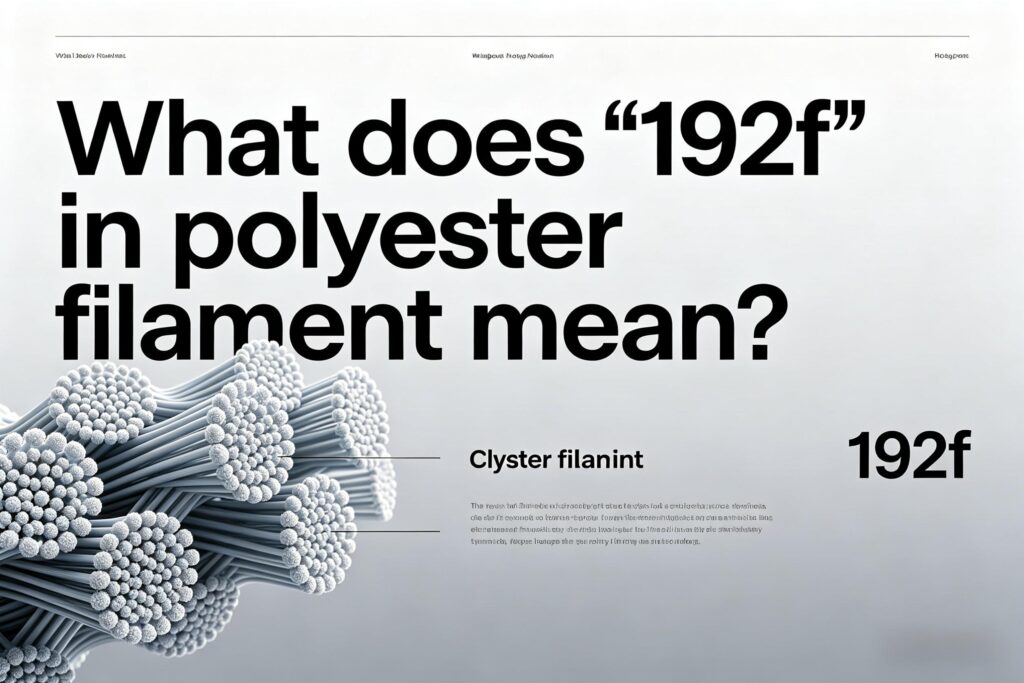
In the sophisticated world of synthetic fibers, the term “192F” is far more than a technical label—it represents a pinnacle of textile engineering with profound implications for performance, aesthetics, and cost-efficiency. For procurement specialists, product developers, and production managers across apparel manufacturing, home textiles, technical fabrics, and beyond, understanding the 192F designation is essential for optimizing material selection and achieving competitive advantage. The “192F” specification indicates a polyester yarn comprising 192 individual, continuous filaments bundled into a single strand—a configuration that dramatically enhances fabric softness, drape, and functionality. This guide provides an in-depth exploration of 192F polyester filament, examining its technical foundations, manufacturing processes, performance characteristics, and strategic applications. By mastering these insights, industry professionals can make informed decisions that balance cost, quality, and functionality in increasingly demanding global markets.
2. Understanding Filament Count: From Basics to Technical Nuances
At its core, filament count (denoted by “F”) refers to the number of individual, continuous fibers bundled together to form a single yarn strand. In polyester filament terminology, the numerical prefix preceding “F” specifies this count, making “192F” a precise descriptor of yarn architecture.
Fundamental Concepts:
- Single Filament: An individual, continuous polymer strand extruded through a spinneret.
- Filament Bundle: Multiple filaments combined to form a yarn, held together by cohesion, twist, or intermingling.
- Denier per Filament (dpf): A critical derived metric: dpf = Total Yarn Denier ÷ Filament Count. For instance, a 150-denier 192F yarn has a dpf of 150 ÷ 192 ≈ 0.78, classifying it as a microfiber.
Key Terminology and Relationships:
| Term | Definition | Example (192F Context) |
|---|---|---|
| Total Denier (d) | Weight in grams of 9,000 meters of yarn | 75d, 100d, 150d |
| Filament Count (F) | Number of individual filaments | 192 |
| Denier per Filament (dpf) | Fineness of individual filaments | 0.39–1.56 (typical range) |
| Cross-Section | Shape of individual filaments | Round, trilobal, octalobal |
| Inter-filament Cohesion | Force holding filaments together | Spin finish, air entanglement, twist |
Industry Standards and Specifications:
- ASTM D1907: Standard Test Method for Yarn Number.
- ISO 2060: Determination of Linear Density (Mass per Unit Length).
- Commercial Tolerance: Typically ±5% for filament count in high-count yarns.
3. The Manufacturing Process for 192F High-Filament Yarns
Producing consistent, high-quality 192F polyester filament requires advanced technology and precise process control, typically achieved through direct melt spinning.
Step-by-Step Production Workflow:
- Polymer Preparation:
- Raw Materials: Purified terephthalic acid (PTA) and monoethylene glycol (MEG).
- Polycondensation: Continuous process to achieve intrinsic viscosity (IV) of 0.62–0.68 dL/g.
- Additive Incorporation: TiO₂ for delustering, color masterbatches for solution dyeing.
- Melt Spinning:
- Extrusion Temperature: 290–300°C to ensure optimal polymer flow.
- Spinneret Design: Precision-engineered plates with 192 orifices (e.g., for 192F direct spinning) or multiples thereof for higher productivity.
- Quenching: Controlled crossflow air at 18–22°C to solidify filaments uniformly.
- Drawing and Orientation:
- Godet Systems: Multi-stage rollers operating at speeds up to 4,000 m/min.
- Draw Ratios: 3.5:1 to 4.5:1 to align polymer chains and enhance tenacity.
- Heat Setting: Thermal stabilization at 180–220°C to minimize shrinkage.
- Intermingling and Winding:
- Interlacing Jets: Compressed air tangling to provide cohesion without twist.
- Winding Precision: Automated systems producing 3–5 kg packages with controlled tension.
Production Challenges and Solutions:
| Challenge | Cause | Mitigation Strategy |
|---|---|---|
| Filament Breakage | Inconsistent quenching or spin finish | Optimized air flow, advanced spin finish formulations |
| Denier Variation | Spinneret clogging or pump fluctuations | Regular maintenance, real-time monitoring |
| Inter-filament Fusion | Excessive heat or inadequate cooling | Enhanced quenching, modified polymer additives |
| Package Defects | Improper winding tension | Computerized tension control systems |
4. Physical and Mechanical Properties of 192F Polyester Filament
The 192F configuration imparts distinctive physical and mechanical characteristics that determine its suitability for various applications.
Quantitative Property Profile:
| Property | Typical Range for 192F | Test Method | Industry Benchmark |
|---|---|---|---|
| Tenacity | 3.8–4.5 g/den (3.3–4.0 cN/dtex) | ASTM D2256 | Excellent for dpf |
| Elongation at Break | 25–35% | ASTM D2256 | Balanced performance |
| Modulus | 90–110 g/den | ASTM D2101 | High stiffness for fine dpf |
| Shrinkage (boiling water) | 5–10% | AATCC 135 | Controllable via heat setting |
| Abrasion Resistance | 25,000–35,000 cycles (Martindale) | ASTM D4966 | Superior due to multi-filament structure |
| Inter-filament Cohesion | 8–15 cN (air-jet intermingling) | Custom methods | Ensures processing integrity |
Functional Characteristics:
- Softness: Exceptionally high due to low dpf and increased filament surface area.
- Drape: Superior flexibility and bending recovery.
- Moisture Management: Enhanced wicking via capillary action among filaments.
- Opacity: Improved covering power despite fine individual filaments.
- Luster: Controllable from bright to full dull via TiO₂ addition.
Microstructural Advantages:
- Increased Surface Area: Approximately 40–50% greater than 96F yarn of same denier.
- Uniform Stress Distribution: Multi-filament structure reduces localized failure points.
- Enhanced Dye Penetration: Finer filaments allow quicker, more even dye uptake.
5. Comparative Analysis: 192F vs. Other Common Filament Counts
Positioning 192F within the filament count spectrum clarifies its unique value proposition.
Performance Comparison Table:
| Filament Count | Typical Denier | dpf Range | Primary Attributes | Best Applications |
|---|---|---|---|---|
| 48F | 70–150d | 1.5–3.1 | High strength, good durability | Industrial fabrics, canvas |
| 96F | 50–100d | 0.5–1.0 | Softness, moderate coverage | Apparel linings, mid-range sportswear |
| 144F | 75–150d | 0.5–1.0 | Enhanced softness, good drape | Quality apparel, home textiles |
| 192F | 75–150d | 0.4–0.8 | Premium hand feel, excellent coverage | Luxury apparel, technical wear |
| 288F | 100–200d | 0.35–0.7 | Ultra-softness, high opacity | High-end lingerie, medical textiles |
Economic and Technical Trade-offs:
| Aspect | 96F | 192F | 288F |
|---|---|---|---|
| Production Speed | 100% (reference) | 85–90% | 75–80% |
| Raw Material Use | 100% | 100% (same denier) | 100% |
| Spin Finish Requirement | 100% | 110–115% | 120–125% |
| Downstream Processing Ease | Excellent | Very Good | Good (requires care) |
| Fabric Premium Achievable | 0–10% | 15–30% | 30–50% |
Market Positioning:
- 192F occupies the “sweet spot” between performance and cost, offering substantial upgrades over 96F/144F without the extreme challenges of 288F+ production.
6. Applications Across Industries: Where 192F Excels
The unique properties of 192F polyester filament make it ideal for demanding applications across diverse sectors.
Apparel and Fashion:
- Luxury Sportswear: High-end athletic apparel where moisture-wicking, softness, and lightweight performance are critical.
- Eveningwear and Suiting: Fabrics with silk-like drape and luxurious hand feel.
- Intimate Apparel: Lingerie and loungewear requiring exceptional softness against skin.
- Performance Outerwear: Lightweight shells and insulation layers.
Home Textiles:
- High-Thread-Count Bedding: Sheeting with superior softness and durability.
- Decorative Upholstery: Fabrics that combine aesthetic appeal with wear resistance.
- Window Treatments: Drapes with excellent drape and light control.
Technical and Industrial Uses:
- Medical Textiles: Surgical gowns and drapes requiring barrier properties and comfort.
- Filtration Media: Enhanced surface area for fine particle capture.
- Specialty Composites: Reinforcements where fine filament distribution is beneficial.
Application-Specific Data:
| Industry | Typical Denier | Key Property Leveraged | Market Share Trend |
|---|---|---|---|
| Apparel | 75d/192f, 100d/192f | Softness, drape | Growing at 8–10% annually |
| Home Textiles | 150d/192f, 200d/192f | Durability, aesthetics | Steady at 5–7% growth |
| Technical Textiles | 100d/192f, 150d/192f | Surface area, filtration efficiency | Rapid growth (12–15%) |
7. Economic Implications: Cost, Efficiency, and Market Positioning
Understanding the cost structure and value proposition of 192F polyester filament is crucial for strategic sourcing and product development.
Cost Breakdown Analysis:
| Cost Component | Proportion of Total Cost | Key Drivers |
|---|---|---|
| Raw Materials (PET) | 60–70% | PTA/MEG prices, polymer grade |
| Energy | 15–20% | Electricity for spinning and drawing |
| Labor and Maintenance | 8–12% | Automation level, technical staff |
| Spin Finish and Additives | 3–5% | Specialty chemicals for high filament counts |
| Quality Control and Waste | 2–4% | Yield efficiency, testing protocols |
Pricing and Market Dynamics:
- Price Premium: 192F yarns typically command a 20–35% premium over equivalent denier 96F yarns.
- Minimum Order Quantities (MOQs): 3–5 tons for standard varieties; 8–12 tons for custom specifications.
- Lead Times: 6–10 weeks for production, excluding shipping.
Value Chain Impact:
- Yarn Producers: Higher margins but require significant technical capability.
- Fabric Manufacturers: Can achieve 25–40% price premiums for 192F-based fabrics.
- Brands and Retailers: Enhanced product differentiation and consumer appeal.
8. Quality Control and Testing Standards for 192F Filaments
Ensuring consistent quality in 192F production demands rigorous testing and adherence to international standards.
Essential Quality Parameters:
| Parameter | Specification for 192F | Test Method | Frequency |
|---|---|---|---|
| Filament Count Accuracy | 192 ± 5 filaments | Microscopic count | Each lot |
| Denier Uniformity | Uster U% < 0.8% | Uster Evenness Tester | Continuous |
| Tenacity Consistency | CV% < 6% | Tensile tester | Every 4 hours |
| Intermingling Points | 60–100 per meter | Custom separation test | Every shift |
| Shrinkage Uniformity | ±1% within lot | Boiling water test | Each lot |
Certifications and Compliance:
- ISO 9001: Quality Management Systems.
- OEKO-TEX® Standard 100: Harmful substance testing.
- Global Recycled Standard (GRS): For recycled content verification.
- Supplier-specific qualifications: Many brands have proprietary compliance requirements.
Common Defects and Remedies:
| Defect Type | Root Cause | Corrective Action |
|---|---|---|
| Missing Filaments | Spinneret blockage | Clean or replace spinneret |
| Denier Variation | Pump fluctuation | Calibrate metering pumps |
| Poor Intermingling | Incorrect air pressure | Adjust interlacing jet settings |
| Package Defects | Winding tension issues | Optimize winding parameters |
9. Sustainability and Environmental Impact of High-Filament Production
The production and use of 192F polyester filament involve specific environmental considerations that are increasingly important to brands and consumers.
Life Cycle Assessment Highlights:
| Stage | Key Impacts | Mitigation Strategies |
|---|---|---|
| Raw Material Production | Fossil fuel depletion, GHG emissions | Use of bio-based or recycled PET |
| Yarn Manufacturing | Energy consumption, water use (minimal) | Energy-efficient spinning, waste heat recovery |
| Processing and Dyeing | Chemical usage, water pollution | Closed-loop systems, eco-friendly dyes |
| End-of-Life | Non-biodegradability, microplastic potential | Design for recyclability, take-back programs |
Sustainable Innovations:
- Recycled 192F Yarns: Produced from post-consumer PET bottles or textile waste, with properties nearly matching virgin yarns.
- Energy-Efficient Spinning: Modern plants reducing energy consumption by 20–30% versus older technologies.
- Waterless Dyeing: Technologies like supercritical CO₂ dyeing applicable to fine-denier filaments.
Circular Economy Integration:
- Mechanical Recycling: 192F fabrics can be recycled into staple fiber for non-wovens or lower-grade yarns.
- Chemical Recycling: Depolymerization to monomers allows true circularity.
- Design for Disassembly: Fabric constructions facilitating filament recovery.
10. Innovations and Future Trends in Multi-Filament Technology
The 192F segment is at the forefront of several key textile innovations.
Emerging Technologies:
- Nanofiber Integration: Combining conventional 192F yarns with nanofiber coatings for enhanced functionality.
- Smart Filaments: Incorporation of conductive or phase-change materials within filament bundles.
- Advanced Spinnerets: 3D-printed spinnerets enabling complex cross-sections and ultra-fine filaments.
- AI-Driven Process Optimization: Machine learning algorithms optimizing spinning parameters in real time.
Market Trends:
- Demand Growth: High-filament count yarns growing at 1.5× the rate of standard filament yarns.
- Regional Shifts: Increasing production capabilities in Southeast Asia and India.
- Vertical Integration: Brands investing in filament production to secure supply and drive innovation.
Future Development Roadmap:
| Timeframe | Expected Advances | Potential Impact |
|---|---|---|
| 1–3 years | Improved spin finishes for better processing | Higher production speeds, lower defect rates |
| 3–5 years | Widespread adoption of recycled 192F | Reduced environmental footprint |
| 5–10 years | Integration of smart functionalities | New applications in wearable tech, medical monitoring |
11. Procurement Strategies for 192F Polyester Filament
Effective sourcing of 192F polyester requires careful planning and supplier management.
Supplier Selection Criteria:
- Technical Capability: Experience with high-filament count production.
- Quality Systems: Certifications, testing protocols, traceability.
- Financial Stability: Ability to invest in ongoing technology upgrades.
- Sustainability Commitment: Environmental management systems, recycled content options.
Negotiation and Contracting:
- Specifications: Clearly define filament count, denier, tenacity, shrinkage, intermingling.
- Pricing Mechanisms: Consider formulas linked to raw material costs for long-term agreements.
- Quality Guarantees: Establish rejection criteria and remedies for non-conforming material.
- Delivery Flexibility: Agreements accommodating demand fluctuations.
Risk Management:
- Dual Sourcing: Reduce dependency on single suppliers.
- Inventory Planning: Safety stock for critical specifications.
- Market Intelligence: Monitoring raw material trends and capacity developments.
12. Leveraging 192F for Competitive Advantage
The 192F designation in polyester filament represents a sophisticated textile solution that balances exceptional performance with commercial viability. For industry professionals, mastery of 192F technology enables the creation of superior products that meet evolving consumer demands for comfort, functionality, and sustainability. As textile innovation accelerates and environmental considerations become paramount, the strategic importance of high-filament count yarns like 192F will only increase. By applying the insights from this guide—from technical specifications to procurement strategies—businesses can harness the full potential of 192F polyester filament to drive growth, differentiation, and success in the competitive global textile industry.
Frequently Asked Questions (FAQ)
Q1: Is 192F polyester filament considered a microfiber?
A: Yes, when the total denier is 150 or below, 192F yields a denier per filament (dpf) of 0.78 or less, which falls within the microfiber category (dpf < 1.0). This gives fabrics made from 192F yarns exceptional softness and drapability.
Q2: How does 192F compare to natural fibers like cotton or silk?
A: 192F polyester can mimic the softness and drape of luxury natural fibers while offering superior durability, moisture-wicking, and resistance to wrinkling and shrinkage. It provides consistent quality and often at a lower cost, though it lacks the natural breathability of cotton or the unique luster of silk.
Q3: What are the main challenges in weaving or knitting with 192F yarn?
A: The fine filaments in 192F yarns can be more prone to breakage under high tension. Successful processing requires optimized machine settings (reduced tension, proper guides), high-quality cones with good unwinding, and potentially sizing or waxing for weaving. Experience and careful handling are key.
Q4: Can 192F polyester be dyed to deep, rich colors?
A: Absolutely. The high surface area of fine filaments can actually enhance dye uptake, allowing for vibrant colors. However, dyeing parameters (temperature, time, carrier use) may need adjustment compared to coarser filaments to ensure levelness and prevent barre.
Q5: What is the typical price difference between 192F and 144F yarn?
A: Expect a 15–25% price premium for 192F over 144F of the same denier and quality grade. This reflects the more complex production process, slightly lower speeds, and higher value in the marketplace.
Q6: Is 192F filament suitable for high-performance outdoor gear?
A: Yes, especially when combined with appropriate fabric constructions and finishes. Its potential for lightweight, high-strength, and good moisture management makes it a candidate for performance layers. It is often used in conjunction with coatings or laminates for weather protection.
Q7: How do I verify the filament count from a supplier?
A: Request a Certificate of Analysis (CoA) which should include filament count verified by microscopic analysis. For critical applications, you can perform your own check using a microscope: carefully untwist a small section of the yarn and count the filaments.
Q8: Does using 192F yarn increase fabric pilling?
A: There is a correlation between finer filaments and a tendency for pilling, as the fine fibers can work loose and form pills. However, this is heavily influenced by fabric construction (tighter weaves/knits reduce pilling) and finishing processes. Anti-pilling treatments can also be applied.
Q9: What’s the difference between 192F and a 2-ply yarn of 96F?
A: A 192F yarn is a single bundle of 192 filaments, while a 2-ply 96F is created by twisting together two 96F yarns. The 192F will generally be softer and more flexible. The 2-ply construction may be stronger and more uniform in thickness but will have a different hand feel and may be more expensive to produce.
Q10: Are there biodegradable versions of 192F polyester?
A: Traditional PET polyester is not biodegradable. However, developments are ongoing in biodegradable polyesters (e.g., PBAT, PHA blends). While not yet common for 192F high-count yarns, this is an area of active research and future potential.
Q11: What spin finishes are used on 192F yarn, and why are they important?
A: Specialized lubricants (spin finishes) are crucial for 192F yarns to reduce friction between the many fine filaments during processing, prevent static electricity, and provide cohesion. They are typically complex emulsions of lubricants, antistats, and emulsifiers tailored for high-speed processing.
Q12: Can 192F yarn be made from recycled PET?
A: Yes, and this is a growing market segment. Recycled PET (rPET) from bottles or textiles can be processed into 192F filament. The key challenge is maintaining the consistency and quality needed for fine filament extrusion, but advanced filtration and processing technologies are making it increasingly viable.
